- The paper presents a novel TCR framework that statistically calibrates model trust to restore feasibility in physics-constrained decision pipelines.
- It employs FDR-controlled discovery, optimal shrinkage calibration, and LP-based minimal repair to precisely localize and correct model misspecifications.
- Empirical tests on power networks demonstrate near-oracle feasibility with significant cost control compared to traditional robust and chance-constrained methods.
Trust-Calibrated Certified Repair for Physics-Constrained Decision Making under Localized Model Misspecification
Overview
This work presents Trust-Calibrated Certified Repair (TCR), a robust approach for transforming candidate decisions into physically feasible deployments in safety-critical engineering systems. Unlike conventional feasibility-restoration pipelines that rely on potentially misspecified physical models, TCR introduces a principled statistical calibration and audit process for model trust. The methodology is instantiated on power network tasks, notably dynamic line rating (DLR), robust transmission redispatch, and distribution voltage regulation, demonstrating near-oracle feasibility while controlling cost and precisely localizing model errors.
Standard repair layers project candidate actions onto a feasible region defined by a nominal physical model, a process that assumes local model fidelity. However, line parameters, thermal ratings, or network topology are routinely wrong at a subset of locations due to aging, ambient conditions, or delayed parameterization, leading to silent, unobservable failures (i.e., “false safety”). Empirical results reveal that even optimal model-trusting solvers, when deployed on true networks under exogenous weather regimes, can achieve less than 50% actual feasibility in stressed scenarios. This demonstrates that naive trust in the nominal model is unsafe in practice.
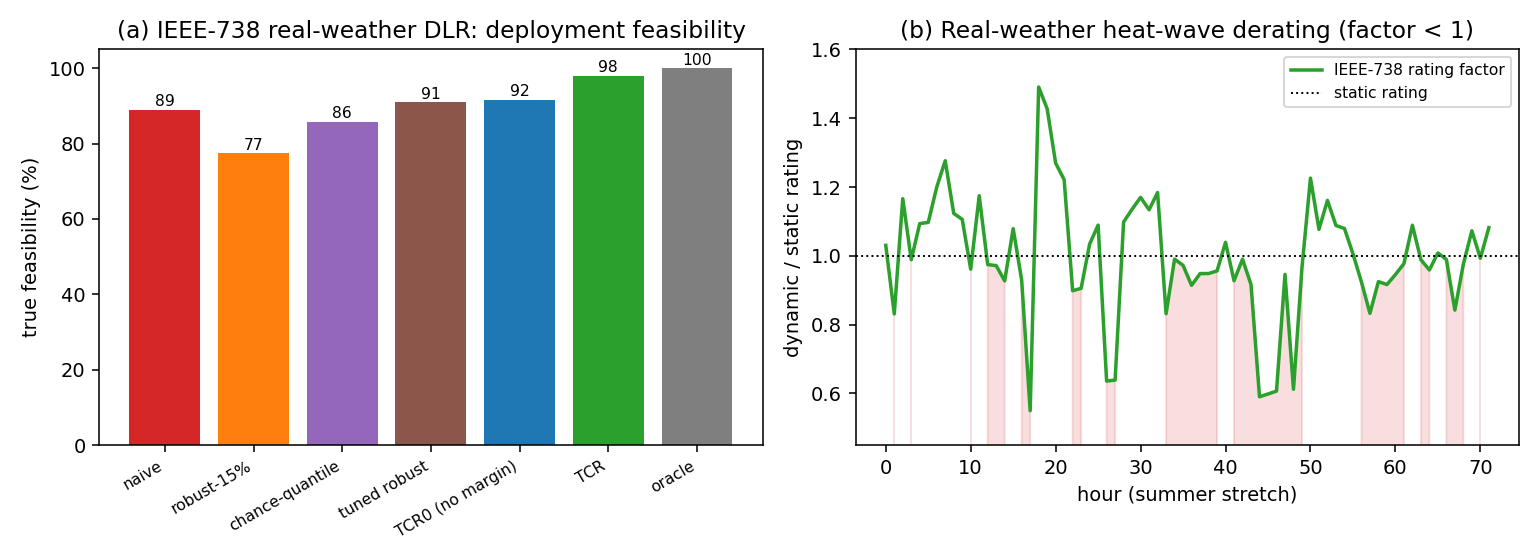
Figure 1: TCR achieves nearly oracle deployment feasibility on DLR; model-trusting and robust repairs exhibit significant safety or cost deficiencies, particularly under sustained weather-driven de-rating.
Trust-Calibrated Certified Repair: Architecture
TCR reframes the repair task as a trust-calibration problem, integrating statistical discovery, risk-minimized calibration, targeted margin computation, and cost attribution, applied post-optimization but pre-deployment. The pipeline is composed of four sequential modules:
- FDR-Controlled Discovery: TCR tests individual model components (e.g., specific line ratings) for data inconsistency using the Benjamini-Hochberg procedure to control the false discovery rate (FDR), robustly localizing model misspecifications without excessive conservatism.
- Trust Calibration: For components identified as misspecified, TCR re-estimates physical parameters via optimal shrinkage (James-Stein/SURE), blending observed data with nominal values in a risk-regularized fashion. Each constraint is then buffered by a targeted margin proportional to residual parameter uncertainty, minimizing unnecessary cost.
- Minimal Certified Repair: Candidate solutions are minimally perturbed using a linear program (LP) to restore feasibility against the trust-calibrated constraint set, with intervention cost weighted for device-specific or system priorities.
- Competence and Attribution: The dual variables from the LP enable precise attribution of intervention costs to genuine physical congestion versus avoidable model error, producing auditable repair certificates.
Theoretical Guarantees
TCR’s modules are supported by rigorous statistical guarantees:
- The FDR discovery controls the Type I error probability per standard multiple-testing theory.
- Calibration achieves a mean-squared error gap versus the oracle that shrinks with data availability, ensuring statistical efficiency.
- The repair program is cost- and feasibility-optimal for the calibrated set, and cost attribution is consistent by construction.
- Under mild probabilistic conditions on margin size, deployment feasibility is certified with target probability 1−α.
Empirical Validation and Numerical Results
The utility of TCR is rigorously evaluated across three benchmark families: dynamic line rating (IEEE-738 on RTS-GMLC), transmission redispatch (PGLib-OPF networks), and voltage regulation (IEEE 33-bus). In each regime, ground-truth plant constraints stem from real measurement data or physically accurate models, with misspecification artificially localized to test detection and calibration.
Headline Result:
On the IEEE-738 dynamic line rating task, TCR achieves 98% true-network feasibility, merely two points below the clairvoyant oracle (100%). All principal baselines (model-trusting, fixed robust, tuned robust, chance-constrained) exhibit significant feasibility or cost gaps; notably, chance-constrained tightening under-protects, resulting in feasibility collapse despite lower cost, while uniform robust margins pay a large cost premium (up to +5.1%) for limited safety.
Discovery is Perfect:
TCR’s FDR-controlled discovery on DLR is flawless (F1=1.00 across seeds) and tightens only the $19$ lines actually exposed by weather-driven derating, minimizing cost relative to naive or over-conservative strategies.
DLR Under Real Weather:
Model-trusting repair is found to fail drastically during hot, calm periods that silently de-rate lines to 50–60% of assumed static capacity—precisely the setting where localized misspecification risks grid safety.
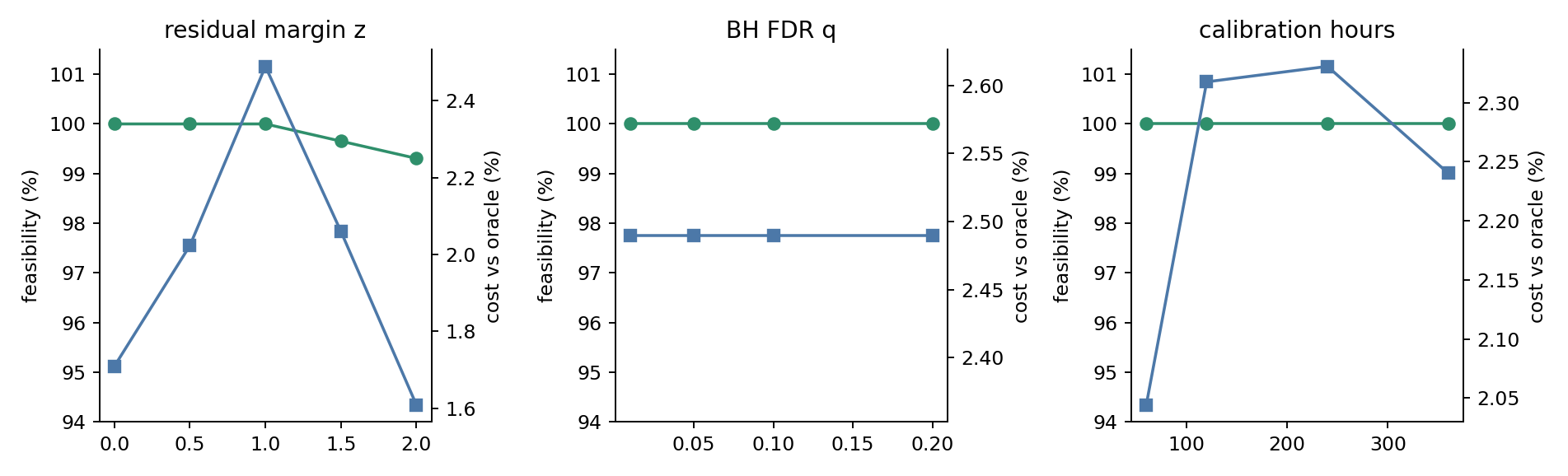
Figure 2: TCR’s feasibility and cost remain robust to the FDR significance level, grid resolution, and increased metering noise, highlighting parameter stability and method reliability.
Cross-Task Generalization:
TCR generalizes without retraining across grid families; on transmission redispatch, feasibility jumps from 58.9% (naive) and 89.3% (tuned robust, +30.2% cost) to 98.3% (TCR, +4.1% cost). In distribution regulation, TCR upholds 100% feasibility at marginal cost (+0.9%), outperforming tuned robust.
Ablation Study:
Ablative variants (removing FDR discovery, shrinkage, or residual margins) demonstrate sharp feasibility and cost degradation, confirming that statistical discovery and targeted calibration are critical for TCR’s performance.
Efficiency:
All TCR repairs require only a lightweight LP; runtimes match naive approaches (<50 ms/instance), rendering the methodology practical for real-time decision support.
Practical and Theoretical Implications
TCR establishes a new standard for certified repair under physics-constrained model uncertainty. It addresses a crucial failure mode neglected in extant learned and robust optimization paradigms: non-uniform, discoverable model misspecification. TCR’s deployable, auditable repair frontier directly improves operational security in power networks but generalizes to any AI- or optimizer-generated decision pipeline deployed against an imperfect physical model.
From a methodological perspective, TCR demonstrates the operational value of integrating statistical error control, adaptive calibration, and dual certificate generation directly into decision restoration. The approach potentially generalizes to broader engineering and cyber-physical domains, wherever control layers must compensate for hidden model error.
Conclusion
Trust-Calibrated Certified Repair offers a statistically principled, deployable framework for certified decision repair in the presence of localized physical-model misspecification. It delivers near-oracle feasibility and cost metrics, precisely localizes model error, and provides certifiable, auditable repair and attribution. TCR’s modular principles—data-driven discovery, risk calibration, margin targeting, and attribution—can directly inform future developments in trustworthy, physics-aware AI for safety-critical engineering systems, particularly where models are locally imperfect but operational guarantees are non-negotiable.