- The paper proposes a novel CL-IGDT framework that models uncertainty using confidence-level-driven and generalized sets for robust distribution network operation.
- It employs the F-PC²CG algorithm, leveraging Fibonacci search and cut-recycling to significantly reduce computational iterations and runtime.
- Case studies on a modified IEEE 33-bus system demonstrate up to 59% reduced recourse cost compared to traditional IGDT and improved adaptability.
Introduction
The robust operation of distribution networks (DNs) in the context of high penetration of renewable energy sources (RESs) is challenged by uncertainties intrinsic to renewable generation and load demand. Traditional frameworks—including stochastic programming (SP), robust optimization (RO), and distributionally robust optimization (DRO)—model uncertainties as decision-independent, relying on fixed probability distributions or uncertainty sets. Information Gap Decision Theory (IGDT) offers an alternative, prioritizing maximization of uncertainty tolerance under a predefined performance criterion. However, conventional IGDT formulations are limited by symmetric, linearly expanding uncertainty sets, failing to capture the asymmetric and nonlinear characteristics observed in practical distribution systems.
This paper introduces an enhanced confidence-level-based IGDT (CL-IGDT) framework, combining a generalized uncertainty set representation informed by historical data and confidence intervals with an advanced solution methodology based on a Fibonacci-parametric column-and-constraint generation (F-PC²CG) algorithm. The proposed approach unifies the expressiveness of decision-dependent uncertainty (DDU), structural coupling among uncertainty dimensions, and offers computational scalability. The theoretical equivalence between CL-IGDT and a family of two-stage robust optimization (TSRO) problems forms the cornerstone of this solution strategy.
Generalized Uncertainty Modeling
Classical and Generalized Sets
The uncertainty modeling is initiated using confidence-level-driven sets, UCL(α), constructed as box-type confidence intervals parameterized by a decision variable α. Unlike classical IGDT sets, these intervals are not uniformly or symmetrically expanded, but are determined by empirical confidence bands and distributional shape (as in historical PV output and load demand).
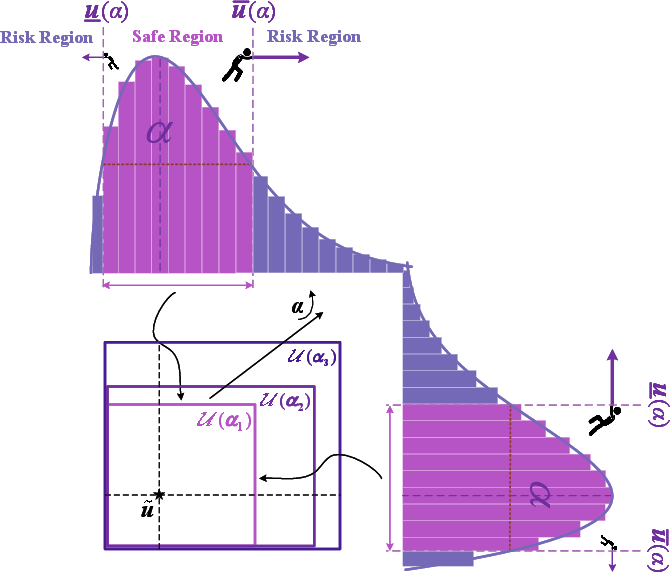
Figure 1: Illustration of a two-dimensional confidence-level-driven uncertainty set. U(α) is constructed by empirical confidence intervals parameterized by α.
To address the structural shortcomings of component-wise bounds, a structural parameter Γ is introduced to formulate generalized uncertainty sets, U(α,Γ). This parameter enables nonlinear, asymmetric expansion and controls temporal or dimensional dependencies among uncertainty sources (e.g., PV correlation over time periods). This yields polyhedral sets that are not only more expressive but encompass prior IGDT paradigms as special cases.
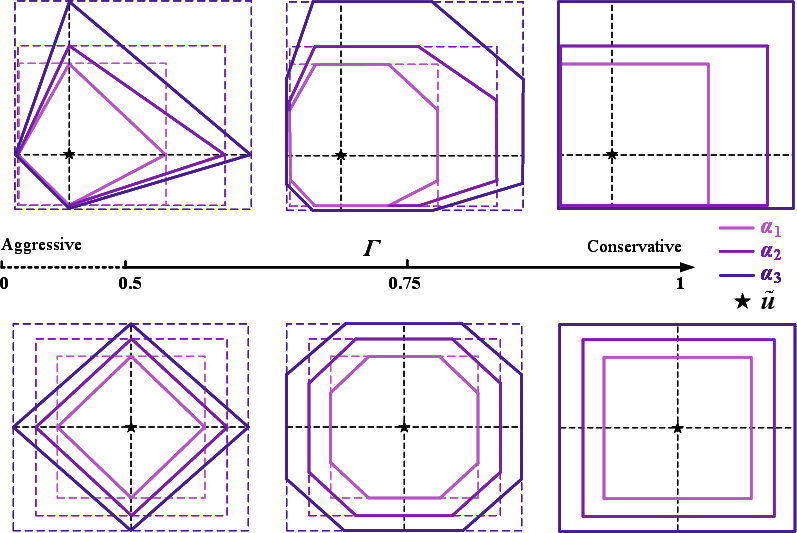
Figure 2: Illustration of two-dimensional generalized uncertainty sets, exhibiting asymmetric (top row) and symmetric (bottom row) expansion governed by α and Γ.
CL-IGDT Framework and TSRO Equivalence
The two-stage DN operation model under CL-IGDT consists of a baseline dispatch planning in the first stage and recourse control actions in the second. Robustness is quantified as the maximum feasible confidence level α∗ such that all operational constraints are satisfied for U(α∗), subject to a cost budget α0.
Formally, the CL-IGDT optimization is proven equivalent to a sequence of TSROs indexed by α1, facilitating a one-dimensional search for optimal robustness. By leveraging the DDU property and the monotonicity of the resulting cost function with respect to α2, efficient interval reduction via Fibonacci search is achieved. The TSRO problem for each α3 is formulated as a single-level mixed-integer program, using dual-based reformulation to expose invariant structural information.
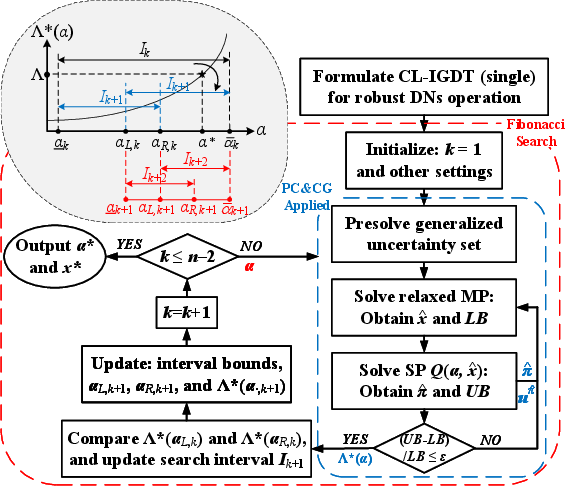
Figure 3: Flowchart of F-PC²CG algorithm, integrating confidence-level search and parametric cut generation.
F-PC²CG Algorithm
Standard column-and-constraint generation (CCG) algorithms suffer from inefficiency due to repeated recomputation of optimality cuts for changing uncertainty sets. The proposed F-PC²CG algorithm incorporates a cut-recycling strategy, exploiting the invariance of dual polyhedron extreme points across TSRO instances. This structural advantage permits warm-starting each TSRO subproblem evaluation with previously accumulated dual information, dramatically reducing inner iteration counts and total computation time.
Algorithmic convergence is guaranteed, with the approximation error bounded by the Fibonacci ratio and computational complexity dominated by the number of dual extreme points, decoupled from the number of search intervals.
Case Study: Modified IEEE 33-Bus System
Robust operation is tested on a modified IEEE 33-bus DN, incorporating DGs and ESSs with historical PV and load profiles to construct α4 for various values of α5. The financial budget is set to 25% above the expected scenario optimal cost. The CL-IGDT yields α6, corresponding to a confidence interval covering roughly 69.1% of most probable scenarios. Compared to conventional IGDT (symmetric set, α7), CL-IGDT vectors are source and time-specific, exhibiting improved coverage and adaptability.
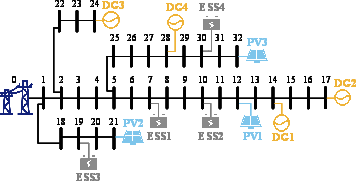
Figure 4: Modified IEEE 33-bus system topology.
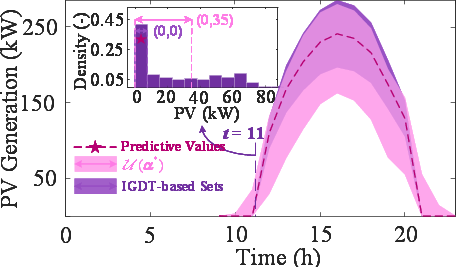
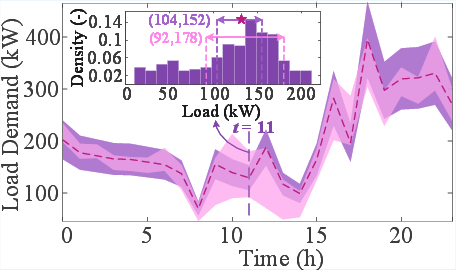
Figure 5: Optimal uncertainty sets for (a) PV generation at bus 12 and (b) load demand at bus 7, comparing CL-IGDT and IGDT approaches.
Out-of-sample tests demonstrate that CL-IGDT reduces average recourse cost by over 59% compared to IGDT and 48% compared to two-stage stochastic programming (TSSP), and eliminates penalty actions entirely. Sensitivity analysis on α8 reveals trade-offs between conservatism and adaptability; intermediate values produce minimum total cost, but optimal α9 is decision-maker dependent.
The F-PC²CG algorithm exhibits superior computational efficiency by recycling previously generated cuts, reducing total iteration count and runtime by over 65% compared to baseline F-CCG (non-parametric). Inner iteration counts sharply drop after initial rounds, with convergence behavior aligning to theoretical predictions.
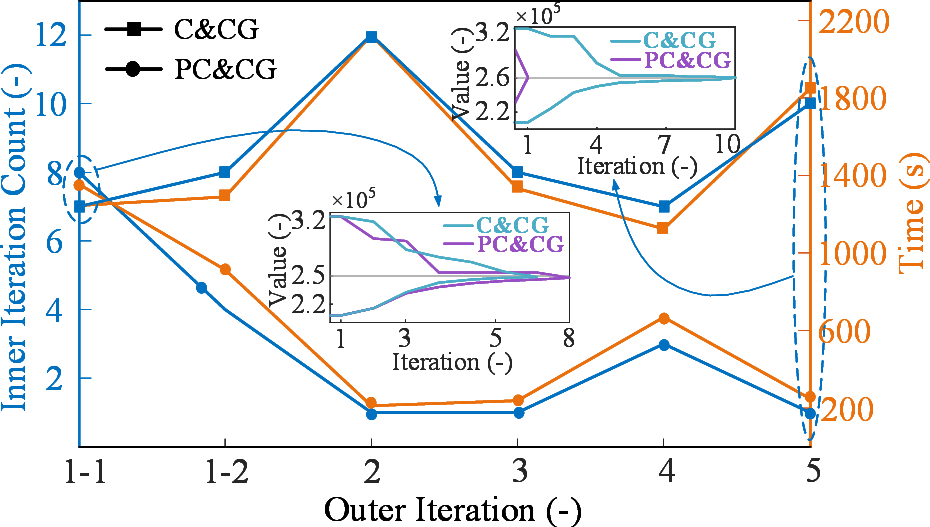
Figure 6: Convergence behaviors of parametric (PC²CG) and non-parametric (CCG) algorithms for function evaluation across Fibonacci rounds.
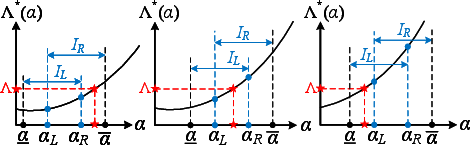
Figure 7: Three representative examples of search interval reduction using the Fibonacci-based customized selection rule.
Theoretical and Practical Implications
The present work advances uncertainty modeling for DN operation by providing a generalized, data-informed, decision-dependent representation. The CL-IGDT framework, through its equivalence with TSRO and the F-PC²CG algorithm, sets a new standard for computational tractability without loss of modeling fidelity. Practically, operators can flexibly tailor robustness versus economic efficiency according to risk tolerance and distributional features, adapting resource allocation dynamically to realistic uncertainty profiles. Theoretically, the approach bridges IGDT with modern robust optimization paradigms, unifying exogenous and endogenous uncertainty modeling under a scalable computational umbrella.
Future research directions include integration of distributed or hierarchical optimization architectures for large-scale DNs, dynamic adjustment of U(α)0 for real-time reliability management, and extension to multi-system coordinated operation (e.g., coupled gas, heat networks).
Conclusion
This paper has established a robust CL-IGDT framework for DN operation, leveraging generalized uncertainty sets and a computationally efficient F-PC²CG algorithm. The formulation improves the expressiveness of uncertainty modeling, achieves superior trade-offs between robustness and economic performance, and demonstrates clear computational advantages. Theoretical equivalence with TSRO and practical validation on standard test systems confirm its applicability and scalability for uncertainty-aware distribution network operation (2604.23252).