- The paper introduces a convex-analytic framework that rigorously quantifies structural misalignment in financial transmission rights.
- It employs geometric polytopes and dual decomposition to map hedging inefficiency and underfunding risk to specific network constraints.
- The analysis reveals how transmission limit derates, enforced contingencies, and temporal aggregation distinctly impact market revenue adequacy.
Structural Misalignment in Financial Transmission Rights: A Geometric and Dual Analysis
Introduction
This paper rigorously addresses structural underfunding and hedging inefficiency in the allocation of Financial Transmission Rights (FTRs) within wholesale electricity markets, focusing on the inherent misalignments between the network models underlying FTR auctions and those employed in Day-Ahead Market (DAM) operations. FTRs are critical in enabling participants to hedge exposure to transmission congestion risk, with payouts ultimately funded by the DAM's merchant surplus. However, the non-identical nature of the network models—driven by factors such as outage notifications, contingency modeling, and temporal aggregation—can yield misaligned hedging instruments. Unlike prior literature that often attributes underfunding to participant behavior, this work formalizes structural sources of misalignment using a geometric and dual-based convex-analytic framework, providing exact constraint-level attribution and quantification tools.
Geometric Framework: Polytopes and Support Functions
The paper formulates both the DAM merchant surplus and the maximal feasible FTR payout as dual support functions over convex network-feasible injection polytopes. Each network model (DAM or FTR) induces a feasible polytope in nodal-injection space, constrained by the transmission topology, enforced contingency sets, and permissible flows. For a given DAM shadow price vector y∗, the DAM surplus and FTR payout become evaluations of the same linear functional in differing polytopes.
A central construct is the alignment gap Δ(y), defined as the difference between the support functions of the FTR and DAM polytopes in the direction determined by the realized DAM shadow prices. Positive gaps correspond to underfunding risk (potential FTR payouts exceeding DAM surplus), while negative gaps indicate hedging inefficiency (not all DAM surplus is hedgeable through FTRs).
The framework accommodates all network model parameterizations, making the allocation instrument-agnostic and robust to bid structure, and highlights the dual role of support functions in both diagnosis and ex ante market design.
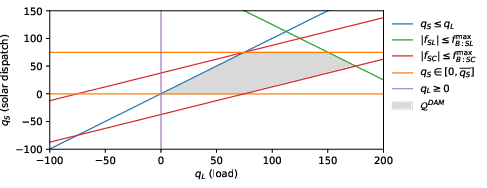
Figure 1: Network-feasible load qL vs solar dispatch qS for the base three-node network, illustrating the boundary of the DAM injection polytope.
Dual Representation and Constraint-Level Attribution
The dual reformulation of the support-function maximization enables direct mapping of alignment gaps to individual transmission element–contingency pairs. Importantly, both DAM and FTR duals share a common feasible set, differing only in objective coefficients induced by network limits. Optimal dual multipliers, even in the presence of standard dual degeneracy (due to polyhedral redundancy and overparameterization in practical networks), quantify the shadow price of each constraint.
Robust multiplier bounds (minimum and maximum dual values across all optimal dual solutions) are introduced, yielding an invariant classification: constraints are definitely binding, degenerately binding, or definitely slack. This enables ISOs to attribute underfunding or inefficiency to specific lines or contingencies, even when the dual solution is not unique. Such robust attribution is critical for transparent ex post diagnostics and for informed FTR network model adjustments.
Quantitative and Qualitative Results for Canonical Model Differences
The framework's power is exemplified through analysis of standard FTR market practices:
- Uniform Transmission Limit Derates: Applying a derate factor α to all enforced FTR constraints induces a proportional reduction in hedging efficiency, η(y∗)=α, with no effect on underfunding risk. The dual certificate is unchanged, isolating the derate effect as a direct efficiency cost.
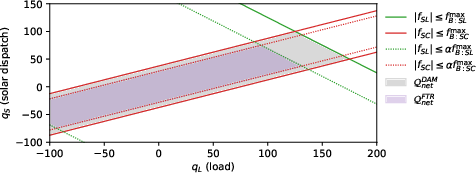
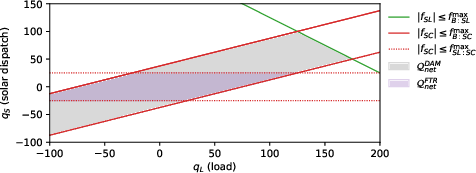
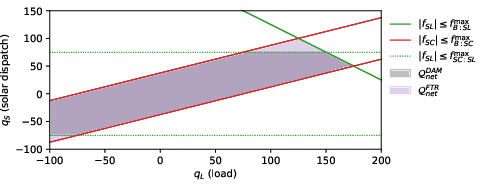
Figure 2: Uniform FTR derate contracts the feasible region, reducing hedging capacity to a fixed fraction of the DAM's potential surplus.
- Enforcement of Extra or Omitted Contingencies: Including additional contingencies in the FTR model (relative to DAM) shifts FTR hedging capacity inward, creating hedging inefficiency but never permitting underfunding. Conversely, omitted contingencies in the FTR model can yield underfunding risk but do not affect attainable hedging efficiency. Which specific constraints drive these outcomes is determined precisely by robust dual multipliers.
- Temporal Aggregation: Analysis of multi-interval FTR products reveals that temporal aggregation cannot increase underfunding risk but can induce inherent hedging inefficiency whenever DAM congestion patterns shift across intervals. The alignment ratio is strictly less than unity except when all intervals feature congruent congestion-supporting faces.
- Exemplification in Toy Model: These mechanisms are tractably visualized in a stylized 3-node network, with all geometric and dual analyses explicitly carried out to showcase the constraint-level diagnostics and alignment gap calculations.
Implications and Future Directions
The presented geometric-dual framework strictly generalizes previous heuristic or aggregate notions of FTR-DAM alignment. By isolating the effects of network parameter choices and outcomes, it enables ISOs to quantify and attribute the structural sources of inefficiency and underfunding, independent of participant behavior or portfolio effects.
Practically, this enables ex post forensics of underfunding events, targeted refinement of contingency notifications or derate schedules, and rational trade-off analysis when designing auction network models for increased forward revenue adequacy while preserving hedging opportunities.
Theoretically, the support-function and dual representations connect the FTR alignment problem to broader convex geometry and polyhedral containment literature. The robust dual decomposition is foundational for future generalizations, including richer AC network models, stochastic uncertainty sets, and the explicit modeling of market participant strategic behavior.
Conclusion
This paper provides a rigorous, unifying convex-analytic approach for diagnosing and quantifying structural misalignment between FTR and DAM network models. The dual-based decomposition yields robust, constraint-level attribution for both regulatory oversight and ex ante market design, filling a critical gap in the practical and theoretical understanding of revenue adequacy and hedging efficiency in transmission markets (2604.17586).