- The paper constructs a PT-invariant bulk state that reproduces the Bunch-Davies vacuum via an infinite sum over conformal descendants.
- It rigorously maps timelike geodesic-integrated correlators to OPE blocks, revealing sensitivity to the imaginary part of the complex central charge.
- The study extends to defect anomalies and entanglement entropy, offering a unified holographic framework for non-unitary dS/CFT dualities.
Holography for Timelike Geodesics in Lorentzian de Sitter and CFT Dual Structure
Introduction and Motivation
This work presents a systematic investigation of the conformal field theory (CFT) dual of massive scalar fields in (d+1)-dimensional Lorentzian de Sitter (dSd+1) spacetime, focusing on the formal, symmetry-based mapping of bulk correlation functions, including those integrated along timelike geodesics, to structures in a dual Euclidean CFTd. The authors address the significant challenge posed by de Sitter’s lack of a conventional global timelike boundary and the resulting non-unitary features of the conjectured dual theory.
The main contributions include the explicit construction of PT-invariant bulk states that reproduce the Bunch-Davies vacuum Wightman function, characterization of the Hilbert space and adjoint structure consistent with dS isometries, a detailed analysis of entanglement entropy in CFT2 with complex central charge, and a novel treatment of geodesic-integrated correlators and their interpretation in terms of OPE blocks and their Casimir partners.
AdS/dS Analytic Continuation and dS/CFT Symmetry Analysis
The basic holographic paradigm relates AdSd+1 to CFTd by virtue of their shared SO(d,2) symmetry. Lorentzian de Sitter emerges via analytic continuation of AdS coordinates, yielding an SO(d+1,1) isometry interpreted as the conformal group acting on the spacelike past and future boundaries (t→±∞).
For AdS/CFT, the Hermiticity structure of the CFT is standard, leading to unitary representation theory and, in three dimensions, central charge d+10. Under analytic continuation d+11, the central charge becomes complex, resulting in a non-unitary Euclidean CFT dual for dSd+12.
The algebra of conformal generators is preserved, but the adjoint operation is non-standard in dS/CFT: e.g., for sl(2,d+13), d+14 rather than d+15. This structure, which depends on the regime of the conformal dimensions, necessitates a doubled Hilbert space and d+16-symmetry as a substitute for unitarity.
Bulk State Construction and d+17-Invariant Dual
The dual bulk local state is constructed as an infinite sum over descendants of a conformal primary:
d+18
where d+19 is fixed by representation theory and d0 are translation generators. This state satisfies a bulk localization constraint and reproduces bulk two-point functions via analytic continuation from AdS to dS. The crucial observation is that the correct bulk-invariant structure requires a d1-twisted inner product, with d2 acting (in bulk coordinates) as the antipodal map.
The resulting construction naturally encodes the doubled static patch and leads to the generalized Hilbert space used to compute dSd3 correlation functions. The overlap of antipodally mapped local states, properly normalized, yields the Bunch-Davies Wightman function.
Entanglement and Central Charge Structure
A key, and perhaps counter-intuitive, result is that for the d4-invariant states, the reduced density matrix and entanglement entropy (computed in dual CFTd5 for a single interval) are only sensitive to the real part of the complex central charge:
d6
with d7 the interval length and d8 the UV cutoff. The classical bulk contribution (d9 for PT0) is not detected; instead, only the one-loop shift (the real PT1) contributes.
Averaging the geodesic lengths for PT2-related geodesics in the bulk similarly gives the same result, confirming that the entanglement entropy, whether calculated geometrically or via CFT, is blind to the classical piece in dS holography.
Timelike Geodesic Integrals and Bulk-OPE Block Dictionary
The central technical advance is the analysis of the correlator
PT3
where PT4 is the Bunch-Davies Wightman function and PT5 is a timelike geodesic anchored between antipodal boundary points. The explicit integration uses Barnes-type representations and contour integration techniques.
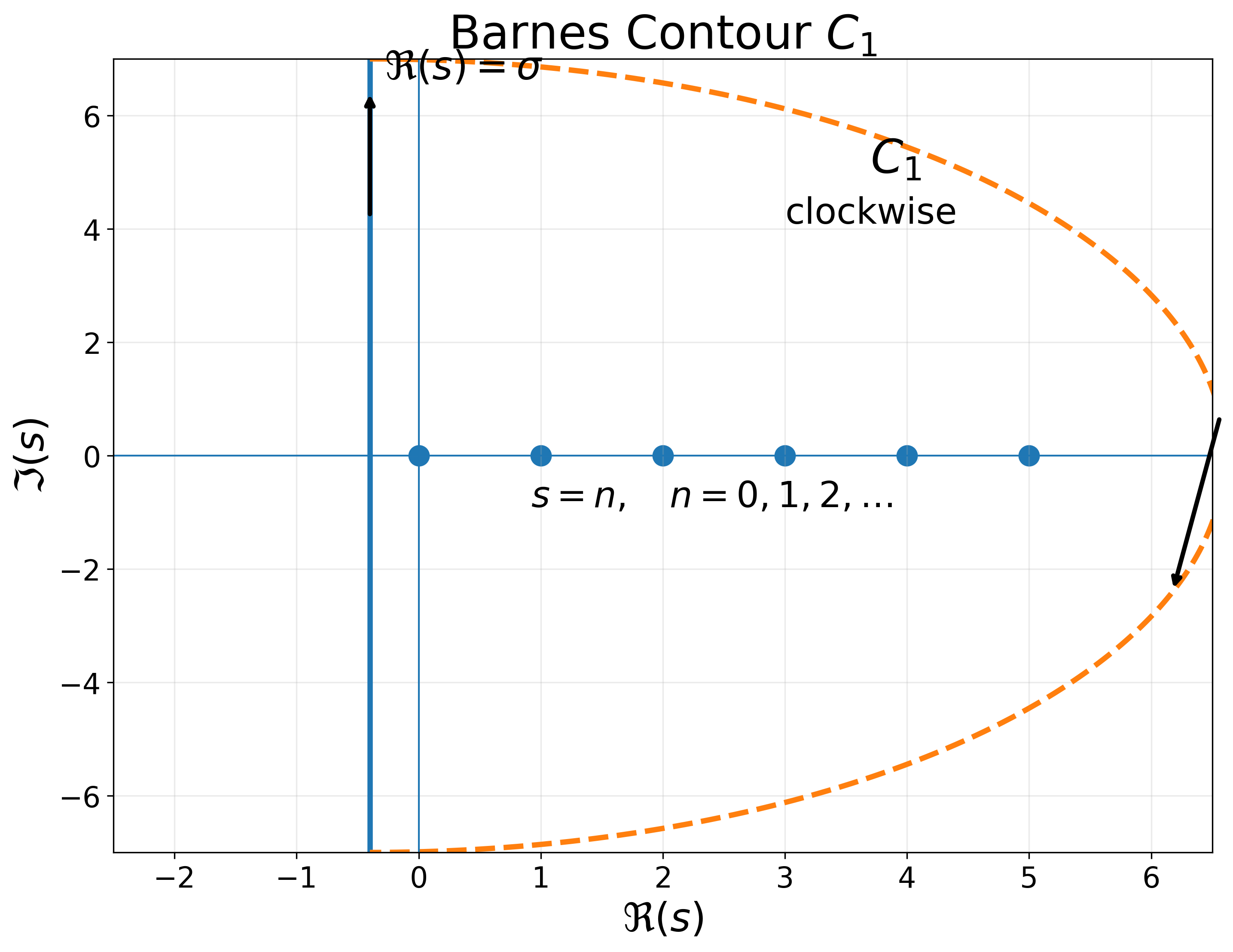
Figure 1: The Barnes clockwise contour PT6 encloses the series of poles PT7, PT8, relevant to the geodesic integral in dS.
Depending on the hyperbolic separation and sign structure, either the clockwise (PT9) or anti-clockwise (20) Barnes contours are used:
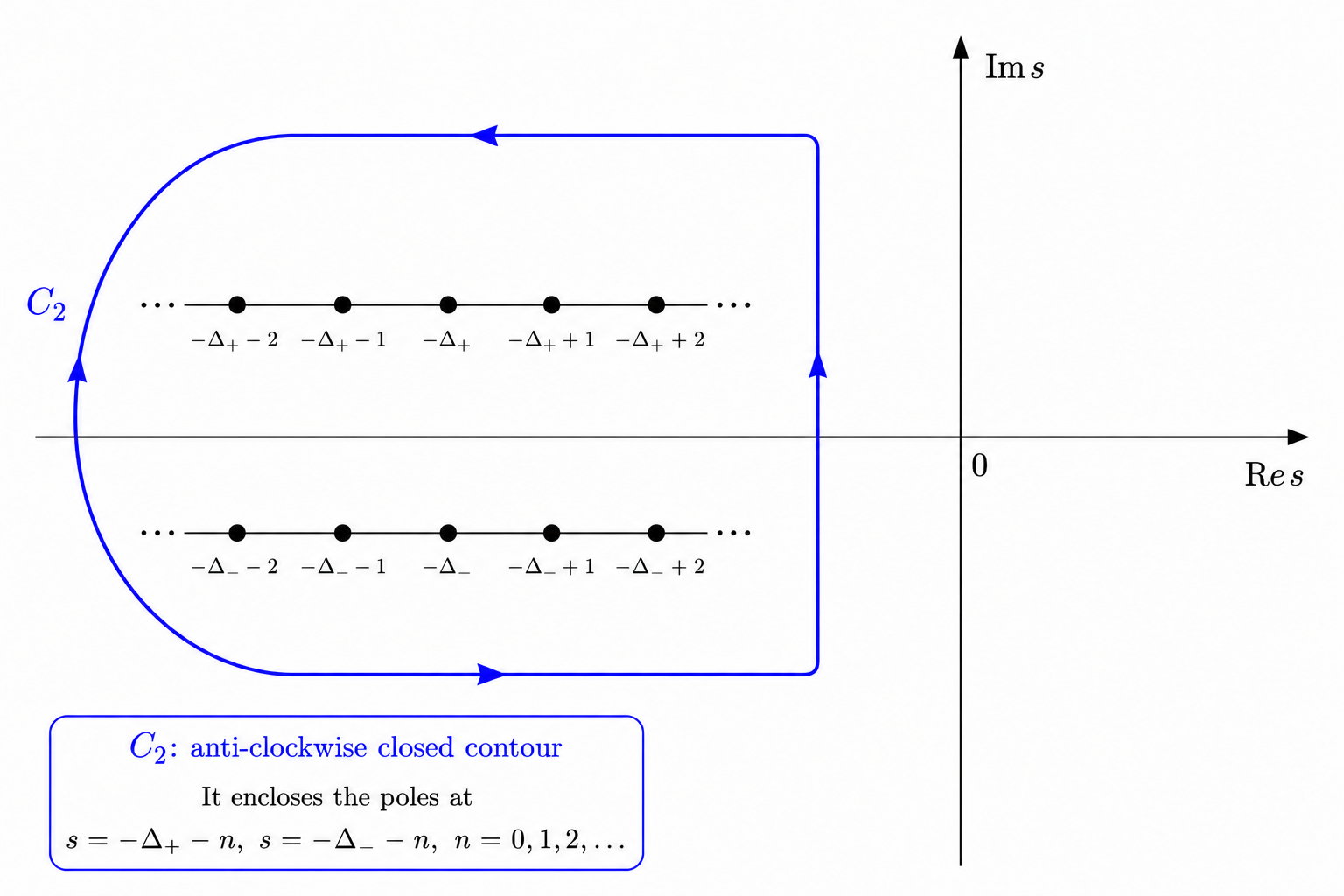
Figure 2: The Barnes anti-clockwise contour 21 for integrating over 22, capturing contributions from the conformal dimensions of the OPE block and its partner.
A striking outcome is that the geodesic-integrated object obeys precisely the same hypergeometric equation as the OPE block in CFT23. Explicitly, the result can be recast as a linear combination of an OPE block for 24 and its "partner" corresponding to 25 (the two roots of the wave equation). The explicit coefficients are determined by analytic continuation and normalization.
This demonstrates that, in contrast to the entanglement entropy, the geodesic-integrated Wightman function is sensitive to the imaginary part of the central charge—the “classical” gravitational effect. Thus, this observable completes the bulk/boundary dictionary for dS/CFT, assigning the real part of 26 to information-theoretic quantities and the imaginary part to bulk geometric data.
The paper extends these results to the theory of conformal defects. The presence of the 27-defect and its associated 28 symmetry enables the application of recent developments in the analysis of defect anomalies. The authors derive integrated Ward identities, classify local anomaly functionals 29, and relate them to multilinear combinations of "tilt" operators localized on the defect.
For d+10 defects (lines), the anomaly is captured by Wess-Zumino-type terms and is classified by d+11. The bulk interpretation is as a worldline sigma model coupled to background NS-NS flux, with the defect fluctuations mapping to Goldstone modes on d+12.
Theoretical and Practical Implications
This study clarifies the operation of holography in non-unitary, cosmological settings. Specifically:
- Hilbert space structure: The d+13-twisted adjoint and doubled Hilbert space underpinning dS/CFT leads to new classes of dual states and observables absent in standard (unitary) holographic dualities.
- Bulk reconstruction: Timelike geodesic integrals, and their CFT duals involving OPE blocks and partners, provide a way to probe classically gravitational information not accessible to canonical information-theoretic measures.
- Defect anomalies: The anomaly classification and the connection to bulk worldline effective actions suggest robust mathematical structures that transcend particular spacetime signatures, with possible connections to brane theory and flow of topological charges.
- Future directions: Extending these constructions to fields with spin, interacting QFTs in dS, or to explicit models of dynamical gravity, and understanding the stability of such non-unitary Hilbert spaces, are all pressing directions.
Conclusion
The paper establishes a precise, symmetry-informed framework for dualizing bulk timelike geodesic observables in Lorentzian de Sitter space to composite, d+14-twisted structures in a non-unitary CFTd+15. The explicit treatment of entanglement, timelike geodesic integrals, and defect anomalies provides a unified approach to holographic duality beyond AdS/CFT, with mathematical and physical implications for quantum gravity, cosmology, and non-Hermitian QFT.
Figure 1: The Barnes clockwise contour d+16 used in the analytic continuation of the integral representation.
Figure 2: The Barnes anti-clockwise contour d+17, capturing the poles at d+18.