- The paper introduces a framework where a de Sitter region is embedded as an end-of-the-world brane in AdS₃, enabling state preparation in a unitary CFT.
- It employs complex gravitational saddles and non-unitary boundary conditions, resulting in complex g-functions and a novel holographic dictionary.
- The method reveals new black hole microstates and provides insights into the analytic continuation between Euclidean and Lorentzian geometries.
Holography of de Sitter through Anti-de Sitter: Non-Unitary Boundary Conditions and Complex Saddles
Introduction and Motivation
The AdS/CFT correspondence provides a well-established framework for relating quantum gravity on asymptotically AdS spacetimes to boundary CFTs, with a precise dictionary between bulk gravitational configurations and CFT observables. In contrast, the holography of de Sitter (dS) space remains much less understood, both conceptually and technically, despite multiple proposals—including dS/CFT, dS/dS, and holography with timelike screens. The challenge is exacerbated by quantum gravity in dS often exhibiting a trivial, non-dynamical Hilbert space in non-perturbative regimes [MV20, BKU20, BNU23, UWZ24, AAIL25].
The paper "Monitoring a de Sitter universe through an anti-de Sitter window" (2606.31705) advances a new perspective: embedding a dS region as an end-of-the-world (EOW) brane inside AdS3 and characterizing the dual in terms of a unitary two-dimensional holographic CFT with carefully engineered, non-unitary boundary conditions. This construction exploits complex gravitational saddles and the flexibility of the AdS/CFT path integral formalism, advancing a concrete realization of dS holography as state preparation inside a unitary AdS/CFT Hilbert space.
Construction: dS EOW Branes in AdS and Complex Saddles
A central technical insight is that AdS3 gravity coupled to dS2 EOW branes (with tension T>1) admits complex, but not real, saddle points in the Euclidean path integral with boundary Σ possessing a boundary of its own (e.g., a disk or cylinder). The gravitational action in this setting acquires its key features due to the non-existence of real saddles where a dS brane intersects the ordinary AdS boundary. Instead, specific complexified geometries—constructed by patching half AdS3 balls and complex disk wedges—serve as dominant contributions.
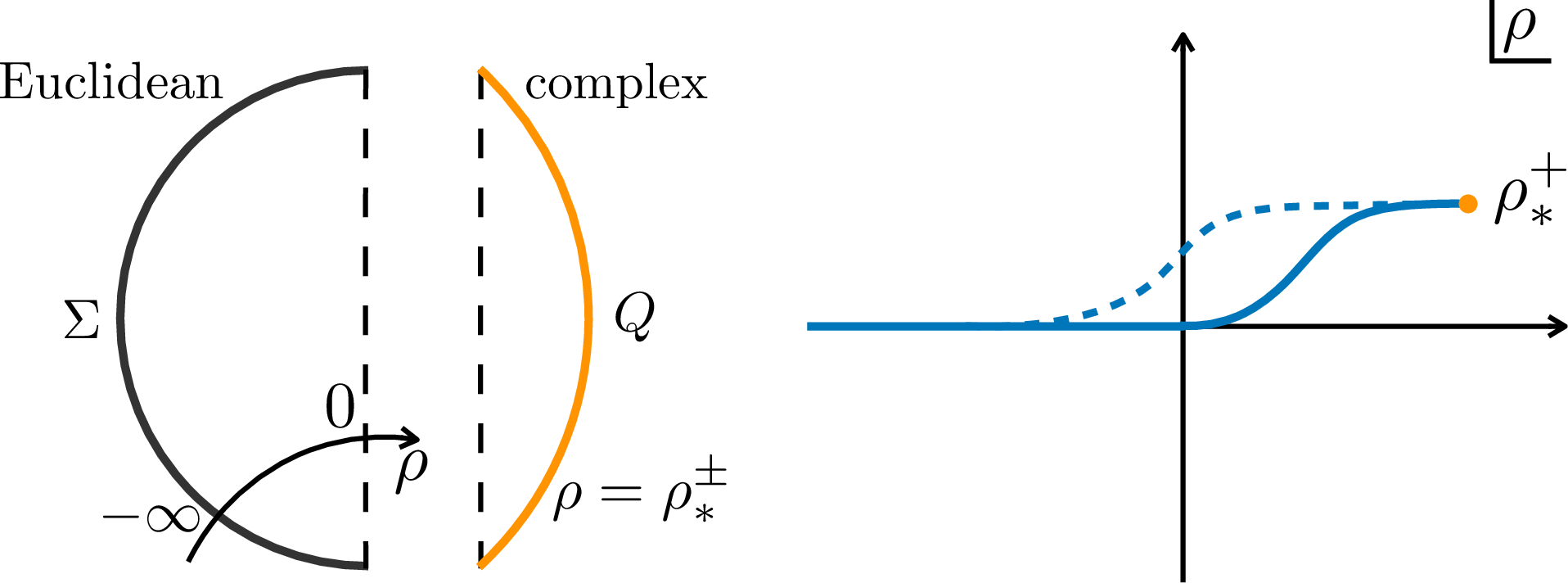
Figure 1: Construction of complex solutions for T>1 by pasting a half-ball and complex disk wedge, visualized as a contour (solid blue) in the complex ρ-plane.
Boundary conditions in the dual CFT reflect this complexity: one is led to consider non-unitary conformal boundary states whose associated g-functions are complex, and which necessarily appear in conjugate pairs. The gravitational g-function, measurable via the on-shell action, is 30, where 31 are endpoints of possible complex contours in the bulk.
State Preparation, Black Hole Microstates, and Lorentzian Continuation
Of particular interest is the scenario in which a dS32 EOW brane lies behind the event horizon of an AdS33 BTZ black hole. The dual CFT state is a pure state prepared via a Euclidean path integral on a cylinder with non-unitary boundary conditions (34), which thereafter evolves unitarily under the CFT Hamiltonian. The analytic continuation to Lorentzian signature yields a geometry featuring a dS patch shielded by the BTZ horizon.
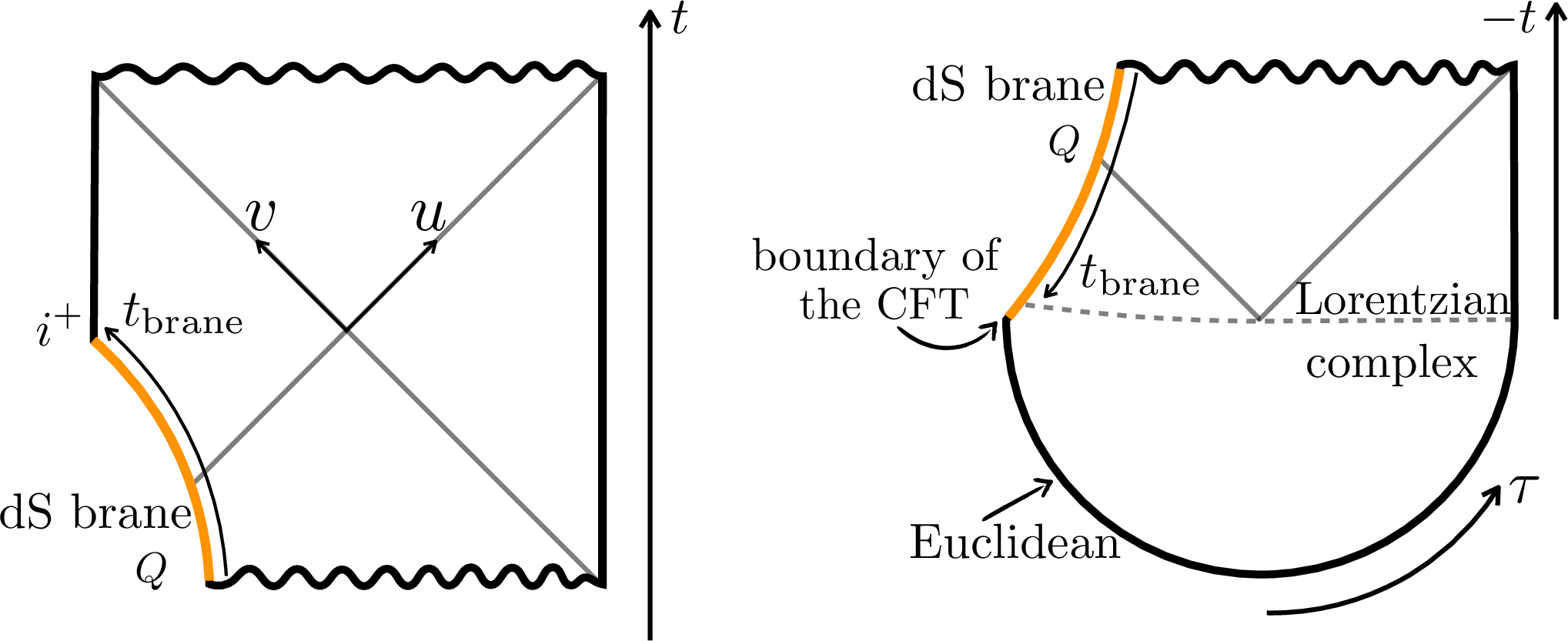
Figure 2: Lorentzian geometry with a dS35 EOW brane behind the event horizon of a BTZ black hole, obtainable by analytic continuation from complex geometry with Euclidean boundary.
The path integral on a 36 cylinder computes the matrix element 37, which remains real and positive if the boundaries are conjugates, as required by the construction. In the high-temperature (small 38) limit, the dominant saddle is a connected geometry whose stress tensor correctly reproduces the energy density of a thermal CFT with effective temperature 39. This is elevated relative to the conventional (unitary boundary) quench, a consequence of the negative conformal weight of the boundary condition-changing (bcc) operator connecting 20 and 21: 22.
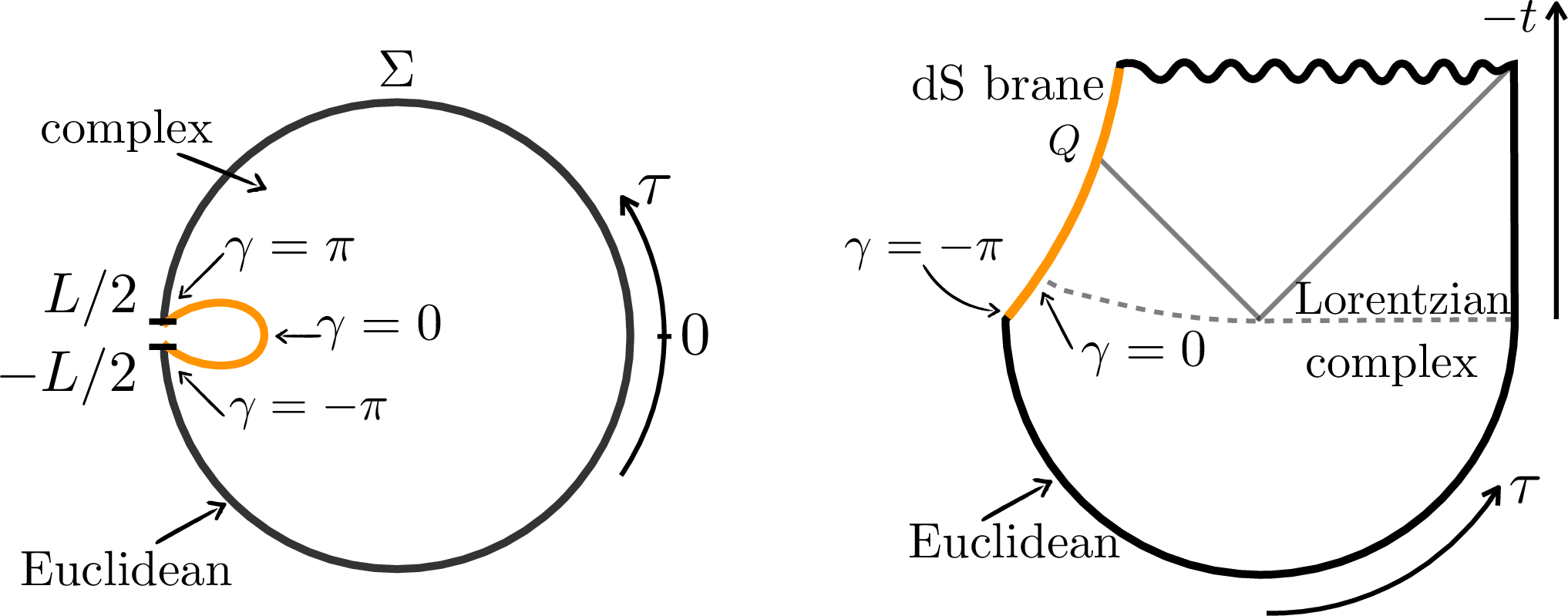
Figure 3: 23 slice of the connected solution for the 24 cylinder, and its Lorentzian analytic continuation.
Non-unitary Boundary Conditions and Complex 25-Functions
A prominent feature of this construction is the explicit appearance of non-unitary conformal boundary states in an otherwise unitary CFT. Such states are characterized by complex coefficients in their Ishibashi state expansions and have complex 26-functions. While traditionally only unitary boundary conditions with real coefficients are considered physical, the present work identifies physical realizations (e.g., compact boson with complex Dirichlet boundary, analytically continued Liouville FZZT branes) and argues their admissibility in the context of holography [FateevZamolodchikovZamolodchikov00, GRW01, Teschner00]. The spectral density of the open-string theory between non-unitary boundaries adheres to expected positivity constraints due to the nature of integration contours in the complex 27 plane.
The connected solutions for the 28 and 29 cylinders exhibit sharply contrasting behaviors: for T>10 (identical, non-unitary boundaries), the partition function is complex and the dominant saddle can change, whereas for T>11 (conjugate boundaries), the dominant saddle is always real and unique. This confirms the necessity of pairing T>12 and T>13 in order to construct real, physical states in the unitary CFT Hilbert space.
Implications and Broader Context
The framework provides a prescription for embedding dS gravity into AdS/CFT with precise CFT duals: the bulk gravitational configurations with dST>14 EOW branes correspond to CFT states and density matrices prepared via path integrals with non-unitary boundaries. The dS sector is thus not treated as an autonomous quantum system, but as a "parasite"—providing state-preparation data for the (unitary) AdS/CFT Hilbert space. This resolves the non-perturbative triviality of dS Hilbert space by relegating dS physics to boundary data for an AdS microstate.
The methodology sits at the intersection of traditional dS/CFT—where dS gravity is conjecturally dual to a non-unitary CFT—and more modern "holographic screens" approaches where holography is implemented on timelike hypersurfaces within dS. Here, the timelike holographic screen remains at the AdS boundary but the dS region is encoded in the procedure by which a CFT state is constructed.
The construction elucidates new classes of black hole microstates (those with a dS EOW brane behind the horizon) and provides a precise dictionary between gravitational and CFT data, including the prediction of a boundary-condition-changing operator of negative conformal dimension, which is entirely absent from the unitary bulk CFT spectrum.
Future Directions
The theoretical architecture presented here opens several avenues:
- Reverse CFT Bootstrap: Given a unitary CFT with non-unitary, complex T>15-function boundary states, one can invert the logic to identify candidate dS EOW branes or their higher-dimensional generalizations.
- Lorentzian Evolution and Decays: Detailed analysis of the Lorentzian dynamics of dS branes—including possible decay processes—can be conducted via bulk reconstruction techniques and brane-localized observables [KSSTW23].
- Black Hole Microstate Structure: The identification of new microstate geometries invites further study on their entropy, distinguishability, and connections to the black hole information paradox.
Conclusion
This work provides a concrete, technically precise embedding of dS holography within the well-established AdS/CFT framework via complex gravitational saddles and non-unitary conformal boundary conditions. The duality operates not by creating an autonomous dS/CFT, but as a protocol for preparing specific pure or mixed states in the unitary CFT Hilbert space. The construction resolves several obstacles in prior approaches, clarifies the role of complexified boundary data, and predicts new phenomena—including the necessity of a negative-dimension bcc operator—in both gravitational and field-theoretic settings. This framework is poised to influence further explorations of quantum gravity in non-AdS spacetimes, the structure of black hole microstates, and the classification of admissible boundary conditions in two-dimensional CFTs capable of supporting holographic duals.
Reference: (2606.31705)