- The paper provides a novel construction of generalized free fields through a doubled 1D CFT framework that precisely reproduces de Sitter scalar correlators.
- It employs convolution products and split representations to map CFT operator algebras to bulk de Sitter dynamics via worldline holography.
- The findings lay the groundwork for exploring quantum gravity in de Sitter space, with implications for SYK models and gravitational backreaction.
Generalized Free Fields in de Sitter from 1D CFT: An Authoritative Overview
Introduction and Framework
The paper "Generalized Free Fields in de Sitter from 1D CFT" (2605.03037) establishes a direct construction of generalized free fields (GFFs) localized along geodesic worldlines in d+1-dimensional de Sitter (dS) spacetime from a pair of large N one-dimensional conformal field theories (CFT1). Leveraging large N factorization, 1D conformal symmetry, and the split representation of dS Green functions, it identifies an operator sub-algebra in the doubled CFT1 system corresponding to a GFF algebra accessible to an observer in de Sitter.
This construction is aligned with the worldline holography paradigm, where the observations of an idealized observer are described by quantum theories restricted to their geodesic trajectory. The approach differs from standard boundary-based dS/CFT prescriptions, providing instead a bulk-local GFF algebra emerging from non-local convolution products of CFT1 scaling operators subjected to a relational (equal-energy) constraint.
Main Construction: Physical Operators and Correlation Functions
A central result is the explicit definition of physical operators OΔ(τ) in the doubled CFT1, given as a convolution of left and right scaling operators of complementary dimensions:
OΔ(τ)=N∫dtOd/2−ΔL(t)OΔR(τ−t)
Here, N is an infinite renormalization factor ensuring finiteness after group averaging. These operators commute with the zero-energy constraint N0, rendering them physical in the sense of worldline quantum gravity.
The two-point function of N1 matches precisely the Wightman Green function of a free massive scalar field in de Sitter:
N2
with N3. This correspondence is established both in the position and frequency domain, with the convolution of CFTN4 two-point functions transforming into the de Sitter hypergeometric Green function.
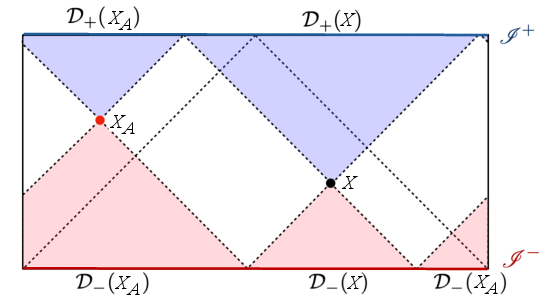
Figure 1: The physical operator N5 as a convolution product, manifesting the group averaging enforcing the zero-energy constraint.
Split Representation and Geometric Mapping
The split representation provides the geometric underpinning for the construction. It decomposes the de Sitter bulk Green function into a convolution of two bulk-to-boundary propagators, corresponding to the pairing of conjugate modes in the CFTN6 system. The integral over the boundary, through this representation, is analogous to Green’s theorem or Huygens’ principle—bulk propagation is entirely captured by boundary data.
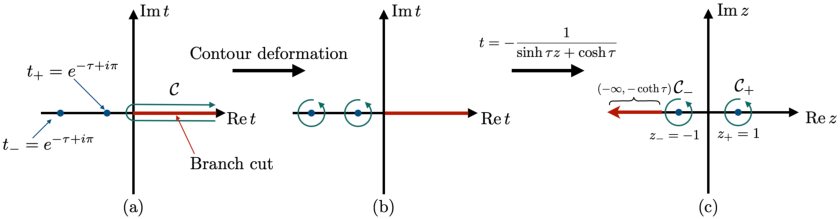
Figure 2: Contour deformation from the N7-integral to the N8-integral in the split representation, illustrating the mapping from CFT domain variables to de Sitter geometry.
Large N9 Factorization and Wick’s Theorem
The implementation of Wick’s theorem for the constructed physical operators is enabled by large 10 factorization. The paper outlines, especially in the SYK context, a mechanism wherein product operators (with appropriately correlated random couplings) generate factorized 11-point functions decomposing into products of two-point functions, satisfying typical generalized free field algebraic rules.
This result generalizes the established correspondence between 2+1D de Sitter and doubled SYK systems to arbitrary spacetime dimensions, and crucially, demonstrates that convolution-based operators in large 12 CFTs have the same correlation structure as free massive fields in de Sitter.
Group Theoretic Structure and HKLL Bulk Operator Prescription
Specializing to dS13, the construction admits an interpretation in terms of 14 group theory. Bulk points are mapped to coset representatives; the convolution structure translates into operator-valued matrix elements in the representation space 15:
16
This group-theoretic view directly relates the physical operators to solutions of the bulk Klein-Gordon equation, with the Casimir eigenvalue equated to the field's mass squared.
The paper further connects the convolution-based worldline operators to the HKLL bulk operator construction in dS/CFT, showing that their integral kernels extend over all of future infinity rather than being causally restricted—a peculiarity of de Sitter geometry.
Microscopic vs Coarse-Grained Constraint: Spectral Implications
A nuanced discussion addresses the difference between enforcing the equal-energy constraint microscopically (one-to-one energy state pairing) versus in a coarse-grained sense (matching within a small window in the large 17 limit). These choices yield different spectral densities in multipoint correlators, translating into time-shifted Green functions but preserving, up to analytic continuation, the main correspondence with de Sitter scalar field correlators.
Practical and Theoretical Implications
The paper’s construction has significant implications for worldline de Sitter holography. It provides a minimal model, realized in generic large 18 CFTs (including DSSYK and Schwarzian QM), for local QFT on a geodesic in de Sitter, with explicit operator definitions and a complete algebraic structure mapped to GFFs.
Practically, the approach enables calculations of correlators in quantum mechanical models that may reproduce semi-classical field theory in de Sitter space, including thermodynamic, entanglement, and quasi-normal mode properties, as well as gravitational backreaction. Theoretically, the model challenges existing boundaries between holographic dual descriptions (AdS/CFT vs dS/CFT), and provides a template for future extensions involving interactions, backreaction, and microscopic realization of de Sitter holography.
Prospects for Future Developments
Future research directions include:
- Computing time-dependent and thermodynamic observables in de Sitter backgrounds using SYK/DSSYK correlators.
- Analysis of OTOCs and quantum chaos within this dictionary, and comparison to classical shockwave interactions in de Sitter.
- Studying quantum entanglement entropy along geodesics mapped to worldline observables.
- Extending the model to include gravitational interactions and finite 19 corrections, formalizing a dictionary between worldline quantum gravity and large N0 quantum systems.
Conclusion
"Generalized Free Fields in de Sitter from 1D CFT" (2605.03037) rigorously constructs, from first principles, a GFF algebra on the geodesic worldline in de Sitter spacetime via coupled large N1 CFTN2 systems. The methods and results synthesize group theoretic, holographic, and spectral representations, delivering precise operator constructions whose correlators match de Sitter scalar Green functions. The construction opens a pathway to a microscopic realization of worldline de Sitter holography and lays the groundwork for further exploration of quantum gravity and holographic dualities in de Sitter space.