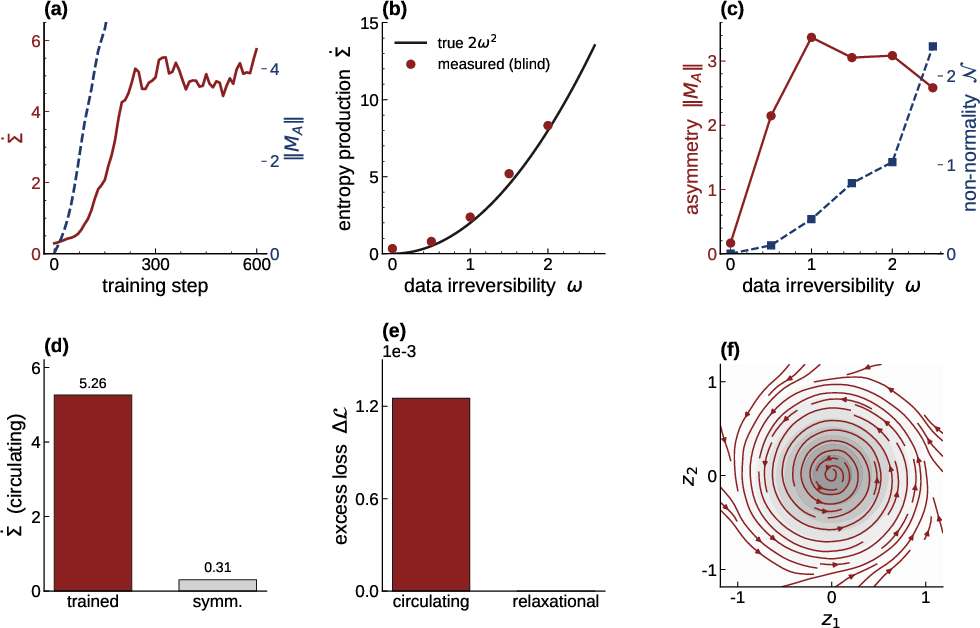
- The paper proposes a novel path-space formulation that replaces next-step prediction with trajectory distribution analysis using the Onsager–Machlup action.
- It demonstrates that attention query–key asymmetry induces irreversible dynamics and measurable entropy production essential for accurate long-horizon predictions.
- The approach unifies prediction, planning, and uncertainty quantification, offering clear architectural guidance for controlling non-equilibrium behavior in world models.
Path-Space Prediction in World Models: Trajectory Distributions and Emergent Irreversibility
This work proposes a fundamental shift in the mathematical object used for prediction in latent world models, departing from the traditional step-wise autoregressive view. Rather than focusing on the next-step conditional distribution p(xt+1∣xt), the author treats the world model as specifying an implicit probability measure P[] over entire future latent trajectories. In the Markovian/local regime, where the dynamics can be described as a diffusion, the path-marginal assumes the Onsager–Machlup action form:
P[]∝e−A[],
with the action functional A[] expressing local kinetic deviations from the model's drift as well as a Jacobian (Stratonovich) correction term. This path-centric viewpoint provides a unifying framework for prediction (as the most probable path/minimum action), planning (least-action subject to constraints), and predictive uncertainty (curvature/variance about the action minimum).
Crucially, this formalism decomposes the latent dynamics into reversible (gradient) and irreversible (circulating) components, allowing operational measures of entropy production and thermodynamic irreversibility to be defined on model rollouts.
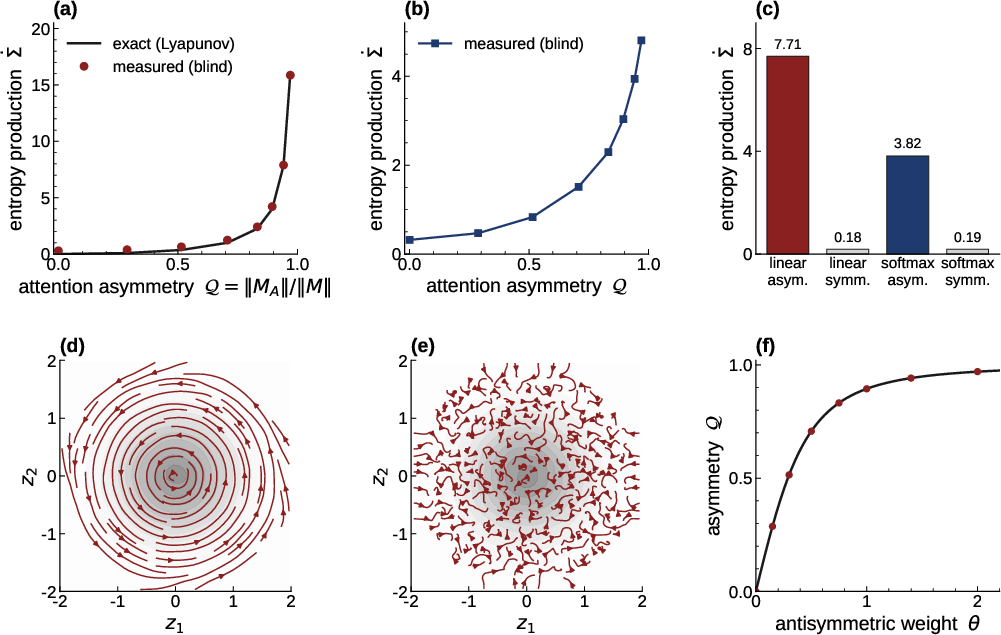
Figure 1: Query–key asymmetry controls entropy production in the predicted latent dynamics, operationalized via measurement in both linear and softmax attention models.
Attention Asymmetry as a Source of Irreversibility
A precise architectural reading connects attention mechanisms to the underlying path action. The query–key product M=WQ⊤WK defines the metric of the kinetic term. Its antisymmetric part, MA, sources the irreversible drift (circulating component) and entropy production in the model’s predicted dynamics. The local drift Jacobian, obtained from attention-weighted cross-covariances, splits into symmetric (potential) and antisymmetric (rotational/odd-elastic) components. Therefore, the attention logit asymmetry—explicitly, the nonzero MA—generates and governs the non-equilibrium aspects of the learned dynamics.
Symmetrizing the query–key weights eliminates MA and hence suppresses entropy production, as well as long-horizon predictive ability for irreversible/circulating dynamics. This analytically identifies the query–key asymmetry as an explicit, architecturally controllable channel for non-equilibrium predictions via the antisymmetric drift Jacobian.
Empirical Validation: Measurement and Intervention
The theoretical claims are operationalized via a set of falsifiable predictions and empirical strategies:
Irreversibility as a Resource for Long-Horizon Prediction
A core empirical result is that irreversibility, as measured by entropy production and induced by attention asymmetry, is not merely an epiphenomenon. It acts as a computational resource: eliminating the asymmetry selectively degrades the ability to perform long-horizon, temporally coherent prediction in settings with genuine non-equilibrium dynamics, while leaving purely relaxational prediction unaffected. Multi-step rollout experiments directly demonstrate that only models with sufficient entropy production (thus, as per the analysis, with P[]7) can track the true conditional mean in irreversible/circulating dynamics over extended horizons (see Figure 3).
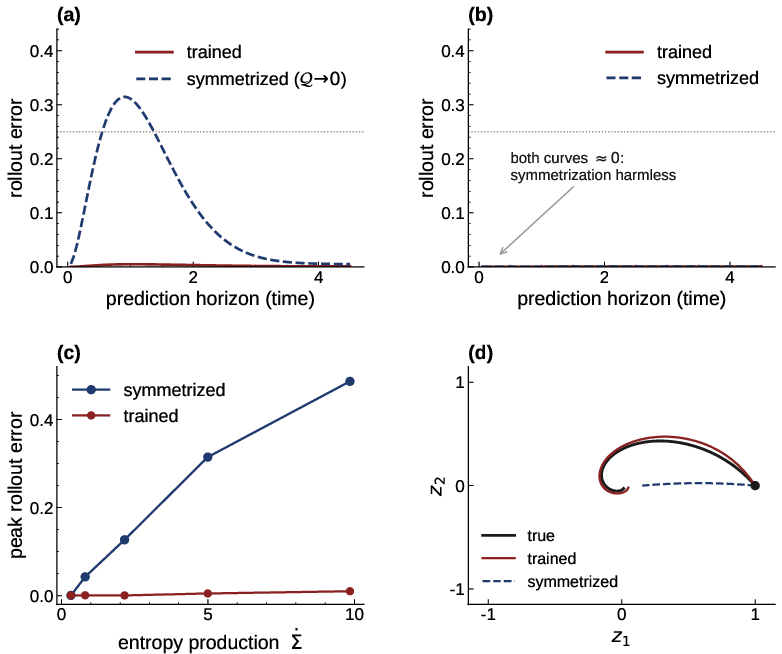
Figure 3: Multistep prediction error increases sharply with symmetrization in circulating (irreversible) tasks, while remaining negligible in relaxational (equilibrium) environments—quantifying the predictive utility of irreversibility.
Practical and Theoretical Implications
The path-space formulation equips the field with a physical-statistical toolkit for analyzing and controlling predictive dynamics in latent world models. Key implications include:
- Unified operational calculus: Prediction, planning, and uncertainty become aspects of the same variational/objective principle on path space.
- Diagnosis and control of model irreversibility: The entropy production serves as an objective, quantitative diagnostic for non-equilibrium structure in predicted trajectories, directly linked to architectural properties.
- Architectural guidance: Designers can modulate the capacity for temporal prediction via the query–key asymmetry, customizing model behavior to task requirements (e.g., circulatory versus relaxing environments).
For future developments, the extension of this local-path, diffusion-centric framework to deep stacks, high-dimensional embedding spaces, and non-Markovian/memory-rich architectures remains an open area for empirical and theoretical exploration. The tensorial and algebraic identification of irreversibility channels provides a precise guide for ablation studies and interpretability analyses in large-scale world-model settings.
Conclusion
This work advances a rigorous path-space perspective on latent world model prediction, displacing state-centric Markovian views in favor of trajectory-distributional reasoning. The approach confers a unified operational handle on prediction, planning, and uncertainty, and establishes a precise mapping from architectural asymmetry in attention to measurable thermodynamic irreversibility in predicted dynamics. The central empirical finding—that irreversibility is both learned and functionally exploited for long-horizon prediction—suggests a new axis for model analysis and design, and lays groundwork for a statistical physics of learned predictive systems with both practical and conceptual significance.