Stochastic Thermodynamics for Autoregressive Generative Models: A Non-Markovian Perspective
Abstract: Autoregressive generative models -- including Transformers, recurrent neural networks, classical Kalman filters, state space models, and Mamba -- all generate sequences by sampling each output from a deterministic summary of the past, producing genuinely non-Markovian observed processes. We develop a general theoretical framework based on stochastic thermodynamics for this class of architectures and introduce the entropy production, which can be efficiently estimated from sampled trajectories without exponential sampling cost despite the non-Markovian nature of the observed dynamics. As a proof-of-concept experiment for a LLM, we evaluate the token-level and sentence-level entropy production for a pre-trained Transformer-based model, GPT-2. We also demonstrate the framework in the linear Gaussian case, where the model reduces to the Kalman innovation representation and the entropy production admits an analytical expression. We further show that the entropy production decomposes exactly into non-negative per-step contributions in terms of retrospective inference, and each of those terms further splits into information-theoretically meaningful terms: a compression loss and a model mismatch. Our results establish a bridge between stochastic thermodynamics and modern generative models, and provide a starting point for quantifying irreversibility in a broad class of highly non-Markovian processes such as LLMs.
Paper Prompts
Sign up for free to create and run prompts on this paper using GPT-5.
Top Community Prompts
Explain it Like I'm 14
What this paper is about
This paper connects two worlds: modern AI that writes or predicts sequences (like words in a sentence), and a branch of physics called “stochastic thermodynamics” that studies the arrow of time. The authors give a way to measure how “time‑directional” a model’s outputs are—basically, how easy it is to tell if a sequence was generated forward or backward. They show how to calculate this measure efficiently for popular models like Transformers (used in LLMs), RNNs, and Kalman filters, even though these models remember lots of past information and are not simple “Markov” systems.
The big questions
In simple terms, the paper asks:
- Can we measure how irreversible (time‑directional) the outputs of a sequence‑generating AI model are?
- Can we do this even when the model’s next step depends on a complicated summary of the whole past, not just the latest step?
- Can we compute this measure efficiently on real models like GPT‑2?
- Can we break this measure into parts that tell us why time direction shows up (for example, because of information loss or because the model’s rules fit forward better than backward)?
How they studied it (with everyday language)
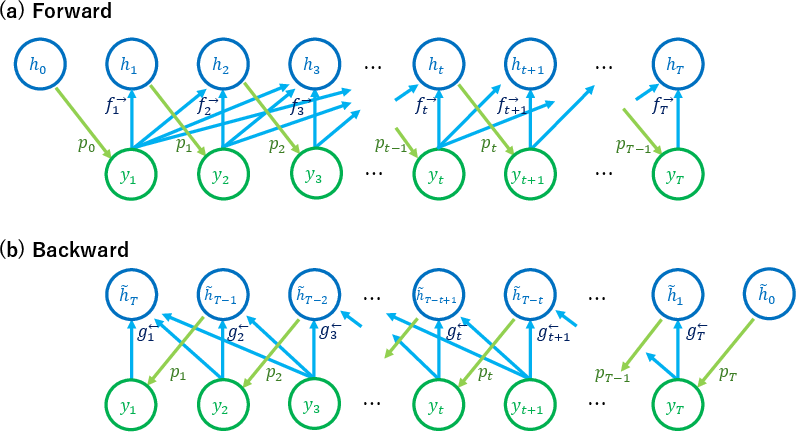
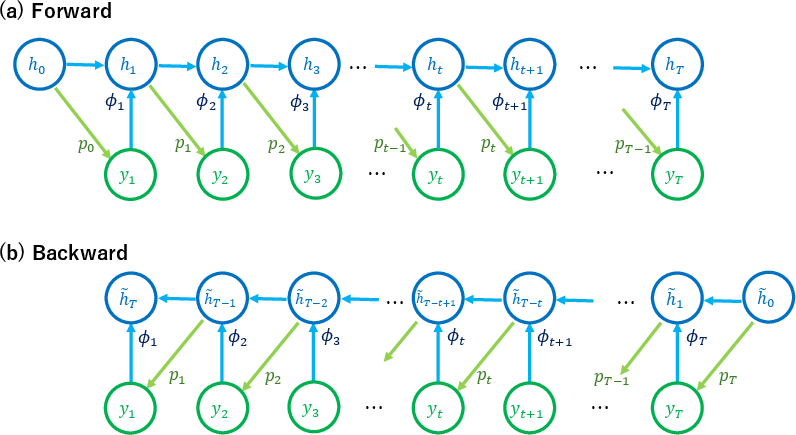
Think of an autoregressive model (like GPT‑2) as a storyteller that writes one word at a time. Before writing each new word, it keeps a “notebook” (its internal memory) that summarizes everything written so far. The key points:
- Autoregressive model: At each step, the model looks at its notebook and picks the next output using a probability rule.
- Deterministic memory: The notebook is a fixed, exact summary of the past—it isn’t random. Given the past words, there’s only one notebook state.
- Non‑Markovian: The next word depends on the whole history (via the notebook), not just the previous word.
The “arrow of time” score they use is called entropy production. In this setting, you can picture it like this:
- Play forward: Generate or evaluate a sequence in the normal order and sum up how surprised the model is at each step (its log‑probabilities).
- Play backward: Feed the same sequence in reverse order through the same model components, also summing the model’s log‑probabilities for those reversed steps.
- Entropy production = forward log‑probabilities minus backward log‑probabilities (averaged over sequences). If forward is much more likely than backward, the arrow of time is strong.
Why this is efficient: Because the model’s notebook is deterministic and the output rule is explicit, you can compute both the forward and backward likelihoods for a single sequence just by running the model twice (once forward, once in reverse). You don’t need to guess giant “history‑dependent” probabilities from scratch. That avoids the usual exponential explosion of possibilities.
They tested the idea in two ways:
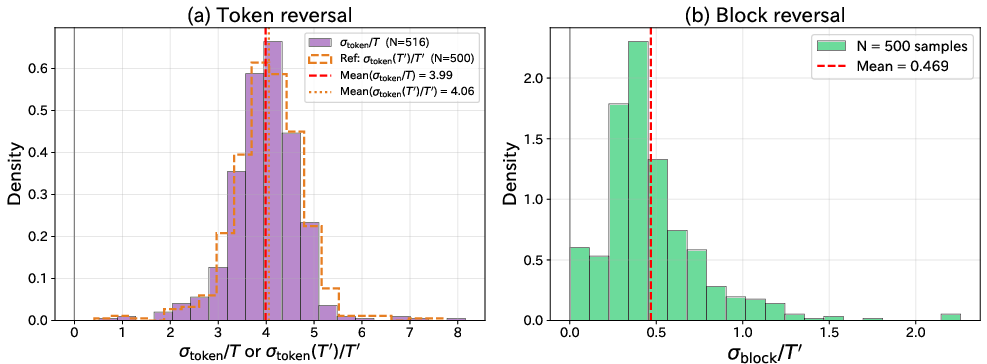
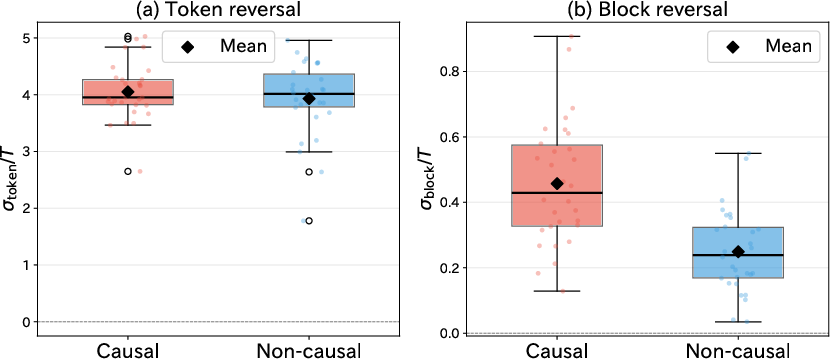
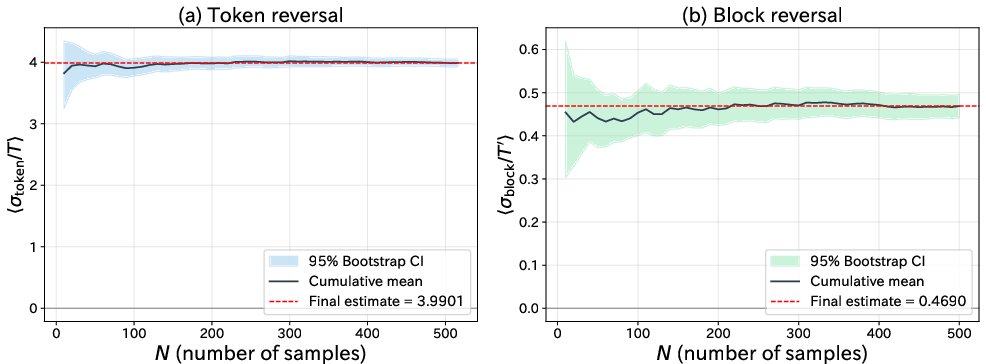
- With a real LLM (GPT‑2): They measured the entropy production at the token level (word pieces) and also at a coarser level (by reversing whole sentences instead of individual tokens).
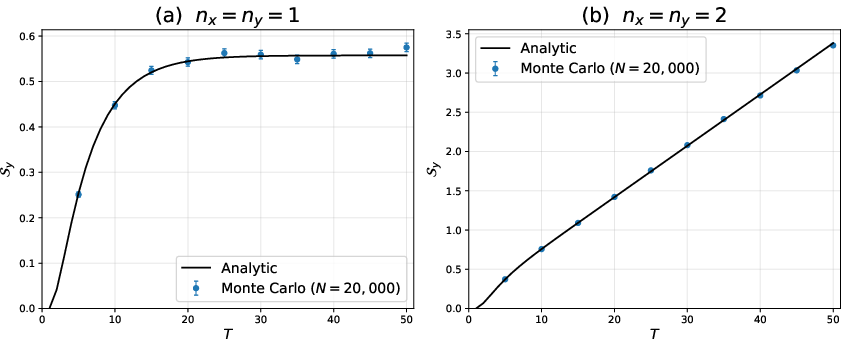
- With a “linear Gaussian” system (matching the Kalman filter): Here, everything is continuous and math‑friendly, so they could write an exact formula and also check it with simulations.
They also show a clean mathematical split of the arrow‑of‑time score into per‑step pieces. Each step’s contribution further splits into:
- Compression loss: Backward‑time memory can’t hold all information about the future (it’s a lossy summary), so it can’t predict as well going backward.
- Model mismatch: The rules designed for predicting forward aren’t perfect when reused backward.
What they found and why it matters
- It works for real models: They computed entropy production efficiently on GPT‑2 using standard forward and backward passes—no special training needed and no huge data requirements.
- Token vs sentence reversal: When reversing at the token level, the arrow‑of‑time measure is dominated by a mechanical effect—strings of tokens don’t “read right” backward. But when they reverse by sentences, the measure looks more meaningful for language, capturing higher‑level structure instead of just weird token order.
- Exact results for the Kalman case: In the linear Gaussian setting (related to the Kalman filter), they derived an exact formula for entropy production and confirmed it with Monte Carlo simulation. This is a clear, math‑solid example showing the framework’s correctness.
- Interpretable decomposition: The entropy production can be broken into non‑negative per‑step terms. Each step’s term splits into:
- Compression loss (information that can’t be reconstructed backward from the future),
- Model mismatch (using forward rules in reverse isn’t perfect).
- This helps diagnose where the “arrow of time” comes from in a model’s behavior.
- Practical and scalable: The cost is basically two log‑likelihood evaluations per sequence (one forward, one backward). For Transformers it scales roughly like the square of the sequence length, for RNN‑like models roughly linearly—matching standard costs. There’s no exponential blow‑up.
Why this matters (implications)
- A bridge between physics and AI: The paper brings a core physics idea—irreversibility—into AI models that produce sequences, giving a principled, computable “arrow‑of‑time” score.
- New diagnostics for LLMs: By seeing how much more “forward” than “backward” a model is, and by splitting that into compression loss and model mismatch, researchers can better understand what the model’s memory keeps, what it forgets, and where its design favors one time direction.
- Better evaluation choices: Reversing at the right level (like sentences instead of tokens) can produce more meaningful measurements for natural language.
- Foundations for future tools: This framework could help analyze and compare architectures (Transformers, RNNs, state space models, Mamba), guide training or model selection, and inspire new methods that manage information more symmetrically in time when that’s desired.
In short, the paper shows how to rigorously measure and interpret the “arrow of time” in powerful sequence‑generating models, doing so in a way that’s both theoretically sound and practical at modern AI scales.
Knowledge Gaps
Knowledge gaps, limitations, and open questions
The paper proposes an entropy-production framework for autoregressive models with deterministic memory and demonstrates feasibility on GPT‑2 and a linear Gaussian case. The following unresolved issues, limitations, and concrete open problems remain:
- Dependence on backward initial distribution: The choice of the backward initial distribution is decoupled from for tractability, but the impact of this choice on is not quantified. Develop methods to either estimate reliably or bound/correct the bias introduced by arbitrary choices of .
- Architectural non-uniqueness: depends on the specific decomposition into (e.g., using a Transformer’s context vector vs. KV-cache, layer choices, temperature ). Characterize invariances or canonicalizations of the decomposition under which is stable, and quantify sensitivity to these design choices.
- Deterministic-memory assumption: The framework excludes models with stochastic latent states (e.g., HMMs, stochastic state-space, diffusion-based generators). Extend the estimator to architectures with stochastic hidden dynamics without incurring exponential sampling cost.
- Backward-process definition for position encodings: For Transformers with absolute positional encodings or other position-dependent components, reversing token order changes positional inputs. Formalize backward-process construction under various positional encoding schemes and quantify the induced “syntactic” artifacts in .
- Support mismatch in Markovian embeddings: In the recursive case, the Markovian embedding can yield disjoint forward/backward supports and divergent . Provide general conditions that prevent divergence or alternative embeddings/backward constructions with shared support.
- Boundary terms for long sequences: Evaluating and especially (if used) is challenging for long sequences or continuous outputs. Develop scalable approximations or bounds for boundary contributions that preserve the fluctuation theorem.
- Statistical efficiency and variance: The variance of the Monte Carlo estimator for as a function of sequence length , model size, and sampling temperature is not characterized. Derive concentration bounds, variance scaling laws, and practical guidance for vs. to achieve target error.
- Real-data evaluation vs. self-generated text: Results focus on model-sampled trajectories. Assess on fixed human text under a pretrained model (teacher-forced likelihoods), and systematically compare with model-generated text to interpret irreversibility relative to real language statistics.
- Sensitivity to tokenization and vocabulary: Token-level entropy production is “dominated by a syntactic artifact” from reversal. Quantify how tokenization schemes (BPE vs. unigram vs. word-level), vocabulary size, and normalization affect ; propose tokenization-invariant or morphology-aware alternatives.
- Calibration of predictive probabilities: LLM softmax probabilities are often miscalibrated. Evaluate how calibration (e.g., temperature scaling, Dirichlet calibration) affects and whether a calibrated provides more reliable irreversibility measures.
- Block-level (coarse-grained) reversal design: The paper suggests reversing sentences/blocks rather than tokens but does not formalize optimal coarse-graining. Establish principled block segmentation schemes, analyze monotonicity/data-processing properties of coarse-grained , and derive bounds relative to token-level .
- Computation at scale: For large Transformers, the required forward+reverse passes are each and memory-intensive. Explore streaming or KV-cache–aware backward evaluation, sparse attention, or chunked approximations that preserve correctness of the log-ratio while reducing compute.
- Online/streaming estimation: Current evaluation requires a backward pass over the full reversed sequence. Develop streaming or causal estimators to approximate online during generation without a full second pass.
- Sampling strategy effects: Different decoding schemes (greedy, top‑, nucleus, temperature) change the forward path measure and hence . Systematically characterize how decoding affects and whether EP can diagnose unsafe or degenerate sampling regimes.
- Interpretation and normative baselines: For language, what constitutes “low” or “high” entropy production? Relate to perplexity, cross-entropy, and linguistic metrics; investigate whether training objectives could control or regularize ; define task-relevant baselines.
- Retrospective decomposition practicality: The per-step decomposition (compression loss + model mismatch) is asserted but not demonstrated for large models. Provide implementable estimators for in Transformers and validate their non-negativity and interpretability empirically.
- Relationship to information-theoretic bounds: Formal links between and directed information, predictive information, or data-processing inequalities are suggested but not established. Derive inequalities and conditions where bounds or is bounded by standard information measures.
- Robustness to numerical issues: Long-sequence log-probability products risk underflow/overflow. Specify numerically stable evaluation procedures for and assess sensitivity to floating-point precision.
- Continuous non-Gaussian emissions: Beyond the linear Gaussian (Kalman) case, tractable continuous-output examples (e.g., mixture models, heavy-tailed noise) are not analyzed. Generalize analytical or sampling approaches for non-Gaussian continuous emissions.
- Misspecification and model mismatch: The Kalman demonstration assumes a correctly specified innovation representation. Analyze under model misspecification and quantify how mismatch between the true data-generating process and the model inflates EP.
- Parity-odd variables and physical reversals: The framework excludes variables with time-reversal parity (e.g., momentum). Extend the formalism to handle parity-odd components and clarify how sign reversals propagate through and .
- Multimodal and conditional generation: The scope is single observed stream . Extend to multimodal or conditional generation (e.g., text conditioned on images) and define for joint or conditional trajectories.
- Choice and sensitivity of : The backward initial latent state is set to a constant but selection criteria and impact on are not studied. Provide principled choices (e.g., stationary point estimates) and sensitivity analyses.
- Applicability to advanced architectures: Mixture-of-experts, retrieval-augmented models, adapters, and dynamic routing introduce time-varying or input-dependent parameters beyond Mamba. Formalize and for these cases and test whether backward reuse is well-defined and tractable.
- Utility for model diagnostics: It is suggested that quantifies irreversibility, but concrete use-cases (e.g., OOD detection, hallucination diagnostics, safety monitoring) are not validated. Design experiments linking to practical model reliability metrics.
- Asymptotics and stationarity: The paper focuses on finite . Establish existence of an entropy production rate , conditions for stationarity/ergodicity under autoregressive generation, and dependence on prompt initialization.
Practical Applications
Practical Applications of “Stochastic Thermodynamics for Autoregressive Generative Models: A Non-Markovian Perspective”
This paper introduces a tractable way to quantify irreversibility in autoregressive generative models (e.g., Transformers, RNNs, Kalman filters, SSMs, Mamba) by defining an entropy production (EP) based on forward/backward path KL divergence that can be efficiently estimated from sampled trajectories. It demonstrates token- and sentence-level EP on GPT-2, provides an analytic EP for linear Gaussian/Kalman models, and derives an exact per-step decomposition into compression loss and model mismatch. These results enable new diagnostics, evaluation metrics, and workflows across sectors that use sequence models.
Immediate Applications
- Model evaluation and auditing for generative models (software/AI; academia; industry)
- Use EP as a complementary evaluation metric to perplexity/log-loss to quantify a model’s “arrow of time” and irreversibility on sequences (e.g., text, code, speech, time series).
- Apply sentence/block-level EP (coarse-grained reversal) to mitigate token-order artifacts and obtain more interpretable signals, as shown for GPT-2.
- Tools/products/workflows:
- Add an “EP score” to model cards and eval suites (e.g., HuggingFace pipelines) by computing per-sequence forward and backward log-likelihoods.
- Dashboards that visualize EP over documents, with per-step contributions to identify anomalous spans.
- Assumptions/dependencies:
- Access to per-token (or per-step) log probabilities from the model; feasible for open models and many APIs.
- Backward process defined by reusing the same emission kernels/maps with an explicit choice of backward initial distribution.
- Training diagnostics via per-step decomposition (software/AI; academia; industry)
- Use the per-step nonnegative contributions (D_t) and their split into compression loss (L_t) and model mismatch (M_t) to locate where the model’s memory summarization loses information vs. where the emission is mis-specified.
- Tools/products/workflows:
- Training-time hooks that log D_t/L_t/M_t over minibatches to guide architecture or hyperparameter changes (e.g., context window, attention settings).
- Curriculum design: upweight spans with high model mismatch to focus learning.
- Assumptions/dependencies:
- Deterministic latent-memory architecture and access to model internals to compute both forward and reversed-order evaluations.
- Drift and anomaly detection in deployed sequence systems (finance, healthcare IoT, industrial IoT; robotics/control)
- Monitor EP over time to detect deviations from expected behavior in sensor streams or control loops modeled by SSMs/Kalman filters; spikes in EP indicate nonstationarity, faults, or adversarial perturbations.
- Tools/products/workflows:
- Runtime EP monitors in edge devices/controllers using the analytic/efficient EP evaluation for linear Gaussian models.
- Alerting systems that trigger re-calibration or fail-safes when EP crosses thresholds.
- Assumptions/dependencies:
- A calibrated autoregressive/SSM/Kalman model of the system dynamics; EP will reflect model mismatch if parameters are stale (which is useful for detection).
- Scientific data analysis: Arrow-of-time quantification (academia; climate/neuroscience/biophysics)
- Quantify irreversibility in experimental time series (e.g., neural spikes, climate indices) by training an autoregressive model and computing EP, without needing full Markovian assumptions.
- Tools/products/workflows:
- Analysis scripts that compute EP on recorded sequences with sentence/block-level coarse-graining for interpretability.
- Assumptions/dependencies:
- A trained model that adequately captures observables; appropriate choice of backward initialization.
- Dataset forensics and curation (software/AI; industry; academia)
- Use EP to identify irreversible or “directionally biased” segments in corpora (e.g., instructions, procedural text) for better dataset balancing, deduplication, or contamination detection.
- Tools/products/workflows:
- Data curation pipelines that filter or annotate high-EP vs. low-EP blocks; sampling curricula emphasizing harder, high-mismatch segments.
- Assumptions/dependencies:
- Compute access for two passes (forward and reversed) per sequence; sensible coarse-graining to avoid token-level artifacts.
- Robustness and security screening of model outputs (software/AI; media integrity)
- Flag outputs with unusual EP profiles (e.g., reversals, adversarially manipulated sequences) as potentially low-quality or machine-generated.
- Tools/products/workflows:
- Post-generation EP auditor that scores responses before delivery; integration into content moderation or provenance tools.
- Assumptions/dependencies:
- Baseline EP distribution for the model/domain; care to avoid false positives on legitimately irreversible content.
- Educational labs and pedagogy (education; academia)
- Use LLMs and SSMs as accessible platforms to teach irreversibility, KL divergence, and stochastic thermodynamics concepts in non-Markovian settings.
- Tools/products/workflows:
- Classroom notebooks that compute EP on small models and compare token- vs. sentence-level reversal.
- Assumptions/dependencies:
- Open models or educational licenses to access log-probabilities.
Long-Term Applications
- Learning objectives and regularization using entropy production (software/AI; academia; industry)
- Incorporate EP (or its per-step components) into training objectives to shape memory compression or reduce model mismatch, potentially improving coherence or controllability of generative models.
- Potential products:
- “Thermo-regularized” LLM training recipes that target desirable EP profiles for different tasks (narrative text vs. code vs. dialogue).
- Assumptions/dependencies:
- Further research on how EP correlates with downstream quality and safety; careful tuning to avoid degrading task performance.
- Standards for model transparency and governance (policy; industry consortia)
- Establish EP-based reporting (aggregate and per-domain EP curves, coarse-graining choices) in model cards to improve transparency about temporal irreversibility and training dynamics.
- Potential workflows:
- Compliance checklists that include EP benchmarks on standard corpora; comparative audits across models.
- Assumptions/dependencies:
- Consensus on backward-initialization conventions and coarse-graining protocols to ensure comparability.
- Decoding and inference-time control via EP (software/AI; user experience)
- Use EP as a runtime control signal to steer sampling (e.g., adjust temperature/top-k) to maintain targeted irreversibility profiles, possibly improving factuality or coherence.
- Potential products:
- EP-aware decoders that adaptively modulate generation to keep EP within task-specific bands.
- Assumptions/dependencies:
- Evidence that EP correlates with quality/safety for given tasks; real-time efficiency for large models.
- Architecture and memory design guided by EP decomposition (software/AI; hardware co-design)
- Co-design memory mechanisms (e.g., state-space layers, attention patterns, KV-cache strategies) to minimize compression loss where needed and reduce mismatch elsewhere, guided by L_t/M_t diagnostics.
- Potential products:
- Memory-efficient LLM variants with EP-tuned layers for long-context tasks.
- Assumptions/dependencies:
- Systematic studies linking EP components to memory architectures and task outcomes.
- Cross-domain anomaly and causality analytics (finance, healthcare, energy, climate; academia/industry)
- Standardize EP-based “arrow-of-time” analytics across heterogeneous time-series using domain-adapted autoregressive models to study nonequilibrium phenomena or directional biases.
- Potential products:
- Analytics platforms that provide EP dashboards for trading signals, patient monitoring, grid stability, or climate regime shifts.
- Assumptions/dependencies:
- High-quality domain models; interpretability frameworks that contextualize EP changes.
- Content provenance and deepfake detection for temporal media (media/security; policy)
- Extend EP tools to audio/video sequence models to detect time-reversed edits or generative artifacts manifested as abnormal irreversibility.
- Potential products:
- EP-based detectors embedded in media verification pipelines.
- Assumptions/dependencies:
- Strong autoregressive models for the target media; benchmarks confirming EP’s discriminative power versus adversaries.
- Scientific discovery of nonequilibrium behavior via ML surrogates (academia; physics/biology)
- Train autoregressive surrogates on complex systems and use EP to characterize nonequilibrium processes without full mechanistic models, generalizing the Kalman case.
- Potential workflows:
- Joint modeling-EP pipelines that compare interventions or environmental regimes by their EP signatures.
- Assumptions/dependencies:
- Robustness of EP estimates to model mis-specification; guidelines for backward initialization in scientific contexts.
- Compression, tokenization, and streaming optimization (software/AI; infrastructure)
- Use the compression-loss component to inform tokenization schemes, chunking strategies, or streaming protocols that better align with model memory and reduce irreversibility where beneficial.
- Potential products:
- EP-aware tokenizers or streaming APIs that adapt chunk sizes and cache strategies to minimize unnecessary information loss.
- Assumptions/dependencies:
- Demonstrated links between EP components and end-to-end efficiency/latency/compression metrics.
Notes on feasibility across applications:
- The framework assumes a deterministic latent memory (typical for Transformers, RNNs, SSMs, Mamba) and access to emission kernels for forward/backward log-likelihoods.
- Backward initialization must be chosen explicitly; adopting the final forward marginal is often intractable, but fixed or analytically specified initializations (e.g., in linear Gaussian cases) are practical.
- Computational overhead is roughly two likelihood passes per sequence; manageable in evaluation/monitoring regimes but requires engineering for very long contexts or real-time constraints.
Glossary
- Autoregressive generative models: Models that produce sequences by sampling each element from a distribution conditioned on a deterministic summary of the past; "Autoregressive generative models --- including Transformers, recurrent neural networks, classical Kalman filters, state space models, and Mamba ---"
- Bayesian retrodiction: Inferring past observations from future data using Bayes’ rule; "from Bayesian retrodiction "
- Causal self-attention: An attention mechanism that only attends to past positions to preserve causality in sequence models; "uses causal self-attention to construct a context vector"
- Coarse-grained trajectories: Trajectories summarized or aggregated over larger temporal or spatial scales to simplify analysis; "lower bounds from coarse-grained trajectories"
- Colored baths: Noise sources with temporal correlations (non-white noise) in stochastic dynamics; "generalized Langevin systems with colored baths"
- Compression loss: The loss of predictive information due to compressing future information into a limited backward latent summary; "a compression loss"
- Crooks-type protocol reversal: Reversing a driving protocol in stochastic thermodynamics in the sense of Crooks’ fluctuation theorem; "based on Crooks-type protocol reversal"
- Deterministic latent memory: A hidden state updated deterministically from past observations that summarizes history for prediction; "autoregressive generative models with deterministic latent memory"
- Deterministic memory update: The non-stochastic rule for updating the latent state from observed data; "together with the deterministic memory update"
- ELBO (evidence lower bound): A variational lower bound on log likelihood used in probabilistic inference; "the evidence lower bound (ELBO) decompositions"
- Emission kernel: The conditional distribution used to generate the next observation from the current latent state; "the emission kernel evaluated at a deterministic latent state"
- Entropy production: A measure of irreversibility quantified by the KL divergence between forward and backward path measures; "introduce the entropy production"
- FLOPs (floating-point operations): A measure of computational cost counting arithmetic operations; "floating-point operations (FLOPs)"
- Forward and backward path measures: Probability measures over entire trajectories in the forward-time and reversed-time constructions; "between the forward and backward path measures"
- Generalized Langevin systems: Stochastic dynamical systems with memory kernels and possibly colored noise; "generalized Langevin systems with colored baths"
- Gibbs distribution: The Boltzmann distribution over states at thermal equilibrium; "the Gibbs distribution with respect to a fixed Hamiltonian"
- Hidden Markov models: Probabilistic models with stochastic latent states whose emissions produce observable sequences; "such as hidden Markov models"
- Innovation representation: A Kalman filter form where updates are expressed in terms of the innovation (prediction error); "the innovation representation of the Kalman filter"
- Integral fluctuation theorem: A result stating that the exponential average of negative stochastic entropy production equals one; "The integral fluctuation theorem ... is automatically satisfied"
- Kalman filter: A recursive estimator for linear Gaussian state-space models providing optimal state estimates; "the Kalman filter"
- KL divergence: A measure of dissimilarity between two probability distributions; "the KL divergence between the forward and backward path measures"
- KV-cache: Stored key–value pairs in a Transformer used to efficiently reuse past attention computations; "the KV-cache"
- Local detailed balance: A condition relating transition probabilities to thermodynamic quantities like heat at each step; "the local detailed balance condition"
- Markovian embedding: Augmenting variables to render a joint process Markovian even if observed marginals are non-Markovian; "the Markovian embedding "
- Mamba: A selective state space model architecture with input-dependent parameters, used as an alternative to Transformers; "Mamba (an alternative architecture for LLMs)"
- Monte Carlo sampling: Estimating quantities by averaging over random samples drawn from a model; "Monte Carlo sampling procedure"
- Non-Markovian: Processes where future states depend on more than just the current state; "genuinely non-Markovian observed processes"
- Observation matrix: The matrix mapping latent states to observations in a linear Gaussian model; "the observation matrix associated with time "
- One-hot vector: A binary vector with a single 1 used to encode categorical tokens; "a one-hot vector"
- One-step-ahead prediction: Predicting the next state or observation based on current information; "the one-step-ahead prediction"
- Path probability: The probability of an entire sequence (trajectory) under a generative process; "Its path probability is"
- Path-probability ratio: The ratio of forward to backward trajectory probabilities used to define stochastic entropy production; "the forward/backward path-probability ratio"
- Positional encoding: Injecting position information into token embeddings to inform sequence models of order; "the positional encoding"
- Protocol reversal: Reversing the sequence of operations or controls in a dynamical model when constructing a backward process; "backward protocols in stochastic thermodynamics"
- Retrodiction: Inferring past observations from future data; "the backward model retrodicts the present observation from the future"
- Softmax: A function converting logits into a probability distribution over discrete outcomes; "the next token is drawn from the emission kernel $p(y_{t+1} \mid h_{t}) = \mathrm{softmax}(W_{\mathrm{out}\, h_{t})<em>{y</em>{t+1}$"
- State space models (SSMs): Models with latent states evolving over time that generate observations; "state space models (SSMs)"
- Stationary Gaussian: A Gaussian process whose statistical properties are time-invariant; "the stationary Gaussian analysis"
- Stochastic thermodynamics: A framework relating stochastic dynamics to thermodynamic quantities like entropy production; "Stochastic thermodynamics provides a general framework"
- Sufficient statistic: A function of data that retains all information relevant for predicting a target; "plays the role of a sufficient statistic"
- Temporal coarse-graining: Grouping fine-grained time steps into larger blocks to analyze processes at a coarser temporal resolution; "temporal coarse-graining"
- Temperature parameter: A scalar controlling the sharpness of a softmax distribution; "the temperature parameter (usually set to $1$)"
- Time reversal: Considering the dynamics or data sequence in reverse temporal order; "time reversal and entropy production"
- Transformer: A neural architecture leveraging self-attention for sequence modeling; "The Transformer architecture"
- Variational inference: Approximate Bayesian inference using optimization over a tractable family of distributions; "variational inference"
Collections
Sign up for free to add this paper to one or more collections.