- The paper introduces a novel QIPI algorithm using eigenstate filtering polynomials to efficiently target arbitrary excited states with geometric convergence.
- It leverages the QSVT framework and Chebyshev decomposition to overcome challenges in preparing interior eigenstates from dense spectra.
- Numerical simulations confirm high-fidelity convergence with moderate polynomial degrees and feasible fault-tolerant resource scaling.
Efficient Excited-State Preparation with Quantum Inverse Power Iteration through Filtering Polynomials
Introduction
The preparation of molecular excited states is a persistent challenge in quantum chemistry due to the exponentially growing Hilbert space and the difficulty in isolating interior (non-ground) eigenstates. Traditional quantum algorithms based on variational frameworks or phase estimation either demonstrate poor scalability for excited states or impose stringent requirements on the initial state fidelity. The present work introduces a quantum inverse power iteration (QIPI) algorithm, leveraging the quantum singular value transformation (QSVT) framework combined with robust eigenstate filtering polynomials (EFP), targeting arbitrary excited states with geometric convergence and efficient fault-tolerant resource scaling (2606.28255).
Background and Motivation
Inverse power iteration (IPI) is an established classical method for isolating specific eigenstates by iteratively applying the shifted inverse (H−ωI)−1 to a trial state, amplifying the component corresponding to the eigenvalue closest to the shift ω. Classical implementation of IPI becomes intractable as system size grows. Earlier quantum analogs of IPI, such as those based on Fourier or Chebyshev decompositions with linear-combination-of-unitaries (LCU) constructions, were either restricted to ground states, exhibited high sensitivity to hyperparameters, or suffered numerical instability in dense spectra, especially when targeting interior eigenstates [kyriienko2020quantum, cainelli2024numericalinvestigationquantuminverse].
Quantum algorithms based on QPE or variational principles similarly falter for high-lying excited states: QPE is unsuitable for states with low overlap, while VQE extensions require careful parameterizations and are limited by barren plateaus and measurement overhead [tilly_variational_2022]. The QSVT framework, however, enables the application of polynomial transformations to eigenvalues of a block-encoded Hamiltonian, suggesting a route to robustly amplify specific eigenstates with controlled ancilla and gate overhead.
Methodological Advances
Chebyshev Decomposition-based QIPI
The Cheb-Inv QIPI approximates the matrix inverse via Chebyshev polynomials. After shifting and rescaling the Hamiltonian to H~=(H−ωI)/s, the approximation to the inverse is realized as a truncated expansion
x−1≈GN(x)=j=0∑Nc2j+1T2j+1(x)
where T2j+1(x) are Chebyshev polynomials of the first kind. While convergence to target eigenstates is possible for sufficiently high degree N, this approach is inherently unstable for moderate N near the spectral origin, especially in cases where the target state's eigenvalue is close to ω. The method requires unfeasibly high polynomial degrees for dense spectra, leading to prohibitively high resource costs and convergence failures for excited states.
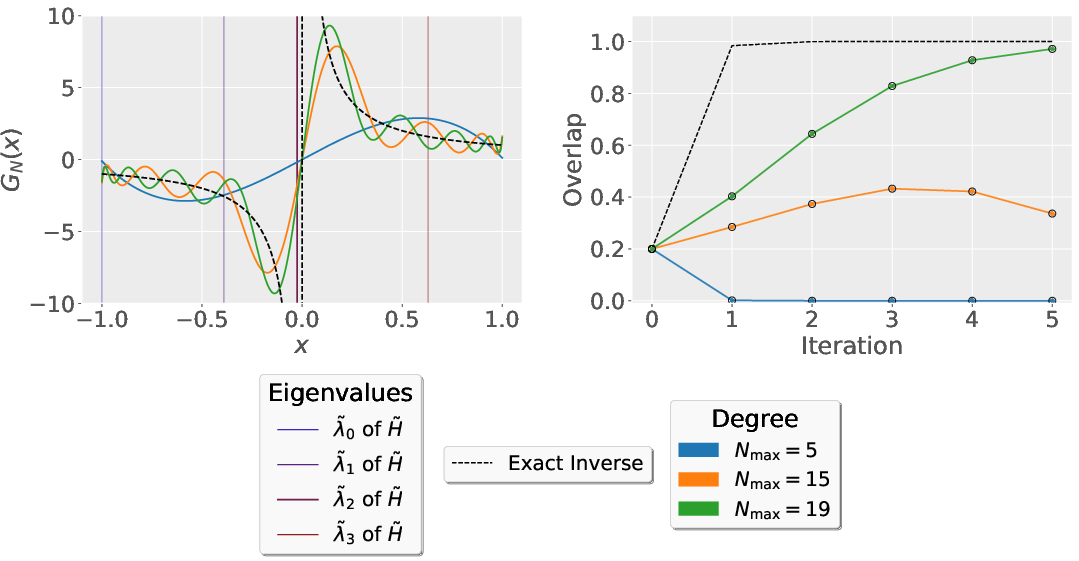
Figure 1: Chebyshev-based QIPI applied to \ce{H2}, demonstrating slow or erroneous convergence for low-degree approximations, and failure near the spectral origin.
Eigenstate Filtering with QSVT
The QIPI protocol based on EFP instead constructs polynomials that are maximized at the target eigenvalue (mapped to the origin after spectral shift), while exponentially suppressing components elsewhere:
Rd(x;Δ)=Tℓ(−1+2(−Δ2)/(1−Δ2))Tℓ(−1+2(x2−Δ2)/(1−Δ2)),d=2ℓ
Here, Rd(0;Δ)=1 and ω0 for ω1 [Lin_2020]. Applying ω2 using QSVT is both stable and highly selective, with rapid geometric suppression of non-target eigenstates regardless of the proximity between ω3 and the true eigenvalue.
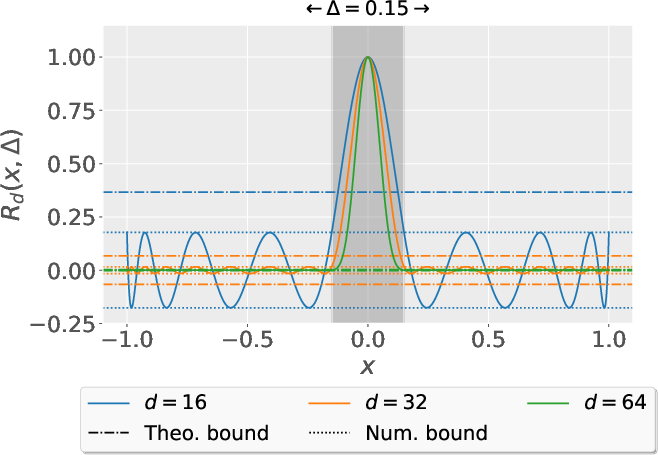
Figure 2: Eigenstate filtering polynomials suppress off-target components exponentially with increasing polynomial degree ω4.
This approach is implemented via block encoding of ω5 into a unitary matrix and alternating applications of ω6 and ω7 rotations, with two ancilla qubits needed for block-encoding and QSVT control. The rotation angles depend only on polynomial parameters and can be precomputed.
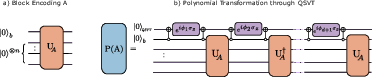
Figure 3: Schematic of QSVT, showing block encoding and control operations required for polynomial transformation of eigenvalues.
QIPI Iterative Protocol
The QIPI iteration applies the filtering polynomial to the state vector, followed by measurement and postselection on ancilla, with the core iterative step
ω8
Repeating this process amplifies the target component by a factor ω9 each iteration, with compression of off-target components controlled by the polynomial degree and spectral window H~=(H−ωI)/s0. This leads to rapid geometric convergence, even in systems with dense spectra or low initial overlap.
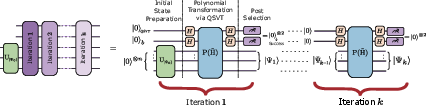
Figure 4: QIPI protocol schematic, illustrating state preparation, QSVT-based filtering, and postselection.
Numerical Results and Resource Estimates
Simulation Studies
QIPI was tested on molecular Hamiltonians of \ce{H2}, \ce{LiH}, and \ce{BeH2} mapped to qubit representations. EFP-based QIPI demonstrates superior selectivity and stability compared to Cheb-Inv, converging to high-fidelity excited-state solutions with modest polynomial degrees, even for low initial state overlaps.
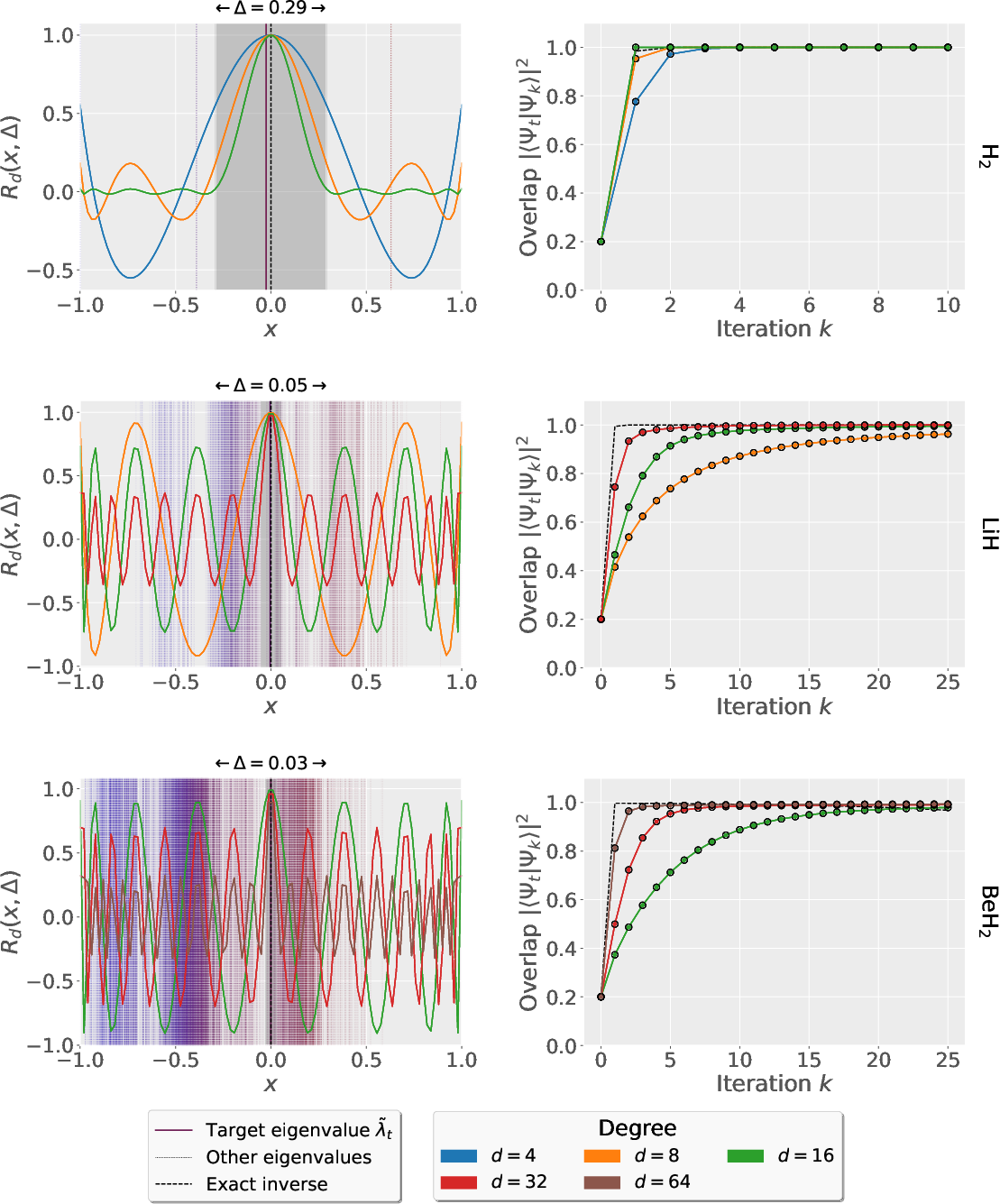
Figure 5: QIPI convergence for \ce{H2}, \ce{LiH}, and \ce{BeH2}: high-fidelity convergence to the target excited state is achieved with few iterations.
Crowded spectra (e.g., in \ce{BeH2}) require narrower filtering windows and higher degree polynomials, increasing the number of block-encoding queries but without instability or divergence. Exploiting symmetries further reduces resource requirements by isolating a relevant spectrum subset.
Fault-Tolerant Gate Synthesis
QSVT-based filtering requires phase rotations H~=(H−ωI)/s1 unavailable natively in the Clifford+T set and thus must be synthesized. Resource estimates show that accurate phase rotations up to H~=(H−ωI)/s2 (≈30 T gates per rotation) suffice for effective amplification, making the protocol practical on early fault-tolerant quantum devices.
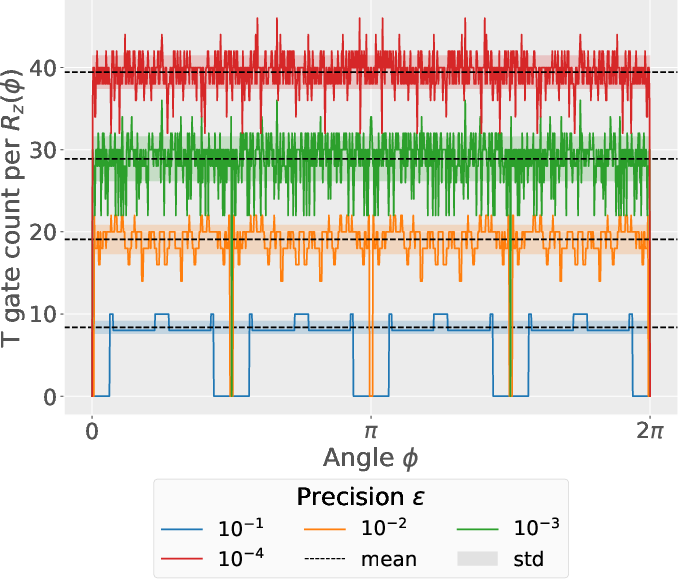
Figure 6: T-count versus rotation decomposition precision for H~=(H−ωI)/s3 gates, showing moderate cost at target precisions.
High-degree polynomials substantially increase T gates, motivating iterative applications of lower-degree filters as implemented in QIPI. This reduces depth per iteration, enhancing noise robustness and suitability for mid-term hardware.
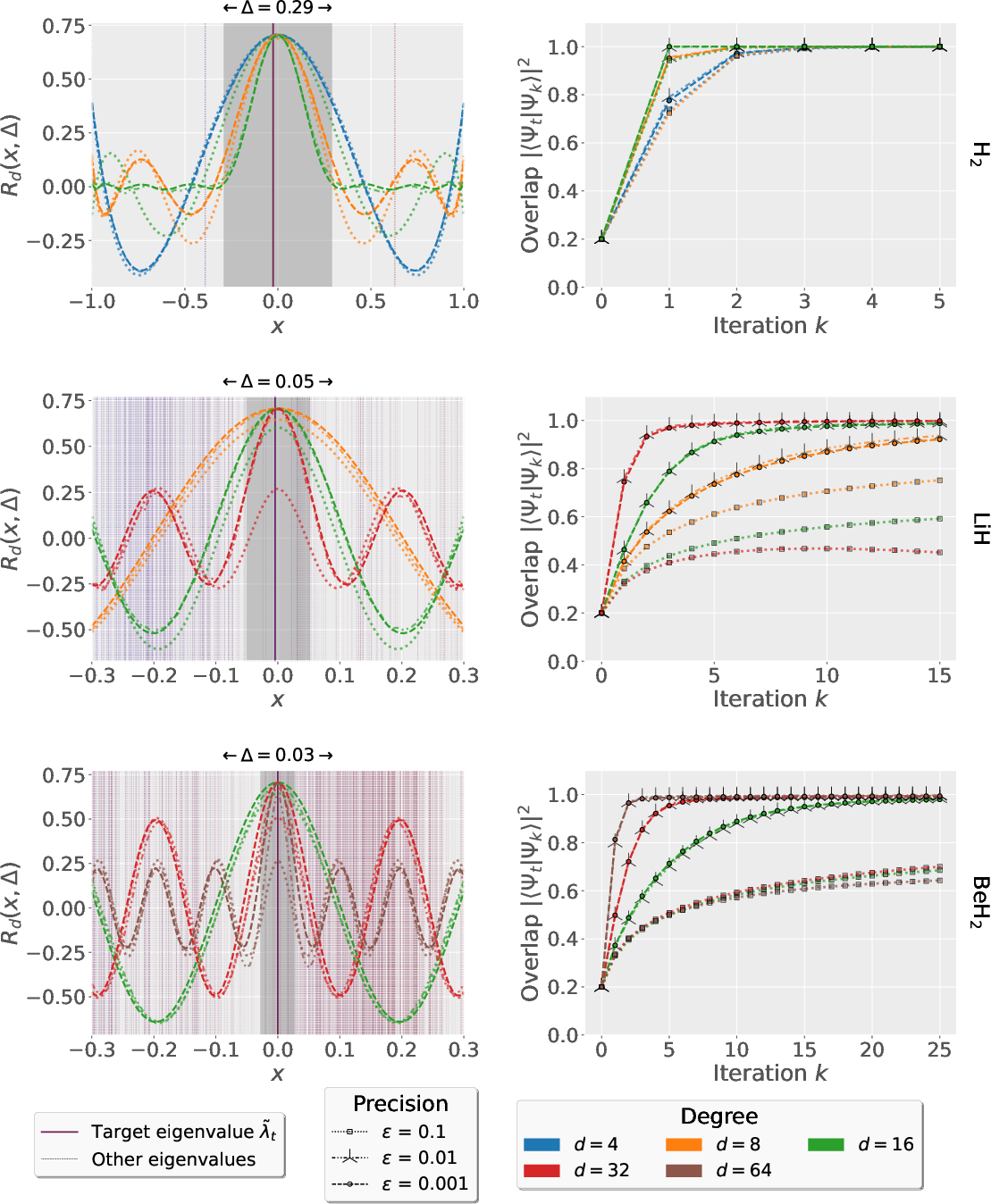
Figure 7: Fidelity for different rotation synthesis precisions: higher precision accelerates convergence but QIPI remains efficient even at moderate precisions.
The amplification ratio per iteration and T-gate cost as a function of window H~=(H−ωI)/s4, degree H~=(H−ωI)/s5, and rotation precision H~=(H−ωI)/s6 further quantifies tradeoffs.
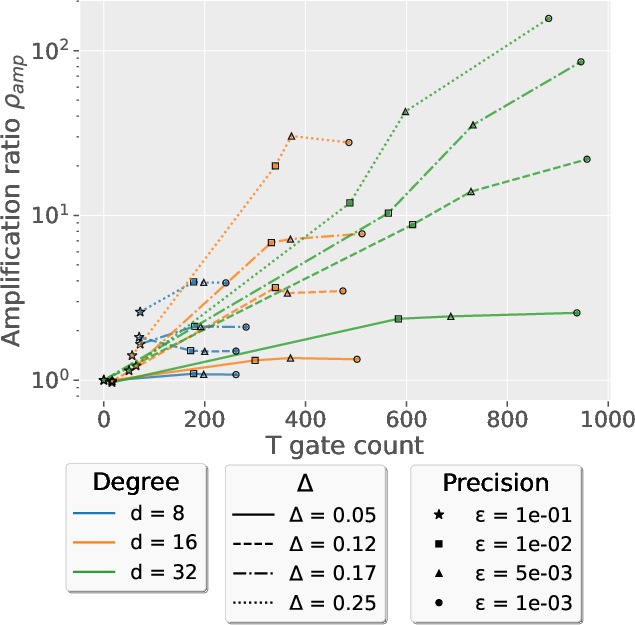
Figure 8: Amplification ratio H~=(H−ωI)/s7 versus T-gate count for various spectral gaps and degrees.
Query Complexity
Theoretical analysis and numerical simulations confirm the total query complexity for QIPI is
H~=(H−ωI)/s8
when amplitude amplification is used, matching the near-optimal complexity of QSP-based filtering, and is achieved with a constant ancilla overhead regardless of polynomial degree or target accuracy. This compares favorably to QPE or LCU-based filtering methods, which require deeper circuits or higher ancilla counts.
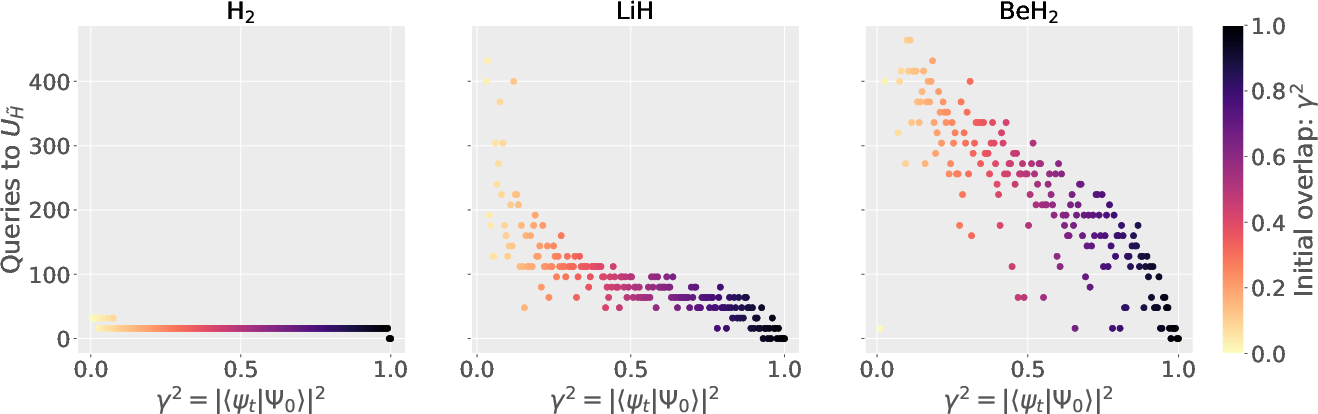
Figure 9: Number of queries required to reach chemical accuracy as a function of squared initial overlap H~=(H−ωI)/s9; x−1≈GN(x)=j=0∑Nc2j+1T2j+1(x)0 scaling is observed even in denser spectra.
Theoretical and Practical Implications
EFP-based QIPI enables robust, scalable excited-state preparation across the entire energy spectrum, not limited to ground or low-lying states. Ancilla and gate overhead are minimized, and no variational optimization or high-fidelity initial state preparation is needed. This framework is adaptable to a broad class of Hamiltonians, including those with dense or near-degenerate spectra, and is compatible with diverse block encoding strategies.
On practical fault-tolerant hardware, the shallow depth and moderate T-count per iteration allow QIPI to circumvent limitations from deep coherent circuits required by alternative filtering methods, with iterative application further mitigating the impact of noise and rotation-synthesis errors.
Theoretically, QIPI bridges classical spectral-filtering intuition with modern polynomial transformation techniques in quantum computation, broadening the algorithmic toolkit for quantum simulation of electronic excited states, materials, and correlated systems.
Conclusion
The QIPI algorithm based on eigenstate filtering polynomials within the QSVT framework addresses longstanding shortcomings in quantum excited-state preparation by achieving geometric convergence, stability against spectral crowding, and resource efficiency. It enables targeting arbitrary eigenstates in large-scale quantum chemistry and many-body applications, with gate synthesis overhead compatible with the capabilities of early fault-tolerant quantum hardware. Further developments in block encoding strategies and error mitigation could enhance its applicability to ever-larger physical systems and more challenging spectral regimes.

