- The paper extends NDAR for integer optimization by harnessing predictable hardware noise to drive better solution quality across qubit and qudit platforms.
- It introduces encoding-specific gauge transformations and analyzes tradeoffs among binary, one-hot, and domain-wall qubit schemes versus native qudit methods.
- Experimental and numerical assessments reveal that qudit-native NDAR delivers optimal attractor feasibility and gauge freedom, boosting performance on next-generation quantum hardware.
Noise-Directed Adaptive Remapping for Integer Optimization: From Qubits to (Encoded) Qudits
This paper presents a comprehensive extension of the Noise-Directed Adaptive Remapping (NDAR) meta-algorithm from binary combinatorial optimization on qubit-based quantum devices to general integer (discrete) domains, with particular focus on both native qudit-based hardware and various qubit encodings for integer variables (2606.28234). NDAR represents a paradigm shift in algorithmic quantum noise management: instead of mitigating or correcting certain types of device noise, NDAR actively exploits the bias induced by predictable noise (the "noise attractor") to enhance optimization performance. The algorithm iteratively remaps the logical encoding of the optimization problem to dynamically align the noise bias with high-quality sampled solutions (see (Figure 1)).
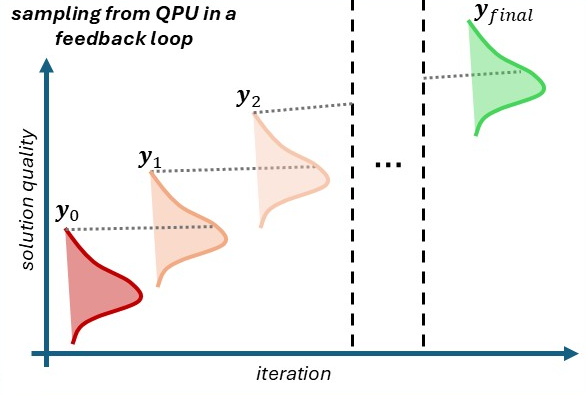
Figure 1: Schematic illustration of NDAR — the solution cost distribution is iteratively improved by adaptive gauge transformations aligning the noise attractor with the best sampled solution.
The original development of NDAR for unconstrained binary problems is extended rigorously here by (i) analyzing encoding-specific requirements for general integer domains, (ii) providing systematic definitions of gauge transformation families per encoding, and (iii) exploring the circuit and feasibility constraints arising from both problem input and encoding choices. The analysis is framed around the maximization of cost functions under possible hard constraints, with the k-colorable subgraph (Max-k-coloring) problem serving as a representative challenge that instantiates the tradeoffs among encodings and hardware paradigms.
NDAR Generalization: Ingredients and Algorithmic Criteria
A core technical contribution is the explicit formalization of the requirements for NDAR beyond binary/qubit scenarios. The four central criteria identified are:
- Attractor Feasibility: The noise-induced attractor state (e.g., all-zero computational basis) must encode a feasible solution at every NDAR iteration to ensure closed operation on the solution space.
- Gauge Transformation Existence and Efficiency: Each sampled bitstring must map, via a uniquely specified transformation within a compatible gauge family, the attractor to the target string. In the qubit case, this is a unique bitflip; for qudits, the mapping involves a nontrivial permutation group leading to exponentially greater gauge freedom.
- Structure Preservation under Remapping: The gauge transformation sequence, acting on the cost Hamiltonian and constraint projectors, must preserve sufficient ansatz structure to enable practical compilation with controlled circuit overhead.
- Handling of Hard Constraints and Invalid Codewords: The algorithmic flow must correct or discard infeasible strings arising from noise or encoding artifacts, and update both objective and constraint Hamiltonians accordingly.
This general framework ensures robust applicability of NDAR across hardware types and problem domains, encompassing both logical (native) d-level qudits and encodings into unary or binary qubit registers.
Qudit-Native NDAR and Qudit Noise Models
The paper develops a detailed qudit extension of NDAR, emphasizing both the physical relevance and algorithmic advantages. Unlike the qubit case where the bitflip group acts simply transitively, qudit implementations admit (d!)n gauge freedoms for n d-level variables, substantially enhancing the flexibility in mapping attractor alignment to hardware-native operations.
The interaction between amplitude damping noise (generalized to d levels) and algorithm design is analyzed in depth. For many experimental platforms (superconducting cavity and transmon-based bosonic qudits), the amplitude damping channel imposes a strong bias toward low-excitation Fock states, aligning precisely with the attractor-centric NDAR mechanism. The analysis covers both zero-temperature and thermal settings, with Kraus and Lindblad formalisms used to model the steady-state and transitional behavior.
This direct mapping—where the attractor is always a valid solution and the gauge structure can be tailored for compilation efficiency—puts qudit-native NDAR on a fundamentally superior algorithmic and experimental footing compared to encoded qubit approaches.
Encoded Qubit Schemes: Binary, One-Hot, and Domain-Wall
The study systematically analyzes several prevalent qubit encodings for integer variables: binary (logarithmic overhead), one-hot (linear overhead), and domain-wall (also linear, with locality advantages). For each, the paper addresses:
- Gauge Transformation Realization: In the binary case, bitflip (Pauli X) transformations suffice, but for k>2 permutations, the mapping may incur circuit structure changes. For one-hot and domain-wall, feasible gauge transformations decompose into contiguous flip operations or localized permutations, but the attractor feasibility and circuit cost differ sharply among encodings.
- Feasibility and Noise Robustness: Binary encoding always yields valid states (when k is a power of k0); one-hot and domain-wall suffer leakage to infeasible subspaces under noise, with domain-wall offering superior NDAR compatibility out of unary encodings.
- Cost Hamiltonian and Operator Locality: Binary encodings generate higher-locality Hamiltonians (up to k1), while unary encodings maintain strictly 2-local operators but with increased qubit overhead.
- NDAR Suitability Ranking: Qudit-native encodings rank highest due to always-feasible attractor and maximal gauge freedom. Binary coding is favored for hardware with limited connectivity or small k2. Domain-wall encodings are recommended for generality, but with careful noise management to avoid subspace leakage.
Application Example: Max-k3-Colorable Subgraph
The theoretical framework is instantiated concretely for the Max-k4-coloring problem. The paper develops operator mappings for each encoding—defining cost Hamiltonians, compiling phase/mixing operators, and specifying gauge remapping for NDAR. Qudit cost Hamiltonians leverage clock and shift operators with efficiently compiled controlled-phase gates, while qubit encodings require more complex gate decomposition (especially for unary schemes). The gauge adaptation protocol is explicitly constructed for both logical and hardware-level implementation, demonstrating practical applicability for current and near-term quantum devices.
Experimental Outlook and Hardware-Aligned Perspectives
A significant aspect relates to the practical integration of NDAR on emerging cavity-based superconducting qudit processors and other platforms supporting bosonic or high-dimensional encodings. The hardware noise in these devices—dominantly amplitude damping—naturally provides the attractor structure NDAR needs. The increased gauge freedom in qudits can be exploited to minimize compilation costs and tailor mapping to available hardware primitives (e.g., SNAP, displacement, or conditional-SUM gates). The architectural challenges—high-fidelity two-qudit entangling gates and error suppression—are discussed in detail, referencing recent progress in experiment and numerical hardware synthesis.
Furthermore, NDAR's compatibility with error suppression techniques, subspace-preserving control, and thermodynamically-influenced algorithmic variants is elaborated. The framework establishes a pathway for integrating adaptive warm-starts, constraint tailoring, and broader open-system paradigms, inviting future exploration into hybrid algorithmic strategies.
Numerical and Comparative Assessment
- Qudit-native encodings provide optimal NDAR compatibility, with always-feasible attractors, straightforward gauge selection, and minimal Hamiltonian locality.
- Binary encodings achieve space efficiency and efficient gauge transformations at the cost of higher operator locality; best suited when k5 is a power of k6.
- Domain-wall/unary encodings achieve low operator locality but encounter significant feasibility and noise-leakage issues, with NDAR applicability improved in the domain-wall variant.
The tradeoff landscape is not strictly monotonic, offering encoding choice leverage for specific hardware and problem regime optimizations.
Conclusion
The extension of NDAR to general integer optimization over both qudits and qubit-encoded variables broadens its relevance and opens a robust design space for leveraging hardware noise as a computational resource, particularly in emerging high-dimensional quantum processors. The systematic encoding-dependent analysis provides operational criteria for selecting gauge transformations, compiling cost and mixer operators, and ensuring feasibility under hard constraints. Qudit-native approaches are algorithmically and physically optimal for NDAR, but judicious choice among available encodings and gauge schemes allows competitive application on qubit platforms for moderate values of k7.
Immediate theoretical and experimental directions include hardware demonstration of NDAR-QAOA on cavity-based qudits, integration with error-removal techniques, and development of NDAR-informed hybrid quantum-classical solvers. The rigorous abstraction of NDAR's requirements, grounded in advanced noise modeling and practical circuit synthesis, should influence both future algorithmic research and hardware architecture development in the context of noisy intermediate-scale quantum optimization.

