- The paper introduces DEFAR, leveraging adaptive directional and frequency rectification to actively correct exposure bias in flow matching.
- It employs anti-drift regularization and frequency compensation to restore low-frequency structures and enhance image fidelity.
- Empirical results demonstrate significant FID and IS improvements across benchmarks, confirming robust model generalization.
Exposure Bias Rectification via Directional and Frequency Signals in Flow Matching
Introduction
Exposure bias, a consequence of the mismatch between training and inference distributions, remains a critical limitation in sequential generative models and, more recently, in the Flow Matching (FM) framework for image generation. "Exposure Bias Can Alleviate Itself via Directional and Frequency Rectification in Flow Matching" (2606.28226) introduces the DEFAR (DirEctional-Frequency Adaptive Rectification) architecture, which fundamentally rethinks exposure bias not simply as a problem, but as a dynamic signal providing adaptive feedback for explicit rectification. The approach leverages two orthogonal dimensions of the bias—directional drift and frequency imbalance—to enable active, rather than passive, correction of inference-time trajectory error in FM-based generative models.
Exposure bias in FM arises from the discrepancy between training-time conditioning (on perturbed mixtures of data and noise) and inference-time conditioning (on recursively predicted, error-prone states). This gap is formally quantified in the paper by simulating single-step inference during training and measuring the resulting drift both in velocity vector space (directional deviation) and frequency space (low/high-frequency content imbalance).
A key finding is that the exposure bias is itself structure-rich: during high-noise timesteps, the exposure bias encodes the missing low-frequency semantic structure that the model struggles to reconstruct, while at low-noise timesteps, its contribution self-decays. The authors propose to harness this property for direct model improvement, using the bias itself to inform corrective training signals.
DEFAR: DirEctional-Frequency Adaptive Rectification
DEFAR introduces two synergistic mechanisms targeting the root causes of exposure-induced drift in FM:
- Anti-Drift Rectification (ADR): A dynamic directional regularizer that computes the true corrective vector from the biased state toward the ground-truth data manifold and adds a cosine-similarity based regularization term. This enables gradient magnitudes to scale adaptively with the severity of drift, achieving active self-correction throughout the flow trajectory.
- Frequency Compensation (FC): Based on frequency-domain analysis via FFT, the method computes the instantaneous exposure bias and uses its spatial distribution as a dynamic, frequency-aware weight map for reweighting the training objective. This adaptive weighting prioritizes low-frequency structure learning precisely when (and where) the model lacks such components, thus creating a negative feedback loop to regulate frequency imbalance.
The two objectives are tightly coupled within the unified DEFAR loss, with balancing coefficients:
LDEFAR=β1LADR+β2LFC
Frequency Domain Analysis and Insights
The paper undertakes a rigorous frequency analysis, leveraging metrics such as Predicted Frequency Ratio (PFR) and Frequency Emphasis of Loss (FEL), to support the claim that exposure bias predominantly encodes missing low-frequency generative content at early timesteps. Extensive empirical measurement across benchmarks (CIFAR-10, CelebA-64, ImageNet-256) reveals that the bias PFR curve is anti-correlated with the prediction PFR; thus, when the model's prediction is spectrally deficient, exposure bias offers a corrective template.
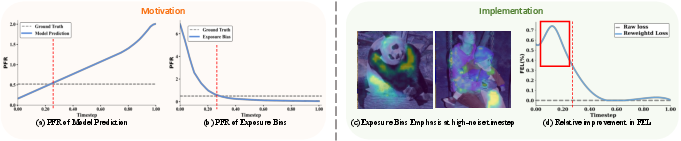
Figure 1: Low-pass frequency analysis of exposure bias reveals complementary trends compared to model prediction and visualizes the spatial regions of bias at high-noise timesteps.
Quantitative Results
Extensive experimentation demonstrates that DEFAR achieves significant gains in FID, sFID, and IS across standard benchmarks, outperforming SiT, IP, SDSS, and MDSS under comparable or reduced training budgets. The integration of ADR and FC is shown to be synergistic—each mechanism yields benefits alone, but their combination consistently achieves the strongest scores. For example, on conditional CIFAR-10 (50 NFE, SiT-B/4), DEFAR achieves an FID improvement of 2.08 over the SiT baseline, and on ImageNet-256, a reduction of up to 1.83 in FID.
Absolute improvements are robust across model scales (SiT-B/4, M/2, XL/2), and DEFAR consistently delivers higher sample fidelity and semantic accuracy.
Qualitative Results
DEFAR yields higher visual fidelity and semantic correctness compared to baseline FM models. Artifacts resulting from error propagation—such as blurring, structure loss, and context boundary ambiguity—are systematically suppressed by DEFAR. Fine details in ImageNet and CelebA samples (background composition, facial regions, object textures) are better preserved and synthesized.
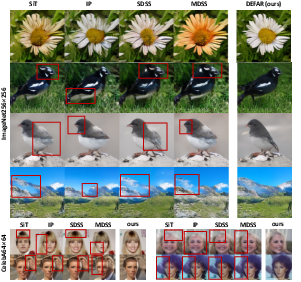
Figure 2: DEFAR samples on ImageNet-256 and CelebA-64 demonstrate improved structural and textural fidelity, resolving blurriness and detail loss present in baseline outputs.
Frequency Restoration and Low-Frequency Compensation
A crucial finding is the ability of DEFAR to recover missing low-frequency structures at high-noise timesteps. Post-training frequency-domain visualization shows that, relative to SiT, DEFAR substantially boosts the low-frequency spectral energy early in the generation trajectory, directly addressing the key failure mode of FM under exposure bias.
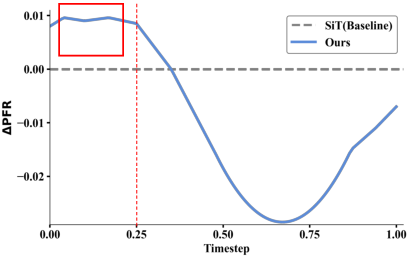
Figure 3: After DEFAR training, low-frequency restoration at high-noise timesteps is evident—regions marked in red highlight successful compensation of large-scale structures.
Architectural Compatibility and Generalization
DEFAR is validated on strong diffusion transformer backbones like REPA and DDT (ImageNet-512), confirming its compatibility as a plug-in regularizer that complements both flow-based and diffusion-based model architectures. Robustness tests with respect to path interpolants (e.g., Linear, SBDM-VP, GVP) and across ODE/SDE samplers further demonstrate generalization—the adaptive feedback framework is not tied to a specific flow configuration.
Inference Robustness
DEFAR consistently constrains FID/IS curves as the number of sampling steps increases: error accumulation with long rollouts is effectively suppressed, whereas baselines suffer quality degradation under the same conditions.
Discussion and Implications
The central theoretical contribution of DEFAR is the demonstration that exposure bias is not merely a nuisance but provides self-referential, information-rich signals for both global trajectory correction and local spectral compensation. By formalizing and exploiting the dynamic structure of the bias, DEFAR closes the loop between training and inference, inducing models that are intrinsically robust to the distribution drift that plagues open-loop generative trajectories.
Practically, DEFAR offers an easy-to-integrate, lightweight wrapper for existing FM and diffusion architectures, with empirical effectiveness established on multiple datasets and model scales. Importantly, its dynamic weighting and rectification strategies are orthogonal and thus complementary to external regularizations (e.g., discriminator guidance, OT-coupling), leading to further gains in combined settings.
Potential future directions include the extension of bias-adaptive correction to sequence models in NLP, video or time series generation, and analysis of exposure bias signals as a source of interpretability in generative systems.
Conclusion
DEFAR reframes exposure bias as an endogenous regularization signal, enabling adaptive, sample-wise rectification along both trajectory and frequency dimensions. The architecture unifies active corrective learning via ADR and FC, surpassing passive noise perturbation or static scheduled sampling paradigms. DEFAR augments flow-matching and diffusion architectures with robust exposure bias immunity, significantly advancing the reliability and scalability of continuous generative modeling.
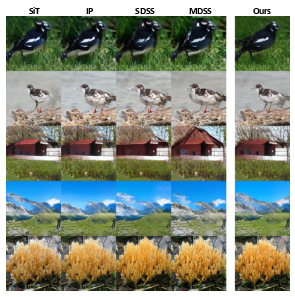
Figure 4: Example of DEFAR's improved visual accuracy and artifact suppression compared to baseline methods on ImageNet-256.
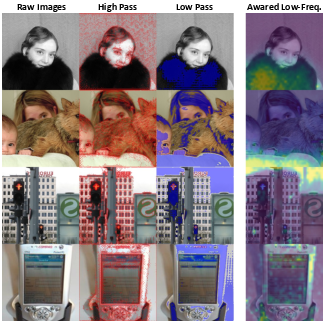
Figure 5: Exposure bias maps consistently activate low-frequency regions, confirming their semantic alignment with structural image content.
Reference: "Exposure Bias Can Alleviate Itself via Directional and Frequency Rectification in Flow Matching" (2606.28226).