- The paper demonstrates that edge gas puffing dominates core fuelling by an order of magnitude, fundamentally challenging current tritium fuel cycle designs.
- The study employs multi-device scaling and dynamic simulations to reveal trade-offs between isotope ratios, DIR integration, and overall fusion performance.
- The authors emphasize that integrating plasma-edge operation with pump and TFC design is critical for achieving safe and efficient reactor-scale fusion.
Integration of Plasma Operating Scenarios and Tritium Fuel Cycle: Matter Injection and Particle Exhaust
Overview
This paper conducts a comprehensive analysis of the interplay between plasma physics—specifically matter injection strategies—and the demands placed on the tritium fuel cycle (TFC) in magnetic-confinement fusion reactors (2606.28043). Through multi-device scaling analyses and system-level modeling, the work demonstrates that the throughput dominated by edge gas puffing, rather than core fuelling, fundamentally challenges established reactor and TFC integration paradigms. The authors argue that neglecting high gas puffing rates or their isotopic composition in TFC design is an untenable simplification for viable reactor systems, especially when employing direct internal recycling (DIR) schemes.
Matter Injection: Roles and Scaling
Matter injection into fusion plasmas encompasses core fuelling (chiefly pellet injection, occasionally neutral beam injection) and gas puffing (Edge/SOL fuelling and impurity seeding). Core fuelling is aimed at sustaining core density for ignition and is a principal driver of tritium throughput. Gas puffing, conversely, is essential to achieve and sustain a detached divertor regime and to manage edge and SOL conditions.
The multi-machine database developed in this study reveals that the engineering magnitude of gas puffing consistently exceeds that of core fuelling by roughly an order of magnitude across both tokamaks and stellarators, and across all relevant device sizes.
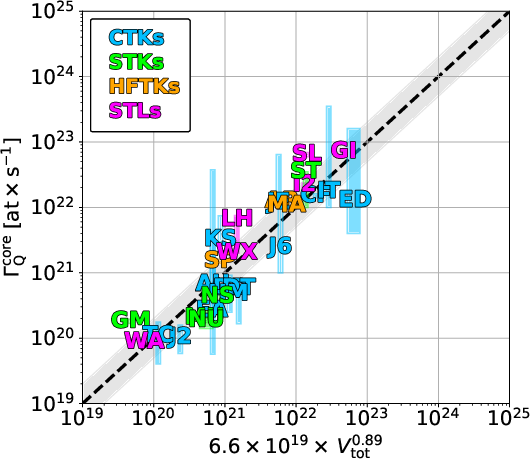
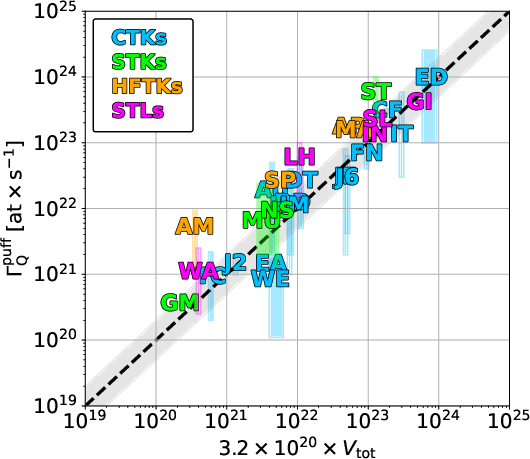
Figure 2: Regression of core fuelling rate as a function of total plasma volume; systematic multi-machine analysis was performed across both tokamaks and stellarators.
This scaling trend remains robust, even as device volume increases, such that the puff-to-core fuelling ratio either remains constant or increases in larger, reactor-scale machines.
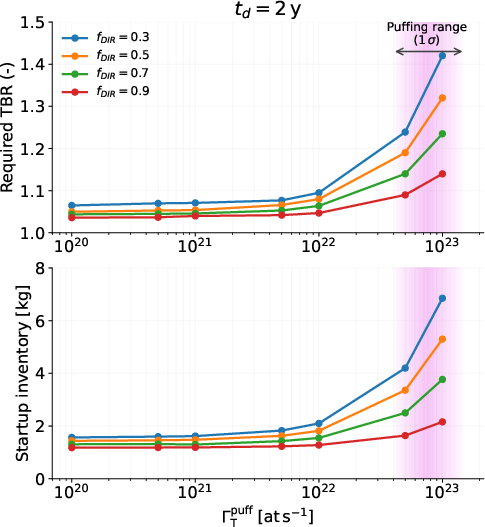
Figure 4: Required TBR and start-up tritium inventory as a function of tritium puff rate. Notable increases occur once gas puff-derived tritium exceeds the core fuelling-derived throughput.
Tritium Fuel Cycle Architectures and DIR Integration
Recent TFC architectures emphasize minimizing inventory and maximizing recirculation rates, relying on high-fidelity DIR loops for rapid tritium recycling. However, typical DIR modeling implicitly assumes that the exhaust D:T mixture remains near the 50:50 ratio targeted for core fuelling. This assumption becomes invalid when gas puffing dominates and is not explicitly tritium-lean. Mitigation strategies, such as enforcing highly deuterium-rich (tritium-poor) puffing, encounter trade-offs: while they reduce TFC inventory requirements, the DIR stream is increasingly imbalanced, leading to core isotope dilution, fusion power loss, or additional requirements on rebalancing the core D:T mixture.
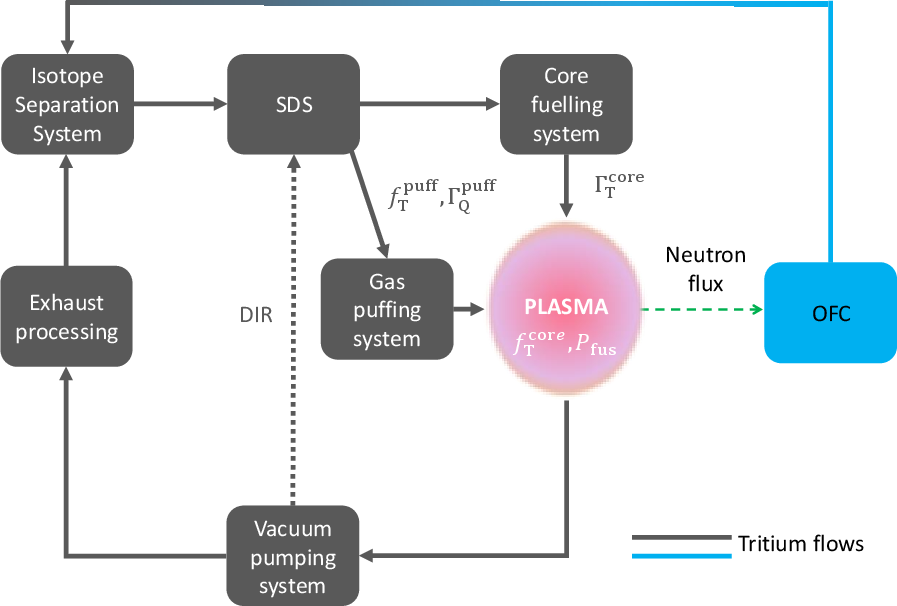
Figure 5: Schematic layout of the extended TFC model including explicit gas puffing with both tritium and impurity contributions.
High-fidelity modeling by the authors shows that unless the tritium fraction in puffing is carefully minimized, TBR and start-up tritium inventory requirements rapidly escalate beyond standard design assumptions. Conversely, strictly deuterium puffing without rebalancing results in rapid core tritium depletion and significant fusion power drops, further emphasizing the degree to which plasma-edge and TFC design must be co-optimized.
Impurity Seeding, Pumped Throughputs, and DIR Limitations
Intensive impurity seeding (e.g., with neon), while reducing edge power loads and thus helping to achieve detachment, introduces another channel for inventory growth and core dilution, exacerbated by any impurity leakage through imperfect DIR loop separation. The study shows that even small rates of impurity bypass via DIR technology (e.g., multi-stage cryopumps vs. metal foil pumps) can lead to impurity buildup in the core on operationally relevant timescales unless separator performance nears perfection.
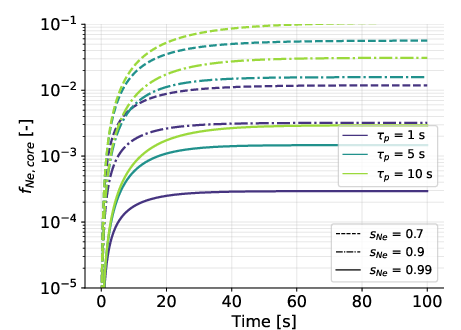
Figure 1: Neon fraction in the core plasma due to imperfect separation as a function of DIR fraction and characteristic separation sharpness.
Moreover, the high magnitude of overall exhaust throughput, dominated by gas puffing, drives the requirement for substantial installed primary vacuum pumping capability, often exceeding present TFC and plant design expectations.
Scenario Optimization and Trade-off Strategies
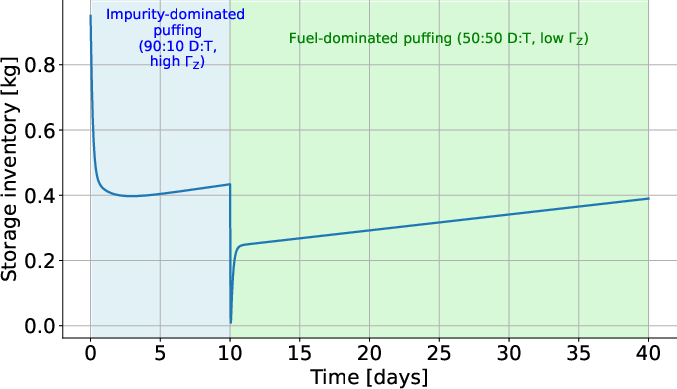
Through dynamic and steady-state simulations, the authors identify nontrivial operating points that balance tritium minimization with core isotope ratio and fusion performance. For example, operating at 75:25 D:T in puffing (with rebalancing) may be preferable over strict 50:50 at very high DIR fractions, but this introduces core performance reduction and only partially alleviates TFC inventory requirements. Further, staged operational strategies are proposed, where startup can be performed in an impurity-dominated, tritium-lean mode, with transition to high-tritium, high-fusion-power operation once TFC inventories have partially saturated.
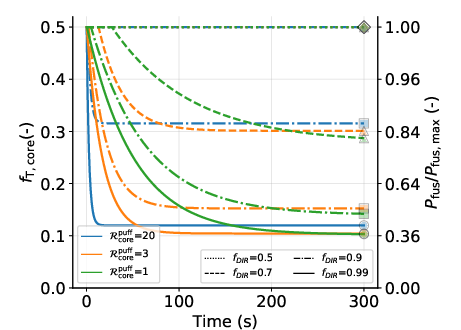
Figure 3: Evolution of the tritium core fraction and normalized fusion power for varying puff/core ratios and DIR fractions, demonstrating trade-offs between DIR optimization and fusion performance.
The analysis also suggests that bypass pumping architectures—reinjecting part of the divertor exhaust upstream to maintain high throughput locally without excessive external fuelling—may offer additional engineering levers to relieve TFC burden.
Implications and Future Directions
Theoretical and practical implications for reactor and TFC system design are significant:
Conclusion
The study unequivocally demonstrates that, for reactor-scale magnetic-confinement fusion, matter injection and particle exhaust—specifically the dominance of gas puffing over core fuelling—profoundly impact the tritium fuel cycle, plant inventory, and operational envelope. The assumption that core fuelling is the main determinant of TFC requirement is no longer supportable under detached divertor paradigms. Integration of plasma-edge, pumping, and TFC design is thus mandatory, necessitating both new modeling infrastructure and re-evaluation of current reactor design processes.
References
- "On the Relationship Between Plasma and Tritium Fuel Cycle Through Matter Injection and Particle Exhaust" (2606.28043)