- The paper introduces Ribbon, an influence-function-based approach that approximates Dirichlet-reweighted risk minimization via efficient post-hoc linear algebra.
- Ribbon achieves calibrated uncertainty estimates by decoupling directional covariance from global dispersion, enabling empirical tuning through the parameter α.
- Ribbon outperforms traditional methods like Laplace and bootstrap with one order of magnitude faster computation and superior uncertainty calibration on diverse benchmarks.
Ribbon: Scalable Approximation and Robust Uncertainty Quantification
Motivation and Methodological Foundations
Accurate uncertainty quantification (UQ) in complex, high-dimensional, or misspecified models remains challenging. Bayesian inference and bootstrap resampling provide principled UQ but are often computationally infeasible for large-scale models due to the need for posterior sampling or repeated model retraining. The paper "Ribbon: Scalable Approximation and Robust Uncertainty Quantification" (2606.27269) proposes Ribbon, an influence-function-based linearization that replaces retraining with efficient post-hoc linear algebra, retaining the first-order data-reweighting properties of Bayesian bootstrap.
Ribbon leverages influence functions to approximate the effect of Dirichlet-reweighted empirical risk minimization around a single fitted model. Specifically, it propagates Dirichlet weights through the empirical loss gradient and local curvature, thus preserving essential resampling-driven variability. For general concentration parameter α, Ribbon yields a calibrated Dirichlet-reweighting family, permitting empirical tuning of the uncertainty scale.
Theoretical Properties and Connections
Ribbon is asymptotically equivalent to the flat-prior Laplace approximation under correct likelihood specification (i.e., HF≈H). For α=1 and correct specification, the covariance of Ribbon's influence-based perturbations matches the Laplace posterior covariance, while under misspecification, Ribbon recovers the robust sandwich covariance H−1HFH−1/n. This robustness arises because Ribbon accounts for gradient variance rather than relying solely on curvature, which can be misleading when the model is misspecified.
Ribbon supports post-hoc calibration, decoupling directional covariance (driven by influence structure) from global dispersion (governed by α). α is tuned on validation data to achieve empirical coverage or likelihood calibration, providing flexibility across tasks and models.
Practical Implementation and Scalability
Ribbon requires only a single model fit and a post-hoc curvature operator (estimated via GGN, KFAC, empirical Fisher, etc.). Subsequent uncertainty quantification involves efficient matrix–vector operations, eliminating the need for repeated retraining. After training, Ribbon draws Dirichlet weights, computes influence-function perturbations, and propagates them to prediction space either via full model forward passes or local Jacobian pushforward.
Ribbon was evaluated on synthetic regression (heteroskedastic sine), California Housing regression, and MNIST classification benchmarks against MC dropout, deep ensembles, bootstrap retraining, Laplace approximation, and Bayesian neural networks. Key findings include:
- Epistemic calibration: Ribbon achieved near-nominal coverage in-distribution and competitive OOD expansion, outperforming Laplace and bootstrap in settings with heteroskedasticity (Figure 1).
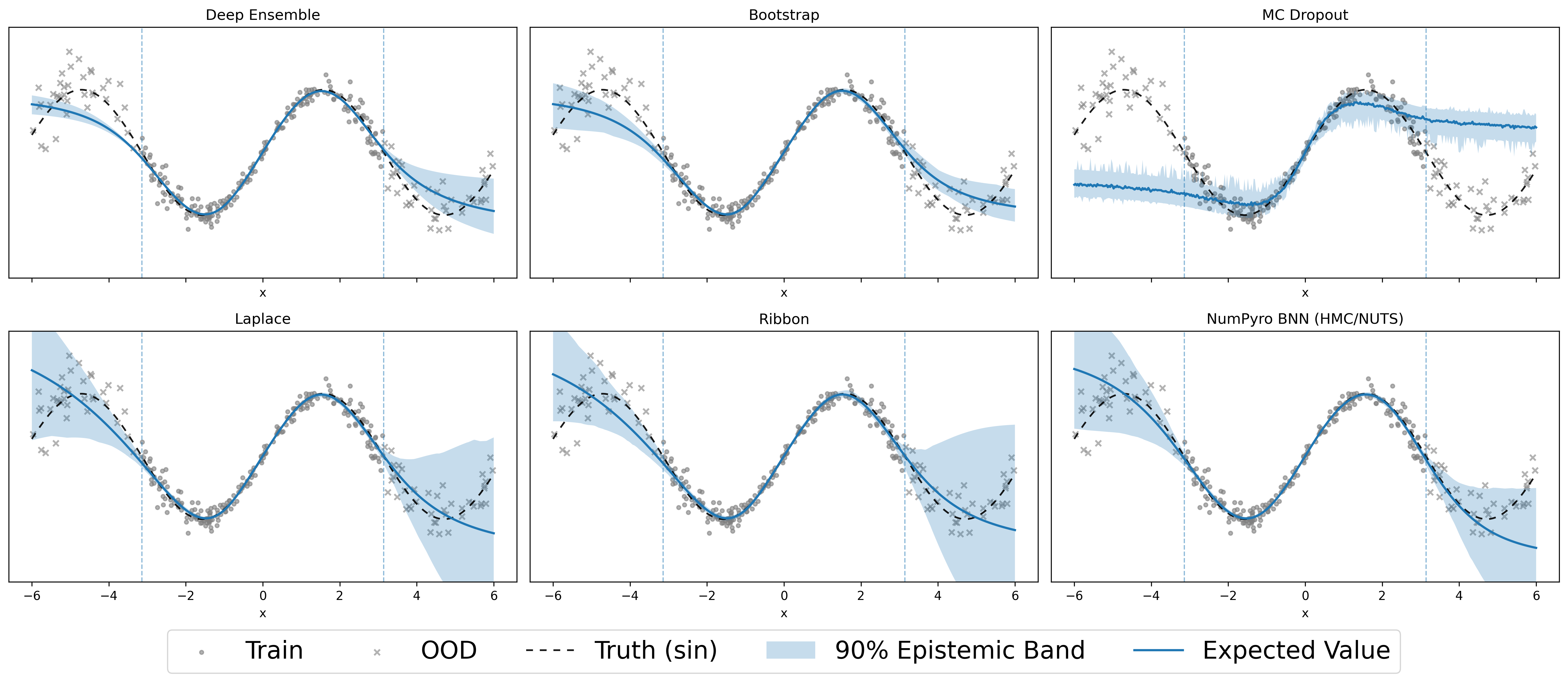
Figure 1: Epistemic uncertainty on the heteroskedastic sine function. Each panel shows the predictive mean, 90\% epistemic interval, noisy data, and the true function. Gray shading marks the in-domain region x∈[−π,π], and red shading marks the OOD region.
- Total uncertainty: Ribbon's total predictive intervals with observation noise matched empirical coverage well and provided sharper intervals on California Housing (Figure 2).
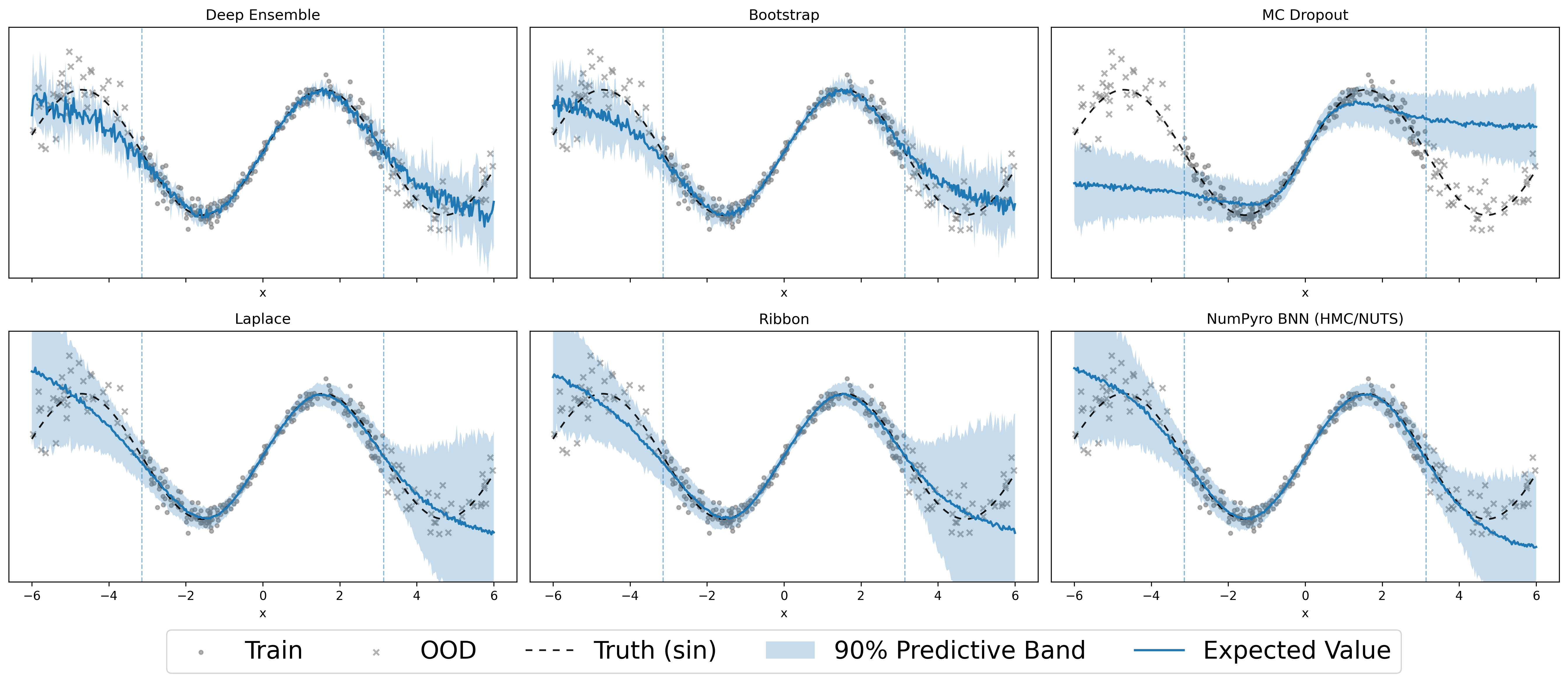
Figure 2: Total predictive uncertainty on the sine dataset. Shaded regions represent 90\% predictive intervals obtained by combining epistemic variability with observation-noise uncertainty according to the method-specific predictive construction.
- Computational efficiency: Post-hoc uncertainty generation for Ribbon was an order of magnitude faster than Bayesian neural networks or bootstrap retraining and comparable to Laplace or MC dropout, with minimal additional cost over the base model fit.
- Calibration and scoring: On MNIST, Ribbon matched Laplace in calibration and Brier score, outperforming MC dropout on ECE and NLL. Ensembles retained the highest accuracy.
- Contradictory claims: The paper challenges the reliability of standard curvature-only Laplace or ensemble-based UQ under certain misspecified regimes, showing that Ribbon can deliver improved coverage and calibration without retraining overhead.
Implications and Future Directions
Practically, Ribbon offers a principled and efficient route to UQ in modern ML pipelines, especially when computational resources preclude retraining or full posterior sampling. Its calibration flexibility via α supports deployment for standardized or heteroskedastic settings. Ribbon's theoretical robustness under misspecification addresses longstanding concerns with curvature-only approaches.
On the theoretical front, Ribbon exemplifies the unification of Bayesian and frequentist perspectives in UQ. The influence-function linearization captures first-order resampling structure and enables sandwich covariance estimation, relevant for both parametric and mildly misspecified models.
Future developments may expand Ribbon to overparameterized models or structured prediction tasks via higher-order influence expansions, adaptive curvature learning, or integration with conformal prediction frameworks for finite-sample coverage guarantees. Ribbon's compatibility with efficient automatic-differentiation frameworks, and its ability to incorporate structured curvature approximations, further position it as an attractive UQ baseline for deep learning.
Conclusion
Ribbon presents a scalable, influence-based approximation to Bayesian-bootstrap uncertainty, unifying curvature-based and resampling-based UQ methodologies. By providing robust predictive uncertainty, empirical calibration, and computational efficiency, Ribbon advances post-hoc UQ for differentiable models. The method's theoretical guarantees and empirical performance argue for its use in practical ML systems where accurate, reliable uncertainty estimates are required and repeated retraining is infeasible.

