- The paper introduces RoSHAP, a novel distributional framework that aggregates feature attributions via bootstrap resampling and kernel density estimation to capture uncertainty.
- The paper demonstrates that RoSHAP consistently yields stable feature rankings across various datasets, outperforming traditional methods like SHAP, LIME, and model-based gains.
- The paper shows that by combining activity, strength, and stability metrics under a Gaussian approximation, RoSHAP enhances model interpretability and supports reproducible feature selection.
RoSHAP: A Distributional and Robust Metric Framework for Stable Feature Attribution
Motivation and Limitations of Conventional Feature Attribution
Current model interpretability is heavily reliant on feature attribution algorithms like SHAP, IG, LIME, and model-based gain metrics. However, these methods conventionally generate point estimates for attribution values that are inherently unstable under stochasticity induced by random train-test splits, model initialization, or sampling. The resulting feature rankings often exhibit substantial variance across repeated model fits even when the underlying predictive accuracy remains high. This instability fundamentally undermines downstream scientific interpretation, especially in high-dimensional domains, as demonstrated by the divergent top gene selections in repeated SHAP runs on the Golub leukemia dataset.
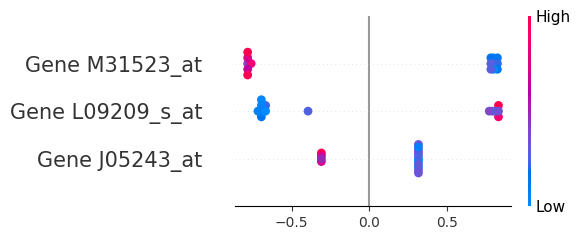
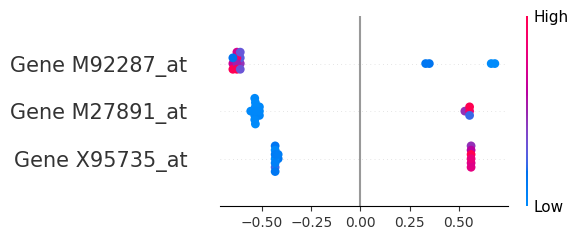
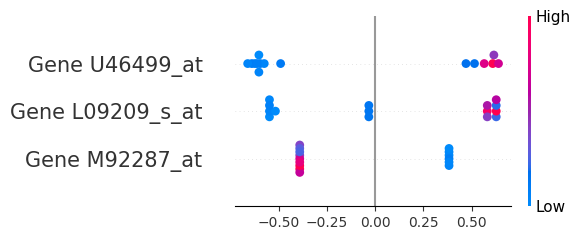
Figure 1: Visualization of variation in the top SHAP-ranked genes across different train-test splits of the Golub data.
Distributional Approach and the RoSHAP Metric
To address systematic instability, the authors introduce a general distributional framework for feature attribution estimation, encapsulated in the RoSHAP metric. The approach models the randomness of feature attribution as a distribution rather than a fixed quantity, using bootstrap resampling and kernel density estimation (KDE) to quantify empirical variability. Each attribution Tij (the contribution of feature j at observation i) is modeled as a zero-inflated mixture: with probability wij the attribution is exactly zero (ubiquitous in tree-based models), otherwise it is drawn from a nonzero distribution Gij. Feature-level attributions are then aggregated as Uj=∑i∣Tij∣.
Under mild regularity conditions (Lyapunov CLT), Uj admits a Gaussian approximation in the limit, allowing the bootstrapped distribution to be summarized by its mean and variance. When some samples have non-negligible influence, KDE is used for nonparametric estimation. This substantially improves both computational efficiency and the fidelity of attribution uncertainty quantification over naive repeated resampling.
The RoSHAP score quantifies three complementary aspects for each feature:
- Activity: Proportion of nonzero attribution, (1−P0j)
- Strength: Median nonzero attribution, mj
- Stability: Attribution SNR, sj (std. deviation of j0)
The aggregated metric is j1, which favors features that are consistently active, have strong attributions, and are robust to train-test randomness.
Computational and Statistical Properties
Simulation studies with structured signal and noise features confirm that robust, distributional aggregation produces markedly more stable rankings than single-run SHAP, LIME, or gain-based approaches. Even with as few as 10 bootstrap runs, RoSHAP reliably surfaces signal features, while single-run and classical importances often suppress them, including features with the largest true effect. Signal features with high j2 are characterized as conditionally informative (feature is often inactive but highly predictive when present), highlighting RoSHAP’s utility in sparse and zero-inflated data regimens.
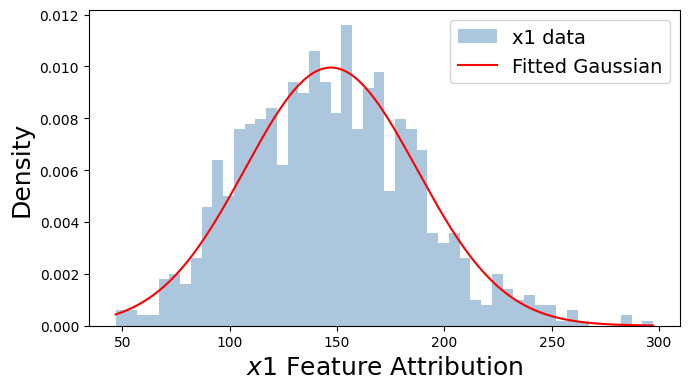
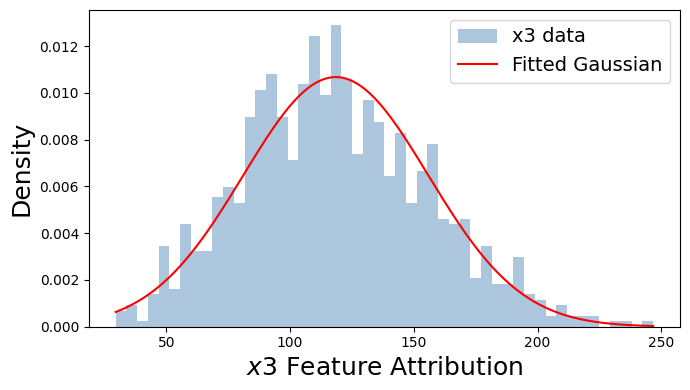
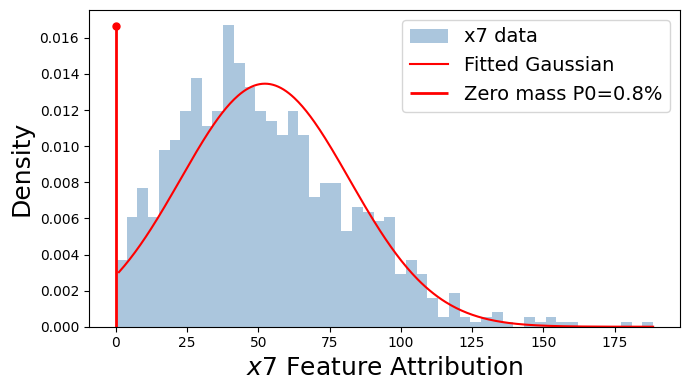
Figure 2: Empirical distribution of bootstrapped importance scores for a key simulated predictor, illustrating the near-Gaussianity and nontrivial zero-mass structure.
The computational complexity is substantially reduced: the Gaussian approximation reduces the required number of bootstrap resamples by over an order of magnitude when Lyapunov’s conditions are met. Thus, RoSHAP scales favorably to large j3 and j4.
Empirical Evaluation: Robust Feature Selection and Interpretability
Tabular Data (Omics, Molecule, and Signal Localization)
Application to canonical datasets (Golub, Musk v2, UJIIndoorLoc) across classification and regression settings demonstrates that RoSHAP-selected features yield predictive models that match or exceed the accuracy of models constructed with features ranked by other methods, with the additional benefit of consistency and interpretability.
In the Golub high-j5 small-j6 genetics scenario, RoSHAP achieves superior performance in recovering biologically relevant genes with reduced variance in feature selection. For Musk v2, where molecular structure descriptors are heavily correlated and noisy, the RoSHAP-based pipeline isolates a compact, predictive set of variables, outperforming standard magnitude-only criteria under both tree-based and linear models.
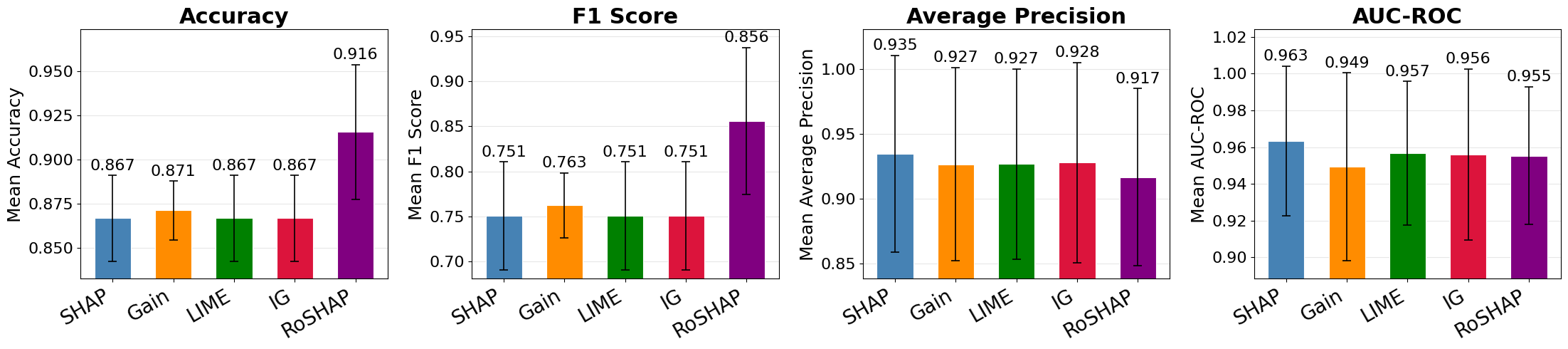
Figure 3: Comparative feature selection performance (mean and variation) on the Golub data using XGBoost. RoSHAP (purple) consistently achieves high mean performance with smaller variance across feature-set sizes.
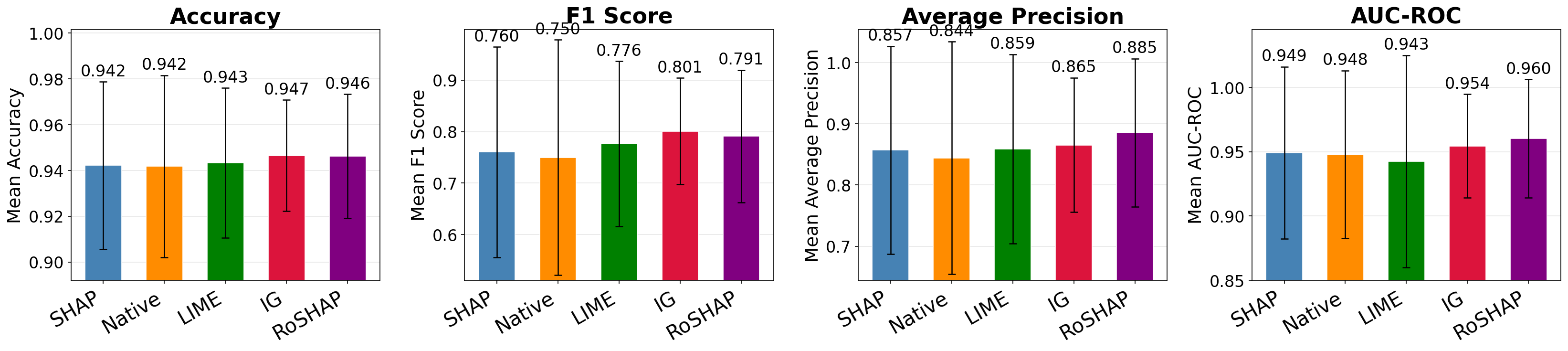
Figure 4: CatBoost-based feature selection on Musk (Version 2): RoSHAP (purple) yields competitive and more stable performance than magnitude-based alternatives.
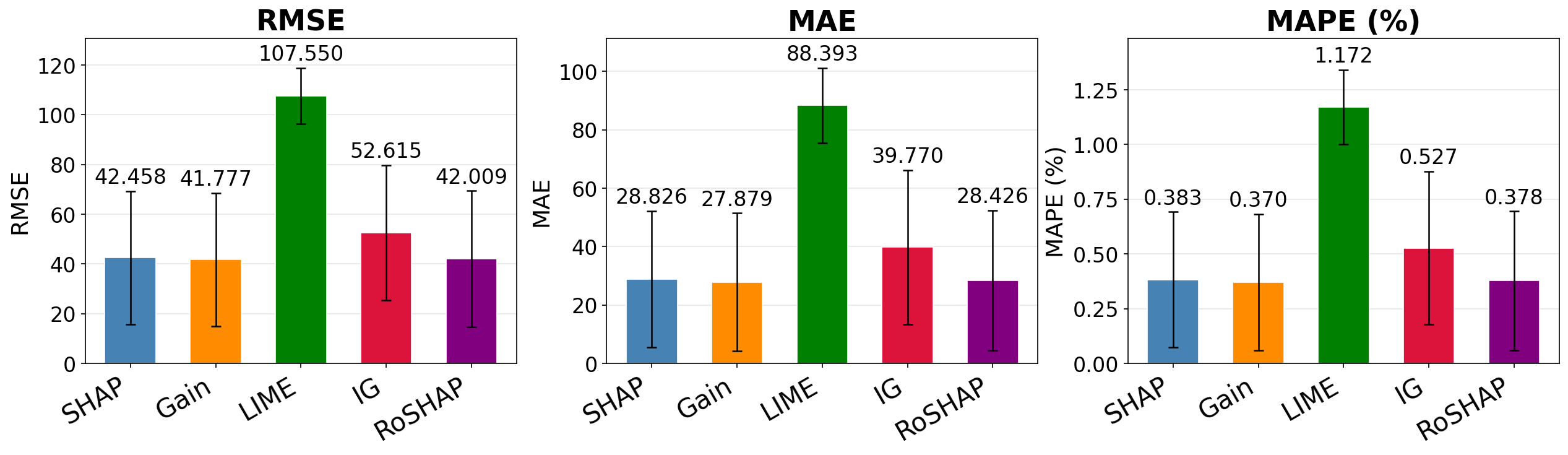
Figure 5: LightGBM-based feature selection for the UJIIndoorLoc regression task: RoSHAP (purple) consistently achieves lower error across subset sizes.
Visual Data (CIFAR-10)
RoSHAP is extended to sample-level, patch-based attributions for ViT models on image data. Classical SHAP for single inference runs results in substantial patchwise attribution variation. The robustized map generated via RoSHAP re-focuses importance on semantically meaningful regions and exposes cases where prediction errors are attributable to the model attending to irrelevant patches.
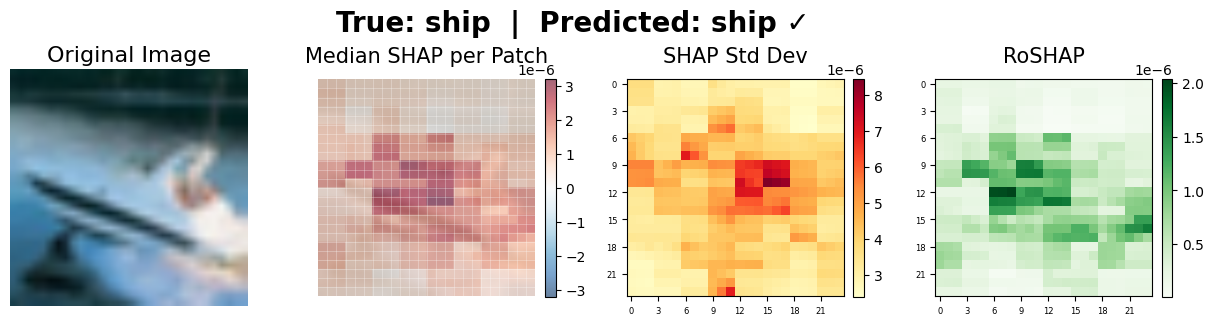
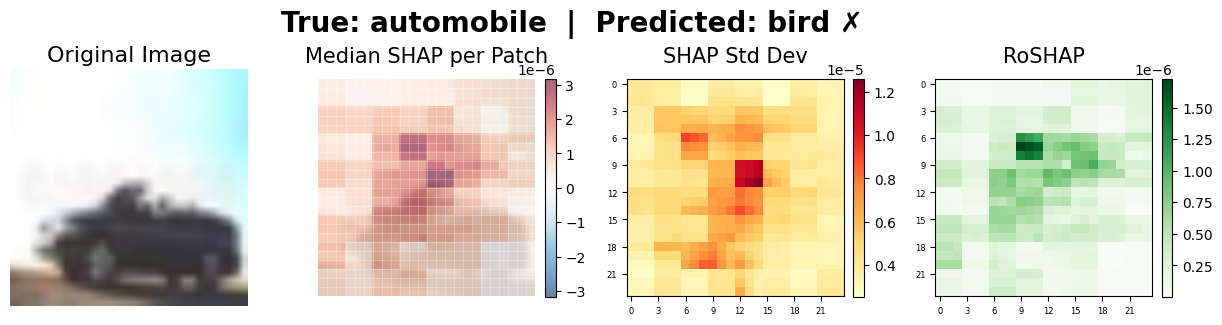
Figure 6: For a correct boat classification, the RoSHAP-based attribution map localizes the most discriminative pixels to the ship body, in contrast to single-run variation.
Implications for Model Reliability, Interpretation, and AI Trustworthiness
RoSHAP directly addresses the stability and reliability of feature attributions, which is foundational for scientific discovery, high-stakes clinical decision-making, and regulatory compliance. By quantifying and integrating attribution uncertainty rather than obfuscating it, RoSHAP enables more interpretable, reproducible, and actionable model insights. Practically, it offers an adaptive mechanism for setting feature selection thresholds that inherently account for signal stability.
From a theoretical viewpoint, the distributional formulation paves the way for advanced forms of attributional hypothesis testing, confidence set generation for feature importance, and robust integration with downstream uncertainty quantification methods in model assessment.
Furthermore, RoSHAP’s architecture-agnostic design (applicable to random forest, gradient boosting, neural networks, and tabular data or image models) ensures the broad applicability and extensibility of the framework. Future developments may incorporate model-intrinsic stochasticity (e.g., dropout, Bayesian inference), richer empirical process concentration bounds, and integration with causal inference pipelines.
Conclusion
RoSHAP delivers a robust, distributional perspective on feature attribution that substantially increases the stability and reliability of model interpretability analyses. By integrating activity, strength, and stability under a bootstrap-based aggregation, the approach mitigates stochastic user-induced variance and calibrates feature selection to reflect persistent, reproducible signals. RoSHAP augments state-of-the-art interpretability and feature selection regimes in machine learning, providing a rigorous foundation for downstream decision-making and interpretability evaluations in high-dimensional and stochastic modeling contexts (2605.15154).