- The paper introduces a confidence-based dynamic programming policy that learns the unknown parameter online to attain full-information benchmarks.
- The methodology provides explicit convergence rates for exponential, Pareto, and bounded-support models, significantly outperforming nonparametric rules.
- The study unifies optimal stopping theory with extreme-value analysis, establishing asymptotically optimal performance guarantees under parametric assumptions.
Asymptotically Optimal Learning for Parametric Prophet Inequalities
Overview
The paper "Asymptotically Optimal Learning for Parametric Prophet Inequalities" (2606.26893) provides a comprehensive study of online learning in prophet inequalities when underlying i.i.d. rewards are drawn from a parametric exponential-type family with an unknown parameter. The study advances the analysis of optimal stopping problems by characterizing the full-information asymptotic competitive ratio under parametric models, introducing a confidence-based dynamic programming policy that learns the unknown parameter online, and providing explicit convergence rates in canonical distributional settings. The implications extend to domains where classic prophet inequality guarantees are insufficient due to a lack of distributional knowledge but where structural assumptions are justified.
In the considered finite-horizon online stopping problem, at each round i∈[n], the agent observes Xi∼Fθ, where Fθ is a member of a one-parameter exponential-type family: Fθ(x)={0,x<x0 1−exp(−θϕ(x)),x0≤x<xF 1,x≥xF,
for a fixed, known strictly increasing function ϕ and unknown θ>0, with either unbounded (xF=∞) or bounded (xF<∞) support.
The goal is to design an online policy τ, using only the sequentially observed rewards (no offline samples), that maximizes the expected competitive ratio
CRn(τ;θ)=Eθ[maxi∈[n]Xi]Eθ[Xτ]
compared to the performance of a "prophet" who knows all Xi∼Fθ0 in advance.
Main Theoretical Contributions
A core result is the precise asymptotic characterization of the optimal competitive ratio in the parametric setting:
- Unbounded support (Xi∼Fθ1): The limit depends on a tail parameter Xi∼Fθ2 (derived from the endpoint growth rate of Xi∼Fθ3),
Xi∼Fθ4
with Xi∼Fθ5, Xi∼Fθ6, and the increment structure capturing extreme-value theoretic properties (Gumbel- and Fréchet-type behavior).
- Bounded support (Xi∼Fθ7): Under endpoint regularity, the optimal competitive ratio converges to Xi∼Fθ8 as Xi∼Fθ9.
(Canonical cases include exponential (Fθ0, Fθ1), Pareto (Fθ2, Fθ3), and bounded power-law families.)
Online Learning Algorithm: Confidence-Based Dynamic Programming
An exploration-exploitation scheme is constructed:
- Exploration: Observe and reject the first Fθ4 samples; use a maximum-likelihood estimator (MLE) for Fθ5 based on a linearized exponential transformation (Fθ6).
- Plug-in DP with Confidence: Construct an upper-confidence bound Fθ7 for the parameter to counteract censoring effects; use backward dynamic programming to calculate thresholds recursively for subsequent rounds, treating Fθ8 as the model parameter.
Theoretical guarantee: With exploration length Fθ9 scaling appropriately in Fθ(x)={0,x<x0 1−exp(−θϕ(x)),x0≤x<xF 1,x≥xF,0, the learned policy attains the full-information asymptotic competitive ratio for the ground-truth Fθ(x)={0,x<x0 1−exp(−θϕ(x)),x0≤x<xF 1,x≥xF,1, matching the unattainable performance of classic nonparametric policies in any heavy-tail regime.
Fθ(x)={0,x<x0 1−exp(−θϕ(x)),x0≤x<xF 1,x≥xF,2
where Fθ(x)={0,x<x0 1−exp(−θϕ(x)),x0≤x<xF 1,x≥xF,3 is the failure probability parameter used in the confidence bound.
Distribution-Specific and Rate-Optimality Results
- Exponential: Convergence to Fθ(x)={0,x<x0 1−exp(−θϕ(x)),x0≤x<xF 1,x≥xF,4, with the rate matching full-information DP, i.e., Fθ(x)={0,x<x0 1−exp(−θϕ(x)),x0≤x<xF 1,x≥xF,5.
- Pareto: Attainment of the Fréchet-optimal limit Fθ(x)={0,x<x0 1−exp(−θϕ(x)),x0≤x<xF 1,x≥xF,6, with convergence rate Fθ(x)={0,x<x0 1−exp(−θϕ(x)),x0≤x<xF 1,x≥xF,7 dominated by intrinsic finite-horizon effects rather than estimation error.
- Bounded-Support Power Family: Convergence rate Fθ(x)={0,x<x0 1−exp(−θϕ(x)),x0≤x<xF 1,x≥xF,8, faster than rank-based rules.
These rates always strictly improve upon nonparametric policies (based on relative ranks alone), especially in Fréchet-type heavy tail settings, where nonparametric rules are provably sub-optimal.
Experimental Results
Figure 1 demonstrates empirical competitive-ratio trajectories on synthetic exponential, Pareto, and bounded-support reward sequences. The proposed algorithm consistently approaches the theoretical full-information limits for all models, outperforming both classic secretary/prophet-style rules and nonparametric rank-based policies, with pronounced separation in the Pareto regime.
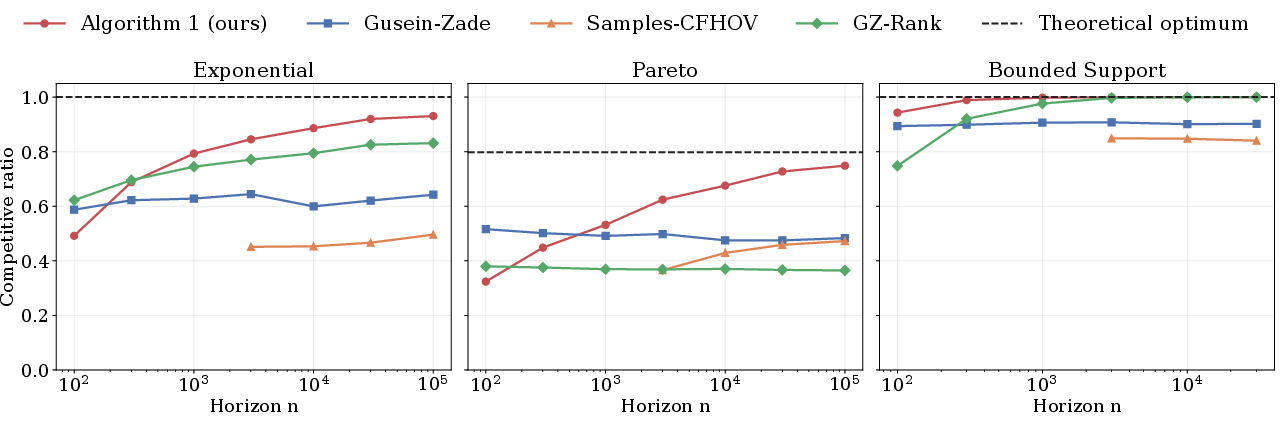
Figure 1: Competitive-ratio curves for exponential, Pareto, and bounded-support rewards, confirming near-optimality across all parametric cases.
Theoretical and Practical Implications
These results provide a sharp separation between:
- Nonparametric prophet learning, where severe sample complexity barriers are provable ([correa2019prophet]), and parametric structure must be assumed for learning to be feasible;
- Parametric prophet learning, where even minimal online observations suffice for asymptotic optimality, provided the structural family is correctly specified.
The analysis unifies optimal stopping theory with extreme-value theory, clarifies when relative-rank rules fail to be optimal, and demonstrates that learning under smoothly parameterized model classes recovers the benefits of known-distribution DP policies.
The confidence-based plug-in DP framework introduces a robust and general approach for parametric optimal stopping, potentially extensible to higher-dimensional, contextual, or structured reward models.
Methodological Highlights
- Reduction of the parametric estimation problem to exponential MLE via sufficient statistics for online learning.
- Construction of tight confidence intervals for Fθ(x)={0,x<x0 1−exp(−θϕ(x)),x0≤x<xF 1,x≥xF,9 based on exponential concentration inequalities.
- Recursion/DP structure is fully explicit in all canonical cases, allowing for analytical and computational tractability.
- Analytical derivation of distribution-specific rates and asymptotic constants through coupling with regular variation / extreme-value analysis.
Limitations and Future Directions
The framework presumes a correctly specified one-parameter exponential-type family; misspecified or multi-parameter settings, as well as models where the structure is not fully known, remain open for further research. Extension to contextual, high-dimensional, or adversarially perturbed settings poses significant new challenges, e.g., in combining regret minimization and competitive analysis with online statistical estimation.
Conclusion
This work sharply characterizes and realizes the optimal approach to online learning in parametric prophet inequalities, both theoretically and algorithmically. For a broad class of exponential-type reward families, it establishes that online learning with only sequential observations suffices to match powerful full-information prophet benchmarks. The developed methodology sets a new standard for structured online optimal stopping under both light-tailed and heavy-tailed regimes, with concrete performance gains over nonparametric techniques and explicit guidance for practical implementation.
Reference:
"Asymptotically Optimal Learning for Parametric Prophet Inequalities" (2606.26893).