- The paper demonstrates that leveraging a linear structure with contextual features enables achieving sharp competitive ratios of 1-1/e (i.i.d.) and 1/2 (non-identical) despite noisy observations.
- It introduces explore-then-decide and ε-greedy methods using lower confidence bound thresholds to effectively balance exploration and exploitation in sequential decision-making.
- Empirical validations on synthetic data confirm that the proposed algorithms outperform classical benchmarks, offering practical insights for online optimal stopping applications.
Introduction
The paper "Learning in Prophet Inequalities with Noisy Observations" (2604.01789) undertakes a rigorous study of the classical prophet inequality problem under realistic, informational constraints: reward distributions are unknown and rewards are observable only through noisy signals. Exploiting the structural assumption that latent rewards are linearly parameterized by observable contextual features, the authors develop learning-based thresholding algorithms that integrate statistical estimation and optimal stopping. The resulting competitive ratio guarantees demonstrate that sharp prophet bounds ($1 - 1/e$ for i.i.d. and $1/2$ for non-identical distributions) are achievable under mild regularity conditions, thus overcoming key impossibility results in the literature.
Problem Setting and Structural Assumptions
The decision-maker sequentially observes noisy reward realizations yi=xi⊤θ+ηi, where each feature xi∈Rd is drawn from an unknown distribution Dx,i; θ∈Rd is an unknown latent parameter and ηi is i.i.d. σ-sub-Gaussian noise. The classical prophet inequality asks: how closely can an online stopping rule approximate the expected value achieved by a prophet (omniscient agent) who always selects the maximum reward? The target is the asymptotic competitive ratio
n→∞liminfE[maxi∈[n]Xi]E[Xτ],
where τ is the stopping time determined by policy and $1/2$0. Key regularity assumptions include boundedness on $1/2$1 and $1/2$2, and non-degeneracy on the feature covariance's minimum eigenvalue.
Noisy Observations: Fundamental Limitations and Structural Recovery
A central result is the demonstration that, in the absence of structural knowledge, noisy reward observations alone induce a trivial competitive ratio: for some distribution classes, any policy must satisfy
$1/2$3
(Proposition 1 of the paper). The critical shift is leveraging feature-dependent linearity: this enables statistical learning of $1/2$4 from noisy observations, thereby permitting nontrivial prophet bounds even when the underlying reward distributions are unknown.
Learning-Based Algorithms and Competitive Ratio Guarantees
Two principal algorithmic frameworks are developed for the i.i.d. case:
Explore-then-Decide with Lower Confidence Bound (LCB) Thresholding
This method employs an initial forced exploration phase of size $1/2$5 to collect pairs $1/2$6. An estimate $1/2$7 is formed via regularized least squares, yielding a lower-confidence bound (LCB) for each $1/2$8 given by
$1/2$9
where yi=xi⊤θ+ηi0 controls the confidence radius. The threshold yi=xi⊤θ+ηi1 is set as the yi=xi⊤θ+ηi2 quantile using yi=xi⊤θ+ηi3 and the LCB estimator. Stopping occurs when yi=xi⊤θ+ηi4.
yi=xi⊤θ+ηi5-Greedy with LCB Thresholding
This method randomly interleaves exploration and stopping phases, where exploration rounds update yi=xi⊤θ+ηi6 online and corresponding LCBs and thresholds are recalculated dynamically. This ensures that information acquisition is temporally distributed, desirable in practical online systems.
Competitive Ratios
Both methods provably achieve the sharp competitive ratio of yi=xi⊤θ+ηi7 in the i.i.d. setting:
yi=xi⊤θ+ηi8
contingent upon a mild growth condition on yi=xi⊤θ+ηi9 relative to the exploration length and the noise level (Corollary 1, Theorem 2).
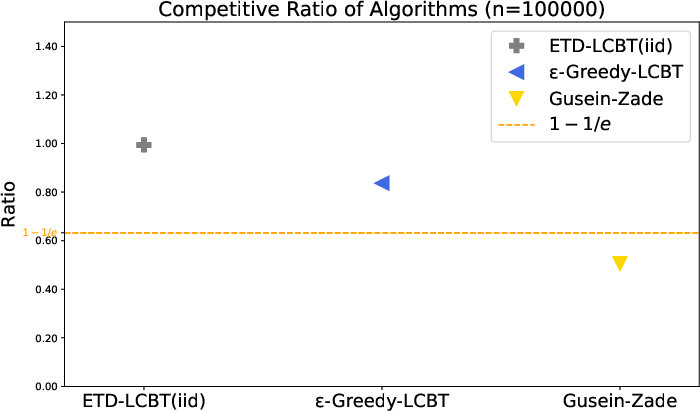
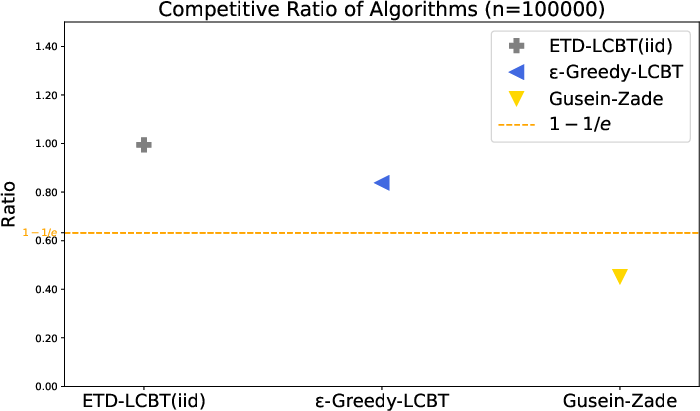
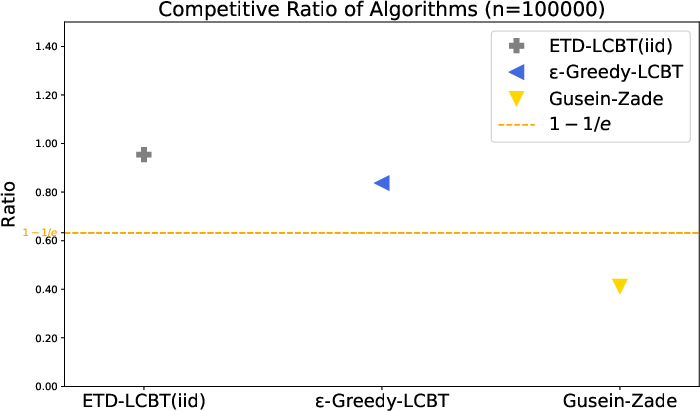
Figure 1: Empirical competitive ratios for i.i.d. distributions under xi∈Rd0 demonstrating performance above xi∈Rd1.
Non-Identical Distributions: Relaxed and Windowed Prophet Benchmarks
For general non-identical rewards, the classical prophet benchmark is unattainable in the online single-sequence setting due to the necessity of initial exploration. The authors target two relaxed benchmarks:
- Relaxed Prophet Benchmark: Exclude pure exploration rounds, compare with xi∈Rd2. The competitive ratio is provably at least xi∈Rd3 (Theorem 4).
- Window Access: By allowing retrospective selection from a window of indices after the exploration phase (of size xi∈Rd4), the method achieved the optimal xi∈Rd5 competitive ratio against the true prophet benchmark (Theorem 6).
Both approaches exploit the linear structure to minimize offline sample requirements or window access size: xi∈Rd6 suffices for polynomial xi∈Rd7.
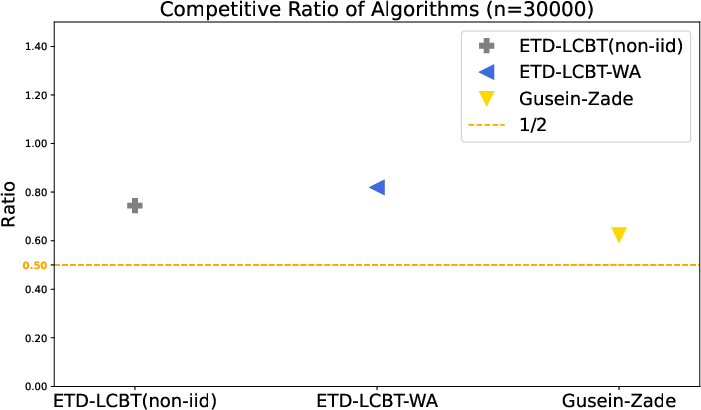
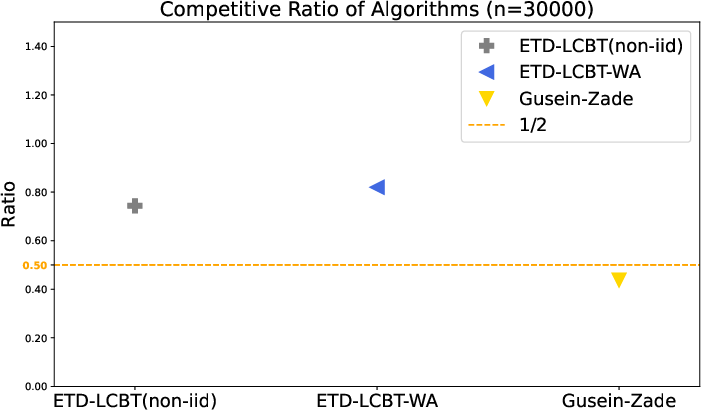
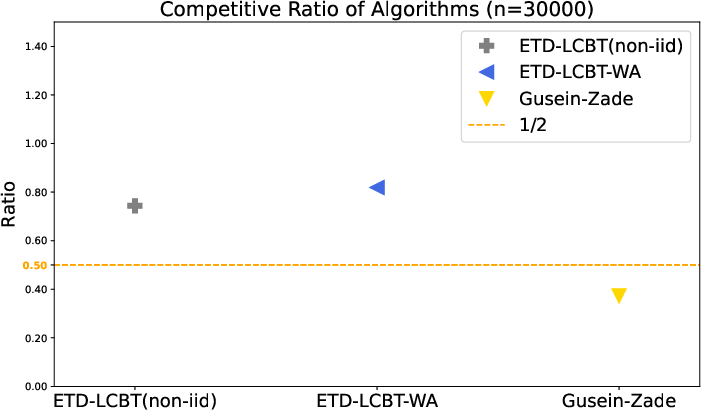
Figure 2: Competitive ratios for non-identical distributions, with xi∈Rd8, confirming the empirical attainment of the xi∈Rd9 bound with window access.
Empirical Validation
Monte Carlo experiments on synthetic data (linear rewards with Gaussian noise) validate the theoretical predictions, showing competitive ratios above thresholds of Dx,i0 (i.i.d.) and Dx,i1 (non-i.i.d.) under increasing noise levels. Both ETD-LCBT and Dx,i2-Greedy-LCBT outperform Gusein-Zade's rule (Dx,i3) as noise increases.
Implications and Future Directions
The results have practical impact for sequential decision-making domains (e.g., advertising, hiring, recommendation) with contextual features and stochastic rewards. By coupling statistical estimation with optimal stopping, the approach paves the way for generalization to more expressive structural reward models beyond linearity, and for extensions to multi-armed prophet problems, correlated reward structures, or adaptivity-limited bandit settings. Future work includes addressing more general noise models and relaxing feature distribution assumptions, as well as higher-order competitive ratios via adaptive/online quantile thresholds.
Conclusion
This paper establishes that, even in the presence of unknown reward distributions and noisy observations, the combination of contextual feature-based linear structure and careful confidence-threshold policies enables sharp prophet inequality guarantees. The algorithmic techniques and theoretical bounds constructed here directly address fundamental impossibility barriers, establishing a robust foundation for realistic online optimal stopping under uncertainty.