- The paper introduces a tail-adaptive framework using sub-Weibull models to derive robust generalization bounds under heavy-tailed loss conditions.
- It adapts information-theoretic and decorrelation techniques to replace KL-based methods with Rényi divergences for stable RLHF and SGLD performance.
- Empirical validation shows that Rényi regularization prevents catastrophic reward collapse, ensuring improved reward stability in heavy-tailed settings.
Introduction and Motivation
The paper addresses the lack of robust generalization guarantees for algorithmic pipelines exposed to heavy-tailed loss distributions, with a particular focus on reinforcement learning from human feedback (RLHF) and stochastic gradient Langevin dynamics (SGLD). Classical generalization theory, both via uniform-convergence (VC theory, Rademacher, Gaussian complexity) and information-theoretic approaches (KL-based mutual information), fundamentally depends on light-tailed (sub-Gaussian or sub-exponential) assumptions—specifically the existence of moment generating functions (MGFs). However, empirical evidence in modern large-scale optimization and RLHF demonstrates the prevalence of genuinely heavy-tailed (sub-Weibull, 0<θ<1) distributions, where existing techniques and KL-based metrics become ineffective because the relevant MGFs diverge.
The paper develops a tail-adaptive information-theoretic framework for generalization analysis under sub-Weibull assumptions. The critical ingredient is a novel decorrelation lemma and divergence comparison, which yields explicit and sharp generalization and reward bounds even in the absence of exponential tail decay.
Sub-Weibull Processes and Tail-Dependent Complexity
The authors leverage the sub-Weibull family as a flexible model for tail behavior, parameterized by θ: θ=2 (sub-Gaussian), θ=1 (sub-exponential), and 0<θ<1 (genuinely heavy-tailed). The central technical result is a maximal inequality (Lemma~\ref{pp-MaximalSW}) demonstrating that, for a family of n i.i.d. sub-Weibull(θ) variables,
E[i∈[n]max∣Xi∣]=O((logn)1/θ),
with explicit, non-asymptotic leading constants and without loss from norm-to-moment conversions.
For processes indexed by metric spaces, the paper extends Dudley's entropy integral: E[t∈TsupXt]≤4CKθ∫0∞[logN(T,d,ϵ)]1/θdϵ,
quantifying the inflation of metric entropy complexity as θ↓0.
KL-based mutual information bounds (cf. [Russo20]) fail when the loss/reward is heavy-tailed. The authors construct a family of shifted-log θ0-divergences, θ1, matching the sub-Weibull tails. They establish two central comparison lemmas, showing that
θ2
so R\'enyi divergences (with appropriately chosen θ3) can substitute for KL in generalization analysis.
A new decorrelation lemma provides a change-of-measure inequality for expectations under dependent couplings (e.g., algorithm outputs depending on the sample) in terms of R\'enyi or θ4 information and an Orlicz-norm tail term. This yields PAC-Bayes, expected generalization, and multi-scale chaining bounds that remain meaningful for sub-Weibull losses.
RLHF: Trust Regions, Goodhart and R\'enyi Regularization
A key application is RLHF, wherein KL-constrained trust regions have become a default for regularizing policy updates away from a reference (pretrained) model. The authors demonstrate, both theoretically and empirically, that even strict KL control can lead to catastrophic "Goodhart" effects when the reward model is heavy-tailed [(2604.10727), kwa2024catastrophic]: as the KL constraint is relaxed, the proxy reward can be aggressively optimized while the true (gold/evaluator) reward collapses.
This phenomenon is visualized in:
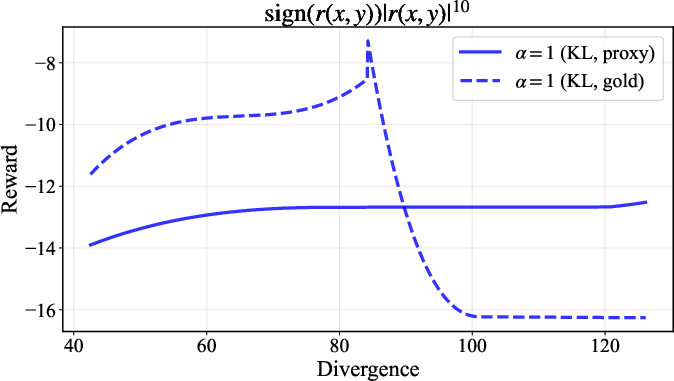
Figure 1: As the power exponent θ5 increases, the proxy reward keeps increasing with KL divergence, while the gold reward peaks and then collapses, signaling catastrophic Goodhart in the heavy-tailed regime.
To mitigate this, the authors analyze and advocate for R\'enyi-regularized RLHF, where R\'enyi divergence constraints provide a power-type penalty on large density-ratio departures, thereby directly controlling extreme policy deviations and yielding sharply bounded increases in expected reward on sub-Weibull tails: θ6
where θ7 is the Orlicz norm of the reward under the reference.
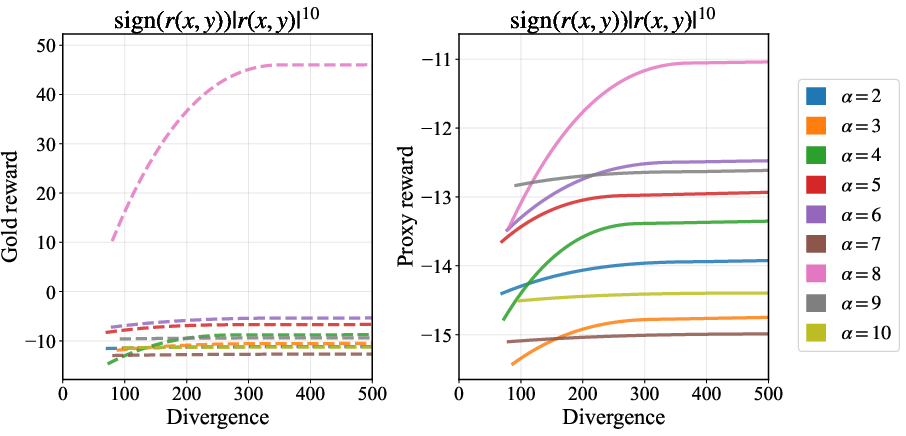
Figure 2: R\'enyi-regularized RLHF with heavy-tailed proxy rewards yields gold reward curves that increase and then plateau, in contrast to KL which exhibits collapse.
Furthermore, in the context of best-of-θ8 policies, the data-processing inequality for R\'enyi divergence ensures no catastrophic reward inflation, and the reward gain scales benignly as θ9.
Experimental Validation and Diagnostics
The empirical section implements an RLHF pipeline with power-transformed proxy rewards to induce controlled heavy tails. Distributional diagnostics confirm the emergence of heavy tails under higher θ=20 (order-preserving transformation):
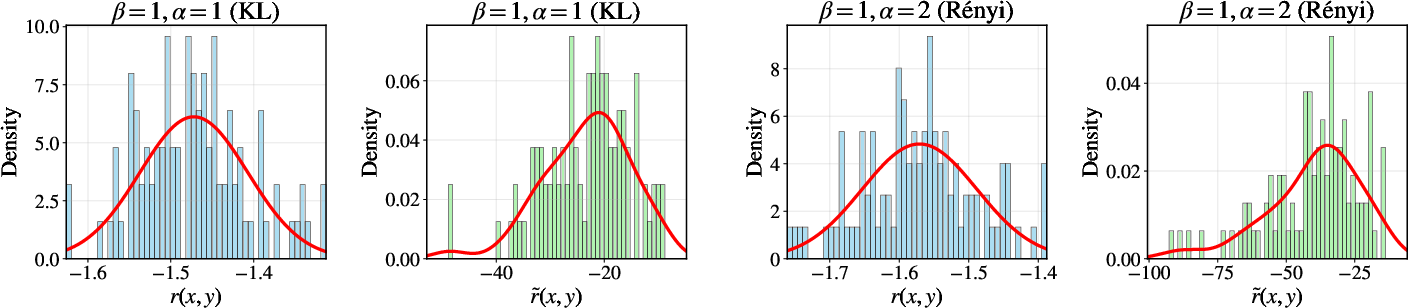
Figure 3: Proxy reward distribution before and after an order-preserving heavy-tailed transformation for θ=21, showing amplified extremes in the latter.
The experiments report striking divergence between proxy and gold rewards under KL penalties as tails become heavier: gold reward rises and then collapses with increasing divergence. Under R\'enyi regularization θ=22, the relationship stabilizes, with the gold reward being monotone or plateauing (see Figures~\ref{divergence_vs_reward11} and~\ref{divergence_vs_reward1210}). This holds across transformations and for additive Weibull-noise constructions.
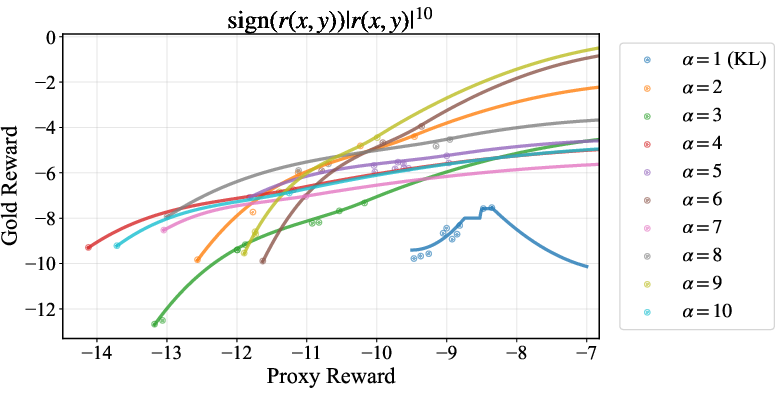
Figure 4: Proxy--proxy-gold reward coupling under R\'enyi regularization remains monotone for all tested heavy-tail scenarios, while KL collapses for large θ=23.
Implications and Future Directions
The work rigorously establishes that KL-based generalization and RLHF regularization are inadequate for heavy-tailed regimes—empirical and theoretical analyses reveal the possibility of arbitrarily poor reward transfer under even minor KL departures. In contrast, R\'enyi and, more generally, θ=24-divergence metrics, provide tail-adaptive, robust bounds connecting algorithmic information and statistical generalization.
This has practical consequences for the construction of RLHF trust regions and the design of regularization in large-scale LLM alignment: tail-aware divergence penalties are critical to avoid overoptimization on rare, spurious reward artifacts and to stabilize transfer to more accurate evaluators.
Theoretically, the framework serves as a blueprint for extending empirical process and information-theoretic learning theory to non-sub-Gaussian, real-world settings—an open question is how to optimize bounds and algorithms when tail indices or process increments are only locally controlled or nonparametric. Methodological extensions to complex dependency structures, non-i.i.d. data (RL trajectories), more general optimization dynamics, and hybrid divergence metrics are natural next steps.
Conclusion
The paper provides a comprehensive, technically sophisticated framework for heavy-tailed generalization in statistical learning, with pivotal implications for RLHF and stochastic optimization. Tail-adaptive information measures, notably R\'enyi divergence, are established as robust and quantifiable tools for both theoretical analysis and algorithm design under heavy-tailed reward and loss distributions. This challenges KL-centric orthodoxy in regularized policy optimization, and points toward more resilient, tail-sensitive algorithmic pipelines for both AI alignment and large-scale learning (2604.10727).

