- The paper reproduces AlphaEdit’s high initial efficacy and generalization, confirming performance up to 2,000 sequential edits.
- It employs null-space constrained parameter updates, ensuring factual preservation while revealing fluency and consistency degradation.
- The study shows that architectural differences can undermine the editing mechanism, highlighting the need for model-specific adaptations.
Reproducibility of AlphaEdit: Scope, Empirical Limits, and Architectural Generalization
Introduction
The reproducibility study of "AlphaEdit: Null-Space Constrained Knowledge Editing for LLMs" (2606.26783) offers a comprehensive and technical assessment of the AlphaEdit framework. The centerpiece of AlphaEdit is its strict null-space constraint on parameter perturbation, which, in principle, ensures knowledge preservation when facts are edited in pre-trained LLMs. This study rigorously validates reported findings, stress-tests the method under extended editing horizons, and interrogates its operational boundaries across modern transformer architectures. The results illuminate both the capabilities and practical fragilities of null-space-constrained editing within diverse deployment regimes.
AlphaEdit Mechanism and Theoretical Foundations
AlphaEdit extends the locate-then-edit paradigm pioneered by ROME and MEMIT, which exploit causal tracing to identify weights most responsible for specific factual associations. The principal advance in AlphaEdit is the explicit projection of each parameter update onto the null space of a key matrix spanning facts to be preserved. The theoretical claim is that, under perfect localization of key directions, the preservation of old knowledge is structurally guaranteed, since updates cannot influence directions spanned by K0. The optimization objective is augmented with regularization and interference-penalty terms for prior edits, and admits a closed-form solution due to the convexity and quadratic structure.
However, the guarantee is conditional: architectural correctness of the localization step and the geometric relevance of the null-space projection are required. Furthermore, the preserved key set is finite and may not globally characterize all background knowledge. Null-space dimensionality and the cumulative effect of batched or large-scale, consecutive parameter updates remain open operational questions. AlphaEdit's purported strengths—modularity, empirical robustness to catastrophic forgetting, and compatibility with locate-then-edit workflows—necessitate thorough reproducibility and boundary testing.
Empirical Replication of Original Results
The study precisely reproduces AlphaEdit's reported efficacy, generalization, and specificity scores on both CounterFact and ZsRE benchmarks, as originally established for Llama3-8B, GPT2-XL, and GPT-J. Efficacy and generalization approach or exceed 99% and 93%, respectively, immediately post-edit, with minimal specificity loss. These high-precision metrics are stable under sequential editing of 2,000 facts, confirming the original claims within the intended evaluation window.
However, the authors systematically identify unexplained sharp discrepancies in fluency and consistency (entropy and reference response-based metrics). Even after correcting KV cache and tokenizer misalignments, text generation quality remains noticeably diminished post-edit. This divergence does not perturb probability-based editing performance, but highlights a latent structural output collapse potentially induced by the editing procedure. The issue persists across generation methods, suggesting a need for future diagnostic and mechanistic analysis.
Generalization Across Modern Architectures
Extending AlphaEdit to Llama3.2, Qwen2.5, Phi3-3.8B, and Gemma2-2B, the study reveals highly non-uniform transferability. While Qwen2.5 and Llama3.2 achieve strong post-edit efficacy and paraphrase accuracy (often >90%), performance collapses on Phi3-3.8B and Gemma2-2B.
Failure analysis attributes these effects to model-architecture deviations breaking causal-tracing localization or violating the mathematical premises of the null-space constraint:
- Fused Projections in Phi3: The joint computation of qkv and gate projections modifies key-vector geometry, making causal tracing unreliable. Empirical evaluation reveals that base generation probabilities for factual completions are nearly random and unaffected by editing, underscoring an ineffective localization.
- Nonlinear Layernorm in Gemma2: Post-MLP RMSNorm disrupts the linear residual assumption. This structural change invalidates the guarantee that orthogonality in pre-norm space preserves facts post-norm, resulting in algorithmic editing failure even when tokenization and generation artifacts are corrected.
These findings demonstrate that AlphaEdit is not a universally robust drop-in editing procedure. Application to non-Llama architectures requires tailoring both localization heuristics and the optimization procedure to account for architectural idiosyncrasies.
Scaling Sequential Edits: Catastrophic Forgetting and Degradation
A core claim of AlphaEdit is robust performance under extended sequences of edits. The paper systematically extends the edit horizon to 10,000 facts, benchmarking both editing-specific and general downstream task metrics after each 1,000-edit interval. Results are architecture-dependent but yield several key observations.
- Initial Robustness, Eventual Degradation: For Llama3-8B, GPT2-XL, GPT-J, and Llama3.2-3B, performance is stable and near-optimal up to 2,000–3,000 edits, consistent with prior claims.
- Onset of Degradation: Beyond 5,000 edits, efficacy, generalization, and general downstream F1 (on GLUE and related tasks) decline—sometimes recover due to model-specific dynamics (notably in GPT-J), but overall display a bounded null-space guarantee.
- Task Sensitivity: Knowledge- and reasoning-intensive tasks, especially MMLU, experience sharper drops compared to more robust or localized tasks.
- No Catastrophic Collapse: Unlike unconstrained methods (such as MEMIT or ROME at scale), AlphaEdit avoids abrupt collapse to chance-level performance. Instead, degradation is gradual and—depending on architecture—sometimes partially reversible.
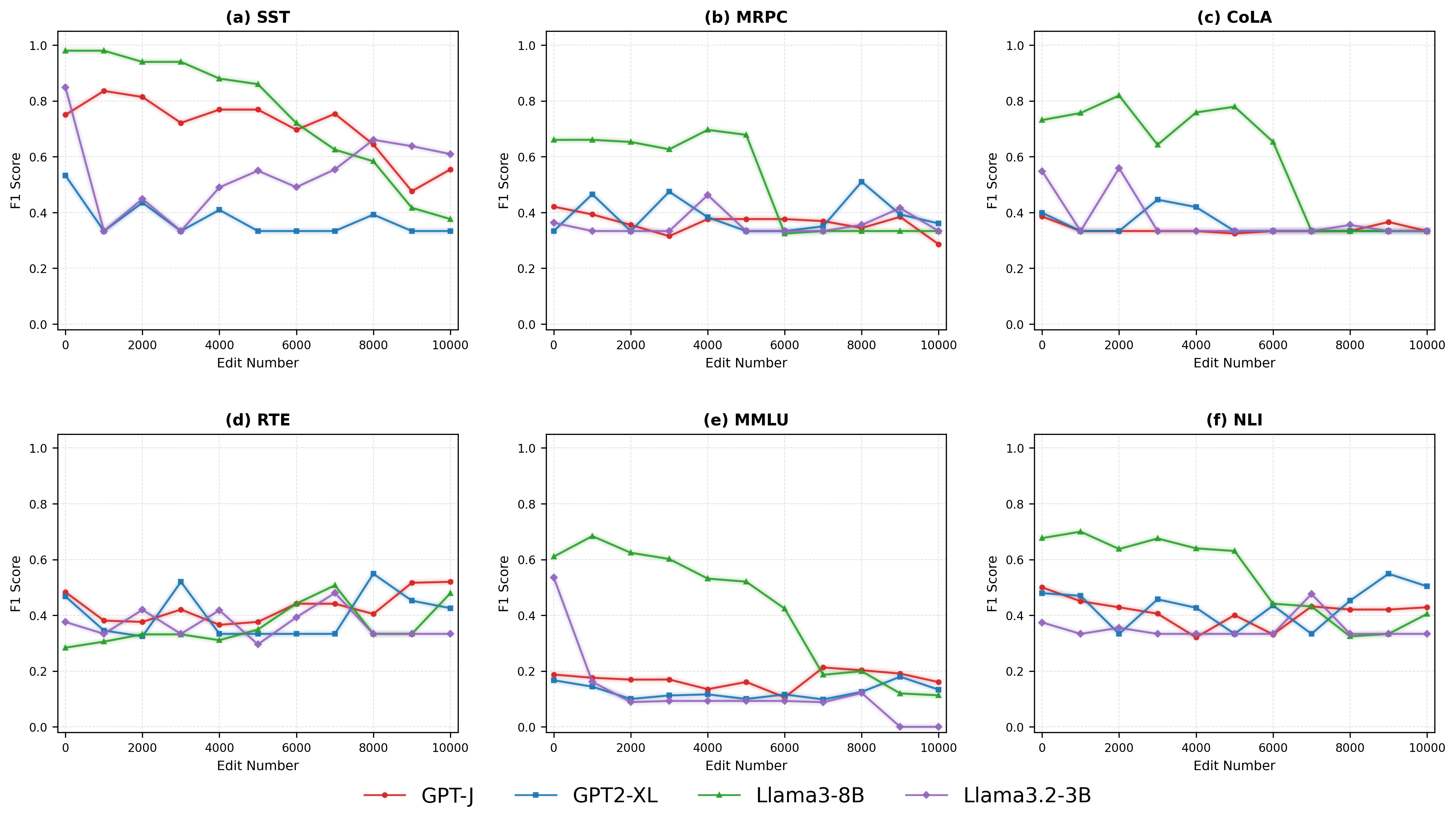
Figure 1: F1 scores for SST, MRPC, CoLA, RTE, MMLU, and NLI across sequential edits indicate non-catastrophic, gradual capability decline with model-specific sensitivity.
The empirical upper bound on AlphaEdit's protection against catastrophic forgetting is thus not absolute, but a function of null-space exhaustion, key-coverage limitations, and the structural alignment between model and editing assumptions.
Assessment on Additional Benchmarks and Safety-Relevant Behavior
Evaluation on BoolQ, HellaSwag, and XSTest further discriminates the resilience of AlphaEdit:
- BoolQ: Reading comprehension deteriorates rapidly in Llama models as edits accrue, while GPT-J demonstrates greater robustness.
- HellaSwag: Low baseline performance and minor fluctuations, but capability in initially strong models converges towards weaker baselines after high edit counts.
- XSTest: Safety-oriented refusal accuracy is more stable, but still demonstrates degradation above 5,000 edits in larger-capacity models.
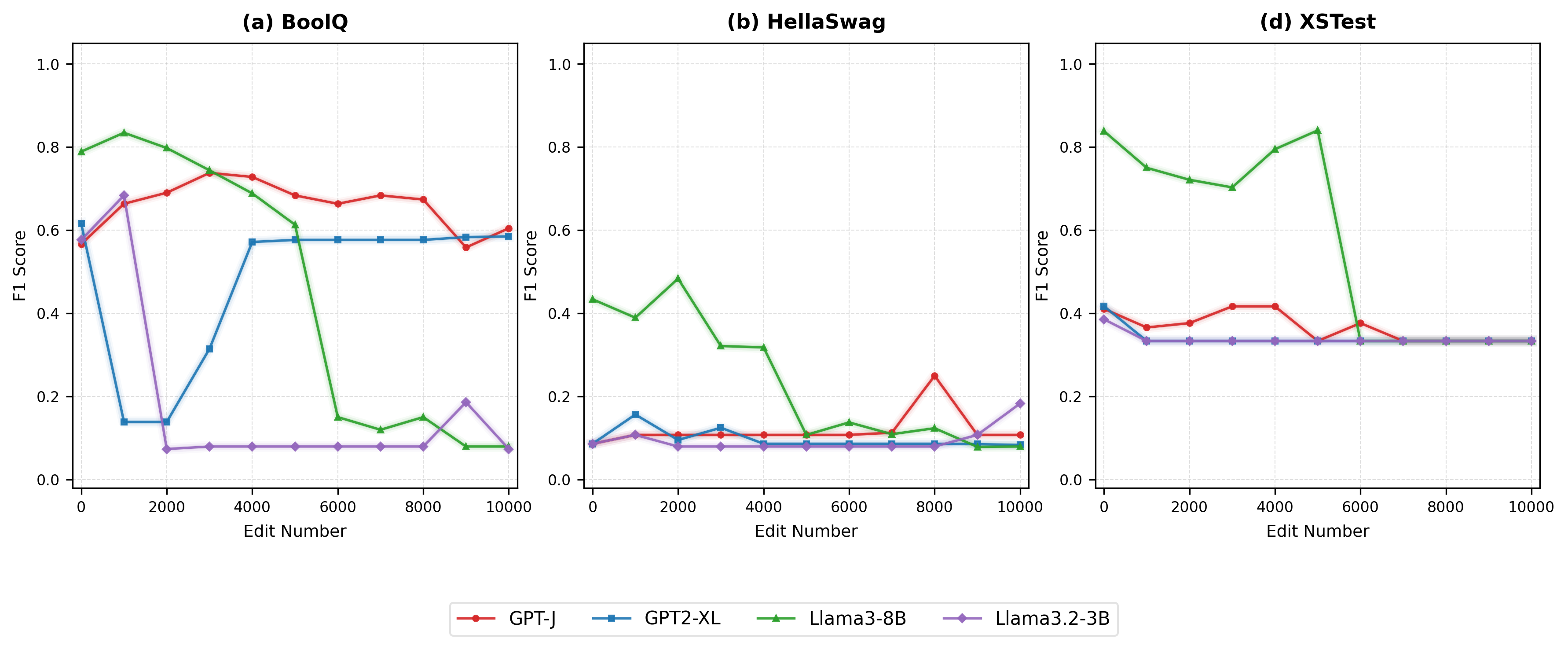
Figure 2: F1 scores on BoolQ, HellaSwag, and XSTest as a function of sequential edits in GPT-J, GPT2-XL, Llama3-8B, and Llama3.2-3B, illustrating both resilience and eventual capability loss on safety and reading-comprehension tasks.
These outcomes indicate that AlphaEdit not only affects factual recall but, under high edit density, erodes auxiliary competencies and safety behavior. Under the lens of AI alignment, this result flags the necessity for longer-horizon calibration and enhanced, architecture-aware edit regularization.
Implications, Limitations, and Future Prospects
This study provides strong, reproducible support for AlphaEdit's theoretical claims under the originally scoped conditions—2,000 sequential edits, Llama-style architectures, and standard evaluation. At the same time, it exposes that AlphaEdit:
- Does not universally generalize to new architectures, with failures originating from localization breakdown and geometric misalignment.
- Offers bounded protection against forgetting: degradation emerges after several thousand edits, not through catastrophic collapse, but via gradual loss of general and safety-related capabilities.
- Induces unaddressed failure modes in generation (referenced by the collapse in fluency and consistency scores), the root causes of which remain to be fully elucidated and addressed.
These results call for:
- Rigorous adaptation of editing-localization to match non-standard layer structures and tokenization schemes.
- Theoretical and empirical development of more general null-space-or orthogonalization schemes compatible with fused and nonlinearly normalized layers.
- Expansion of capability/safety evaluations beyond short-range factual recall to holistic and multi-task settings.
Conclusion
The reproducibility analysis of AlphaEdit confirms the main findings and practical operational boundaries of null-space constrained editing for LLMs. The null-space approach is highly effective within its original scope, but its guarantees are not absolute and are sensitive to architectural features and edit scale. Facilitating reliable, safe knowledge editing across future LLMs will require further fundamental advances in both geometric editing theory and model-tailored engineering.

