- The paper introduces LightEdit, a framework for lifelong LLM knowledge editing through selective probability suppression and edit-aware relevance filtering.
- It employs an edit-aware selector and in-context decoding to maintain high reliability, generality, and locality while preventing catastrophic forgetting.
- Experimental results show LightEdit's superior performance and efficiency over traditional methods, even with thousands of sequential edits.
Scalable Lifelong Knowledge Editing via Selective Probability Suppression: The LightEdit Framework
Introduction
The challenge of incorporating dynamic, up-to-date knowledge into LLMs without retraining a model from scratch has motivated research into knowledge editing methodologies. Traditional parameter-editing and retrieval-based methods are confronted with significant trade-offs, such as catastrophic forgetting, high retraining costs, or poor generalization to unseen editing distributions. The paper "Towards Scalable Lifelong Knowledge Editing with Selective Knowledge Suppression" (2604.19089) introduces LightEdit, a framework designed to efficiently support lifelong knowledge editing by integrating an edit-aware filtering mechanism with selective in-context probability suppression during inference. LightEdit demonstrates strong performance in both accuracy and computational efficiency across multiple benchmarks and models.
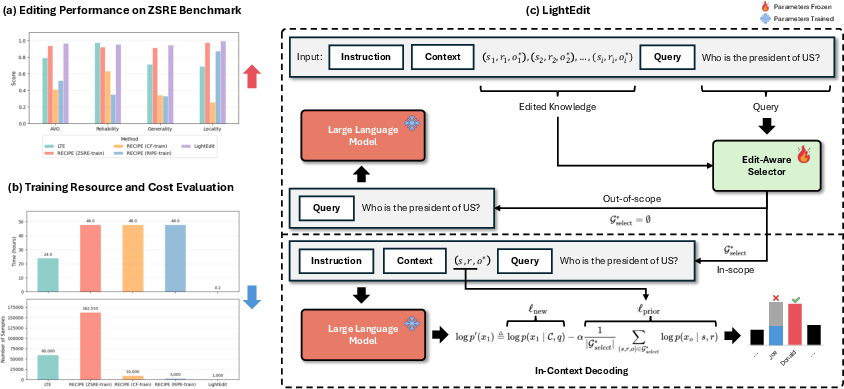
Figure 1: Comparative experimental results show LightEdit’s substantial performance and efficiency benefits over prior lifelong knowledge editing methods and the LightEdit framework architecture.
Problem Setting and Key Evaluation Criteria
Lifelong knowledge editing requires models to evolve with continual knowledge insertions (edits), maintaining consistency, generalization, and minimal interference with unedited content. The paper formalizes three core evaluation criteria for lifelong editing:
- Reliability: Correctness on in-scope queries directly referencing edited facts.
- Generality: Robustness to paraphrased queries semantically aligned with edited content.
- Locality: Conservation of original outputs for out-of-scope queries (i.e., minimal collateral change to unrelated information).
Unlike most prior approaches that either update parameters or use monolithic external memories, LightEdit combines a supervised cross-encoder to select relevant knowledge with an in-context decoding mechanism that explicitly downweights the probability of original (pre-edit) knowledge at inference. This avoids direct parameter modifications and modeling collapse.
LightEdit: System Architecture and Workflow
Edit-Aware Selector (EAS)
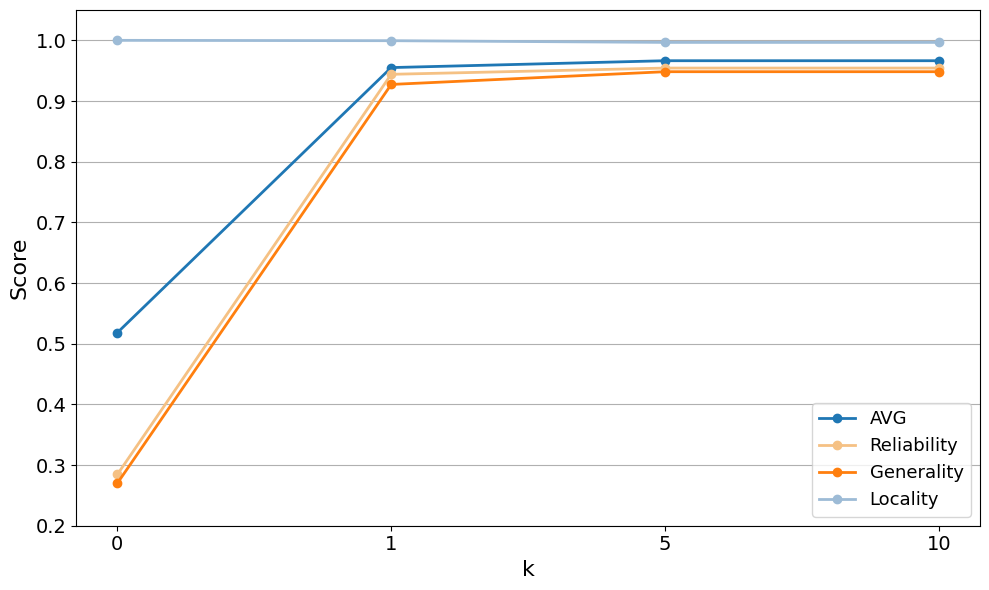
The first component is the edit-aware selector, implemented as a binary classifier (fine-tuned XLM-RoBERTa) that encodes a pairwise entailment decision between a query and each retrieved knowledge triple candidate. The candidate set comes from a top-k retrieval over the knowledge memory. Only facts judged as relevant are prepended to the LLM prompt, ensuring only pertinent information is injected, preserving locality.
In-Context Decoding (ICD) with Selective Probability Suppression
Upon detection of a knowledge conflict, in-context decoding adjusts the model’s output by suppressing the log probability of the initial token of the original (pre-edit) answer. This is achieved via subtraction of a scaled prior log probability term, parameterized by α, from the context-conditioned log probability. By controlling only the first token, the mechanism leverages the cascading effect of autoregressive generation, balancing fluency with effective knowledge steering.
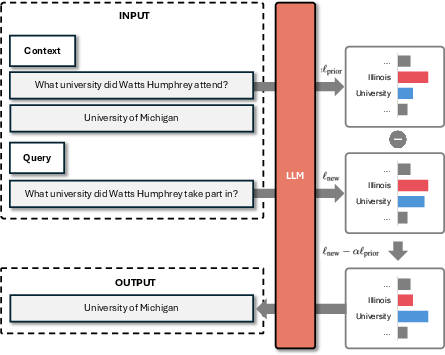
Figure 2: In-context decoding suppresses the prior answer’s probability, guiding the generation towards selecting the edited content in conflicting scenarios.
Experimental Results
Comprehensive evaluations were conducted on ZSRE (relation extraction), Counterfact (counterfactual edits), and RIPE (measuring ripple effects of edits beyond the target). LightEdit outperforms parameter-editing (ROME, MEMIT), memory-augmentation (SERAC, GRACE), and recent retrieval-augmented frameworks (LTE, RECIPE) on all three metrics, both for LLaMA-3 and GPT-J architectures.
Notably, LightEdit achieves reliability, generality, and locality scores exceeding 0.94—0.99 on all datasets, with only negligible degradation as the number of sequential edits increases from 1,000 to 5,000 (see supplementary results), confirming robustness and minimal performance drift.
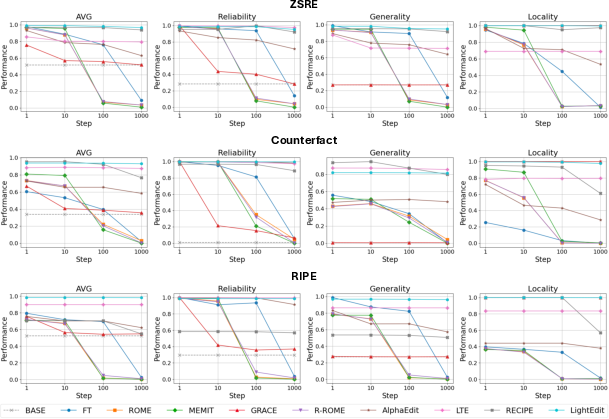
Figure 3: LightEdit’s editing performance remains stable with increasing edit steps, unlike alternative methods, which show rapid degradation.
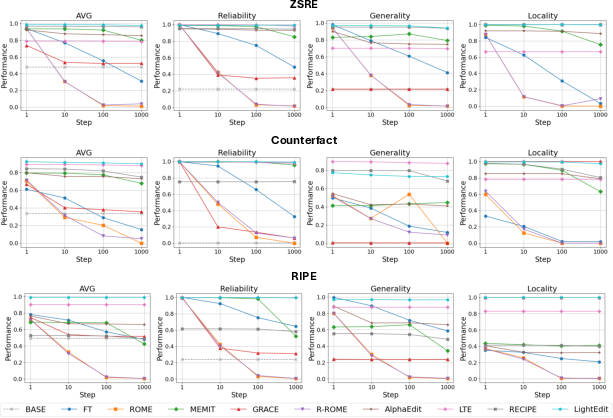
Figure 4: Editing performance scaling with edit size using GPT-J further confirms LightEdit’s model-agnostic robustness.
Ablation and Sensitivity Analyses
The paper presents extensive ablation studies:
LightEdit’s editing and inference cost is significantly below that of baselines, with total per-edit times orders of magnitude lower than parameter-editing methods.
Semantic Effects and Robustness
To establish that LightEdit meaningfully alters model behavior, the authors visualize the model’s token distributions before and after editing, showing a clear semantic shift towards the inserted fact from the first token, supporting the method’s efficacy in resolving factual conflicts while maintaining output fluency.
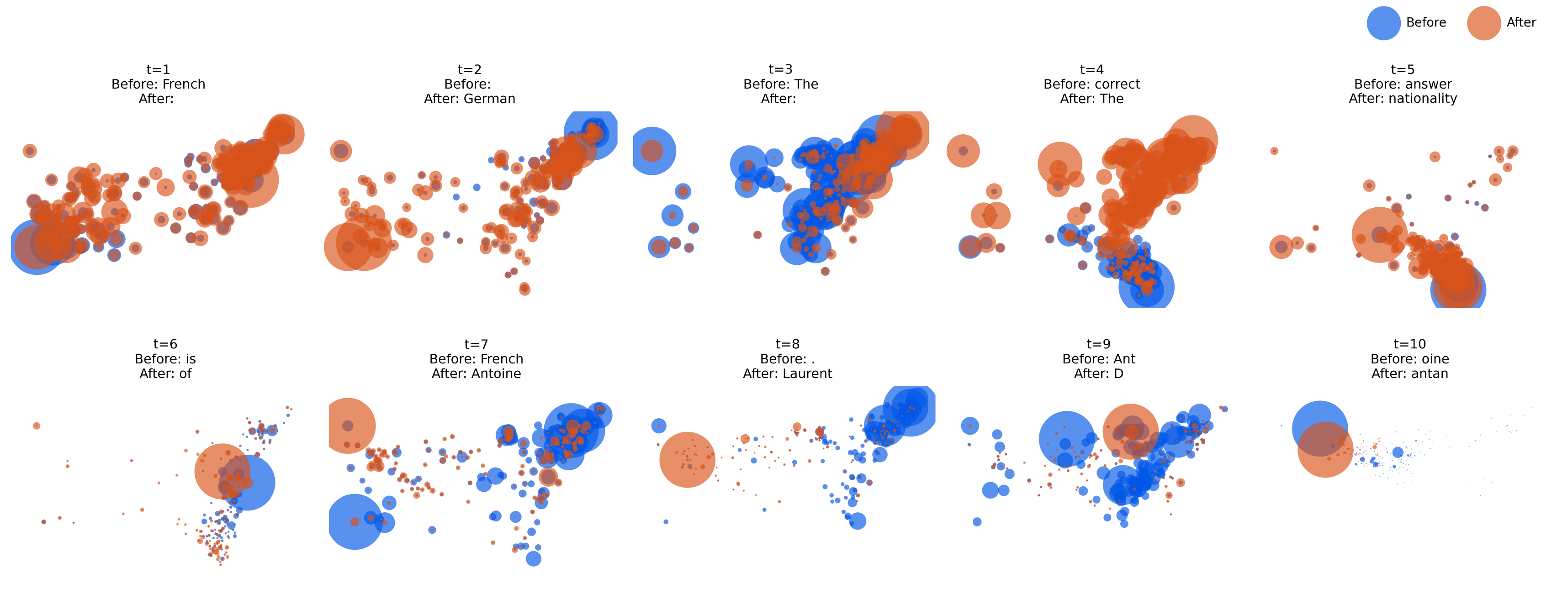
Figure 6: Token distribution embeddings for each generated position after in-context decoding: the probability mass shifts rapidly toward the revised answer.
Comparison with Baselines and Generalization
On the UniEdit unified benchmark and under extended edit regimes, LightEdit’s performance remains robust and well-balanced across reliability, generality, and locality. When compared to in-context learning-based editors (IKE), LightEdit achieves higher generality and locality and is less sensitive to prompt length constraints or context scaling.
Implications and Future Directions
LightEdit demonstrates that lifelong knowledge editing can be achieved efficiently without parameter retraining or massive task-specific data, by decoupling relevance filtering and probabilistic knowledge suppression at inference. Its efficiency and minimal interference on unrelated capabilities suggest strong practical viability for production LLM maintenance. However, the framework’s reliance on cross-encoder supervision and careful hyperparameter tuning highlight open challenges in fully automating the selection and suppression processes. Integrating differentiable selector components or extending to open-ended reasoning (including hierarchical, multi-hop, or temporal edits) would be promising future directions.
Potential future developments include:
- Extension to temporal or contradictory knowledge revision scenarios, where facts change and must be reconciled in context.
- Application to safe and fair knowledge revision, including unlearning or bias correction.
- Integration with retrieval-augmented generation pipelines for explainable and traceable LLM editing.
Conclusion
LightEdit delivers a highly efficient, accurate, and scalable lifelong knowledge editing solution by synergizing relevance-aware retrieval with inference-time probability modulation. It achieves state-of-the-art reliability, generality, and locality across diverse scenarios, requires minimal retraining, and remains robust to scaling and adversarial conditions. The framework marks meaningful progress towards continuous LLM revision, pointing toward a new class of systems for knowledge management in deployed AI models.