Surviving by Serving: Functional Relevance Drives Self-Organization in Complex Adaptive Systems
Published 25 Jun 2026 in q-bio.NC, cs.NE, and nlin.AO | (2606.26733v1)
Abstract: Complex adaptive systems often develop organized structures without centralized control. Yet the local mechanisms by which functional organization emerges and persists remain incompletely understood. Here we propose Surviving by Serving (SBS) as a general principle of self-organization: components persist as long as their outputs are utilized by other components, whereas prolonged non-utilization promotes adaptation and exploration. To investigate this idea, we introduce a minimal multi-agent model in which agents transform shared resources and receive only local feedback when their outputs are subsequently utilized elsewhere in the system. Despite the absence of global objectives, the system spontaneously self-organizes into functional interaction networks. We observe the emergence of stable transformation chains, core-periphery organization, and the generation of novel states that enable previously inaccessible target conditions to be reached. Remarkably, self-sustaining interaction networks can arise even without external selection pressures, creating a pre-adaptive search phase from which later functional solutions emerge. These findings suggest that functional utilization may provide a simple, substrate-independent mechanism for the emergence and stabilization of organized structure in complex adaptive systems.
The paper demonstrates that agents persist only when their outputs are utilized, triggering the formation of self-organized, functional networks.
It employs a minimal multi-agent model with local feedback, credit-driven adaptation, and resource transformation to generate robust core-periphery structures.
Simulation results reveal that the SBS mechanism overcomes state-space constraints and drives novelty generation, offering insights for designing adaptive systems.
Surviving by Serving: Functional Relevance-Driven Self-Organization in Complex Adaptive Systems
Introduction
This work posits and formalizes the Surviving by Serving (SBS) principle as a substrate-independent driver of self-organization in complex adaptive systems. Unlike traditional approaches that hinge on global optimization, selection, or explicit fitness criteria, the SBS mechanism ties agent persistence exclusively to ongoing functional relevance: agents persist only as long as their outputs are utilized elsewhere in the system. Through a minimal multi-agent model operating solely on local feedback, the authors demonstrate that SBS robustly induces the emergence of functional networks, core-periphery structures, and mechanisms for generating states that achieve previously unreachable objectives—without central coordination or external task specification (2606.26733).
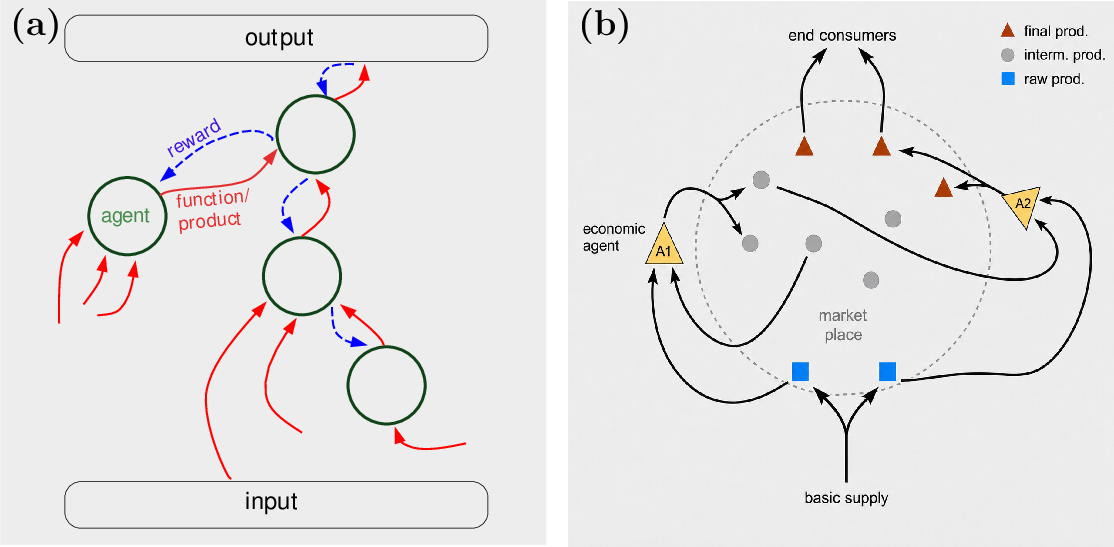
Figure 1: Conceptual overview of the SBS principle (a) and corresponding adaptive interaction network model (b), highlighting purely local credit assignment via utilization.
Model Architecture and Adaptive Dynamics
Simulations are conducted in a resource transformation network comprising a fixed agent population, raw-material sources, evaluators, and an aging mechanism. All system elements interact by the reading, transformation, and selection of vectors in a continuous, normalized feature space. Each agent is parameterized by input requirement vectors, transformation coefficients, and a modification vector, and has the capacity for credit-driven adaptive mutation.
Agents earn credit exclusively when another agent or evaluator utilizes (“serves”) one of their generated state vectors (post-transformation outputs). Prolonged non-utilization raises the probability of adaptation via a Hill function, resulting in incremental, local parameter mutation. Evaluators are stateless entities with fixed target conditions, selecting for agent-generated states that exceed a cosine similarity threshold. The raw-material source injects new feature vectors, while the aging mechanism enforces resource turnover. Agents cannot directly self-use their outputs, and input constraints preclude trivial circulation.
Emergent Functional Interaction Networks
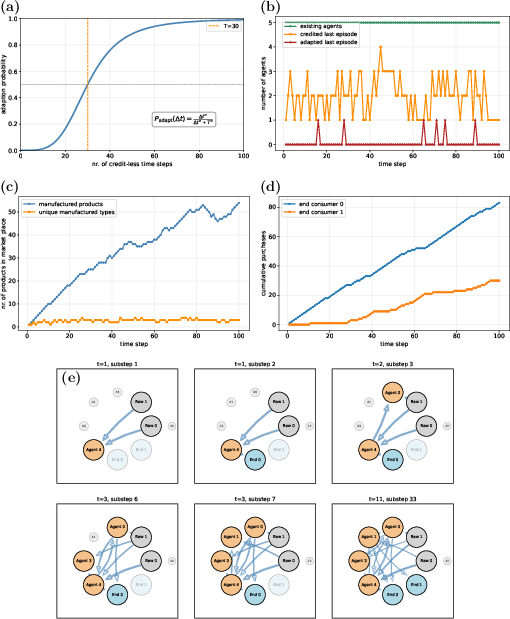
Even in minimal systems (Nagt=5), the SBS rule leads to the robust emergence of stable transformation chains that satisfy simultaneous evaluator targets—a full-target criterion—despite the absence of centralized planning or long-range feedback. The key driver is distributed, local validation: functional relevance, measured only by immediate utilization, bootstraps the spontaneous assembly of interaction pathways.
After initialization, only a core subset of agents receives persistent credit and stabilizes, forming a backbone for network structure, while the periphery adapts or is phased out due to lack of local functional relevance.
Figure 2: Empirical time-course of network emergence, credit assignment, adaptation rates, and state selection events demonstrating the SBS process in a minimal agent system.
Overcoming State-Space Constraints and Generating Novelty
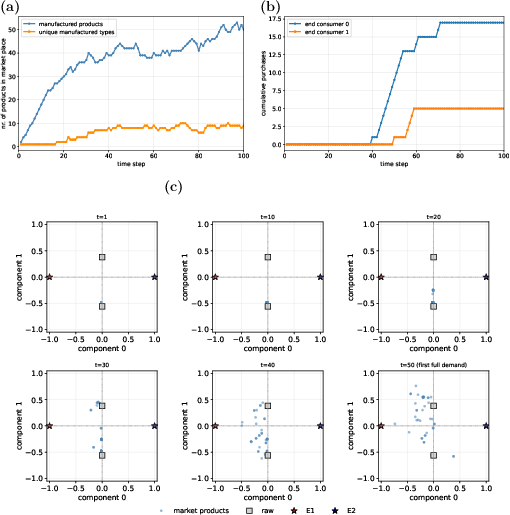
The Missing Dimension Hurdle (MDH) experiment probes the network’s ability to transcend structural deficits in the initial resource pool. Agents are tasked with generating outputs in a latent dimension absent from all raw materials but required by evaluators. Here, agents’ out-of-subspace mutation terms (ηoosRi) permit the incremental emergence of the necessary feature via multi-step transformations and recurrent adaptation.
Thirty to forty episodes are required for the cumulative effect of exploratory adaptations to generate sufficient amplitude along the required dimension, after which evaluator targets previously inaccessible are met, implying that SBS can systematically overcome geometric bottlenecks via distributed, credit-driven search and novelty generation.
Figure 3: Dynamics of state-space exploration, showing gradual diffusion into previously inaccessible dimensions and eventual target satisfaction under MDH conditions.
Core-Periphery Organization and Structural Stability
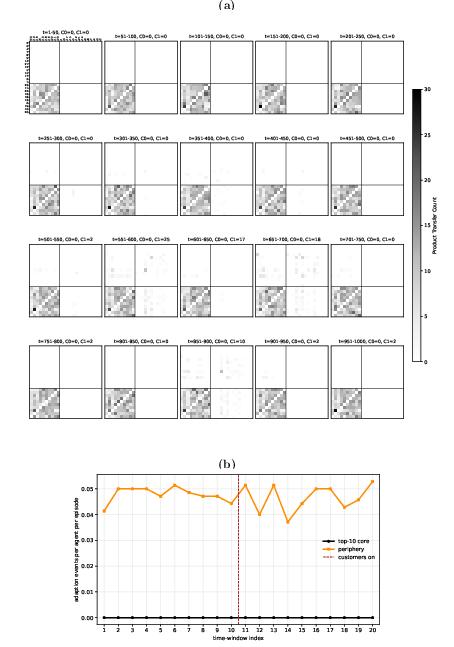
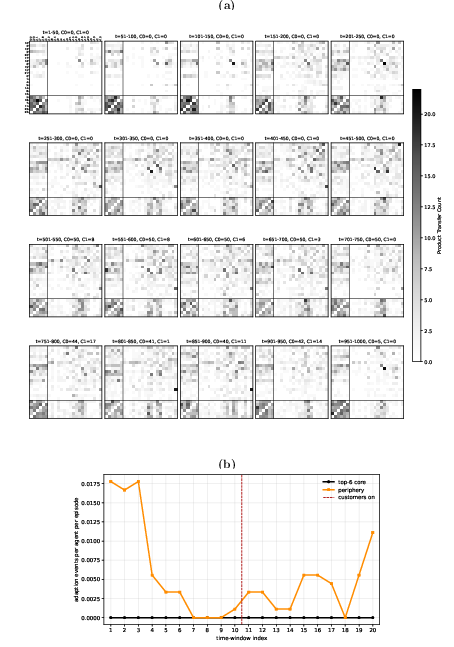
Scaling to Nagt=24 in MDH conditions, simulation runs consistently yield the spontaneous separation of agent populations into a densely interactive, persistent core and a weakly-adaptive periphery. Core members stabilize through mutual utilization, with adaptation effectively quenched, while the periphery continues to explore parameter space. Notably, this core-periphery distinction arises independently of evaluator activity; cores pre-exist external target imposition, serving as a pre-adaptive search mechanism.
Multiple simulations confirm that core composition and structure are in general stable within runs, although variance exists across initialization seeds. A minority of cases exhibit more distributed or unstable core-periphery distinctions.
Figure 4: Matrix visualization of stable core network emergence and temporal adaptation rates in the core versus periphery.
Figure 5: Example of weaker, less stable core network formation and heightened adaptation dynamics, highlighting sensitivity to parameter choices and initial conditions.
Parameter Dependence and Functional Diversity
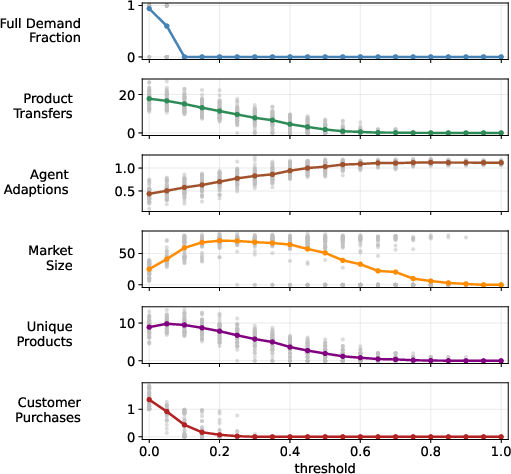
The acceptance threshold (Θacc) for agent or evaluator selection acts as a critical order parameter for network properties. Lower thresholds yield redundant, high-frequency transfers and widespread agent participation, while high thresholds restrict functional connectivity, suppress transfer rates, and force persistent adaptation. Both interaction space size and unique state diversity exhibit unimodal dependency on Θacc, with diversity maximized at intermediate values.
Figure 6: Collective metrics—including target attainment frequency, agent transfers, adaptation rates, and diversity—as a function of selectivity parameter Θacc.
Theoretical Implications and Conceptual Extensions
Substrate-Independence and SBS as a Mechanism for Autocatalysis
SBS generalizes existing theories of autocatalytic and autopoietic organization by making persistence contingent on ongoing local functional integration. Unlike traditional autocatalytic sets or network closure, SBS introduces a dynamic, relational test for persistence—utilization—rather than dependence on structural connectivity alone. This principle is applicable to chemical, neural, economic, technological, and artificial agent systems without modification.
Distributed Selection and Organizational Closure
By linking persistence exclusively to downstream functional impact, SBS operationalizes distributed selection absent any global objective, akin to organizational closure in biological systems. Core-periphery emergence under SBS provides an explicit mechanism for balancing robustness (via core exploitation) with evolvability (peripheral exploration), paralleling phenomena seen in neural, social, and technological networks.
Implications for Adaptive Information Processing and NeuroAI
The analogy to reservoir computing and self-organizing recurrent neural architectures is direct: agent transformations correspond to high-dimensional dynamical representations, evaluators act as readouts, and credit assignment via SBS provides a relational analogue to local learning mechanisms or utility propagation. SBS suggests possible extensions to neural architectures in which network subcomponents adaptively stabilize based on actual downstream utilization, independent of explicit global optimization—potentially bridging the gap between self-organization and functional task learning.
Future Directions
Potential extensions include recursive or relevance-weighted credit propagation, richer adaptation dynamics, and exploration of open-ended systems with dynamic agent populations. Of particular interest would be explicit propagation of evaluator-derived credit through intermediary utilization chains, enabling deeper task-driven self-organization while preserving SBS’s localism. Systematic parameter sweeps and theoretical analysis of the transitions between redundancy, diversity, and sparsity regimes are warranted to classify SBS-driven phenomena across complex system architectures.
Conclusion
This work provides compelling evidence that the SBS principle—persistence through functional relevance as validated by ongoing utilization—constitutes a minimal, domain-general mechanism for the emergence of functional organization in complex adaptive systems. SBS yields adaptive core-periphery architectures, supports open-ended generation of novel functional states, and is robust to domain, substrate, and parameter specification. It complements and extends classical theories of autocatalysis, organizational closure, and distributed intelligence, and offers actionable insights for the design of biologically inspired adaptive networks and artificial cognitive systems.
“Emergent Mind helps me see which AI papers have caught fire online.”
Philip
Creator, AI Explained on YouTube
Sign up for free to explore the frontiers of research
Discover trending papers, chat with arXiv, and track the latest research shaping the future of science and technology.Discover trending papers, chat with arXiv, and more.