- The paper demonstrates that minimal agent mobility divergence, without advanced optimization, suffices for global connectivity.
- Analytical and empirical methods reveal how interface occupation, boundary distances, and network densification evolve with increasing exploratory fractions.
- Findings highlight that structured spatial constraints, rather than sophisticated strategies, drive system-wide integration in agent-based landscapes.
Problem Statement and Model Architecture
This paper systematically investigates the emergence of large-scale connectivity from local stochastic dynamics in structured agent-based systems. The primary focus is to determine whether system-level reconfiguration demands agent-level sophistication—optimization, learning, or directed search—or whether global structural change arises from minimal heterogeneity in agent mobility when embedded in a spatially constrained, multi-attractor landscape. The environment is modeled as a continuous two-dimensional space partitioned into K attractor basins separated by boundaries. Agents are classified as embedded (locally constrained near attractor centers) or exploratory (higher-mobility dynamics), with the exploratory fraction p controlling the heterogeneity gradient.
Mechanistically, exploratory agents apply either pure random-walk dynamics (baseline), interface-sensitive scoring (bias toward inter-attractor boundaries), or novelty bonuses (favoring unvisited attractors). The network-level structure emerges by encoding each observed attractor transition as a directed edge in a dynamically accumulated transition graph whose component and density structure are key system observables.
Spatial Differentiation and Event Localization
Heterogeneous mobility, even in the absence of explicit agent-level optimization, produces significant spatial segregation. As p increases, the exploratory sub-population exhibits systematic localization near inter-attractor boundaries. Quantitative measures—mean boundary distance and interface occupation—demonstrate that embedded agents remain distant from interfaces, while exploratory agents increasingly concentrate at the interfaces as mobility heterogeneity intensifies.
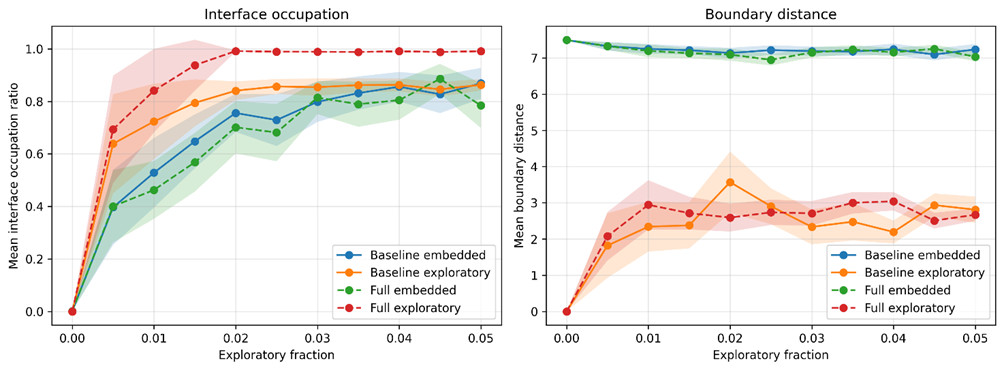
Figure 1: Interface occupation and mean boundary distance as functions of the exploratory fraction p for embedded and exploratory agents, contrasting baseline and full (structured) models.
Crucially, transitions between attractor states—configuration switching—are localized at boundaries. The conditional probability of a transition event is sharply peaked for agents proximate to interfaces, and vanishes rapidly with basin-depth, across both agent types, but with a broader distribution for exploratory agents.
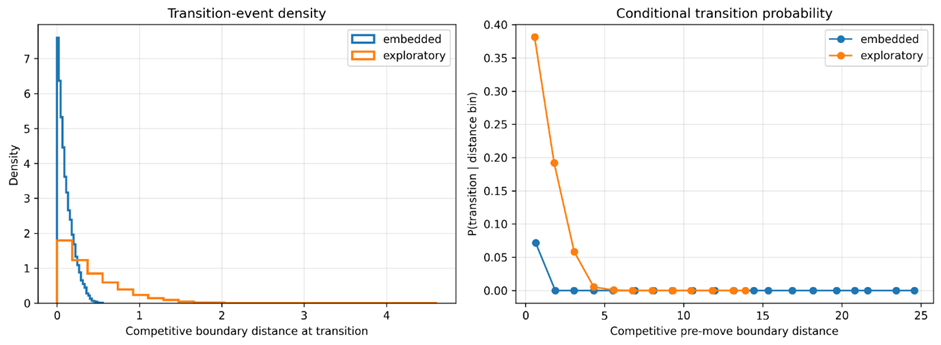
Figure 2: Distribution of competitive boundary distance at transition events and conditional probability of transition as a function of pre-move distance, segregated by agent type.
Transition-Network Expansion and Emergent Connectivity
At the system scale, repeated localized boundary crossings accumulate over time, inducing transition-network expansion. Analytical and empirical network measures (edge count, density, mean degree) substantiate that increases in p engender densification of the transition network. Exploratory agents act as effective catalysts for the construction of network edges, integrating previously isolated attractor regions.
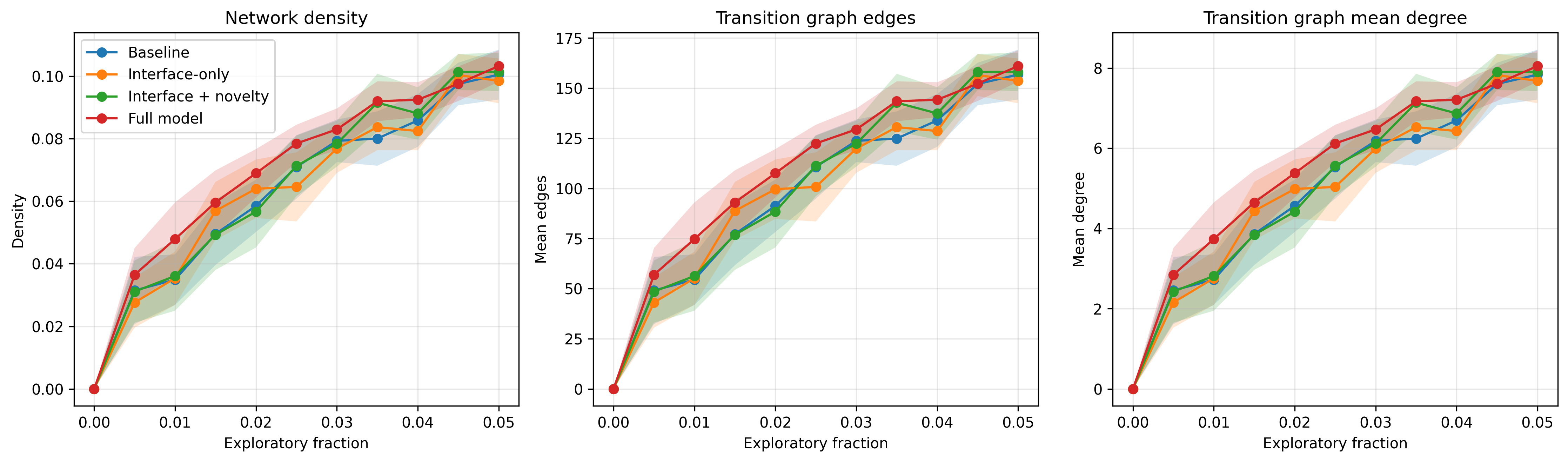
Figure 3: Network density, edge count, and mean degree as functions of p across mechanism conditions, depicting network expansion and run variability.
Emergent global connectivity presents as a percolation-like process: as p rises, the largest weakly and strongly connected components of the transition network undergo a rapid growth phase, delineating a crossover from fragmentation (multiple disconnected states) to a highly integrated, system-spanning connectivity structure. This is not a static percolation on predefined links, but a dynamic, trajectory-induced coupling contingent on spatial heterogeneity and the gradual, stochastic traversal of boundaries.
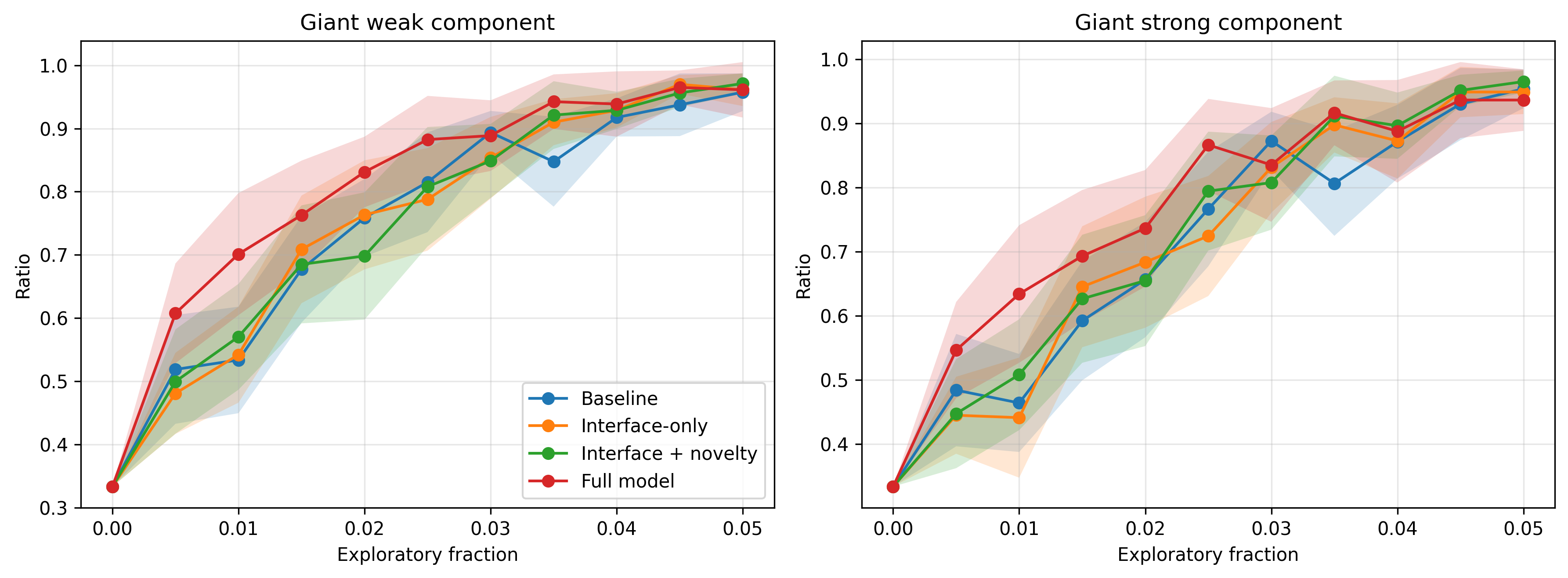
Figure 4: Relative sizes of the largest weakly and strongly connected components versus p, highlighting the regime shift from fragmentation to integration.
Network-formation is robust under pure random walks: mobility heterogeneity alone suffices for expansion. Interface-bias and novelty mechanisms amplify but do not alter the qualitative dynamics. Mechanism isolation experiments confirm the minimality of the process: the essential ingredient for global reconfiguration is stochastic boundary crossing in a structured landscape.
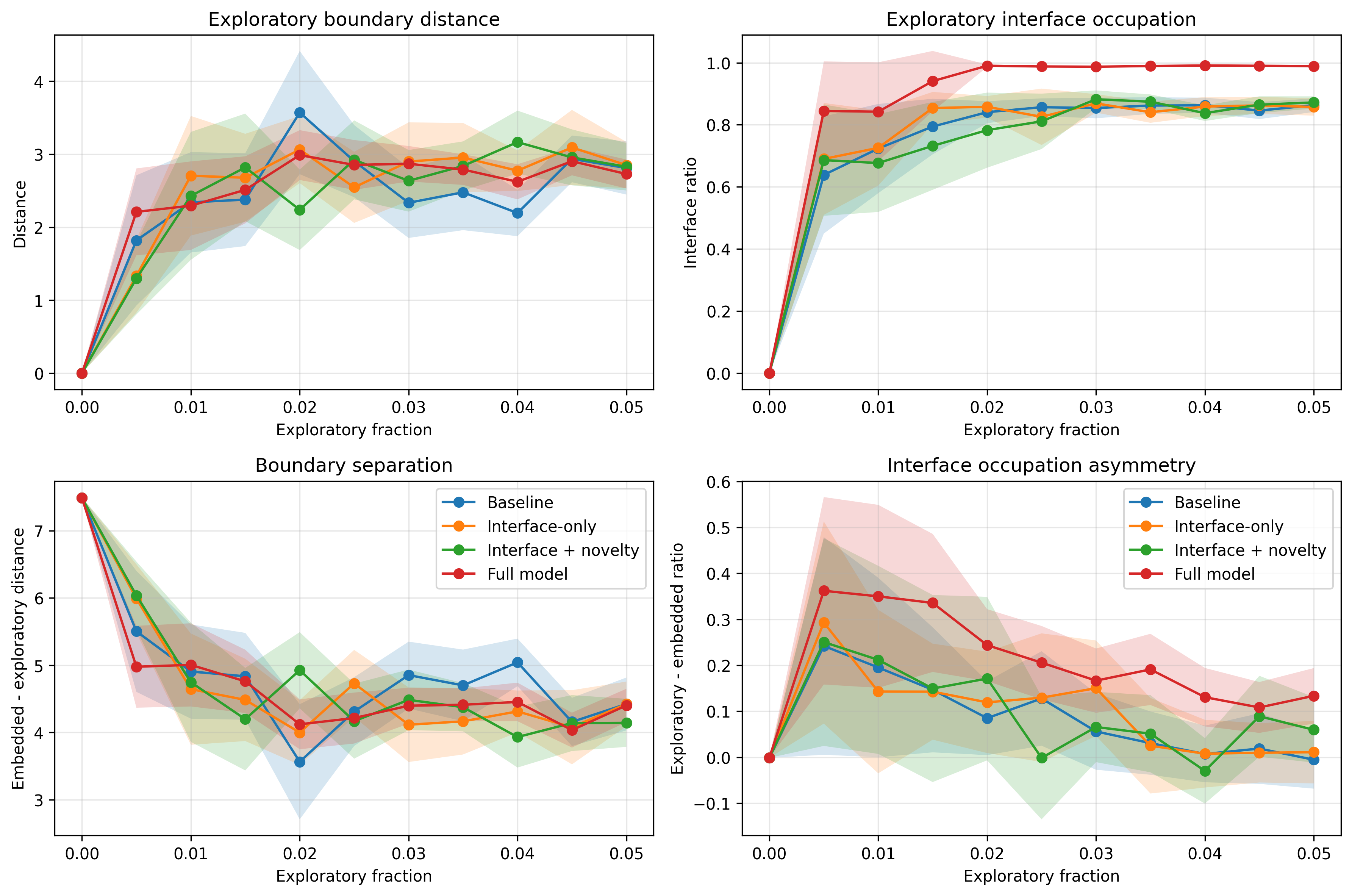
Figure 5: Mechanism decomposition: spatial and interface observables across progressively enriched agent mobility mechanisms.
Role of Spatial Structure and Null Control
Disabling the attractor-induced spatial structure (flat-landscape control) nullifies the specificity and interpretability of the mechanism. In this regime, differential spatial organization between agent types collapses; interface occupation and boundary-distance separation vanish. Although transition networks constructed operationally remain connected, connectivity loses physical significance and becomes an artifact of unconstrained region assignment.
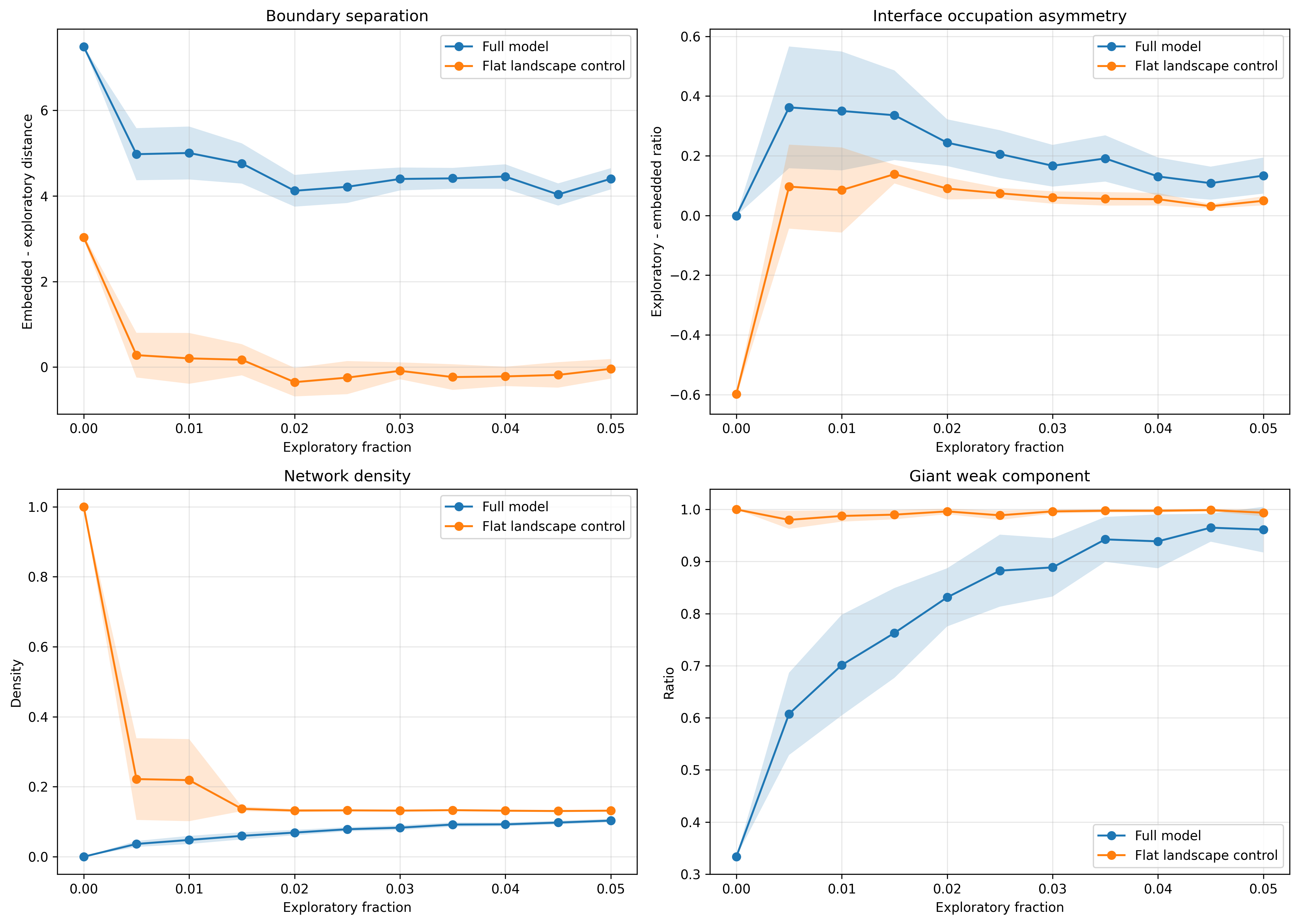
Figure 6: Comparison of structured versus flat landscapes: spatial differentiation and network observables (boundary-distance separation, interface occupation asymmetry, network density, and weak component size).
Robustness and Dynamical Signatures
The identified mechanism is robust to changes in the number of attractors K; both the transition in weak component size and network densification persist across landscape complexity variations. The derivative dCw/dp evidences steepest connectivity growth at low p0, demonstrating diminishing marginal integration with increasing exploratory fraction, consistent with percolation onset.
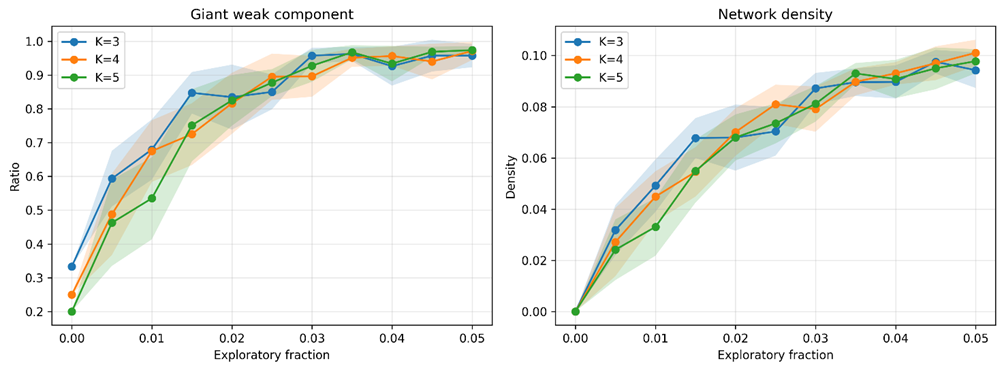
Figure 7: Robustness to p1: weakly connected component size and network density across different p2.
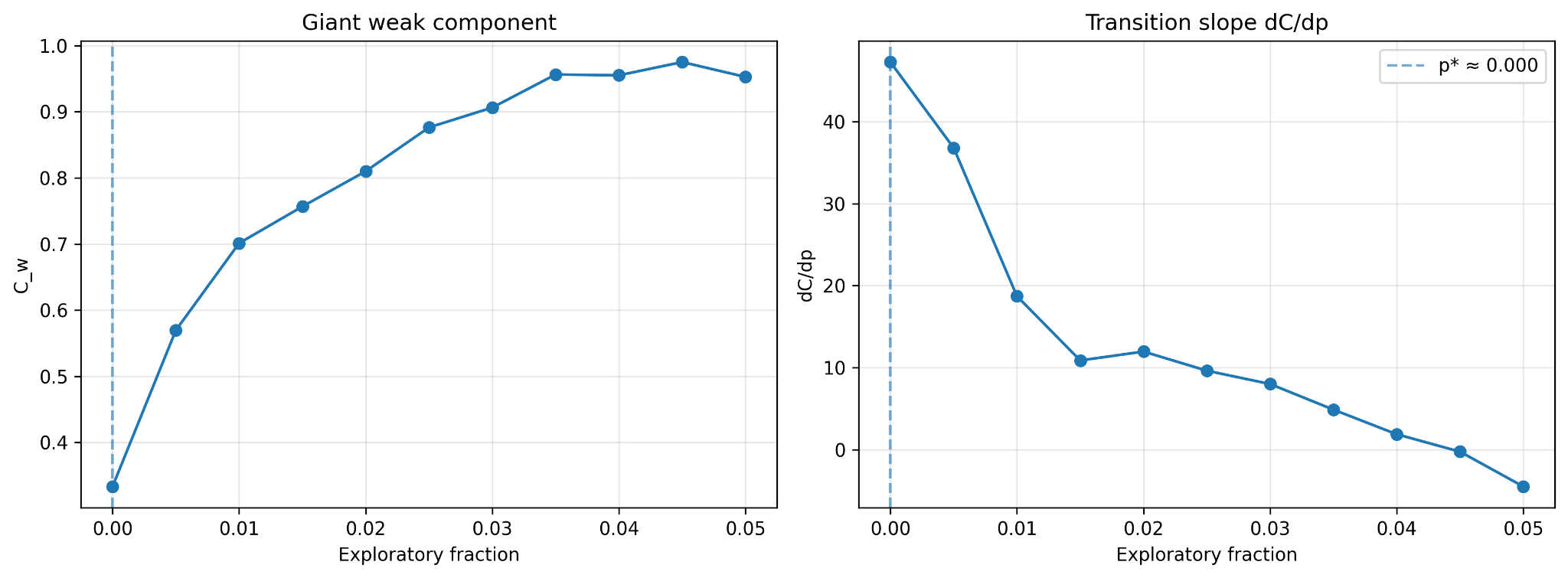
Figure 8: Numerical estimate of p3 as a function of p4, revealing early rapid growth in global connectivity.
Practical and Theoretical Implications, Prospects
This work shifts theoretical emphasis from agent-level ingenuity to system-level mediation by boundaries and landscape geometry. It demonstrates that minimal mobility heterogeneity catalyzes reconfiguration only within structured environments. The findings generalize to any system where boundaries separate metastable states—organizational learning, ecological niche shifts, or multi-modal fitness landscapes. Exploratory minorities suffice to bridge and integrate, mechanical innovation is not required. This reconceptualizes the exploration-exploitation dilemma as fundamentally contingent on the structure of the state space, not solely agent adaptivity.
For AI research, these insights suggest that sophisticated exploration strategies in RL or multi-agent systems may be superfluous in structured environments where minimal stochastic dynamics suffice for coverage. Conversely, true innovation or exploration may require not enhancing agent intelligence, but introducing or modifying environmental structure to facilitate meaningful transitions.
Future directions include quantifying critical thresholds for network percolation analytically, integrating adaptive landscapes, agent communication, or endogenous attractor evolution, and formalizing the relationship to classic percolation and network theory classes.
Conclusion
Through rigorous decomposition, the paper demonstrates that global connectivity in structured agent-based systems is a minimal emergent property resulting from the interaction between stochastic mobility heterogeneity and landscape-imposed boundaries. Neither optimization nor cognitive adaptation is required; simple random walks by a minority population effectuate system-wide reconfiguration via interface crossings. The mechanism collapses when environmental structure is removed, demonstrating conditional emergence. Boundaries are not merely geometric features but active mediators channeling local fluctuation into global order. The findings refine the theoretical understanding of emergence in complex systems and bear practical implications for the design and analysis of agent-based models across domains.

