- The paper demonstrates that Gradient Fan-in Asymmetry (GFA) explains why deeper Transformer layers become redundant.
- It introduces CascadeFormer, a depth-tapered Transformer that aligns capacity with gradient structure to improve efficiency without sacrificing accuracy.
- CascadeFlow Pruning leverages accumulated gradient norms to identify and remove redundant layers, validated by both correlational and interventional evidence.
Introduction
Uniformly stacked residual architectures anchor current large-scale Transformers, yet empirical analysis increasingly reveals that deeper layers in such networks provide diminishing utility. "CascadeFormer: Depth-Tapered Transformers Motivated by Gradient Fan-in Asymmetry" (2606.26538) presents a mechanistic hypothesis—Gradient Fan-in Asymmetry (GFA)—to explain this phenomenon. The authors show that the structural flow of gradient information in residual architectures is inherently front-loaded, endowing early layers with richer compositional updates while causing deep layers to become increasingly redundant. The work provides both correlational and interventional evidence, and translates the GFA perspective into two efficiency strategies: CascadeFormer, a depth-tapered Transformer that achieves strong efficiency gains at fixed training cost, and CascadeFlow Pruning, an effective gradient-based layer pruning heuristic.
Structural Origins of Layer Redundancy
The empirical redundancy of deeper Transformer blocks is evident from representational analyses: in pretrained LLaMA checkpoints, the similarity between layer activations increases with depth, signaling a collapse of representational diversity. The effect is exaggerated in LayerSkip models, designed to exit early and thus concentrate importance in initial layers (Figure 1).
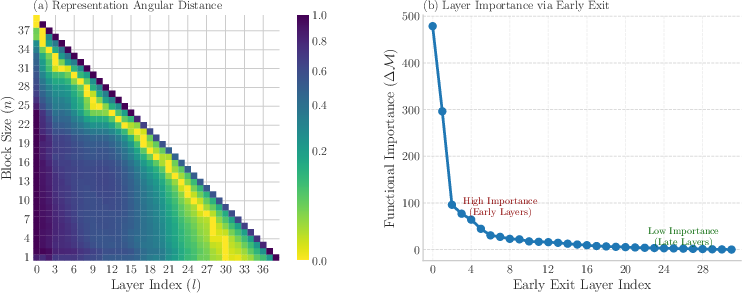
Figure 1: Deeper transformer layers exhibit growing redundancy, as illustrated by representational similarity and ablation-based functional importance (ΔM) measurements in public LLaMA checkpoints and LayerSkip models.
Traditional accounts attribute redundancy to attenuated gradients in deep layers. However, the authors articulate GFA, contending that the limiting factor arises from the composition of the gradient rather than its overall magnitude. In Pre-LayerNorm Transformers (xl+1=xl+Fl(xl)), each layer receives a gradient that is a sum of an identity path and all downstream functional paths; the number of such paths (gradient fan-in) decreases monotonically with depth (Figure 2).
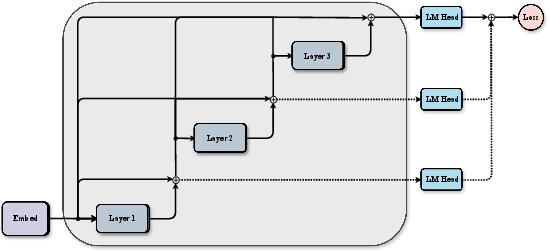
Figure 2: Gradient Fan-in Asymmetry: the number of gradient-contributing paths decreases linearly with depth, generating a structural gradient information bottleneck in later layers.
Deep supervision further amplifies this asymmetry, with auxiliary losses creating quadratic disparities in fan-in that exacerbate front-loading of the training signal. The resulting hypothesis is that deep layers are exposed to a sparser set of compositional gradient signals and thus assimilate less functional complexity during training.
Empirical Evidence Across Architectures
Gradient Flow and Functional Importance
To quantify the interplay of structural gradients and utility, the authors introduce two layerwise metrics: the accumulated gradient share (gˉi), defined as the L2 norm of all gradients reaching a layer over training, and functional importance (ΔMi), measured by the degradation in perplexity or accuracy upon layer ablation.
Consistent with the theoretical GFA, gradient L2 norm per layer decays linearly in vanilla Transformers and quadratically in LayerSkip (deep supervision) models. ResNet-50 exhibits similar front-loading (Figure 3).
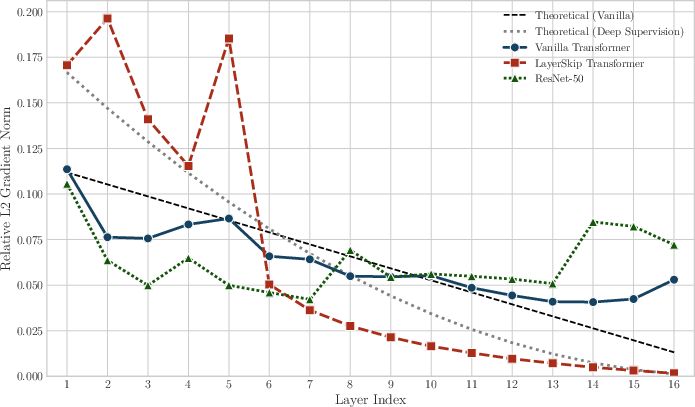
Figure 3: The empirical per-layer gradient norm follows the fan-in decay predicted by GFA theory in Transformers and ResNets.
A strong positive Spearman correlation is measured between the accumulated gradient share and functional importance: ρ=0.62 in vanilla Transformers, ρ=0.83 in ResNet-50, and near unity (ρ=0.99) in LayerSkip models (Figure 4). This supports GFA as a predictive mechanism for post-hoc layer importance.
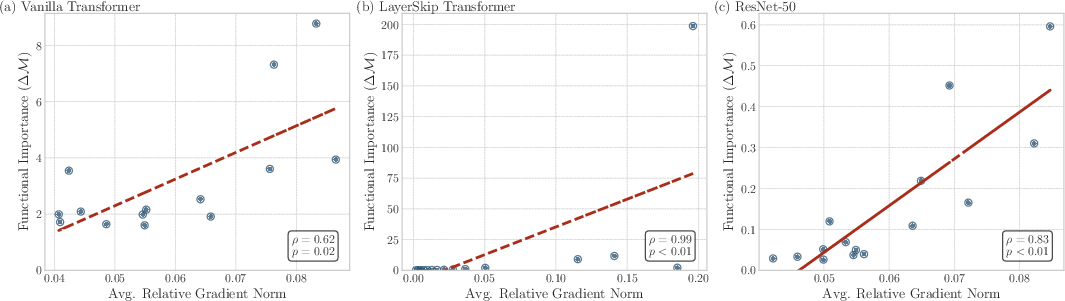
Figure 4: The accumulated gradient share during training predicts final ablation-based layer importance; see main text for Spearman correlation values.
Layer-wise plots further reinforce the correlation between gradient norm and functional contribution across all tested architectures (Figures 6–8).
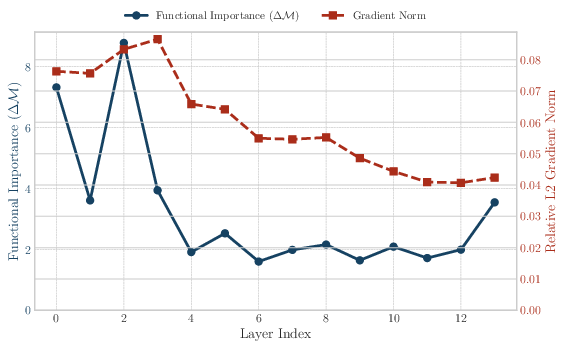
Figure 5: Layer-wise comparison of gradient norm (dashed) and functional importance (solid) for the vanilla Transformer, visually affirming the quantitative correlation.
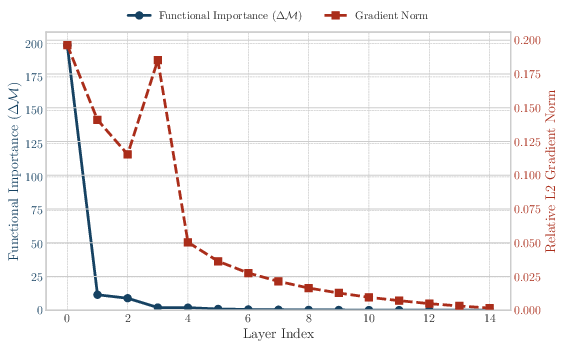
Figure 6: Near-perfect correspondence between gradient norm and functional importance in the LayerSkip Transformer under deep supervision.
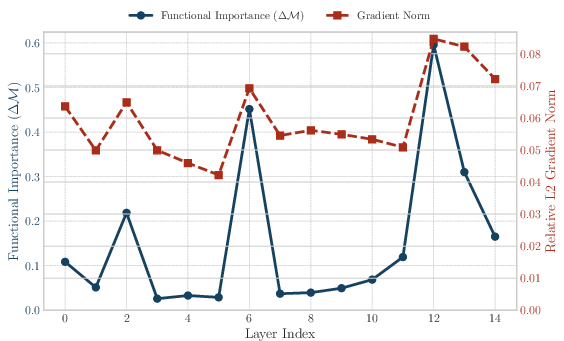
Figure 7: Gradient-importance correlation in ResNet-50 validates the generality of GFA beyond LLMs.
Interventional Evidence: Disentangling Magnitude from Structure
To discriminate between gradient magnitude and fan-in as the causal driver, the authors apply two interventions. First, forcibly equalizing per-layer gradient norms ("amplification intervention") fails to rescue deep-layer importance and may even exacerbate redundancy. Second, structurally increasing downstream path counts for deep layers by parameter-shared repetition ("virtual depth" intervention) does elevate late-layer functional contribution (Figure 8).
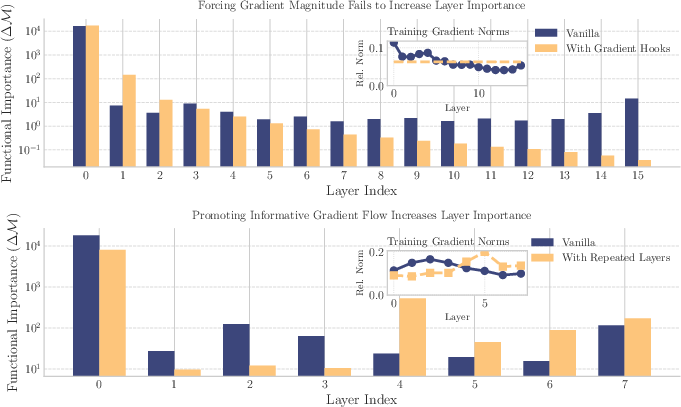
Figure 8: Interventions: equalizing gradient norms (top) does not restore deep-layer importance; increasing path counts (bottom) elevates late-layer significance—consistent with the GFA hypothesis.
These results substantiate the primacy of compositional structure in gradient flow, as opposed to simple magnitude, in shaping functional hierarchy.
CascadeFlow Pruning
CascadeFlow Pruning (CFP) prunes layers by ranking their accumulated training gradient L2 norms (gˉi), requiring no post hoc analysis. Empirically, CFP achieves the lowest perplexity and rank-stability compared to similarity, Taylor, or magnitude-based methods, especially under aggressive pruning, while maintaining competitive downstream accuracy. Importantly, this gradient-based heuristic is directly motivated by the structural flow of information, not merely by local sensitivity proxies.
CascadeFormer internalizes GFA by aligning model capacity with gradient compositional diversity: model width (attention and/or FFN dimension) is tapered with depth. This design is parameterized by a schedule of reduction in the number of attention heads and/or FFN units. When matched with a uniform baseline on training FLOPs, the strongest attention-tapered variant (CascadeFormer-A2) delivers comparable perplexity (17.84) while reducing inference latency by 8.6% and increasing throughput by 9.4% on an A100 GPU. This demonstrates that efficiency can be improved through GFA-informed architecture without sacrificing accuracy, as capacity is allocated where the effective learning signal is richest.
Implications and Future Directions
These findings underscore the relevance of structural factors in the allocation of model capacity and training resources within deep networks. Uniform scaling may not be optimal: intentional heterogeneity, matching layerwise capacity to the compositional flow predicted by GFA, yields measurable efficiency gains. From a theoretical standpoint, GFA motivates a reevaluation of what architectural redundancy reveals: not an artifact of optimization failure or poor initialization, but a predictable outcome of path structure. Practically, this enables both hardware-level acceleration (by reducing late-layer computation) and more stable, training-time pruning protocols.
The results also expose a design tension: one could embrace the asymmetry (as in CascadeFormer), or seek to engineer uniformity in importance by mitigating GFA—potentially through new forms of deep supervision or long-range skip connections that inject compositional diversity into late-layer gradients. Whether such approaches can reconcile efficiency and capacity at scale—in particular for 100B+ parameter models—remains an open empirical question. Theoretical work on the relationship between gradient structure, effective rank, and functional utility is warranted.
Conclusion
This work provides a rigorous, structural account of layer redundancy in deep residual architectures via Gradient Fan-in Asymmetry. Supported by both correlational and causal evidence, the authors motivate two efficiency methods—CascadeFlow Pruning and CascadeFormer—that outperform conventional alternatives. The perspective offered by GFA not only explains empirical patterns, but opens the door to a new class of architectures and pruning strategies that match capacity to the signal processing structure inherent in residual models. The implications for future efficient model design and our theoretical understanding of depth in neural networks are significant, with open questions regarding scalability and the generality of GFA to ultra-deep or high-rank settings.

