- The paper introduces a moment-based framework that detects and quantifies Wigner negativity using only a few copies of the state, significantly reducing experimental resources.
- It establishes three detection hierarchies—including the Hankel-matrix criterion—that leverage low-order moments to bypass full state tomography.
- The framework also extends to the quantification of entanglement and nonclassicality in continuous-variable systems, paving the way for scalable quantum advantage.
Moment-Based Detection of Wigner Negativity with Few Copies
Introduction and Motivation
Wigner negativity, wherein the Wigner function assumes negative values, is central to the resource theory of nonclassicality in continuous-variable (CV) quantum systems. Negativity in the Wigner function is known to underlie quantum computational advantage, marking the boundary between efficient classical simulation and genuine quantum protocols, as established in the context of the Gottesman-Knill theorem and related results. Existing schemes for detecting Wigner negativity typically rely on full quantum state or phase-space tomography, which require a number of state copies scaling unfavorably with system size, thus impeding experimental scaling. The paper "Operational detection of Wigner negativity in arbitrary quantum states from few copies" (2606.26084) addresses this core issue by constructing a framework for detecting and quantifying Wigner negativity that leverages only low-order moments of the Wigner function, which can be estimated efficiently from a few copies of the state.
Moment-Based Detection Hierarchies
The central insight is that the global moments of the Wigner function,
wm=∫W(α)mdα,
encode sufficient statistics to formulate operational, experimentally accessible witnesses for Wigner negativity, circumventing full tomography.
Three complementary hierarchies emerge from the classical moment problem applied in phase-space:
- Lp-norm inequalities (LP hierarchy): Positivity of the Wigner function enforces
(wn)n−2−(wn−1)n−1≥0
for all n≥2. Violation certifies negativity. The proof is a direct consequence of Hölder's inequality.
- Log-convexity (LC hierarchy): The moment sequence {wn} of any positive measure is log-convex:
wn−1wn+1−wn2≥0.
This follows as a direct application of Cauchy-Schwarz to functionals of W.
- Hankel-matrix positivity: The strongest hierarchy involves the positivity of the full Hankel moment matrix
[Hn]ij=wi+j+1
for all n. Violation of positive-semidefiniteness at any order strictly implies Wigner negativity. Since higher-order minors include all lower-order information, the Hankel hierarchy is strictly stronger than the scalar LP and LC tests.
This hierarchy is supported by empirical analysis: random CV states exhibit that the detection probability converges rapidly to one with increasing Hankel order, whereas LP and LC conditions saturate or even degrade at higher orders.
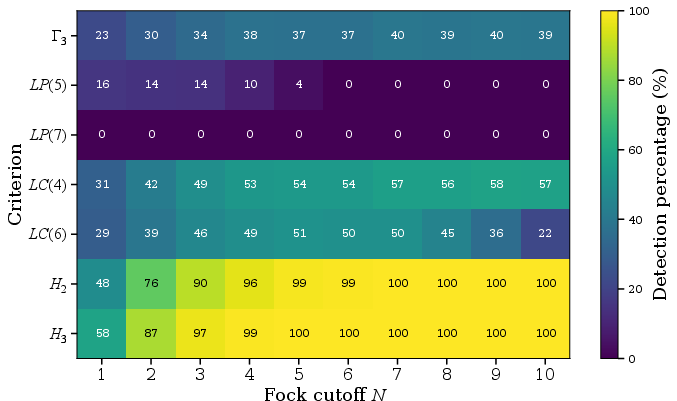
Figure 1: Detection probability of the moment-based hierarchies for random states drawn from the Hilbert-Schmidt ensemble in the truncated Fock space. Higher-order Hankel conditions approach perfect detection of Wigner-negative states.
Quantitative Witnesses and Direct Estimation
To move from detection to quantification, the authors establish lower bounds on the well-studied logarithmic Wigner negativity,
L(W)=log(∫∣W(α)∣dα),
using only a finite set of experimentally accessible moments. Specifically, for even integer Lp0,
Lp1
with Lp2, yields a certified lower bound:
Lp3
Lp4 is shown to be optimal given these constraints (i.e., it yields the tightest lower bound among all finite-moment-based quantifiers).
Crucially, the paper presents a multicopy operational representation for any Wigner moment,
Lp5
with Lp6 a universal observable involving collective and relative parity measurements after a fixed interferometric transformation.
This structure enables efficient estimation via:
- Preparation of Lp7 identical copies.
- Application of an orthogonal Gaussian network separating collective and relative coordinates.
- Joint parity measurement on the Lp8 relative modes.
This representation directly links the phase-space moment structure to multicopy, experimentally feasible observables, thus supporting both straightforward laboratory implementations and powerful randomized measurement protocols.
Numerical Evaluation and Classical Shadows
The performance of the detection and quantification protocols is evaluated on families of Fock, cat, and Dicke states as well as on generic random states. The numerical results, using classical-shadow estimation of moments from randomized measurements, corroborate the feasibility of the protocol with few resources and without state-dependent assumptions.
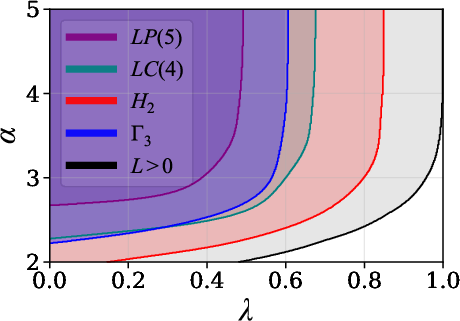
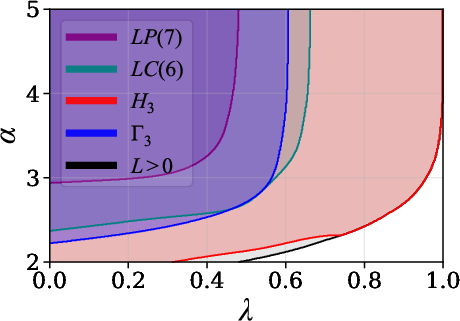
Figure 2: Agreement between randomized classical-shadow estimations and exact values for both the detection witness Lp9 and quantification (wn)n−2−(wn−1)n−1≥00 for Fock states, demonstrating direct experimental viability.
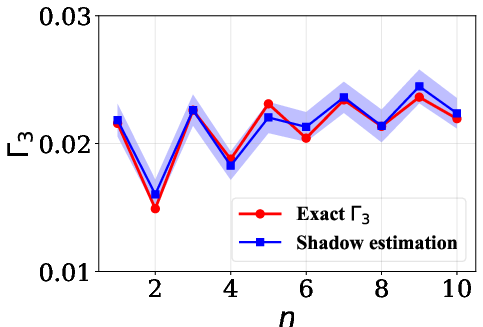
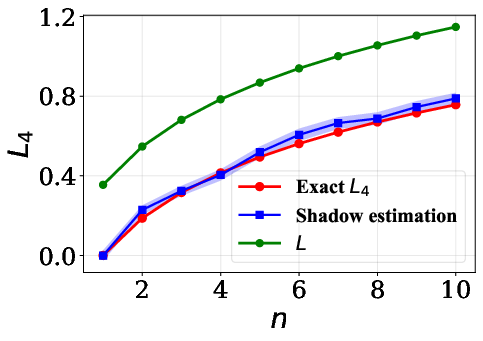
Figure 3: Parameter regions revealing the increased power of the Hankel hierarchy (H2, H3) compared to LP and LC conditions for even cat states. Shaded regions denote Wigner-negativity detected by the respective criteria.
Applications to Entanglement and Nonclassical Resources
Beyond single-mode nonclassicality, the framework generalizes to resources such as bipartite/multipartite entanglement. When suitably constructed Wigner functions correspond to structural features like NPT entanglement (e.g., through collective/reduced phase-space distributions), the same moment-based hierarchies act as entanglement witnesses. Particularly, sufficient negativity in the reduced (or center-of-mass) Wigner function, detected via these moment criteria, certifies entangled or genuinely multipartite entangled (GME) structure, in line with recent operational reductions and resource theories.
Implications and Future Directions
This work establishes Wigner moments as central, scalable invariants for the detection and quantification of quantum nonclassicality in CV systems, enabling experimental protocols that require only few state copies and limited measurement resources. Theoretically, the results clarify the relationship between the structure of quantum resources and classical moment problems, hinting at stringent convex-geometric boundaries between simulable and non-simulable quantum states.
Immediate future work includes the derivation of complete and optimal moment conditions for arbitrary systems, possible generalizations to other quasiprobability distributions, and experimental realizations in photonic and atomic platforms using multicopy interferometric networks.
Conclusion
The paper formulates a rigorous and operationally accessible framework for detecting and quantifying Wigner negativity across arbitrary quantum states, requiring only a finite set of global moments estimable from few state copies. The derived moment-based hierarchies, with the Hankel-matrix criterion at their apex, yield powerful practical witnesses far surpassing existing tomography-based or scalar-inequality approaches in both detection probability and resource efficiency. The framework unifies phase-space nonclassicality, resource quantification, and feasible experimental observability, and suggests concrete routes toward scalable certification of quantum advantage in continuous-variable information-processing architectures (2606.26084).

