- The paper proposes a novel detection protocol that uses moments of the KD quasiprobability distribution to isolate and quantify quantum imaginarity.
- It employs a Y-twirl map and hierarchical Hankel determinants to serve as witnesses, ensuring scalability for high-dimensional and many-body systems.
- The interferometric realization using a Mach–Zehnder setup directly links interference visibility to the ℓ1-imaginarity measure, optimizing experimental resource usage.
Detection of Quantum Imaginarity via Moment-Based Methods and Interferometric Realization
Introduction and Motivation
Complex numbers are fundamental in quantum mechanics, yet their operational indispensability, especially in distinguishing quantum advantages, remains under continuous investigation. A key concept arising from this scrutiny is the "resource theory of imaginarity," which classifies quantum states with nonzero imaginary matrix elements in a fixed basis as resources for quantum information processing. While imaginarity is now understood to be distinct from more established quantum resources such as coherence and entanglement, practical, scalable detection of imaginarity is an outstanding challenge, particularly for high-dimensional or many-body systems. The paper "Detection of quantum imaginarity using moments and its interferometric realization" (2604.00164) addresses this gap by developing a detection protocol grounded in experimentally accessible moments of the Kirkwood–Dirac (KD) quasiprobability distribution, together with a concrete interferometric scheme for their measurement.
The resource theory of imaginarity defines quantum states as "free" if they are real in some computational basis. States with at least one off-diagonal matrix element possessing a nonzero imaginary part exhibit imaginarity. The ℓ1-norm measure Mℓ1 quantifies this feature by summing the moduli of the imaginary parts of all off-diagonal density matrix elements. Notably, imaginarity is independent of coherence and entanglement—maximally coherent or entangled states can, in a suitable basis, be free of imaginarity.
The detection strategy utilizes the KD quasiprobability distribution, which is generally complex and constructed with respect to two noncommuting observables. The extended KD distribution captures multi-time or multi-observable correlations and encodes complete state information. However, full reconstruction is experimentally prohibitive; hence, the detection protocol targets moments (polynomial averages) of the KD distribution.
Moment-Based Detection Protocol
The protocol comprises several critical steps:
- Y-Twirl Map for Isolating Imaginarity: The Y-twirl operation is introduced to eliminate all real off-diagonal matrix elements from the density operator in the reference basis, preserving only imaginarity. For a d-dimensional Hilbert space, this operation sets all diagonal entries to $1/d$ and scales off-diagonal imaginary parts by $2/d$, zeroing out all real parts.
- KD Distribution Nonpositivity as Signature of Imaginarity: The extended KD distribution of the Y-twirled state is constructed with respect to a pair of mutually unbiased bases. The paper proves that non-positivity (in a specific total-absolute-value sense) of this distribution is equivalent to the presence of imaginary coherence.
- Hierarchy of Moment-Based Criteria: Determinants of systematically constructed Hankel matrices—assembled from successive KD moments (rn)—serve as witnesses. For all free (real) states, these determinants are nonnegative. Any negative determinant (for some order m) is a sufficient certificate of imaginarity. This yields a hierarchical test, where higher-order moments enable greater sensitivity.
- Practical Example: The method is concretely demonstrated for a parametrized qubit state. It is shown that for all values of the underlying phase yielding nonzero imaginarity, there exists a Hankel determinant (of order depending on the measurement basis) which becomes negative, thereby detecting the resource.
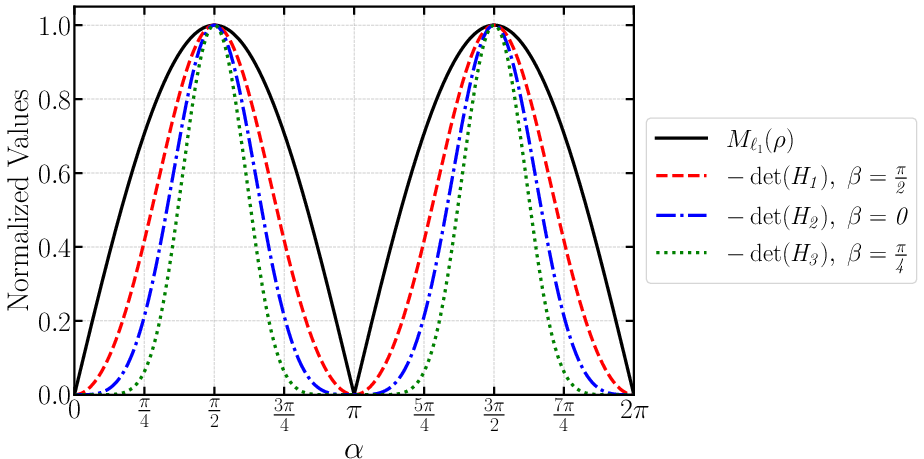
Figure 1: Amount of imaginarity versus phase and the order of Hankel determinant required for detection, for a parametrized qubit state.
Interferometric Realization and Scalability
Implementation of the protocol leverages the Mach–Zehnder interferometer, where the path acts as a control qubit and the internal system (encoding the quantum state) is the target. Key points in the experimental realization include:
- Visibility as a Moment Estimator: The n-th moment of the KD distribution is experimentally accessible as the visibility of an interference pattern when a specific (controlled) unitary, Sn, acts on n copies of the Y-twirled state.
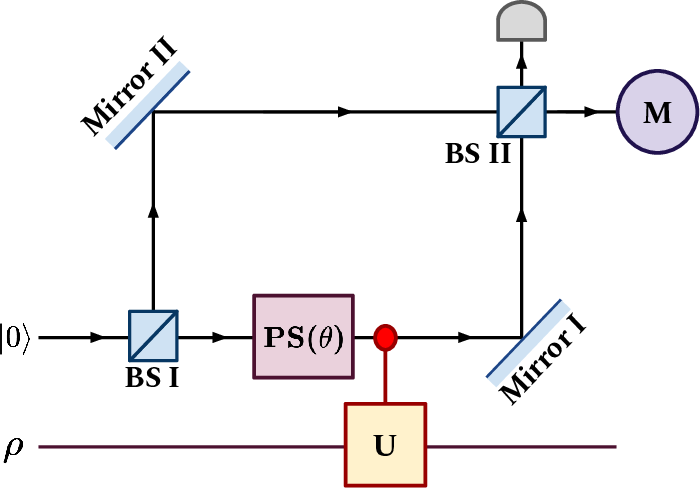
Figure 2: Schematic of the Mach–Zehnder interferometer employed for extracting visibility corresponding to quantum imaginarity.
- Generalized Interferometric Scheme: For each Mℓ10, the interferometric apparatus can be extended to access the Mℓ11-th KD moment via suitably controlled operations, making the protocol scalable and minimizing experimental overhead.
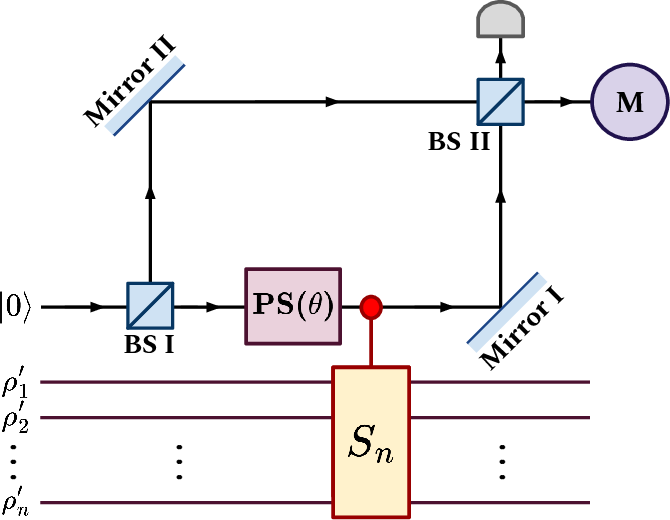
Figure 3: High-level representation of the generalized Mach–Zehnder interferometric scheme for Mℓ12-th order moment estimation.
- Direct Imaginarity Detection via Visibility: The paper further proves that directly summing visibilities associated with certain unitaries generated by anti-symmetric imaginary generators yields exactly the Mℓ13-imaginarity measure. This equivalence enables rapid, measurement-efficient screening for imaginarity without reconstructing any distribution.
Implications, Experimental and Theoretical
The protocol achieves high scalability: the required measurement resources grow logarithmically with Hilbert space dimension, in contrast to the polynomial scaling of techniques requiring density matrix reconstruction or measurement of exponentially many observables. This is particularly significant for many-body quantum systems or high-dimensional optical encodings. By framing detection entirely in terms of nonlinear moments—robust to noise and accessible in a single-shot or parallelized fashion—this methodology is well matched to shadow tomography and randomized measurement techniques in NISQ architectures.
The theoretical separation between imaginarity, coherence, and entanglement is sharpened, with hierarchical criteria demonstrating that imaginarity cannot in general be inferred from witnesses of the latter two resources. The formalism provides a direct operational footing for the abstraction of imaginarity as a quantum resource and ties it to measurable interference phenomena.
Future Outlook
Potential extensions of this framework include:
- Development of tight lower and upper bounds for quantitative imaginarity measures based on finite-order moments.
- Application to the temporal dynamics of imaginarity in open systems, quantum channels, and measurement-induced phase transitions.
- Integration with machine learning protocols to optimize basis selection or post-processing of visibility data for enhanced detection thresholds.
- Generalization of moment-based methods to other nonclassical resources, particularly in contexts where quasiprobability nonpositivity is an operational indicator (e.g., contextuality and quantum thermodynamics).
Conclusion
This work provides a comprehensive, experimentally feasible protocol for detecting quantum imaginarity by leveraging moments of the Kirkwood–Dirac quasiprobability distribution and their direct realization via interferometric visibility measurements. The hierarchical structure of moment-based witnesses enables both qualitative and quantitative resource certification in large Hilbert spaces with minimal experimental overhead. The formal and practical separation of imaginarity from coherence and entanglement, along with the explicit operational recipes included, represent significant progress in the detection and quantification of fundamental quantum resources (2604.00164).

