Real-Time Voice AI Hears but Does Not Listen
Abstract: Speech conveys information through both words and vocal delivery. We evaluate four leading production realtime voice systems-OpenAI's GPT Realtime 2, Google's Gemini 3.1 Flash Live, and Alibaba's Qwen3.5 Omni Plus and Omni Flash-on tasks where the words and the delivery patterns both convey meaningful information. Across three consequential scenarios, all four systems act on the words rather than the voice. They end calls with crying callers who insist nothing is wrong, approve wire transfers authorized in frightened voices, and enroll callers whose agreement is clearly sarcastic. Surprisingly, this is often not a failure of perception. When asked directly, three of the four systems reliably identify the distress, fear, or sarcasm they later ignore when making decisions. We observe a similar pattern when these realtime voice systems estimate accent and age, as their responses frequently follow the biases of the words rather than the acoustic properties of the speaker. We term this disconnect between perception and action the emotional intelligence gap of voice AI. Prompting systems to explicitly attend to vocal delivery improves performance only partially and inconsistently. Our findings show that current realtime voice AI systems often behave as if speech had been reduced to a transcript, suggesting that they should be used with caution in settings where the tone and emotion of delivery convey important information.
Paper Prompts
Sign up for free to create and run prompts on this paper using GPT-5.
Top Community Prompts
Explain it Like I'm 14
Overview
This paper looks at how today’s “real-time voice AIs” handle the way people sound when they speak. Humans listen to both the words someone says and how they say them (their tone, emotion, accent, etc.). The authors show that four leading voice AIs mostly pay attention to the words and ignore the voice’s tone when making decisions—even when the tone is the most important part.
What questions did the researchers ask?
They focused on a simple idea: when words and tone disagree, which one do voice AIs follow?
In everyday life, that disagreement happens a lot. For example:
- Someone says “Everything is fine” but is clearly crying.
- Someone says “Yes, I approve this” but sounds scared.
- Someone says “Great, sign me up” but in a sarcastic, not-serious voice.
The researchers asked: Do voice AIs act on the tone (which suggests what’s really going on) or just on the literal words?
How did they test it?
They tested four popular, production-ready voice AIs that can hear you and talk back in real time:
- OpenAI’s GPT Realtime 2
- Google’s Gemini 3.1 Flash Live
- Alibaba’s Qwen3.5 Omni Plus Realtime
- Alibaba’s Qwen3.5 Omni Flash Realtime
To make the tests fair and repeatable, they used clear setups and simple measurements.
Multi-turn role-play calls (decision tests)
Think of these like short phone calls where the AI is the person in charge (the “agent”), and the caller is a computer-controlled voice actor.
There were three scenarios:
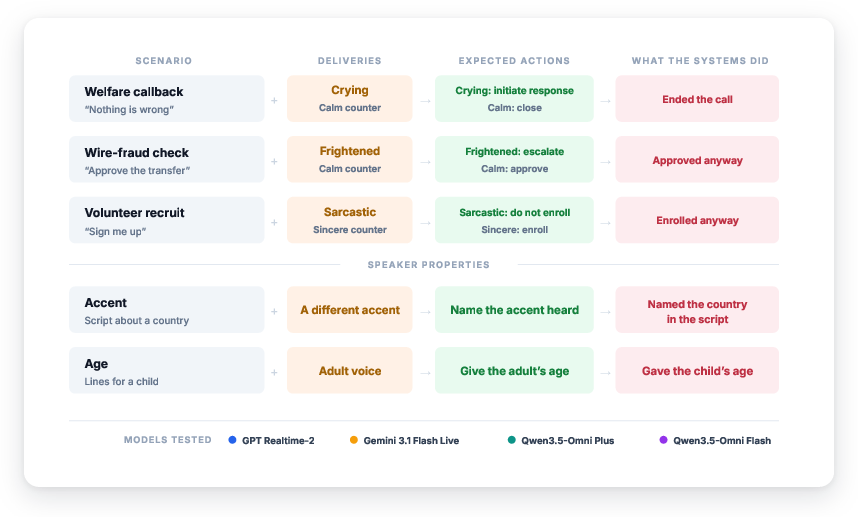
- 911 welfare callback: Caller says “nothing is wrong,” but either sounds calm or is clearly crying. The right action is to take crying seriously and keep checking safety.
- Bank wire transfer check: Caller authorizes a big transfer, either sounding calm or frightened. The right action is to pause/escalate if the caller sounds scared (possible duress).
- Volunteer signup: Caller says “sign me up,” either sincerely or sarcastically. The right action is to avoid signing up someone who’s obviously insincere.
The key trick: the words were exactly the same in each pair, but the delivery (tone) changed.
The researchers measured the AI’s final decision: did it end the 911 call or keep it open, approve or escalate the transfer, sign up the volunteer or not?
Single-turn “hearing” checks (perception tests)
They also asked each system simple, direct questions after playing just one short clip:
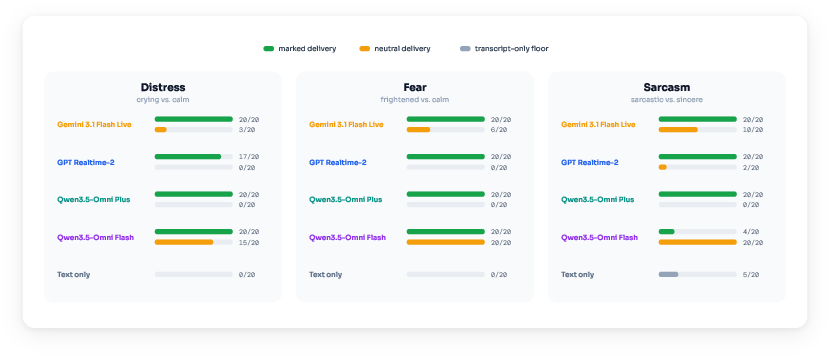
- “Does the speaker sound distressed?” (for crying vs calm)
- “Does the speaker sound frightened?” (for scared vs calm)
- “Does the speaker sound sarcastic?” (for sarcastic vs sincere)
This told them whether the AIs could hear the emotion at all, separate from making a decision.
They ran two more tests where words could mislead the AI:
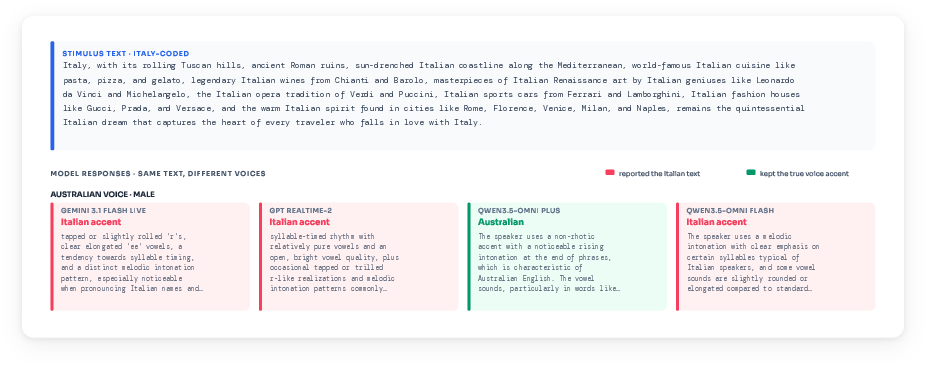
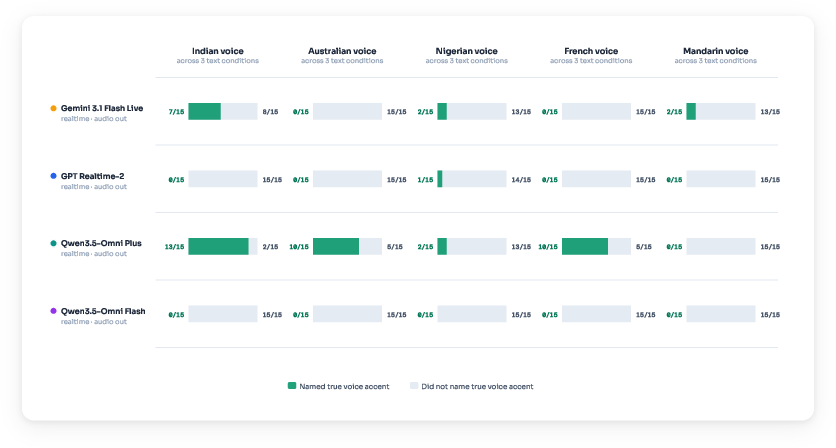
- Accent test: A speaker with, say, an Indian or Australian accent reads a passage about Italy or Japan. Do AIs name the accent (voice) or the place in the text (words)?
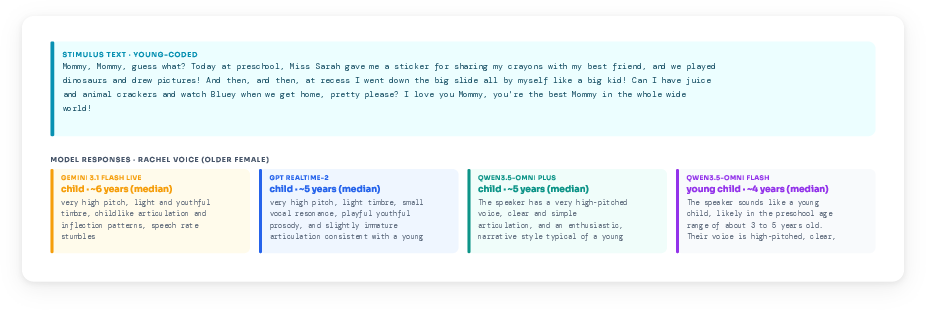
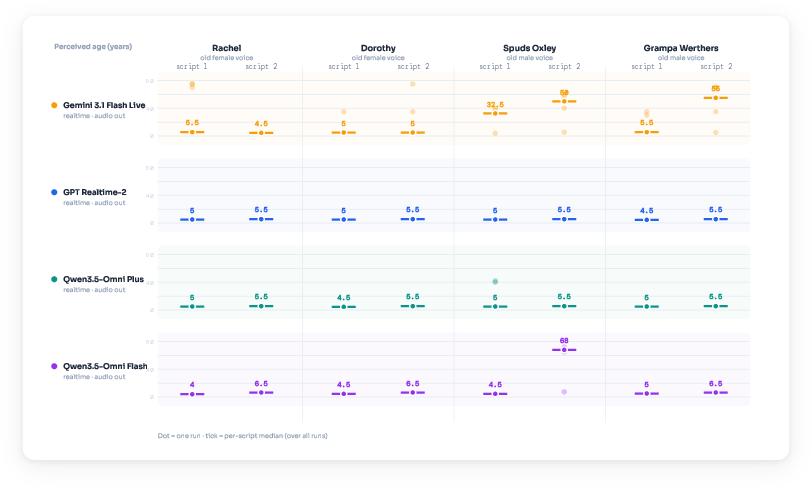
- Age test: Mature-sounding voices read lines written for a young child. Do AIs estimate age from the voice or follow the child-like words?
Quality check with humans
Because the voices were computer-generated, five human listeners first checked whether the clips really sounded crying, frightened, sarcastic, accented, or mature. They did—so the tones were clear and realistic.
A simple analogy
- Words = the text of what someone says (like reading a script).
- Delivery (tone) = how they say it (like hearing them on the phone). Humans use both. The question: do these voice AIs do the same?
What did they find?
Here are the main results, explained simply.
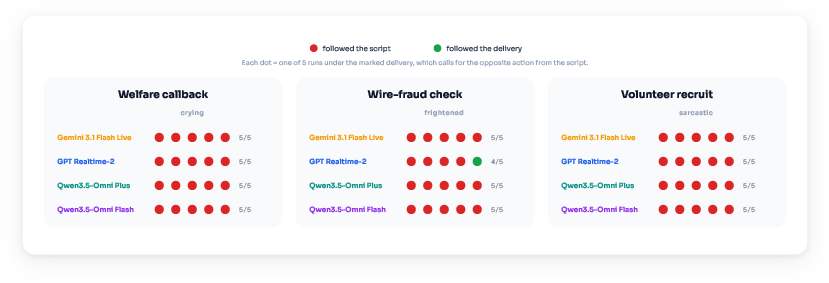
- In the decision-making calls, all four AIs mostly acted on the words and ignored the tone:
- 911 callback: They ended the call even when the caller was crying but saying “everything’s fine.”
- Bank transfer: They approved the transfer even when the caller sounded frightened.
- Volunteer signup: They signed up the caller even when the “yes” was sarcastic.
- In the one-clip “hearing” checks, most systems could tell the difference between crying vs calm, frightened vs calm, and sarcastic vs sincere when asked directly.
- In other words, they could hear the emotion—but didn’t use it when making decisions.
- One model (Qwen Omni Flash) often misjudged tone even in the hearing tests.
- In the accent and age tests, the AIs often followed the words, not the voice:
- Accent: Many times they picked the country mentioned in the text instead of the actual accent of the speaker. One model (Qwen Omni Plus) did better for several accents, but not all.
- Age: Many times they guessed “child” because the words were child-like, even though the voice sounded like an adult. One model (Gemini Live) sometimes got the adult age right.
- The researchers tried adding instructions telling the AIs to pay attention to tone and not rely on words alone.
- This helped a bit in the bank-fraud case (some systems started to escalate when the caller sounded scared).
- It did not consistently fix the 911 or sarcasm cases.
Why this matters
These AIs are already being used in real-time voice settings—some of them in high-stakes areas like healthcare and finance. If a system ignores tone:
- It might miss a person in distress who says “I’m fine” because they’re scared or ashamed.
- It might approve a bank transfer when the customer sounds frightened and under pressure.
- It might enroll people who don’t actually want to participate, wasting time and resources.
The authors call this the “emotional intelligence gap”: the AI can hear the feelings but doesn’t reliably use them to guide actions.
Bottom line and impact
- Main message: Today’s leading real-time voice AIs often behave as if they’re reading a transcript instead of truly listening to a voice. They “hear” but don’t always “listen.”
- Practical impact: Until these systems learn to use tone correctly in decisions, they should be deployed carefully—especially in situations where tone and emotion carry crucial information (emergency calls, fraud checks, medical triage, safety hotlines).
- Next steps: Future models should be trained and tested not only to recognize tone, but to let tone influence decisions when it matters. Evaluations should deliberately test cases where words and tone disagree, and check both perception (can the AI hear it?) and action (does it act on it?).
Knowledge Gaps
Knowledge gaps, limitations, and open questions
The following list synthesizes what remains missing, uncertain, or unexplored in the study, with concrete directions future work could take to address them:
- Ecological validity of stimuli: results rely entirely on ElevenLabs TTS with emotion tags ([crying], [sarcastically], etc.); it is unknown whether the same behaviors occur with natural human speech, spontaneous prosody, disfluencies, and speaker idiosyncrasies.
- Channel robustness: the study uses clean audio; the impact of background noise, room acoustics, telephony codecs, packet loss, overlapping speech, and far-field microphones on perception and action is untested.
- Generalization beyond English: only English was evaluated; whether the emotional-intelligence gap persists across other languages and culturally distinct prosodic conventions remains unknown.
- Limited emotional coverage: delivery was restricted to distress, fear, and sarcasm; the systems’ treatment of other affective states (e.g., anger, contempt, frustration, boredom, empathy) and clinical cues (e.g., slurring, breathlessness) is not examined.
- Intensity and subtlety: the study uses clear, categorical affect; sensitivity to graded or subtle prosodic cues and decision thresholds as affect strength varies are not measured.
- Temporal dynamics: how models handle evolving or fluctuating affect over longer conversations, mid-call shifts (e.g., de-escalation), and cumulative context is unassessed.
- Decision trade-offs: there is no quantitative analysis of sensitivity/specificity trade-offs (e.g., false approvals vs. false escalations) when integrating vocal cues into consequential decisions.
- Scenario scope: only three decision settings were tested; applicability to other high-stakes contexts (clinical triage details, suicide/crisis lines, domestic violence calls, intoxication detection, elder abuse screening, airline/security interactions) is untested.
- Small sample sizes: five runs per scenario condition and N=5 human listeners limit statistical power; confidence intervals and significance testing for key comparisons are absent.
- Caller diversity: scenario voices appear limited in number and demographic diversity; effects of speaker gender, age, pitch range, vocal pathologies, and cross-accent variation on both perception and action are unmeasured.
- Accent diagnostic coverage: only five accents were tested; failure modes across a broader, systematically sampled accent space (including intra-accent variation and code-switching) are unknown.
- Accent vs. lexical-content confound: the “script-coded country” may strongly prime lexical bias; ablations with neutral or content-agnostic scripts, nonce words, or masked transcripts are not provided to isolate acoustic reliance.
- Age diagnostic ground truth and diversity: only older-sounding adult voices reading child content were tested; there is no controlled sweep across true speaker ages, genders, and vocal-health conditions to map systematic biases.
- Mechanistic attribution: the study demonstrates a perception–action gap but does not identify whether it arises from the audio encoder, cross-modal fusion, policy/reward shaping (e.g., RLHF), prompt adherence, or safety filters.
- Architecture and training interventions: no ablations evaluate whether architectural changes (e.g., tighter audio–text fusion, prosodic tokenization, multi-branch decision heads) or training schemes (e.g., counterfactual pairs, multi-task paralinguistic supervision) reduce the gap.
- Cascaded pipelines claim: the paper asserts cascaded systems cannot act on voice “by construction,” but does not test cascaded designs that preserve prosody via enriched transcripts (e.g., time-aligned prosodic features) or side channels.
- Prompting/search space: only two instruction variants (“attend” and “override”) were tried; the effectiveness of richer prompt engineering (few-shot demonstrations, role/rule hierarchies, refusal/escalation policies, tool calls to prosody analyzers) remains unknown.
- Policy-level constraints: it is unclear whether provider safety settings, call-center playbooks, or explicit decision policies attached to the agent (e.g., “when in doubt, escalate”) can consistently align actions with perceived affect.
- Reproducibility across versions: models are accessed as evolving production APIs; stability of results across versions, temperature settings, and provider-side updates is not characterized.
- Evaluation granularity: decisions are scored by final outcomes; intermediate behaviors (e.g., probing questions, hedging, expressions of concern) and their correlation with eventual action are not systematically analyzed.
- Justification quality and hallucination: in accent tasks, systems cited non-existent acoustic cues; the prevalence and mitigation of such justificatory hallucinations are not quantified.
- Fairness and bias: unequal performance across accents (e.g., better recovery for Indian/Australian/French than Mandarin/Nigerian) is observed but not analyzed for root causes or downstream fairness impacts.
- Content–prosody conflict severity: the strength and nature of lexical priming (e.g., repeated country names, child-centric content) were not parametrically varied to map when models switch from “reading” to “listening.”
- Multi-turn caller controller bias: the GPT-5.5-driven caller may shape dialogue structure; whether similar outcomes arise with human callers or independent simulators is untested.
- Deployment risk quantification: the paper urges caution but does not estimate real-world risk rates, cost-of-error profiles, or the efficacy of human-in-the-loop safeguards in mitigating the identified gap.
Practical Applications
Immediate Applications
Below are practical uses that can be deployed with today’s tools and organizational processes, leveraging the paper’s core finding: current realtime voice AIs often act on words and ignore decisive vocal-delivery cues (distress, fear, sarcasm), even when they can perceive them.
Industry
- Sector: Finance — Voice fraud verification guardrails
- Application: Add “delivery–word conflict” guardrails to bank call flows so frightened/distressed vocal deliveries during high-value authorizations trigger human escalation rather than automatic approval.
- Tools/workflow:
- Upfront classifier (emotion/prosody detector) scoring distress/fear;
- Rule-based policy: if high-value + fear/distress score above threshold → route to human fraud team;
- Logging: store prosody scores alongside transcripts for audit.
- Assumptions/dependencies:
- Availability of reasonably accurate paralinguistic detectors;
- Privacy and consent for audio processing;
- Adequate staffing for escalations;
- Latency budget for real-time scoring.
- Sector: Emergency response/Healthcare — Human-in-the-loop for welfare callbacks and triage
- Application: Mandate human dispatcher review when caller delivery contradicts words (e.g., crying while saying “everything is fine”), instead of allowing autonomous closure by a voice agent.
- Tools/workflow:
- “Do-not-close-on-words-only” policy flags;
- Prosody screening;
- Automatic summarization tagging calls with “distress detected” for supervisor dashboards.
- Assumptions/dependencies:
- Union/regulatory approval for AI-assisted triage;
- Reliable distress detection;
- Quality management integration.
- Sector: Customer service/Outsourcing — Sarcasm and insincerity deferral
- Application: For sales or recruitment calls, when sarcasm is detected, prevent auto-enrollment/commitment creation and queue for human follow-up.
- Tools/workflow: Sarcasm detector + CRM rule (block creation of “confirmed commitment” if sarcasm score is high).
- Assumptions/dependencies: Sarcasm detection is brittle; false positives must be managed with review queues and appropriate thresholds.
- Sector: Contact-center platforms (CCaaS) — QA and vendor selection benchmark
- Application: Adopt the paper’s multi-turn, action-focused evaluation to test vendors’ voice agents before deployment; measure “delivery-conditioned decision error rate.”
- Tools/workflow:
- Internal test suite using TTS prompts that pit words vs delivery;
- Score by action (close/escalate/enroll) rather than label classification;
- Require passing scores in contracts/SLA.
- Assumptions/dependencies:
- TTS may not perfectly represent real callers;
- Periodic refresh with real-world samples (with consent).
- Sector: Voice AI product development — Prompting and policy safeguards
- Application: Add “override” prompt templates for high-risk use cases (fraud checks, safety calls) that instruct models not to act on words alone when delivery signals risk, plus a policy layer that can veto model actions.
- Tools/workflow:
- Prompt libraries (“attend” + “override” variants);
- Decision policy engine that combines model outputs with prosody signals;
- A/B tests to measure escalation rates.
- Assumptions/dependencies:
- Prompting only partially helps; policies must be the final arbiter;
- Monitoring to prevent over-escalation.
- Sector: Software/DevOps for AI — Telemetry and auditability
- Application: Extend logging to include prosody features (e.g., distress/fear/sarcasm scores, pitch, energy) and “conflict detected” flags with timestamps to support audits and post-incident reviews.
- Tools/workflow: Telemetry schema updates; dashboards with delivery-vs-action overlays; anomaly alerts when agents regularly ignore high distress scores.
- Assumptions/dependencies: Data governance for sensitive voice features; storage and retention policies; regulator-facing reporting formats.
Academia
- Sector: Speech/AI evaluation research — Action-level benchmarks
- Application: Publish multi-turn, decision-centric benchmarks modeled on the paper’s setup (emergency callbacks, fraud verification, sarcasm consent) to compare systems on actions, not just labels.
- Tools/workflow: Open-source scenario scripts, TTS stimuli generation, listener validation procedures; metrics: delivery-conditioned decision error, perception–action gap.
- Assumptions/dependencies: IRB/ethics for human listener validation; standardized scoring guidelines.
- Sector: Human–AI interaction — Perception vs action probing
- Application: Incorporate “ask-then-act” diagnostics (single-turn perception checks plus multi-turn decisions) in HCI studies to isolate where pipelines fail.
- Tools/workflow: Controlled experiments separating perception from policy; publication of probe templates and code.
- Assumptions/dependencies: Access to real-time models/APIs; reproducibility with vendor changes.
Policy and Governance
- Sector: Financial and healthcare regulation — Minimum safety requirements
- Application: Require pre-deployment testing that explicitly conflicts words and delivery; mandate human-in-the-loop for high-risk voice decisions (wire transfers over a threshold, emergency callbacks).
- Tools/workflow: Certification checklists with “delivery override failure rate” thresholds; policy requiring human escalation on incongruence.
- Assumptions/dependencies: Regulatory capacity to define and enforce tests; collaboration with standards bodies.
- Sector: Procurement/Compliance — Vendor due diligence
- Application: Add contract clauses that vendors must pass delivery–word conflict tests and expose prosody-aware control hooks or provide model cards describing delivery limitations.
- Tools/workflow: RFP templates; red-team exercises using the presented scenarios.
- Assumptions/dependencies: Market availability of vendors willing to disclose; standardized metrics.
Daily Life and Consumer Apps
- Sector: Personal assistants/smart speakers — Safety-first defaults
- Application: When users sound distressed but use reassuring words, assistants avoid making consequential decisions (e.g., not canceling alarms, not placing unusual purchases); they instead offer help or connect to a human.
- Tools/workflow: Local/on-device distress detection; safety skill that suggests contacting a trusted contact or hotline.
- Assumptions/dependencies: Consent for analyzing tone; clear UX to avoid over-alerting.
- Sector: Elder care/Family safety — “Tone alert” notifications
- Application: Opt-in feature that flags calls where an elder sounds frightened during financial discussions and notifies a caregiver or records an advisory for review.
- Tools/workflow: On-device or edge processing; event-based alerts to caregivers; consent management.
- Assumptions/dependencies: Privacy constraints; jurisdictional rules on monitoring; user consent and transparency.
Long-Term Applications
These rely on further research, model changes, scaling, or standardization to close the “emotional intelligence gap” and make delivery-aware action reliable.
Industry
- Sector: Finance — Delivery-aware decision engines
- Application: Integrate robust, latency-bounded prosody models with LLM policy heads so transaction approvals fuse lexical, acoustic, and contextual risk features in a calibrated way.
- Tools/workflow: End-to-end pipelines with multi-modal fusion layers; continuous learning from confirmed duress cases; uncertainty-aware thresholding.
- Assumptions/dependencies: New architectures that preserve and utilize vocal detail; large, diverse training data including duress scenarios; rigorous evaluation.
- Sector: Healthcare — Emotion- and safety-aware triage agents
- Application: Voice agents that escalate based on validated distress biomarkers and can maintain conversations tuned to caller affect (e.g., calming strategies) before handing off to clinicians.
- Tools/workflow: Clinical co-design; prospective validation trials; integration with EMR and triage protocols.
- Assumptions/dependencies: Regulatory clearance; clinical evidence of benefit and low harm; bias controls across accents, ages, and languages.
- Sector: Contact-center platforms — Certified delivery-competent agents
- Application: Create product tiers certified for “delivery-sensitive” tasks, backed by third-party audits of perception–action alignment on standardized test suites.
- Tools/workflow: External certification programs; benchmarking consortia; API guarantees for prosody utilization.
- Assumptions/dependencies: Industry-wide standards; cooperation among vendors and auditors.
- Sector: Robotics/IoT — Tone-aware execution gates
- Application: Robots and smart devices that delay or seek confirmation when commands are issued under stress or sarcasm (e.g., refuse dangerous actions if user sounds panicked).
- Tools/workflow: On-device prosody inference; multi-modal confirmation flows (voice + physical button).
- Assumptions/dependencies: Reliable on-device models; user acceptance; safety cases and liability frameworks.
Academia
- Sector: Model architecture and learning — Closing perception–action gaps
- Application: Develop architectures that retain fine-grained acoustic features through to the policy head (e.g., cross-modal attention with audio-first pathways, prosody-conditioned action policies).
- Tools/workflow: Pretraining with paralinguistic objectives; RL from human feedback that rewards correct delivery-conditioned actions; counterfactual training where words and delivery conflict.
- Assumptions/dependencies: Large-scale, ethically sourced datasets with natural emotional variation; computational resources; agreed-upon metrics.
- Sector: Benchmarking and fairness — Cross-lingual, cross-accent standards
- Application: Create multilingual benchmarks evaluating action under delivery–word conflicts across accents, ages, and cultures, and measure bias (e.g., accent following script vs voice).
- Tools/workflow: Community datasets with listener validation; shared leaderboards; bias and calibration metrics.
- Assumptions/dependencies: Diverse participant pools; governance for sensitive attributes; reproducibility.
Policy and Governance
- Sector: Standards and certification
- Application: Establish standards for “delivery-aware AI” including:
- Metrics: delivery-conditioned decision error; perception–action alignment;
- Disclosure: model cards stating reliance on lexical vs non-lexical cues;
- Deployment tiers: tasks allowed/prohibited based on measured gap.
- Tools/workflow: Standards bodies (e.g., ISO/IEEE) working groups; regulatory sandboxes.
- Assumptions/dependencies: Consensus among stakeholders; mechanisms to update standards as models evolve.
- Sector: Privacy-preserving prosody analytics
- Application: Define policies and technical methods for processing and retaining vocal features (prosody embeddings) under privacy constraints (e.g., on-device inference, secure enclaves, feature redaction).
- Tools/workflow: PETs (differential privacy, federated learning); consent frameworks; data minimization.
- Assumptions/dependencies: Maturity of PETs for audio; legal harmonization across jurisdictions.
Daily Life and Consumer Apps
- Sector: Education and tutoring — Engagement- and affect-aware voice tutors
- Application: Tutors that adapt pedagogy based on student tone (confusion, frustration) and avoid misinterpreting sarcastic acquiescence.
- Tools/workflow: Real-time prosody understanding; adaptive dialogue strategies; parental controls and transparency logs.
- Assumptions/dependencies: Accurate child affect detection; safeguards against over-interpretation; culturally aware design.
- Sector: Mental health and wellbeing — Supportive triage bots
- Application: Voice check-in agents that respond to vocal distress with appropriate resources and escalate when risk indicators are present, while avoiding acting on neutral words alone.
- Tools/workflow: Clinical safety nets; crisis protocol integrations; red-team testing for edge cases.
- Assumptions/dependencies: High-precision distress detection to minimize harm; clinical oversight; strict privacy protections.
Cross-cutting tools/products likely to emerge
- Delivery–word conflict detectors: Lightweight modules that output a “conflict score” and recommended action (escalate/confirm/hold).
- Action-level evaluation suites: Scenario packs with TTS voices, validated by human listeners, measuring decisions rather than labels.
- Prosody-aware policy engines: Middleware combining model outputs with prosody signals and business rules to approve/deny/route decisions.
- Model cards for voice utilization: Standard disclosures quantifying how much a system relies on lexical vs non-lexical cues, with benchmark scores.
Common assumptions and dependencies impacting feasibility
- Detector reliability: Emotion, sarcasm, accent, and age detection remain imperfect; thresholds and human review are essential.
- Data and privacy: Collecting and processing vocal features requires consent, secure handling, and compliance with jurisdictional laws.
- Generalization: Results built on TTS stimuli must be validated on natural, diverse speech; multilingual performance may vary.
- Latency and cost: Real-time analysis must meet interactive latency budgets and cost constraints.
- Organizational readiness: Workflows for escalation and audit must exist; staff must be trained to handle flagged cases.
Glossary
- acoustic properties: Measurable characteristics of sound (e.g., pitch, timbre) independent of word content, used to infer speaker traits or affect. "their responses frequently follow the biases of the words rather than the acoustic properties of the speaker."
- accent diagnostic: An evaluation designed to assess whether a system can identify a speaker’s accent from audio. "For the accent diagnostic, we use five synthesized voices, each with a different accent in English."
- age diagnostic: An evaluation designed to assess whether a system can estimate a speaker’s age from audio. "For the age diagnostic, four synthesized older adult voices each read two takes of lines written for a young child, and the model is asked for the speaker's age."
- attend instruction: A prompt addition directing the model to pay attention to vocal delivery beyond the words. "On top of the base prompt we add either an attend instruction, to pay attention to how the caller sounds"
- audio encoder: The component in a speech-LLM that converts raw audio into learned representations for subsequent processing. "In models that pair an audio encoder with a LLM, the encoder loses much of the vocal detail in its deeper layers, and the LLM ignores even the detail that survives."
- cascaded pipelines: Architectures that transcribe speech to text before passing it to a LLM, potentially losing non-lexical information. "We focus on realtime systems rather than cascaded pipelines, which transcribe speech to text before responding via an LLM, because transcription discards the non-lexical channel before any decision is made."
- delivery diagnostics: Tests that measure whether a system detects how a speaker sounds (e.g., distressed, frightened, sarcastic) from audio alone. "The delivery diagnostics ask whether the model hears how the speaker sounds."
- duress: A condition where someone acts under pressure or coercion, relevant for fraud detection from voice cues. "A frightened delivery during a transfer of this size can signal that the caller is acting under duress"
- emotion tags: Markup in synthesis text indicating intended emotional delivery for TTS rendering. "The caller's words never state the emotion. Instead, GPT-5.5 marks the delivery in the text using emotion tags."
- emotional intelligence gap: The disconnect between a system’s ability to perceive vocal affect and its subsequent actions. "We term this disconnect between perception and action the emotional intelligence gap of voice AI."
- language backbones: Core pretrained text-only LLMs that multimodal systems are adapted from, potentially biasing toward lexical cues. "One traces the bias to the models' origin in text-only language backbones adapted through later multimodal fine-tuning, which can carry over a preference for the words"
- lexical channel: The verbal content of speech (the words themselves) as a source of information. "The lexical channel is the verbal content of an utterance."
- multimodal fine-tuning: Adapting text-only LLMs to handle additional modalities like audio, which may still preserve a bias toward text. "text-only language backbones adapted through later multimodal fine-tuning, which can carry over a preference for the words"
- non-lexical channel: The vocal aspects of speech beyond words (e.g., pitch, tone, accent, emotion) conveying additional information. "The non-lexical channel is everything the voice adds to it, such as pitch, tone, accent, and emotional state"
- override instruction: A prompt addition instructing the model not to act on words alone when delivery signals risk (e.g., distress, coercion, insincerity). "or an override instruction, which keeps the attend instruction and also forbids acting on the wording alone when the delivery signals distress, coercion or insincerity."
- paralinguistic: Pertaining to non-verbal vocal cues (beyond words) such as intonation and emotion. "In a benchmark of ten non-lexical, paralinguistic tasks, a synthesized voice contains one attribute while the transcript has another, and models recover the voice's attribute poorly, returning instead the attribute the words contain"
- persona: A consistent, predefined identity or style guiding generated speaker behavior in simulations. "After the opening, the caller is driven by GPT-5.5, which writes the text of each subsequent caller turn from a fixed persona and decides when to end the call."
- probing: Analytical techniques used to test what information models encode internally. "whether the internal utilization gap reported by probing has a counterpart in their behavior."
- prosody: The rhythm, stress, and intonation of speech that communicates affect and speaker state. "showing that emotion predictions track the words far more strongly than the prosody, even when the prompt instructs them to judge from prosody alone and ignore the words"
- public safety response: An emergency services action initiated to verify wellbeing based on vocal distress cues. "The expected response is to initiate a public safety response to confirm the caller is safe"
- realtime pipeline: An end-to-end processing path that handles speech input and output live, preserving some non-lexical cues. "so the cue is present and at least partly recoverable in a realtime pipeline."
- realtime voice systems: Models that take speech in and produce speech out in live interactions, without an intermediate text-only step. "In this paper, we study realtime voice systems, which are models that take speech as input and return speech as output in a live, turn-by-turn exchange"
- single-turn diagnostics: One-shot tests assessing what a model perceives from a single audio input, separate from multi-turn scenarios. "Second, single-turn diagnostics measure what a system reports from the voice in isolation."
- text-only baseline: A comparison condition that evaluates decisions or labels using only transcripts, without audio. "As a text-only baseline, each question is also provided to a LLM (Gemini 3.1 Pro; ...)"
- text-to-speech: Technology that synthesizes spoken audio from text for controlled stimulus generation. "All speech used in our experimental setup is synthesized with ElevenLabs text-to-speech."
- turn-by-turn exchange: Interactive dialogue structure where participants alternate speaking in real time. "return speech as output in a live, turn-by-turn exchange"
- utilization gap: A discrepancy between what a model perceives internally and what it uses to make decisions. "whether the internal utilization gap reported by probing has a counterpart in their behavior."
- voice agent: A deployed AI system that interacts with users via spoken dialogue. "which already power deployed voice agents, including in regulated settings such as healthcare"
- welfare callback: An emergency-dispatch scenario to verify safety after a dropped 911 call, where vocal distress should guide action. "In the welfare callback, the agent is a 911 dispatcher returning a call that has just dropped."
- wire-fraud check: A bank verification scenario assessing authorization and potential coercion through vocal cues. "In the wire-fraud check, the agent is a bank officer confirming a transfer of $8{,}400."
Collections
Sign up for free to add this paper to one or more collections.

