- The paper introduces a RLVR framework that simulates geological histories and enforces a precise JSON answer schema for model evaluation.
- It leverages synthetic stratigraphic and seismic imaging to train VLMs, achieving significant improvements in event type and attribute recovery.
- Experimental results demonstrate effective cross-domain transfer, with RLVR-tuned models outperforming baselines even in complex geological scenarios.
Geo-Strat-RL: Towards Verifiable Geological Event Reasoning with Vision-LLMs
Motivation and Problem Scope
Geo-Strat-RL introduces a controlled RLVR (Reinforcement Learning with Verifiable Rewards) framework for evaluating and improving geological event reasoning in VLMs. Geological interpretation involves reconstructing a latent sequence of events (deposition, tilting, faulting, intrusion, erosion/unconformity) from stratigraphic cross-sections or seismic-style images. Unlike object recognition, this task depends on inferring indirect and sometimes ambiguous temporal and structural relationships. Existing VLMs (e.g., LLaVA, Qwen-VL, Gemini, GPT-5.5) show instruction-following and pattern recognition skills, but their capacity to recover explicit geological event histories from visual evidence remains unmeasured, especially in the absence of visual annotations.
Geo-Strat-RL addresses this by simulating geological histories, producing paired schematic and seismic-style images alongside a canonical chronological event log, and exposing these as RL tasks for VLMs. Crucially, the paper formalizes a compact, verifiable answer schema and enforces strict protocol—models receive only the image and text prompt and emit event sequences in a specified JSON format.
Synthetic Environment Construction
The synthetic generator simulates geological evolution as a stochastic process, yielding stratigraphic diagrams and their paired acoustic amplitude renderings reflecting the same underlying geohistory. Generation proceeds through a deterministic event program: sampling number/relation of depositional packages, applying tilting, finite faulting, erosion, intrusion, and late-stage complexity (including superposed faults and additional layers). Visual ambiguity is introduced via randomized layer textures and colors, and only event sequences with explicit visible evidence are retained in the answer key.
The renderer for seismic-style images rasterizes physical fields (acoustic impedance, P-wave velocity, density) derived from lithological properties, simulates wave propagation and imaging, and composes final amplitude sections with controlled noise/artifacts. This creates a paired test-bed for evaluating cross-domain reasoning—can models trained on diagrams transfer to seismic data, and vice versa?
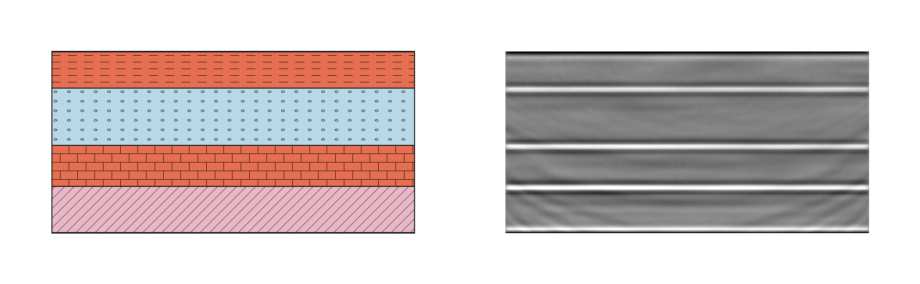
Figure 1: A simple paired held-out scene rendered as a stratigraphic diagram and as a seismic-style amplitude section—both are linked to an identical hidden geological history.
Task Definition and Reward Decomposition
Given an image, models must infer a JSON event sequence comprising five primitive event types (D = deposition, T = tilting, F = faulting, E = erosion/unconformity, I = intrusion) and associated attributes. The verifier scores outputs via a weighted, fine-grained decomposition: JSON validity, event count, order, type, deposit/fault/intrusion/unconformity attributes, extra-event penalty, and prose filtering.
Two aggregated scores are defined:
- R: full weighted reward, reflecting both format and geological correctness.
- Rgeo: geology-only mean, considering only event content attributes for transfer analysis.
Experimental Protocol
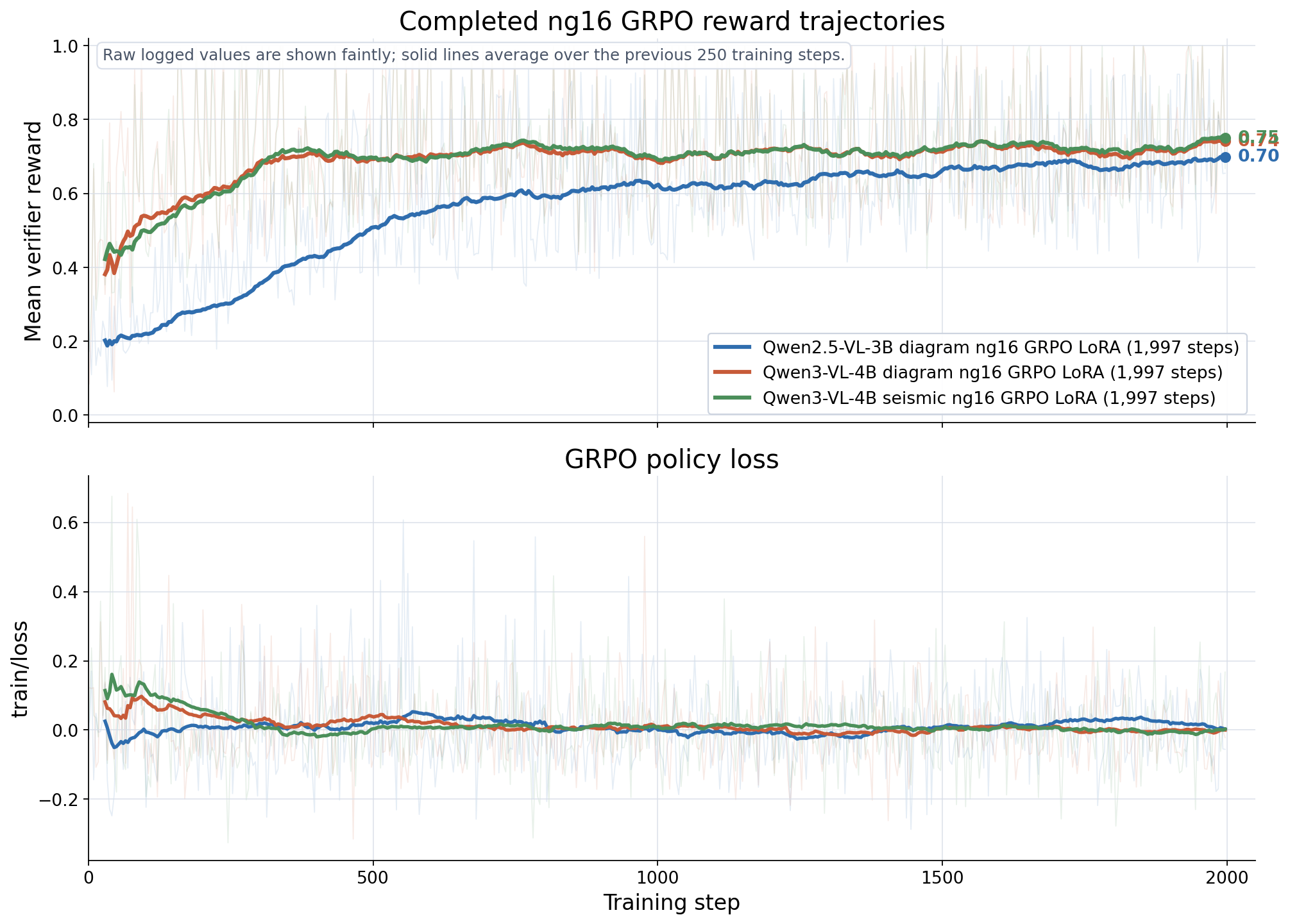
RLVR training leverages Hugging Face's TRL (Group Relative Policy Optimization, a PPO variant) with LoRA adapters on Qwen2.5-VL-3B and Qwen3-VL-4B pretrained models, using 16 generations per prompt and 2000 RL steps. Held-out test and validation sets are precisely partitioned (distinct seeds, no overlap), and evaluation is performed over multiple rollouts per example with bootstrap-derived CIs for robust comparison.
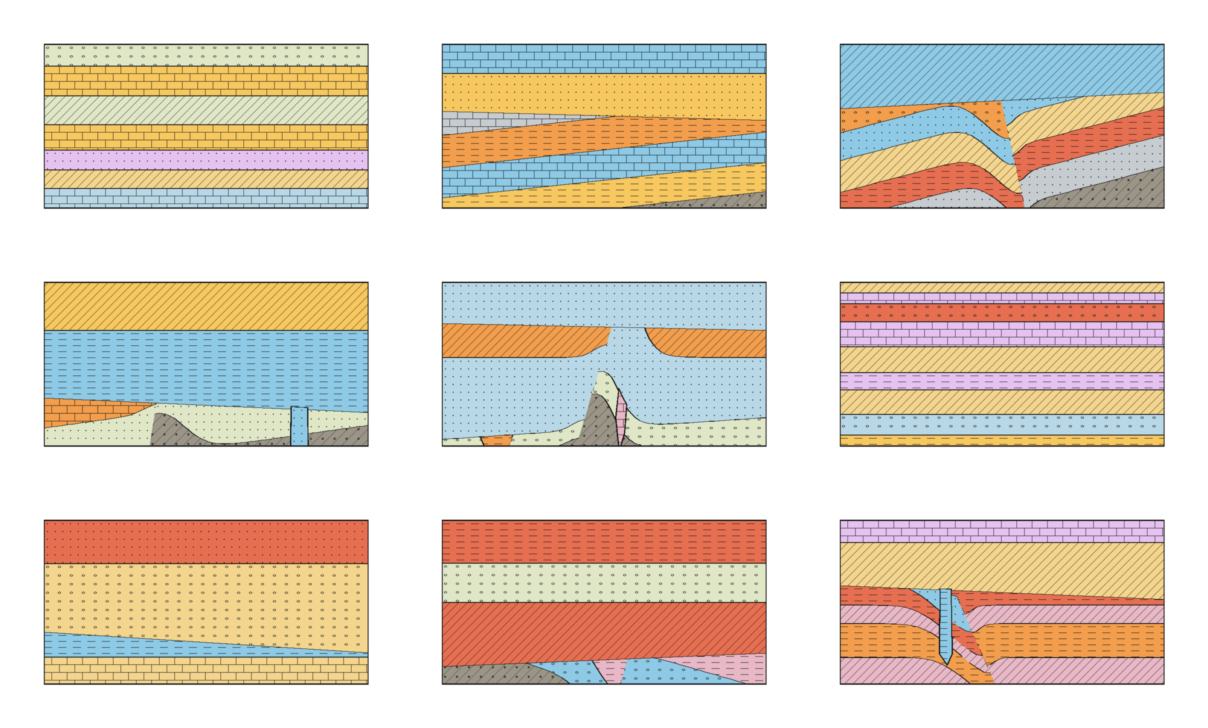
Figure 2: Examples from the synthetic dataset: models must reconstruct a concise event chronology solely from unannotated stratigraphic diagrams.
Results: RLVR Impact and Cross-Domain Generalization
RLVR tuning via LoRA adapters yields consistent, substantial improvement in geological event reconstruction:
Comparison against closed models (e.g., "GPT-5.5" [openai2026gpt55system]) shows similar performance: Rgeo=0.668 (diagram evaluation). All top models achieve perfect JSON validity and prose compliance, indicating that RLVR enforces both interface and content learning.
Performance stratified by generator complexity shows that RLVR delivers consistent improvements across all difficulty buckets—although absolute performance declines with increased complexity, the gap between RLVR-tuned and base models is stable.
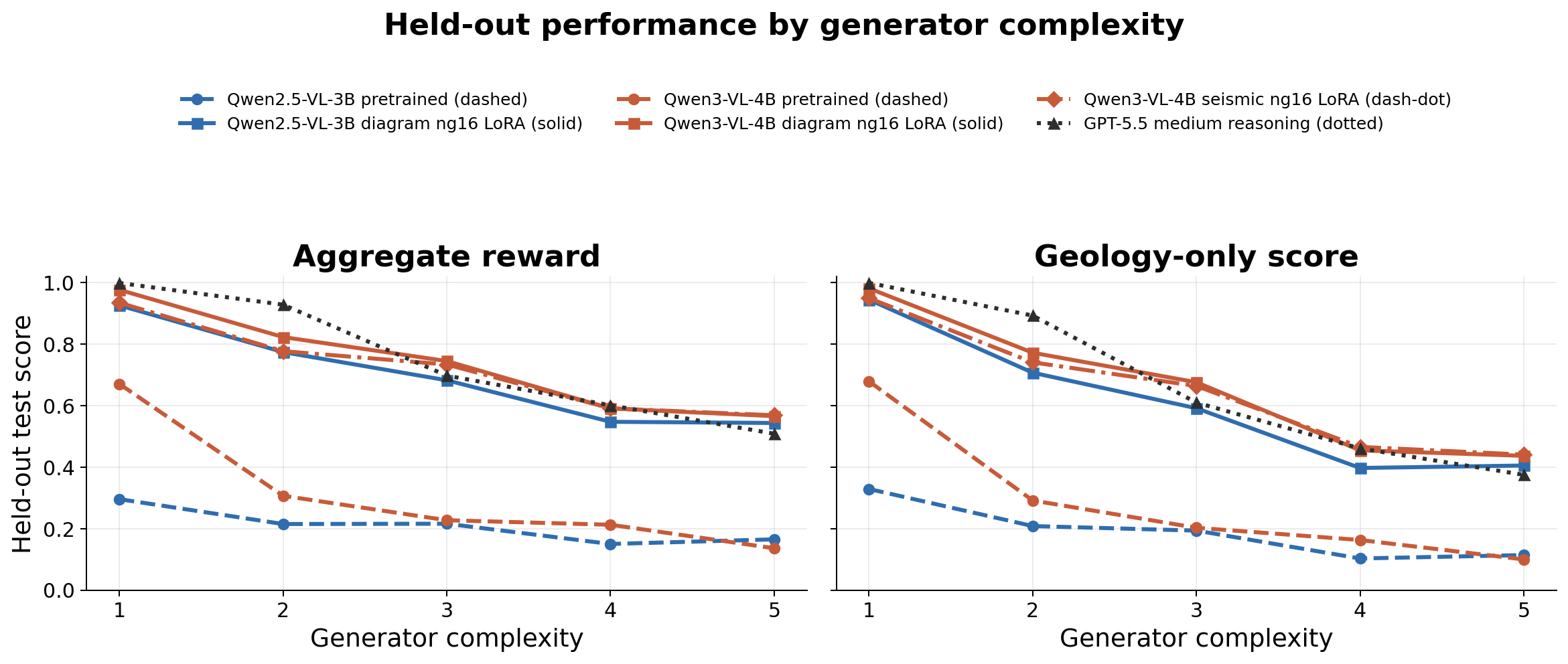
Figure 4: Performance versus geological generator complexity. RLVR consistently improves geological event recovery over pretrained baselines at all complexity levels; closed models are competitive only at lower complexity.
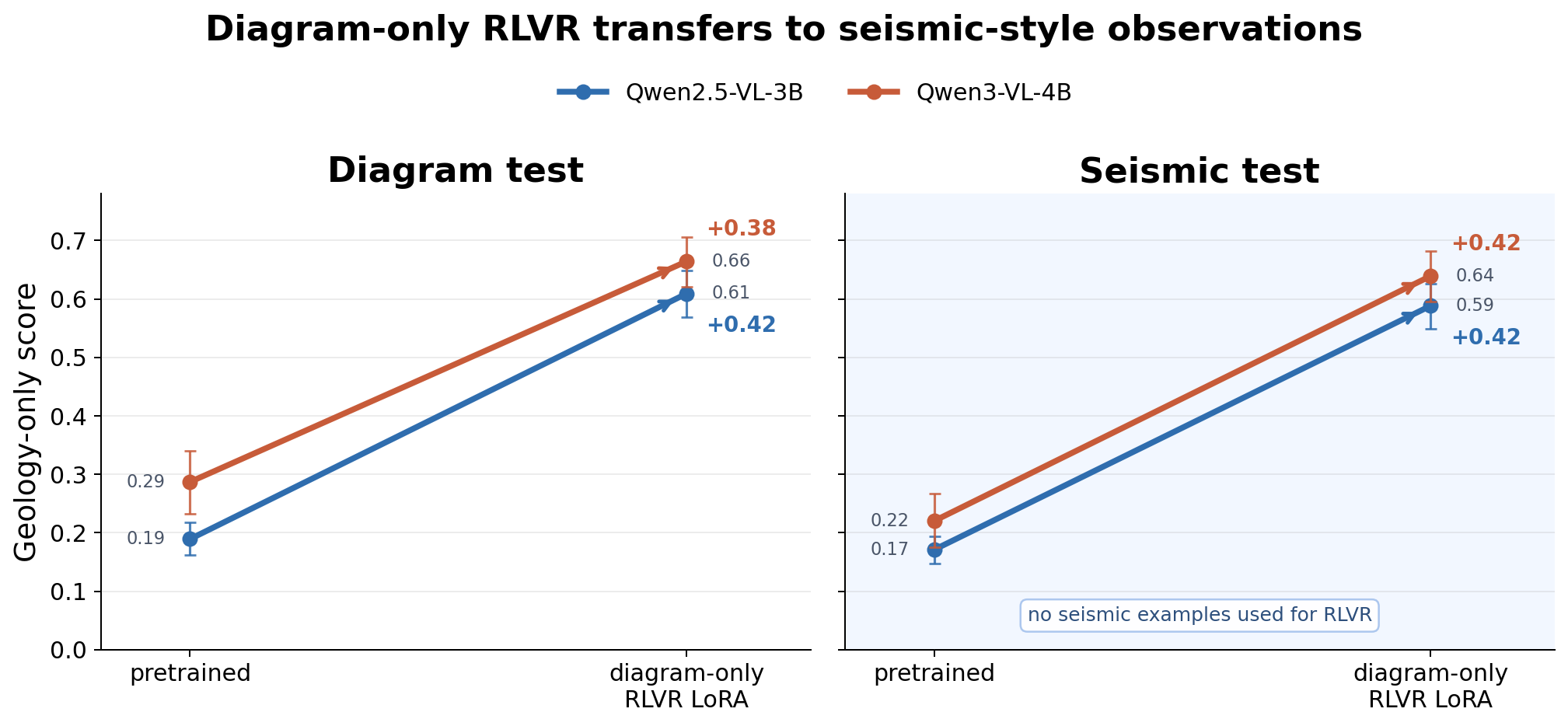
Transfer to seismic-style domains—without any seismic-specific training—demonstrates that models acquire geological reasoning not tethered to the diagrammatic observation space:
Components analysis reveals that the strongest improvements are in event counting, event type recovery, and deposition attributes, with fault and especially unconformity attributes remaining as the most persistent and challenging error sources in both domains.
Discussion and Implications
Theoretical Ramifications
The study affirms that modern VLMs, especially when tuned with executable reward signals, can perform latent temporal/geological reasoning that extends beyond direct pattern matching. Furthermore, RLVR approaches such as Group Relative Policy Optimization with LoRA adapters are effective for precise domain-specific logic transfer even with minimal human supervision.
Despite this, the research identifies the inherent difficulty in recovering complex structural attributes, particularly unconformity relationships—this marks a boundary for current VLM visual-reasoning capabilities. Notably, closed models like GPT-5.5 achieve comparable overall scores, suggesting these skills may emerge at scale without explicit geological RLVR, but are amplified by targeted feedback.
Practical and Future Directions
Geo-Strat-RL's controlled synthetic benchmark enables precise, auditable breakthroughs in both model and algorithmic design. The demonstration of cross-domain adaptation (diagram ↔ seismic) is a step toward robust, reusable geoscientific AI agents. However, the synthetic domain cannot fully capture the ambiguities, noise, and multimodal integration required for field geology or operational seismic interpretation.
Key future work includes:
- Extension to human or expert geoscientist performance benchmarks.
- Enrichment of processes (facies uncertainty, multiple valid interpretations).
- Systematic ablation studies separating UI/schema compliance from genuine temporal/structural reasoning.
- Development of interpretability protocols—mapping VLM attention or rationales onto granular geological events.
The benchmark design allows granular error attribution, supporting interpretability-focused diagnostics and chain-of-thought evaluation for model introspection.
Limitations
Geo-Strat-RL reflects intentionally stylized and synthetic geological scenarios. The dataset and reward function do not attempt to represent the full ambiguity, multimodal integration, sensor physics, or interpretive practices of real-world geoscience workflows. While the seismic renderer includes plausible wave propagation and imaging steps, it remains a controlled proxy devoid of the complexities of real seismic acquisition/processing. Direct operational applicability is not claimed; rather, the framework is optimized for precise measurement of VLM reasoning under verifiable, high-ambiguity supervised settings.
Conclusion
Geo-Strat-RL systematically advances the measurable evaluation of geological event reasoning in VLMs, enabling both honest progress tracking and low-variance protocol design for RLVR in high-ambiguity domains. The positive transfer across observation modalities confirms that verifier-driven RL can encode transferable scientific reasoning. The main practical impact lies in improved task-specific benchmark methodologies and synthetic environments for geoscience, not in direct deployment for field interpretation. The theoretical consequence is an evidential basis for RLVR as a tool for instilling latent temporal and structural logic beyond vision-to-language surface mapping. This paradigm can be generalized to other scientific and engineering domains where the answer key is unambiguous under controlled conditions.