- The paper establishes composable security by using trusted single-qubit rotation devices to replace conventional trusted sources and detectors.
- The methodology leverages simulation-based proofs and rotation-based measurement/preparation to achieve indistinguishable outcomes from an ideal system.
- The practical implications extend to quantum key distribution, oblivious transfer, and more, reducing hardware complexity while preserving protocol security.
Cryptographic Utility of Single-Qubit Rotations
Introduction
The paper "On the cryptographic potential of single-qubit rotations" (2606.23392) rigorously analyzes the power of single-qubit rotation devices within quantum cryptographic protocols. The central thesis is that the reliance on trusted qubit sources and detectors can be displaced by utilizing trusted single-qubit rotation devices in conjunction with untrusted qubit sources or detectors. This paradigm shift has profound implications for the design, standardization, and practical deployment of quantum communication architectures such as the Qline. Leveraging the Abstract Cryptography framework, the paper establishes composable and universally applicable constructions for cryptographic primitives, particularly single-qubit measurement and preparation.
Framework and Definitions
The security proofs employ the Abstract Cryptography framework, which models cryptographic protocols as composable systems with user and adversarial interfaces. Security is defined via simulation-based criteria: a protocol is ϵ-secure if a simulator exists such that the protocol is indistinguishable from the ideal system up to advantage ϵ. This guarantees composability across complex cryptographic constructs.
The paper distinguishes two primary operational scenarios:
- Single-Qubit Measurement: Trusted measurement devices are replaced by applying a rotation (by −θ or −θ+rπ, where r is random) and using an untrusted detector. Security is achieved via outcome randomization and angle encryption.
- Single-Qubit State Preparation: Trusted sources are replaced by applying a rotation (by θ) to an untrusted prepared qubit, subject to protocol-specific assumptions (notably, π-periodicity of angle distribution and entanglement-based variants).
Secure Construction of Single-Qubit Measurement
The authors define formal systems SDB (trusted detector) and SDC (rotation-based measurement), showing their indistinguishability (SDC≈0SDB∘SIM) for any adversarial distinguisher, thus demonstrating composable security.
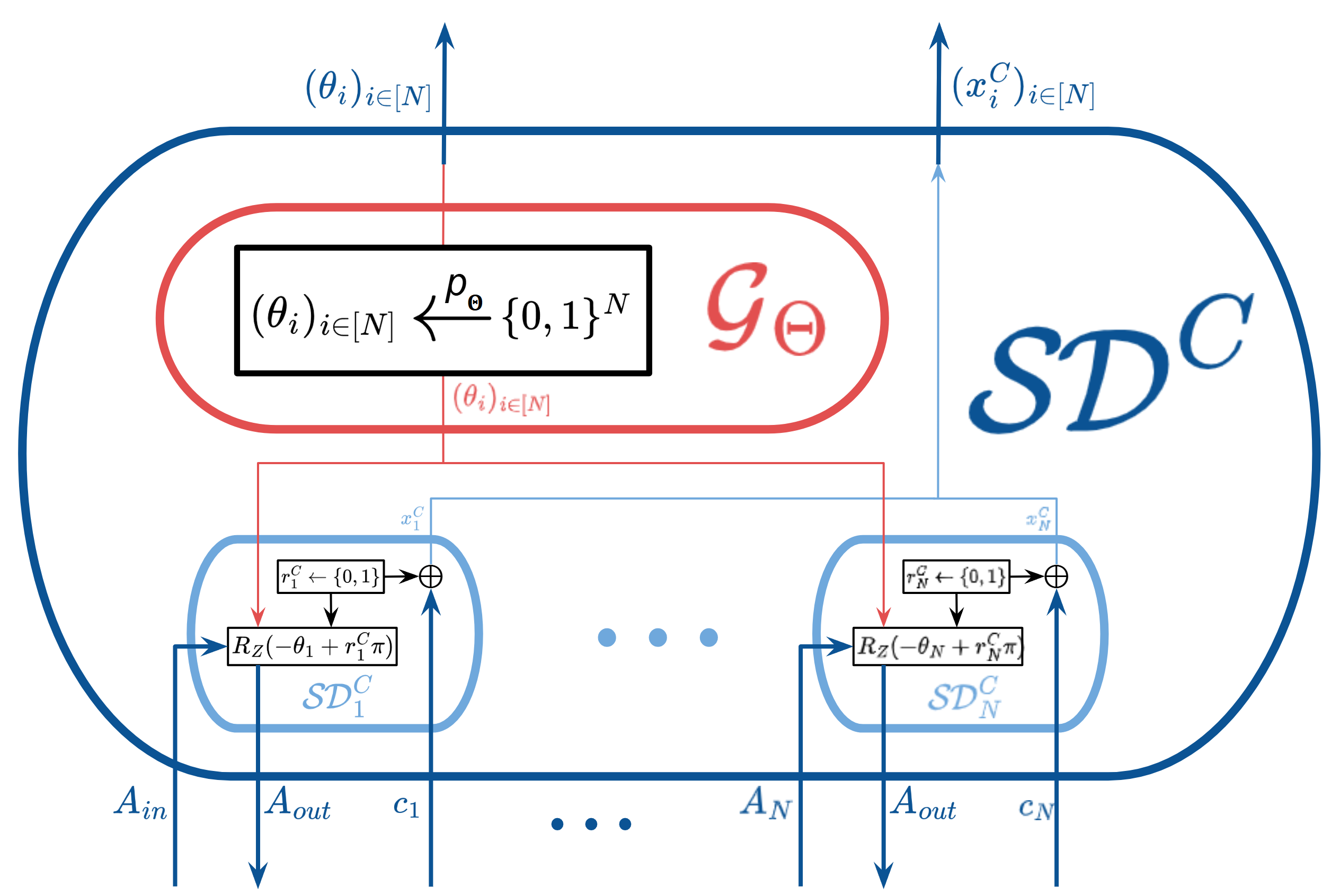
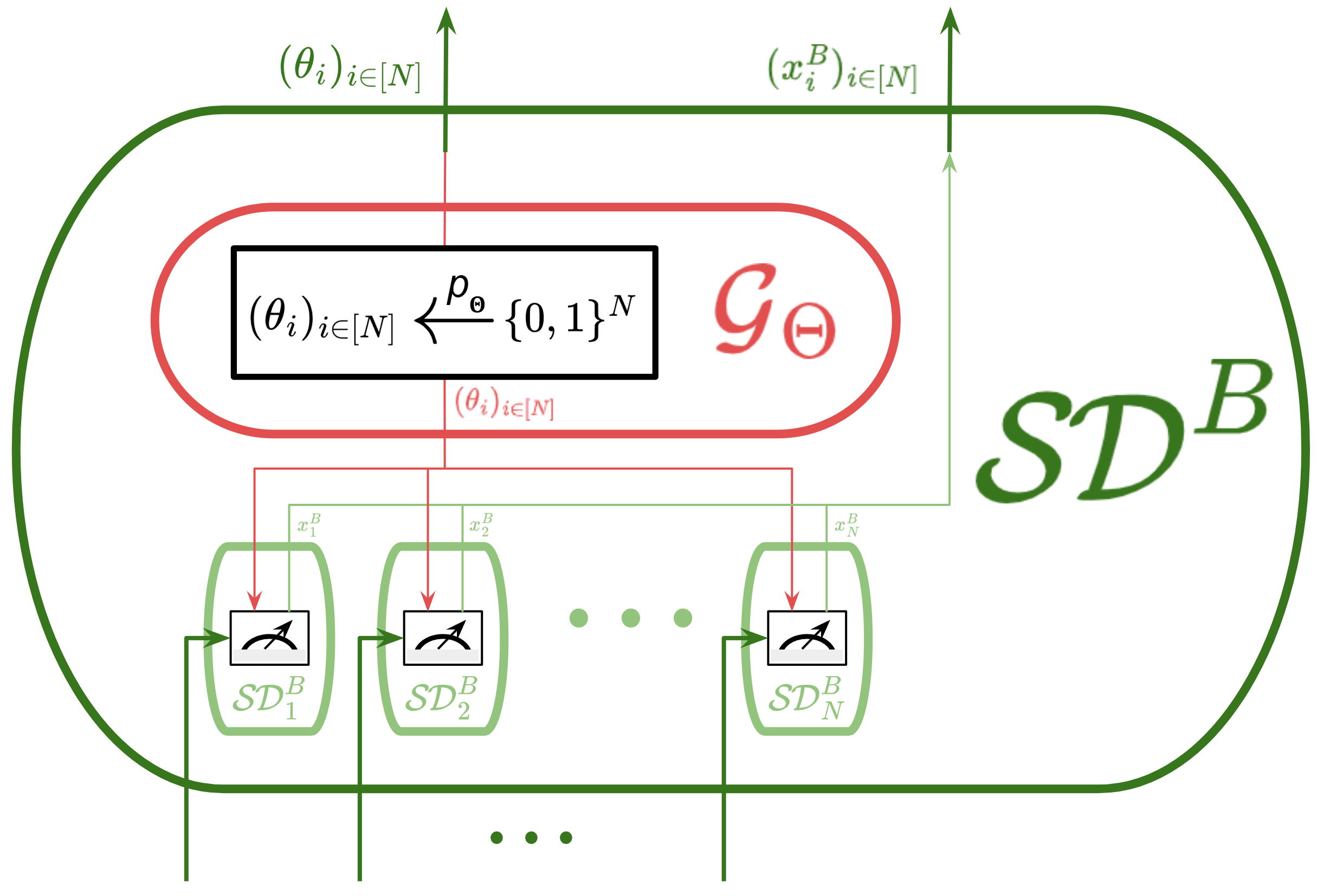
Figure 1: The system ϵ0, which securely implements single-qubit measurement using single-qubit rotation and untrusted detection.
The proof leverages the indistinguishability of the output state distributions when adversaries are given either system, which is achieved through the strategic application of ϵ1 rotations and classical outcome randomization. The analysis is extended to parallel compositions, thereby supporting protocols involving multiple qubits. The result is universally applicable to quantum protocols requiring single-qubit measurements on an arbitrary basis.
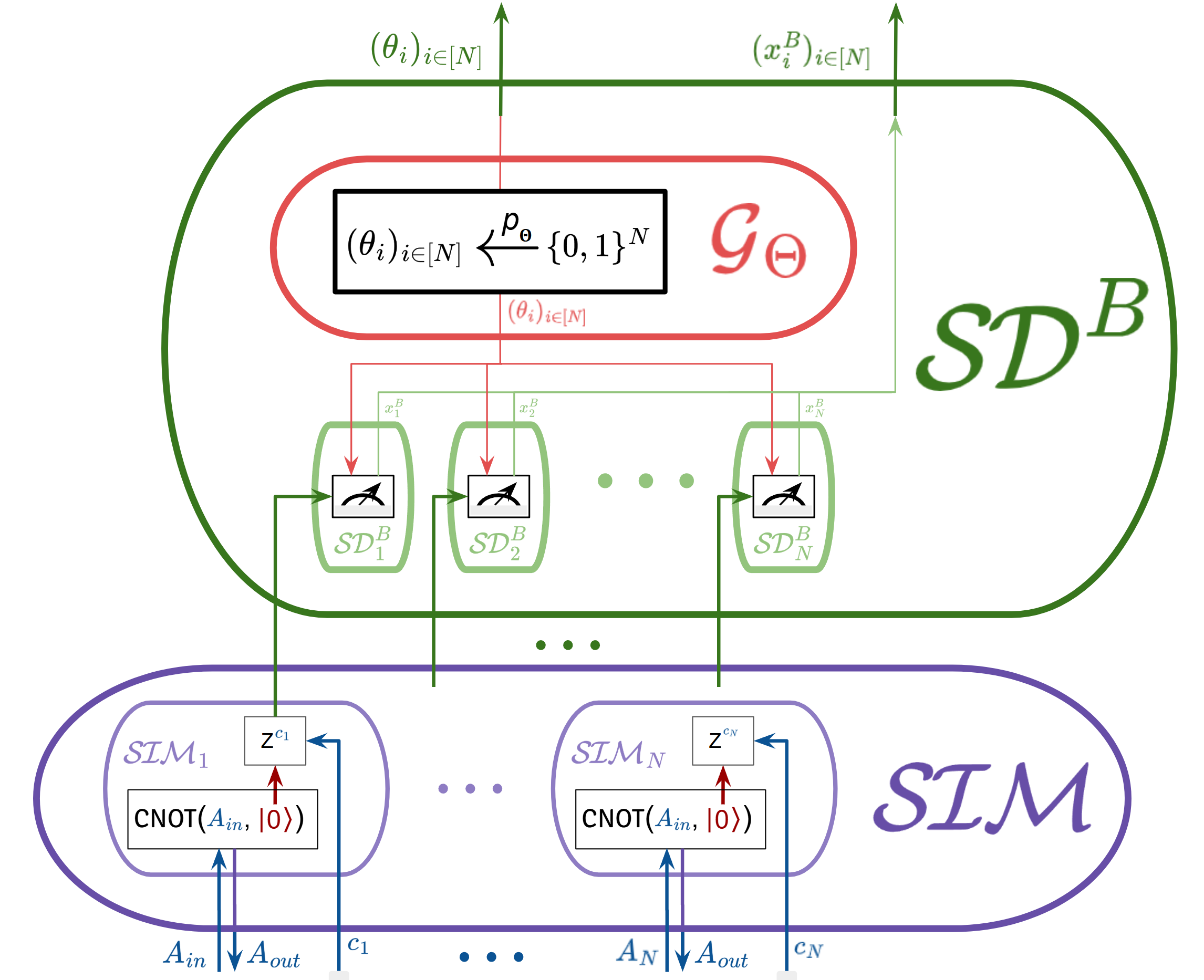
Figure 2: The system SIM plugged into SDB, functioning as a simulator to prove the indistinguishability for security claims.
Secure Construction of Single-Qubit State Preparation
The state preparation scenario is more nuanced. Protocols are analyzed under the assumptions of ϵ2-periodicity (ensuring indistinguishability upon angle flips) and the existence of entanglement-based variants where security holds under untrusted state distribution.
Two construction variants are introduced:
- CNOT-Based Variant: Security is demonstrated by equivalence to preparing entangled pairs and measuring one qubit in the ϵ3 basis, flipping angles accordingly.
- Entanglement-Based Variant: Security is achieved by direct entanglement-based protocol simulation (receiving EPR pairs from an untrusted source, measuring one qubit, and outputting the other).
These constructions leverage the composability property, ensuring that replacing trusted sources with rotation-based devices retains protocol security under the simulation-based framework.
Applicability to Quantum Cryptographic Primitives
The constructions are shown to be applicable to a spectrum of quantum cryptographic protocols:
- Quantum Key Distribution (QKD): Both entanglement-based and prepare-and-measure versions admit secure implementation using single-qubit rotation devices for intermediate nodes, extending formal security guarantees to the Qline.
- Quantum Oblivious Transfer (QOT): Via equivalence to entanglement-based QOT, the constructions enable secure participation with only rotation devices for both sender and receiver roles.
- Quantum Bit Commitment (QBC) and Delegated Quantum Computing (DQC): The theoretical analysis indicates that variants of these protocols can similarly leverage single-qubit rotations in lieu of trusted sources/detectors, particularly when self-testing or consistency-checking phases are incorporated.
Security Model and Limitations
The paper clarifies the scope of security: while the constructions shift trust from preparation/detection devices to rotation units, they are not device-independent and do not mitigate side-channel attacks. The essential assumption is that the rotation device reliably processes single-qubit states—ensured by device certification—which may present a technological challenge but is theoretically feasible within current photonic implementations.
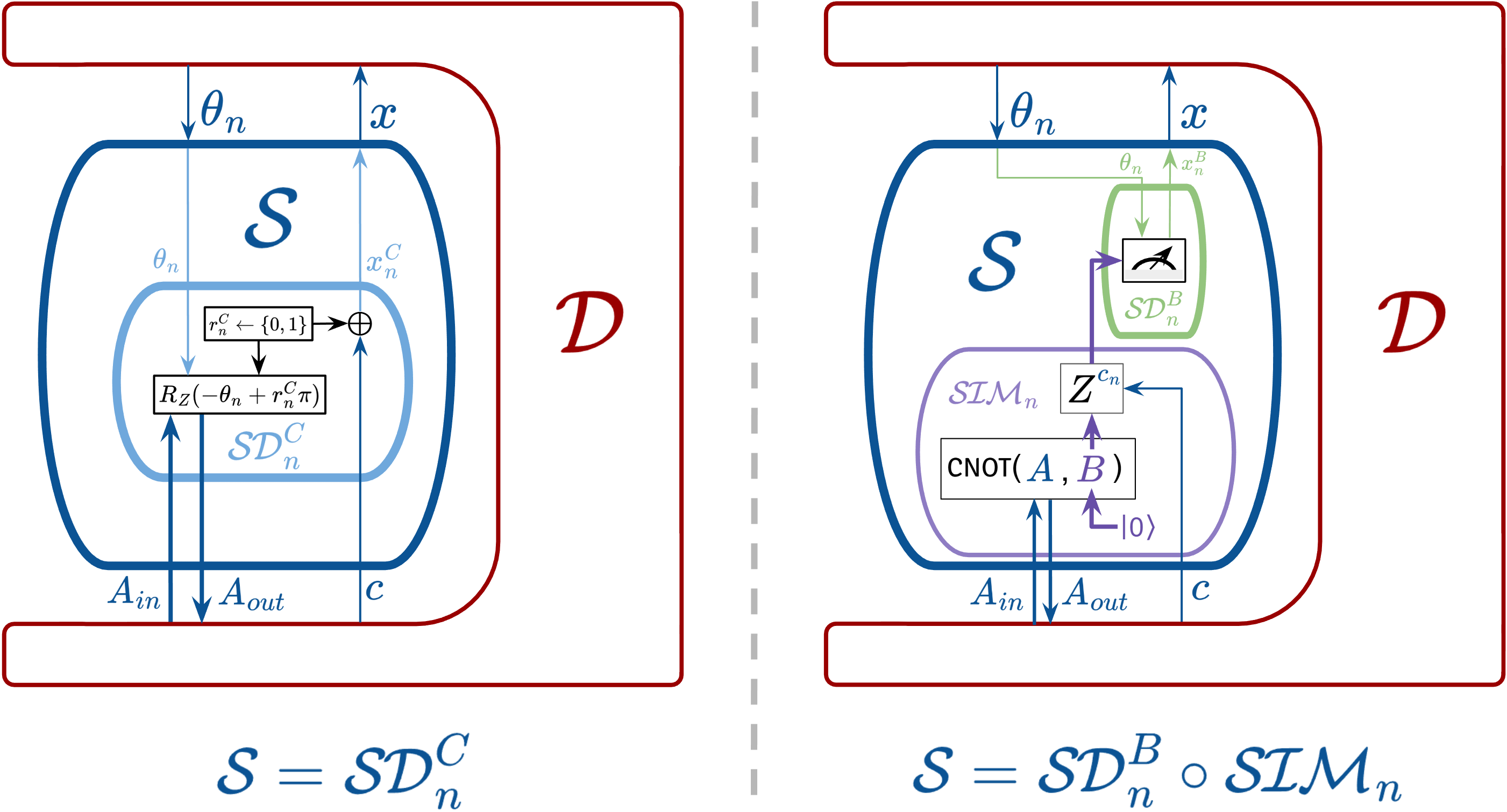
Figure 3: Security proof setup, where a distinguisher interacts either with SDC_n or with SDB_n composed with SIM_n, demonstrating indistinguishability.
Implications and Future Directions
The formal validation of the Qline architecture's versatility facilitates a standardized user hardware model for quantum networks: users need only maintain trusted rotation devices, with qubit preparation and measurement outsourced to untrusted providers. This reduces hardware complexity and cost, potentially accelerating the deployment and scale-up of quantum communication networks.
Practically, the results motivate the engineering of certified single-qubit rotation devices and the examination of their feasibility in a networked setting. Theoretically, the paradigm shifts attention to exploring the limits of cryptographic security when only rotations are trusted, and extending composable security guarantees to novel quantum protocols.
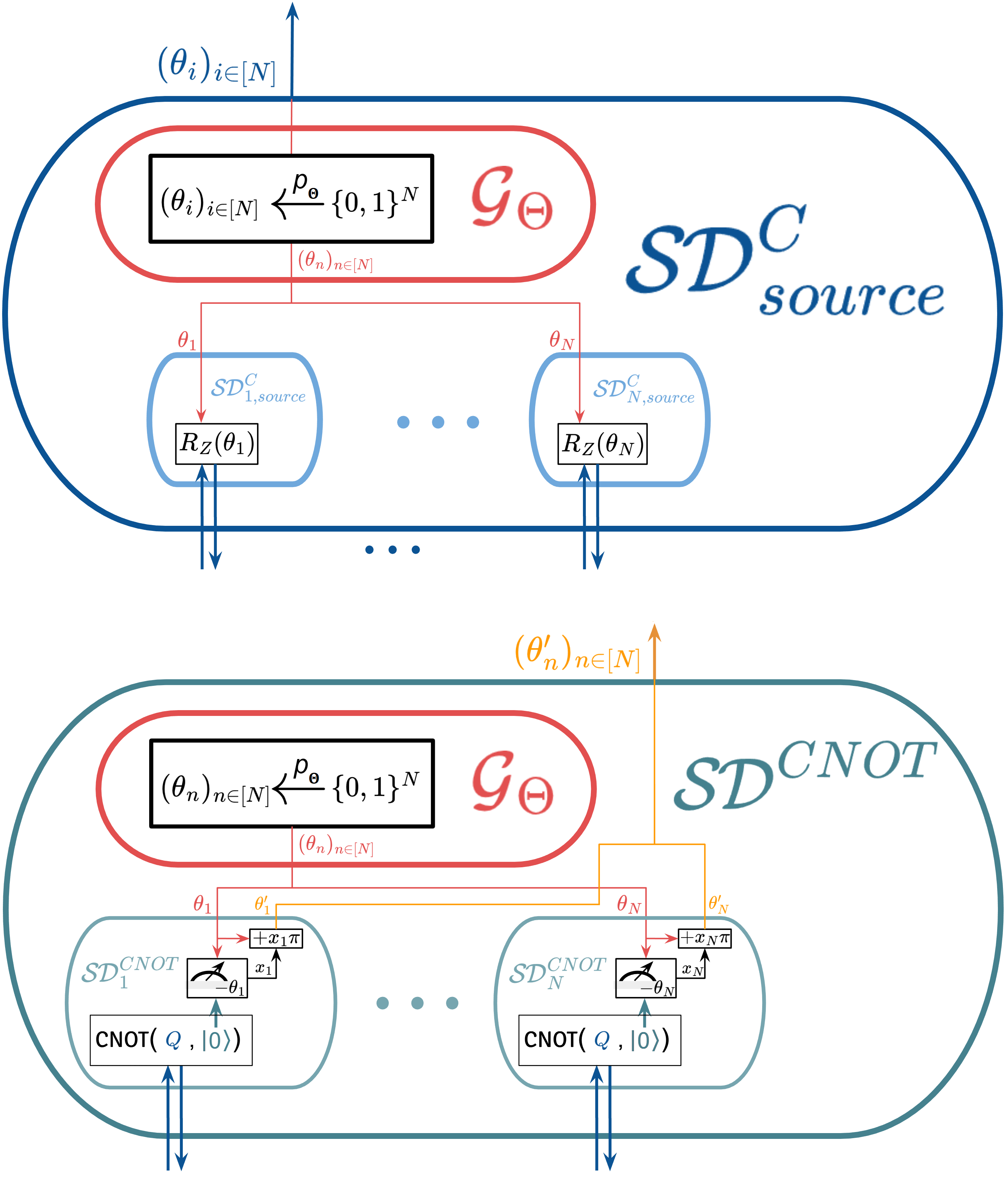
Figure 4: Charlie’s state distribution ϵ4, showing the flow of quantum information through rotation and untrusted detection.
Conclusion
This work rigorously establishes the composable security afforded by single-qubit rotation devices in quantum cryptographic protocols. The formal constructions and proofs provide blueprint methodologies for replacing trusted qubit sources and detectors with untrusted devices supplemented by rotations, substantially broadening the applicability of the Qline architecture and offering pragmatic pathways to standardized, scalable quantum networks. Future research will pursue device certification, extend the framework to larger classes of protocols, and address practical resistance to side-channel vulnerabilities.

