Published 15 May 2026 in quant-ph | (2605.16093v1)
Abstract: Quantum mechanics enables information-processing advantages even at the level of a single qubit. A paradigmatic example is the 2$\to$1 random access code (RAC), where a qubit outperforms a classical bit in retrieving encoded information. In the standard form, however, this quantum advantage is restricted to a single receiver, since decoding measurements inevitably destroy the encoded information. Contrary to this, we address how long the information encoded in a single qubit remains accessible even after multiple decoding, each with a quantum advantage. Introducing preparation distinguishability as an operational resource associated with the sender, we show that its interplay with measurement incompatibility on the receiver's side can mitigate measurement-induced disturbance, thereby enabling an arbitrarily long sequence of receivers to each retain a quantum advantage. Our results show that, even under repeated measurements, the information encoded in a qubit need not be entirely exhausted, revealing a stronger communication feature than previously recognised.
The paper demonstrates that a single qubit can support an arbitrarily long sequence of independent receivers, each achieving quantum advantage in the 2→1 RAC setup.
The study highlights that optimal trade-offs between preparation distinguishability and measurement unsharpness are key to overcoming classical bounds.
Analytical bounds and recursive Bloch sphere analysis confirm that quantum advantage is maintained despite sequential measurement-induced disturbances.
Unbounded Sequential Quantum Communication with a Single Qubit
Overview and Motivation
The paper "Unbounded Communication Power of a Qubit" (2605.16093) critically re-examines the limits of prepare-and-measure quantum communication tasks, specifically random access codes (RACs) utilizing a single qubit. Traditionally, the quantum advantage in these scenarios was thought to be strictly limited by measurement-induced disturbance, constraining the number of independent receivers who could access quantum-enhanced information. The authors demonstrate that, contrary to prior assumptions, a single qubit can sustain an unbounded sequence of independent receivers, each achieving quantum advantage in the 2→1 RAC, provided the correct trade-off between preparation distinguishability and measurement incompatibility is maintained. This result extends the operational capabilities of a qubit far beyond established bounds.
Sequential RAC Scenario and Communication Advantage
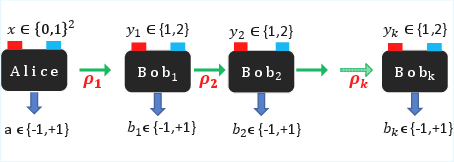
The core setup involves Alice encoding two classical bits into a single qubit and then sending this qubit through a sequence of Bobs. Each Bob independently attempts to recover one of the bits using an unsharp (non-projective) measurement, and then passes the post-measurement state to the next Bob. The central operational question is: How many Bobs can sequentially achieve quantum advantage?
Figure 1: Alice's preparations are sequentially passed from one Bob to the next, each of whom performs one of the two measurements aiming to independently reveal quantum advantage in the 2→1 RAC.
The authors show that, via precise manipulation of preparation distinguishability and measurement incompatibility parameters, there is no fundamental upper bound on the number of sequential receivers, each retaining a quantum advantage over any classical protocol.
Preparation Distinguishability as an Operational Resource
Preparation distinguishability, defined as the maximal statistical (trace) distance between outcome distributions generated by two preparations over all measurements, is identified as a key resource governing RAC performance and quantum advantage. Specifically, for a pair of marginal ensembles P0, P1, the maximal average success probability in state discrimination is directly tied to this distance.
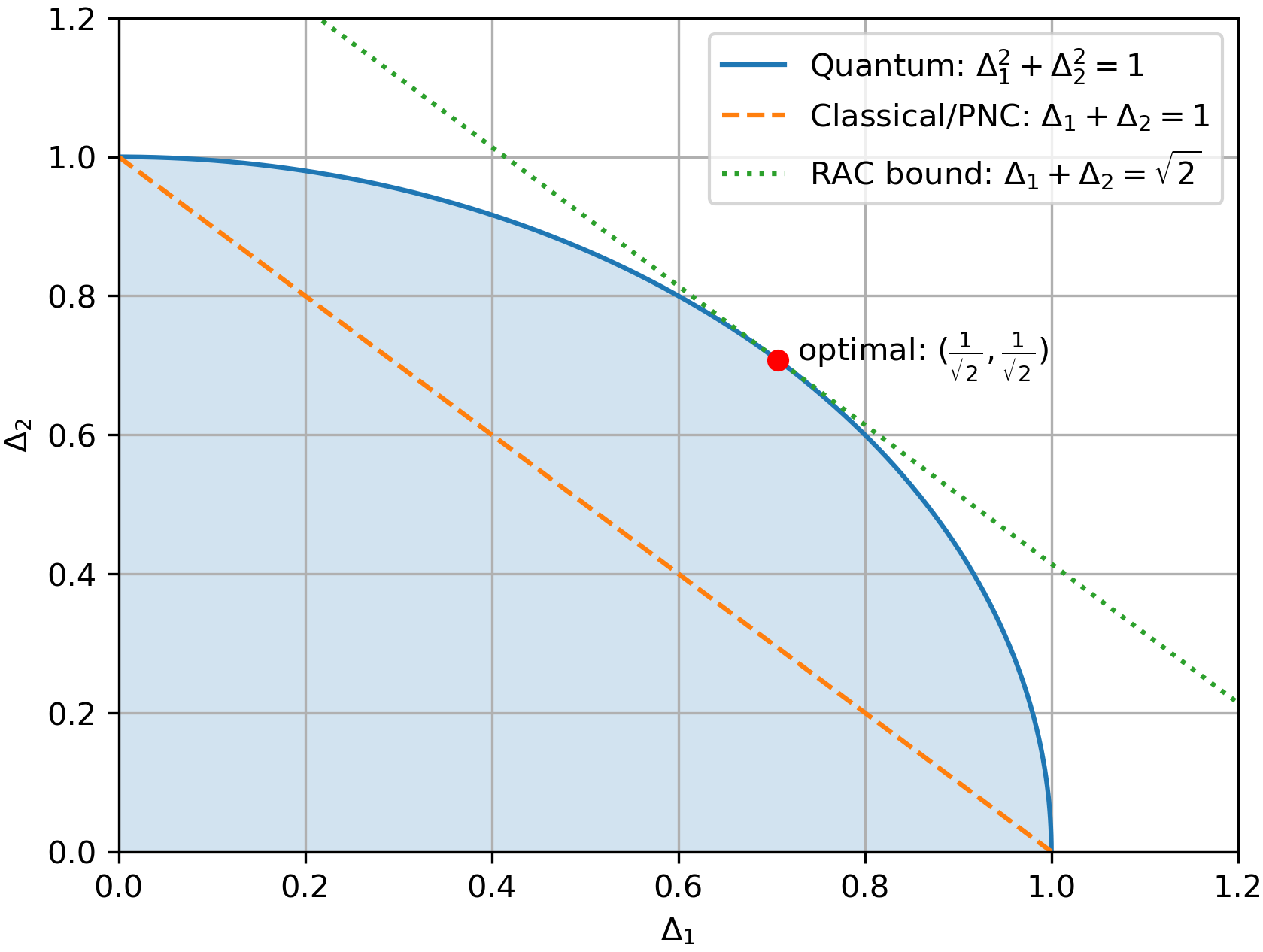
When viewing the 2→1 RAC as two binary discrimination problems (recovering either bit), the success probability can be expressed in terms of two preparation distinguishabilities, Δ1 and Δ2: Pavg≤21+4Δ1+Δ2
Classical/preparation-noncontextual models strictly obey Δ1+Δ2≤1, limiting the average success probability to ≤43.
Quantum theory, however, allows jointly attainable distinguishability pairs forming a quarter unit disk (Δ12+Δ22≤1), with maximum quantum success probability 21(1+1/2)—a clear violation of classical bounds.
Figure 2: Comparison of constraints on preparation distinguishabilities (Δ1,Δ2) in the 2→1 RAC. Classical models are restricted to a simplex, while quantum-achievable points form a quarter disk.
Trade-off Between Preparation Distinguishability and Measurement Incompatibility
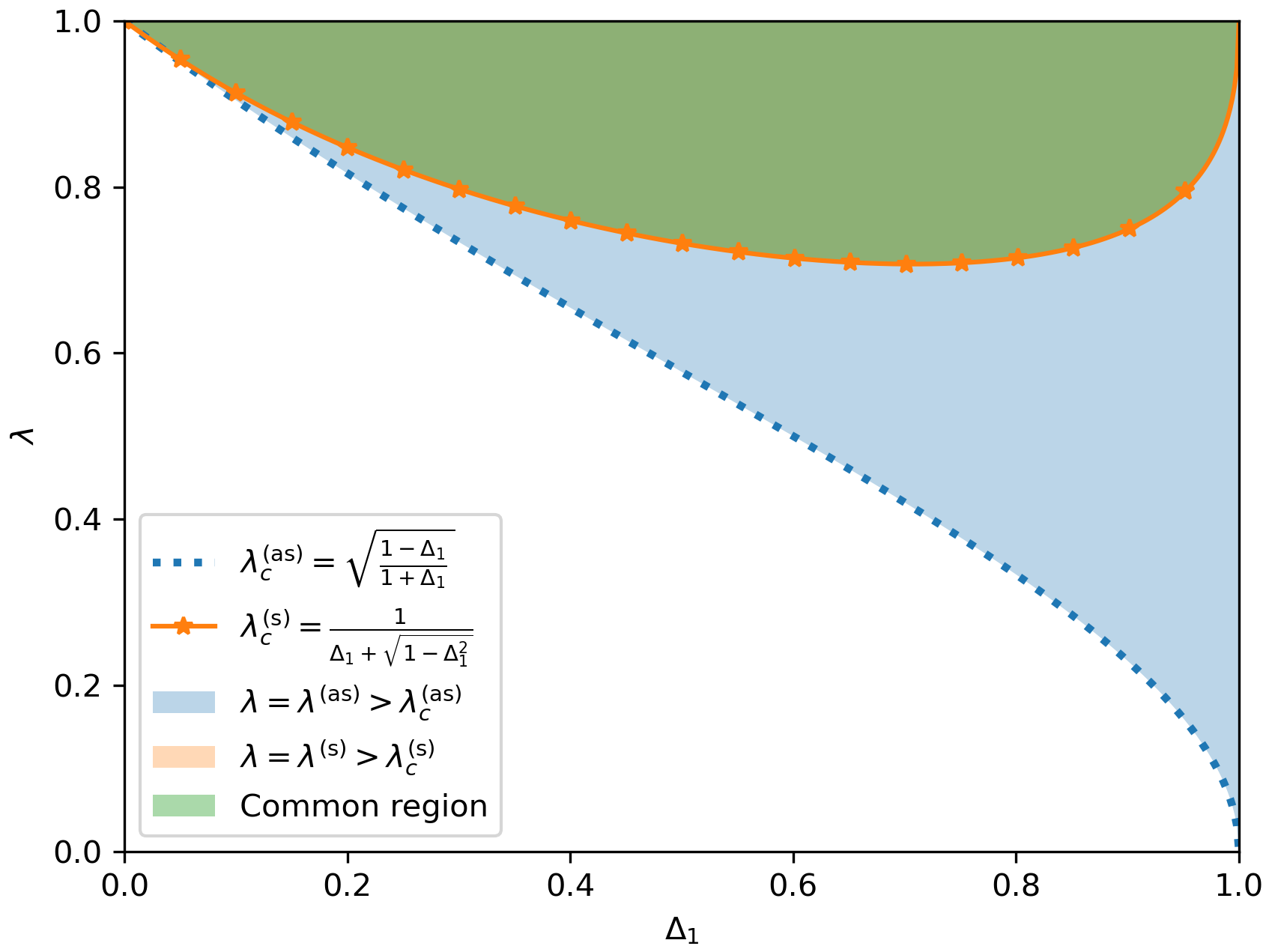
Quantum advantage in sequential RACs is fundamentally governed by the interplay between the distinguishabilities of preparations and the incompatibility (unsharpness) of measurements. The latter is parametrized by P10, characterizing the POVM's sharpness.
For two measurements with equal unsharpness P11, the threshold for quantum advantage is: P12
Optimal quantum advantage coincides with minimal threshold P13 at P14.
In asymmetric scenarios (one projective, one unsharp), the threshold can be driven arbitrarily low as P15, showing that nearly compatible measurements suffice for quantum advantage when preparation distinguishabilities approach classical bounds.
Figure 3: Comparison of symmetric and asymmetric thresholds for unsharpness parameters as functions of preparation distinguishability; shaded regions denote quantum advantage.
Evolution Under Sequential Measurements and Bloch Sphere Dynamics
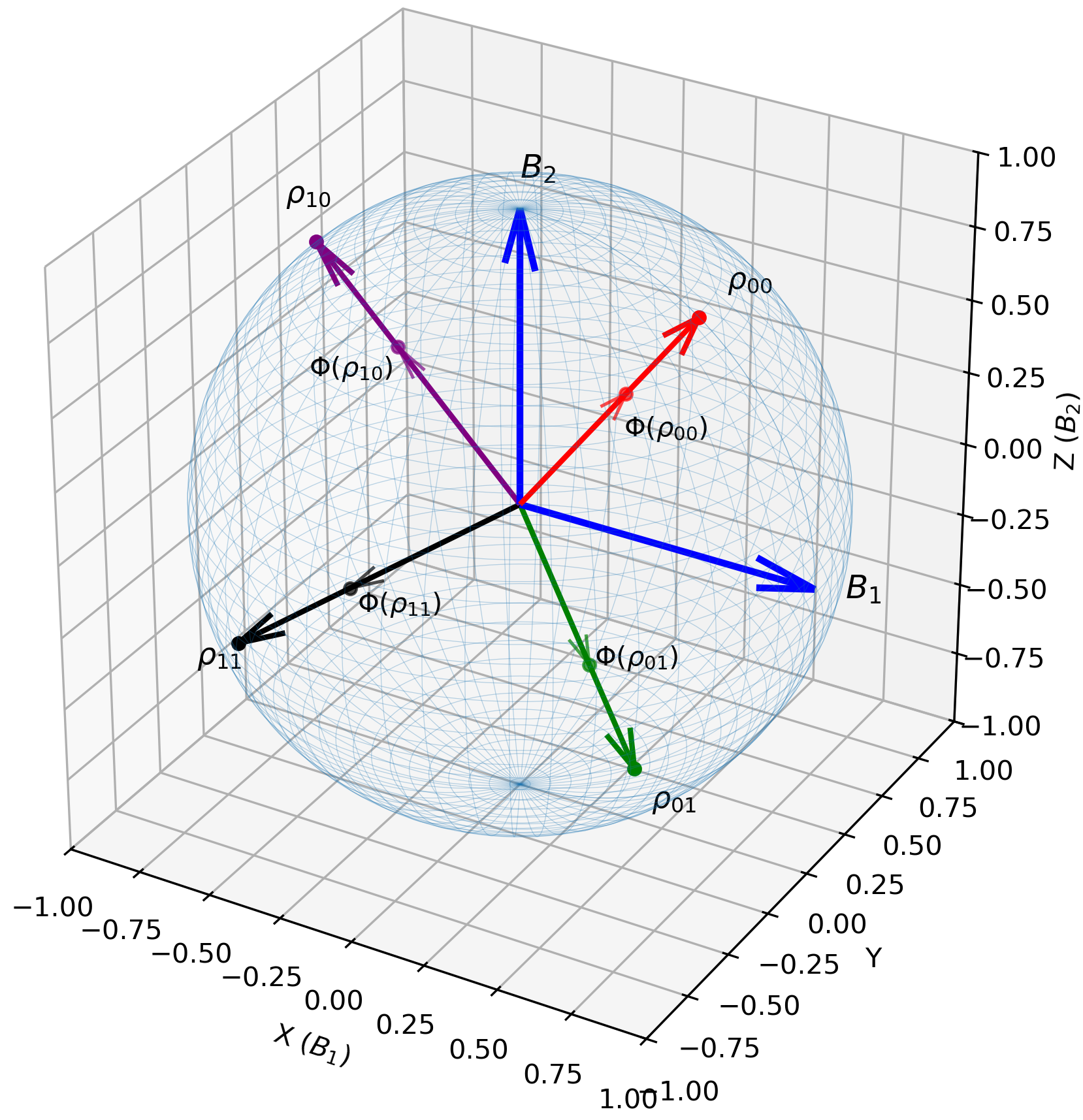
The authors utilize Bloch sphere representations to qualitatively and quantitatively track the evolution of state preparations and measurement directions under sequential, non-selective measurement channels.
Figure 4: Bloch sphere representation of preparation states and measurement directions before and after non-selective measurement channels shows contraction of distinguishabilities but preservation of Helstrom measurement basis.
A recursive formula describes the contraction of distinguishabilities after P16 steps: P17
Given a suitable initial preparation, a monotonically increasing sequence of unsharpness parameters P18 can ensure that an arbitrary number P19 of sequential receivers each have a quantum advantage.
Strong Claims and Numerical Results
Unbounded sequential sharing: The paper explicitly demonstrates the feasibility of an arbitrarily long sequence of receivers in the sequential RAC scenario, each achieving quantum advantage.
Fundamental trade-off: The operational resource of preparation distinguishability is tightly constrained by quantum mechanics (Δ10), but sequential advantage is possible whenever measurement incompatibility satisfies Δ11.
Numerical feasibility: The authors provide analytical upper bounds and recursive constructions for the preparation and measurement parameters necessary for large-scale sequential sharing scenarios.
Theoretical Implications and Future Directions
The results highlight a nontrivial information-disturbance trade-off in sequential quantum measurement scenarios, refuting prior beliefs about rapid exhaustion of quantum information in single qubits. This demonstrates that the quantum resources—preparation distinguishability and measurement incompatibility—are more resilient and operational than previously recognized.
Practically, this opens the door for multi-user quantum communication protocols that are not spatial but temporal, potentially enabling scalable one-to-many communication in quantum networks. The findings suggest new avenues for resource-theoretic formulations of prepare-and-measure tasks, integrating both measurement and preparation resources. Additionally, these results refine our understanding of semi-device-independent and device-independent certification tasks, particularly regarding self-testing and randomness generation via sequential operations.
Conclusion
The paper establishes that the communication power of a single qubit is unbounded in sequential communication scenarios, overturning classical and quantum contextual bounds on information accessibility. The operational interplay between preparation distinguishability and measurement incompatibility enables scalable quantum protocols for many independent receivers. This result advances the theoretical foundations of quantum information and suggests new opportunities for temporal quantum communication architectures.
“Emergent Mind helps me see which AI papers have caught fire online.”
Philip
Creator, AI Explained on YouTube
Sign up for free to explore the frontiers of research
Discover trending papers, chat with arXiv, and track the latest research shaping the future of science and technology.Discover trending papers, chat with arXiv, and more.