- The paper introduces a generalized quantum teleportation protocol that supports arbitrary measurement axes with corresponding adaptive restoration operators.
- It presents an analytical framework and algorithmic formulation to derive restoration unitaries that ensure faithful state reconstruction even with multi-axis measurements.
- Enhanced protocol security and network adaptability are demonstrated, making it suitable for heterogeneous quantum networks and cryptographic applications.
Multi-Axis Quantum Teleportation: Protocol Generalization, Analytical Foundations, and Security Implications
Introduction
Quantum teleportation underpins distributed quantum information processing and secure quantum networking. The canonical protocol—employing joint Bell measurements in the computational (Z) basis—facilitates faithful, loss-resistant transmission of qubit states by leveraging EPR entanglement and two bits of classical communication. However, this fixed measurement axis is restrictive for heterogeneous quantum networks, complex distributed setups, and advanced cryptographic applications, where dynamic measurement adaption and basis diversity are paramount. The paper "Enhance Quantum Teleportation with Multi-Axis Measurement" (2604.16728) presents a rigorous generalization: a teleportation protocol supporting arbitrary choice of measurement axes with corresponding basis-conditioned restoration on the receiver side, underpinned by a comprehensive mathematical and algorithmic analysis. The implications extend to both flexible quantum communication architectures and enhanced protocol security.
Standard Quantum Teleportation Protocol
The standard teleportation protocol is instantiated as follows: Alice holds an arbitrary qubit ∣Msg⟩=α∣0⟩+β∣1⟩, and she and Bob share an EPR pair. Alice entangles ∣Msg⟩ with her EPR share via CNOT and Hadamard, performs a two-qubit Z-basis measurement, and transmits the resulting classical bits to Bob. Bob then applies a basis-dependent unitary from {I,X,Z,ZX} to reconstruct the original state.
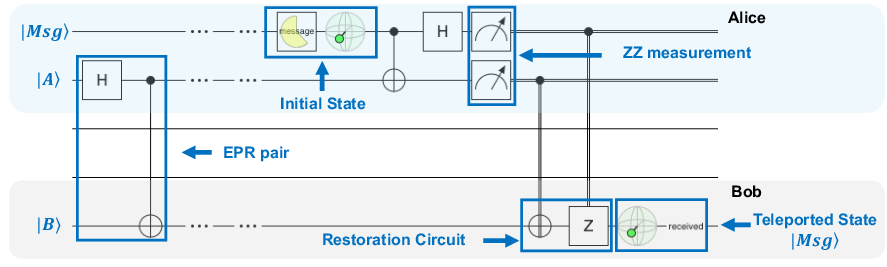
Figure 1: Quantum teleportation protocol with Z-basis measurement and Pauli restoration on Bob's side, enabling perfect state transfer.
The protocol is manifestly correct: the measurement projects Bob’s qubit into one of four orthogonal conditional states, each related to ∣Msg⟩ by a Pauli transformation. Restoration then maps this state back to the original. The protocol has been realized on numerous platforms, including photonic, atomic, and hybrid qubits, and is central for scalable distributed quantum computation and long-distance quantum communication.
Multi-Axis Measurement: Motivation and Foundation
Physical constraints in practical networks, the need for adaptive measurement (e.g., for quantum repeaters, entanglement swapping, QKD protocols), and error-resilient designs necessitate generalization beyond fixed-basis Bell measurements. Measurement in arbitrarily oriented Pauli or even non-Pauli bases is implemented by pre-rotating the measurement qubits (e.g., with Hadamard or S/S† gates) prior to a standard Z-basis readout.
The core technical question is thus: can quantum teleportation remain correct if arbitrary measurement axes are used, provided Bob's restoration is appropriately adapted? The answer provided in this work is affirmative, building an explicit constructive protocol for measurement in an arbitrary local basis and demonstrating (by calculation) that the correct restoration maps Bob’s post-measurement state to ∣Msg⟩.
Analytical Construction of Multi-Axis Teleportation
The protocol generalization is derived as follows: Let the measurement directions on Alice’s two qubits be specified by local unitaries Umsg and UA mapping their respective chosen axes to Z. After CNOT, Hadamard, and these rotations, Alice measures both qubits in Z, yielding classical bits b1b2. The resulting conditional state of Bob’s qubit is a linear function of ∣Msg⟩0 and the components of ∣Msg⟩1. Bob can always apply a (bit-dependent) unitary restoration ∣Msg⟩2—constructible by inverting a 2x2 complex matrix equation—to map his post-measurement state to the initial ∣Msg⟩3. The restoration operator is uniquely determined by the measurement basis and outcome.
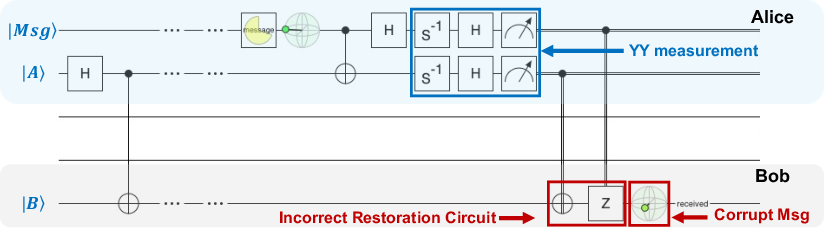
Figure 2: Teleportation protocol incorporating arbitrary (multi-axis) measurements on both Alice’s qubits, requiring updated restoration unitaries for protocol correctness.
A key nontrivial observation is that default Pauli restorations are insufficient and can render the protocol incorrect when the measurement axes deviate from ZZ. The explicit construction and analysis for nontrivial cases, e.g., both-Y basis, hybrid (Y/Z), and asymmetric ∣Msg⟩4, are presented. For instance, when both qubits are measured in Y, Bob’s restoration operators become ∣Msg⟩5—compositions of Hadamard and phase gates with Pauli operators—as demonstrated both analytically and with circuit simulation.
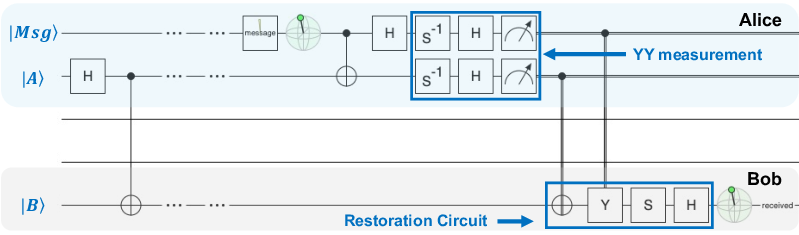
Figure 3: Quantum teleportation using Y-basis measurements on both qubits and corresponding restoration circuit, achieving faithful state transfer with nonstandard restoration.
The analytical process for determining restorations under arbitrary bases is generalized to an algorithmic formulation, and the existence and uniqueness of these operators is formally established.
Security Implications and Network Applications
The protocol generalization also introduces enhanced resistance to insider threats and eavesdropping. In standard teleportation, compromise of the EPR channel and interception of both classical bits enables full state recovery by an adversary. By instead randomizing or privately choosing the measurement axis for each run, protocol participants can prevent adversarial reconstruction of the input quantum state without side-channel knowledge of basis choice. This property is functionally analogous to a basis key in QKD: any adversary lacking the basis selection yields only a scrambled or useless quantum state, even if all classical information is compromised. Adaptivity and secrecy in measurement choice thus serve as cryptographic enhancement, bolstering protocol security without dependence on trusted third parties or additional entanglement.
Implications for Future Distributed Quantum Systems
This basis-general protocol paves the way for heterogeneous quantum networking, where sub-networks employing different hardware, basis preferences, or error models need interoperable teleportation. The algebraic framework for determining basis-conditioned restorations can be embedded into quantum network stack abstractions, allowing on-the-fly adaptation to node-specific constraints. In quantum computer architecture, this could facilitate fault-tolerant link-level teleportation adapted to logical encoding bases or syndrome extraction axes.
Additionally, basis adaptivity is essential in distributed entanglement purification and entanglement swapping, where nonstandard measurement bases optimize yield or fidelity. The security property has implications for authenticated or verifiable quantum communication and may inspire new protocol constructions for quantum cryptography.
Conclusion
This work rigorously establishes that quantum teleportation achieves perfect fidelity under arbitrary measurement axis choices, provided restoration is appropriately adapted and analytically specified. The generalization substantially expands the protocol's flexibility and applicability, making it relevant for advanced, heterogeneous, and security-aware quantum networking scenarios. By providing closed-form solutions for restoration under any measurement basis and clarifying the resulting security properties, the paper lays an analytical and methodological foundation for basis-adaptive quantum communication protocols.
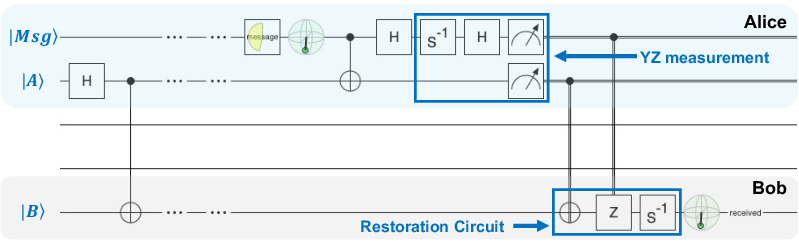
Figure 4: Hybrid measurement configuration with Alice measuring in Y and Z, achieving correct restoration with ∣Msg⟩6 on Bob’s side.
Future prospects include integration into modular, basis-agnostic quantum network protocols, further security analysis in adversarial network models, and practical demonstrations on near-term distributed quantum processors.

