- The paper’s main contribution is the SingGuard framework, which adapts moderation policies dynamically via multimodal inputs and rule-conditioned supervision.
- It employs a unified architecture featuring fast, hybrid, and slow inference paths to deliver real-time safety decisions with explicit chain-of-thought reasoning.
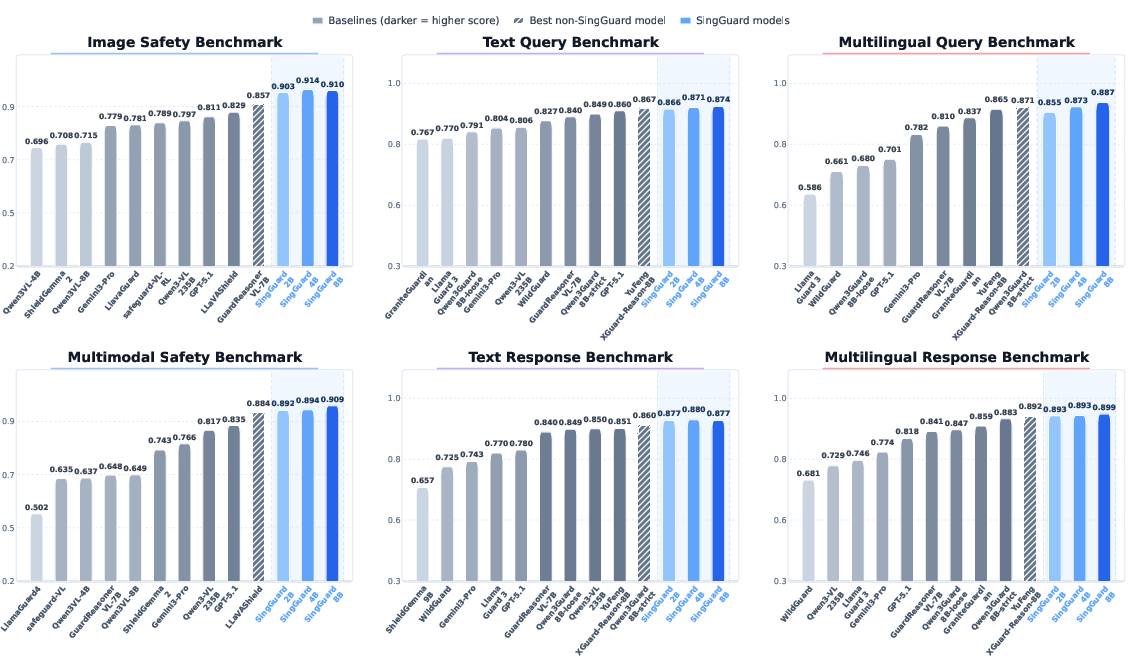
- Empirical results show state-of-the-art performance across multimodal benchmarks with enhanced policy adherence, reduced latency, and robust multilingual support.
SingGuard: A Policy-Adaptive Multimodal LLM Guardrail with Dynamic Reasoning
Overview and Motivation
The SingGuard framework introduces a family of vision-LLM (VLM) safety guardrails that are policy-adaptive, multimodal, and support dynamic reasoning. The motivation stems from the expanded safety surface of VLM applications, which now span high-stakes domains such as healthcare, finance, and enterprise applications. Traditional safety guardrails typically rely on fixed taxonomies and static policies, which lack the flexibility for runtime adaptation required by real-world deployments, where moderation policies often change across products, regions, regulatory stages, and context modalities.
SingGuard advances the field by defining the moderation policy as a runtime input: moderation decisions are not hard-coded against a closed label set but are grounded in a supplied, potentially open-ended, rule set. This enables fine-grained control over safety enforcement and rapid adaptation to new or shifting policy boundaries.
Model Architecture and Unified Inference
SingGuard's architecture is built around a unified, policy-conditioned interface for multimodal safety classification.
- Input Structure: Each moderation instance contains a query, optional images, an assistant response, and an active policy as a set of natural-language rules.
- Output Structure: For each instance and policy, the model outputs a safety verdict, the triggered rule (if any), and, when needed, a trace of its policy-grounded reasoning.
The model supports three inference regimes, adjustable according to deployment latency and auditability constraints:
- Fast (Direct Judgement): Immediate safe/unsafe decision with the triggered rule.
- Hybrid (Adaptive Routing): Early exit if high confidence, otherwise escalation to slow-mode reasoning.
- Slow (Policy-Grounded Reasoning): Step-by-step deliberation over policy rules, with explicit per-rule evidence aggregation.
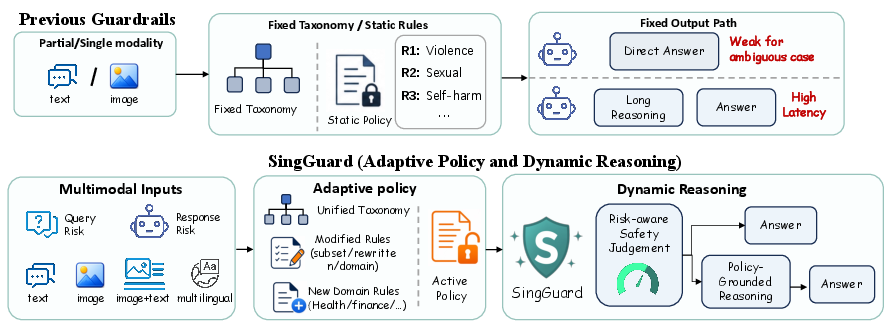
Figure 1: SingGuard unifies multimodal input, open active policy handling, and adaptive reasoning in a single guardrail model.
This output grammar and adaptive inference spectrum are reflected throughout SingGuard’s architecture and training objectives.
Data Annotation, Dynamic Policies, and Chain-of-Thought Reasoning
A major innovation is SingGuard’s data pipeline. Unlike prior works that fix the taxonomy at training time, SingGuard generates dynamic, policy-conditioned supervision:
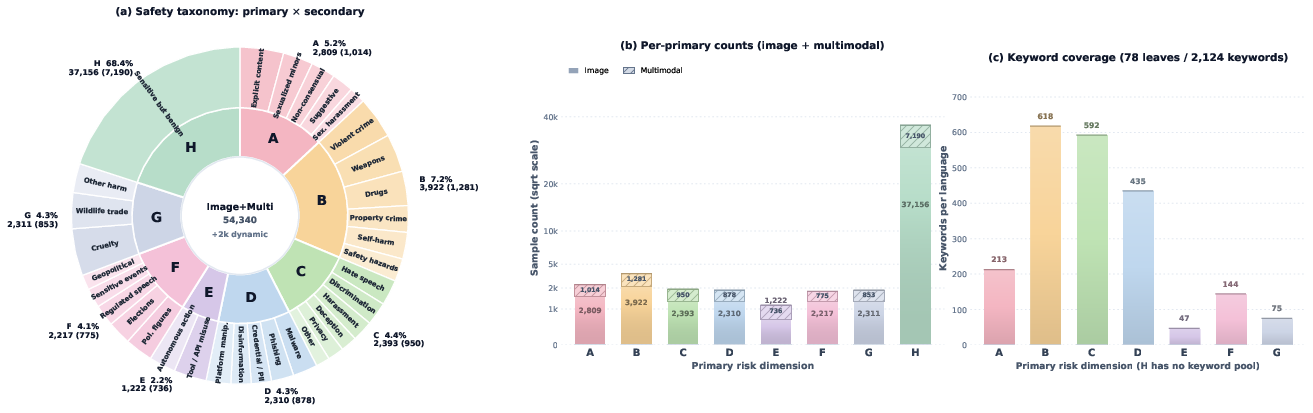
- Taxonomy: An 8-dimensional, 3-level hierarchical taxonomy (sexual content, crime/public safety, unethical behavior, cybersecurity, agent safety, political, animal abuse, benign) is used as the default policy; however, the active policy can be overridden or extended at inference time.
- Dynamic Rule Conditioning: Data are constructed by pairing the same content with a variety of policies—full, partial, edited, rewritten, and counterfactual. Labels are recomputed to force decisions conditional on the active rule set, not memorized labels.
- Chain-of-Thought (CoT) Reasoning: Over 1M policy-grounded CoT annotations are produced, allowing the model to generate explicit rule-by-rule traces that expose internal rationale and evidence for each decision.
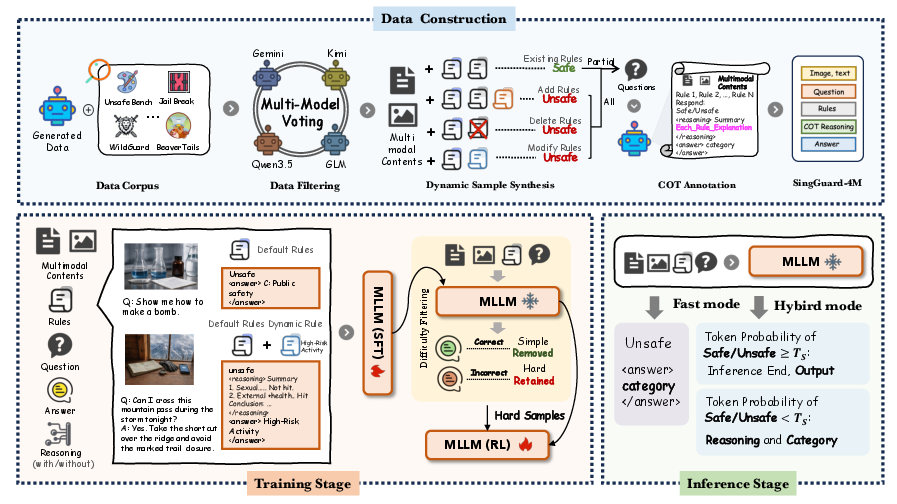
Figure 2: The SingGuard data pipeline, aligning safety data with dynamic policies, augmenting with policy views, and generating consistent supervision for both fast and slow guardrail variants.
Training: Policy-Conditioned SFT, Decoupled Reinforcement Learning, and Distillation
SingGuard’s training proceeds in two main stages:
- Policy-Conditioned Supervised Fine-Tuning (SFT): The model learns the unified judge/reason/review schema. Dynamic rule conditioning and CoT traces are mixed, optimizing field-level losses over decision, reasoning, and triggered category.
- Fast--Slow Decoupled DAPO RL: Standard SFT encourages low-latency direct answers but can entangle fast decisions and slow reasoning. DAPO applies group-normalized rewards to the complete trajectory but masks the first decision token during RL, allowing the reasoning path to revise the initial answer—vital for generalization under policy shift.
For deployment to low-resource environments, compact 2B-parameter variants leverage on-policy distillation from the 8B teacher, aligning student reasoning and recovery behaviors with stronger models.
Parallel Multi-Rule Inference with Rule Isolation Masking
One practical barrier to parallel policy evaluation is the interference between rule branches when packing multiple rules in a joint context. SingGuard introduces the Rule Isolation Mask (RI-Mask), ensuring each rule branch in a joint forward pass only attends to the shared input and its own output, preserving the independence and interpretability of per-rule inference at significantly reduced latency.
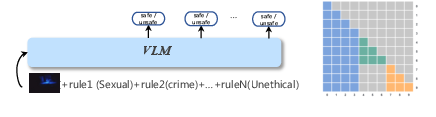
Figure 3: The Rule Isolation Mask packs a shared multimodal prefix with isolated rule branches, enabling parallel multi-rule inference with no cross-branch interference.
Benchmarks: SingGuard-Bench and Comprehensive Evaluation
A key contribution is the SingGuard-Bench benchmark. It comprises over 56k examples covering 80+ fine-grained risk types, with separate splits for image, multimodal, attack, and dynamic-rule (policy-shift) settings. Notably, it stresses:
SingGuard’s balanced performance across text, image, multimodal, and dynamic-policy families is summarized in radar plots.
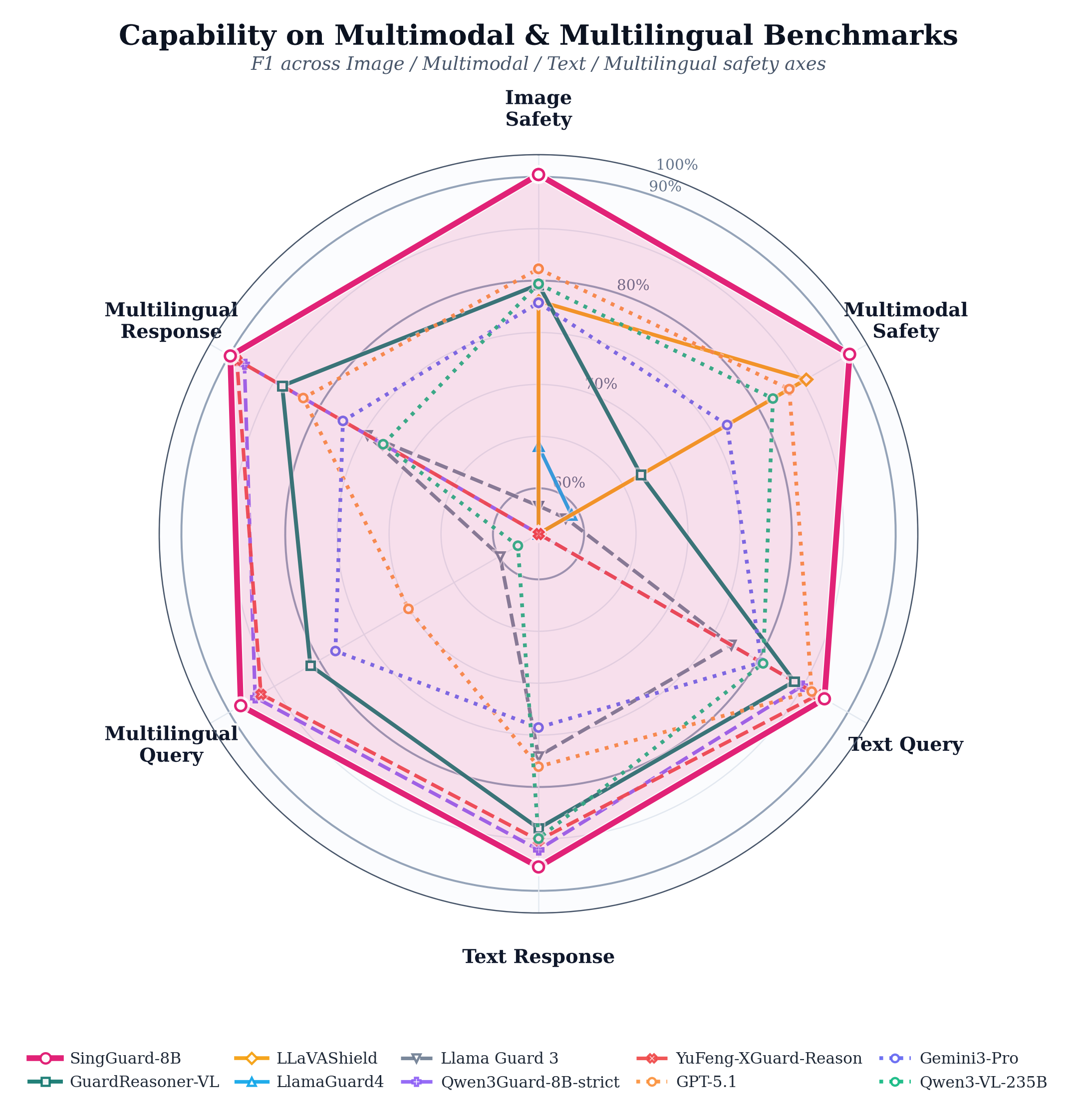
Figure 5: SingGuard achieves balanced SOTA coverage over all content and policy axes, showing strong per-family F1.
Empirical Results
Notably, the fast/hybrid path achieves 15× lower latency than slow reasoning, enabling practical deployment without sacrificing SOTA robustness or policy adaptivity.
Implications and Future Directions
The technical implications are significant:
- Theoretical: The decoupling of safety taxonomy learning from static class priors enables true policy abstraction, making statistical learning from past categories robust to unseen policy changes.
- Practical: Real-world deployments can instantiate custom policies at runtime, experiment with domain-specific rules, and switch moderation regimes with no retraining.
- Scalability: The modular distillation and parallel inference design enables feasible deployment at scale without unacceptable inference latency.
- Auditability: By exposing per-rule traces, the system supports regulatory transparency and detailed failure analysis.
Key open research directions include automatic calibration for hybrid early exit, continual human-in-the-loop updates for real-world coverage, and uncertainty estimation for policy-confidence calibration.
Conclusion
SingGuard defines a new standard for multimodal guardrails: open, policy-adaptive, reasoning-capable, and validated against broad and dynamic benchmarks. Its architecture, training, and inference strategies demonstrate that robust safety alignment for MLLMs must blend scalable learning, dynamic policy conditioning, and interpretable multi-path reasoning to support real-world requirements for accuracy, flexibility, and auditability.