- The paper introduces a novel autonomous workflow that uses skill-orchestrating LLM agents for calibrating a 112-qubit superconducting quantum processor.
- The methodology integrates multi-LLM architectures and parameter-efficient fine-tuning to achieve accurate calibration and cross-chip generalization.
- Empirical results validate scalable, auditable lab automation, reducing reliance on specialized human intervention in quantum device calibration.
Agentic Calibration of a 112-Qubit Superconducting Processor via Skill-Orchestrating LLMs
Introduction
The paper "Vibe Calibration: Autonomous Bring-up of a 112-Qubit Superconducting Quantum Processor by a Skill-Orchestrating Language Agent" (2606.22376) presents a full-stack autonomous laboratory workflow leveraging LLMs for calibration and characterization of superconducting qubit arrays. By distilling operator expertise into modular executable workflows—Agent Skills—accessible to an LLM-driven agent, the authors demonstrate end-to-end bring-up and calibration on a 112-qubit processor, establishing a new benchmark for agentic orchestration of quantum hardware. This essay examines the system architecture, training pipeline, Skill abstraction, cross-chip generalization, and implications for agentic laboratory automation.
Model Architecture and Agent Deployment
The system deploys three LLM architectures: (1) Qwen3.6-35B-A3B, a Mixture-of-Experts (MoE) backbone, (2) Qwen3.5-4B, a dense 4B alternative, and (3) Kimi K2.6 via KimiCode as a qualitative control. Fine-tuned checkpoints are served behind Claude Code interfaces with custom vLLM, LiteLLM proxy, and context-window enforcement middleware. This stack ensures tool exposure, robust output control, and compatibility for laboratory workloads dominated by code-heavy and Chinese inputs.
LoRA-Over (2605.16470) is employed for parameter-efficient fine-tuning, over-parameterizing low-rank adaptation matrices to optimize generalization. Architectural decisions emphasize attaching adapters to attention and feed-forward projections for all experts (MoE) and maximizing inference efficiency for memory-constrained deployments (dense 4B).
Validation loss curves for all training runs are shown below, highlighting convergence dynamics across base models and datasets:
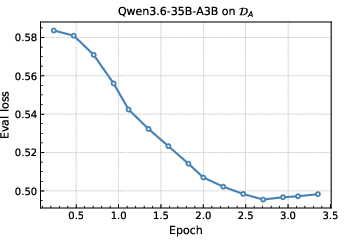
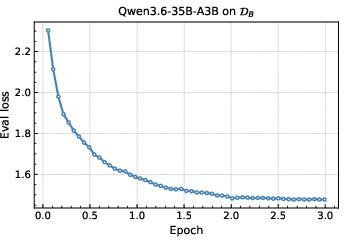
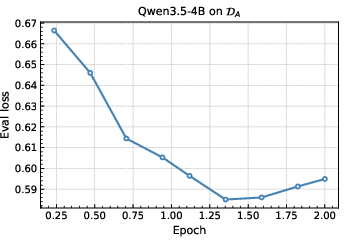
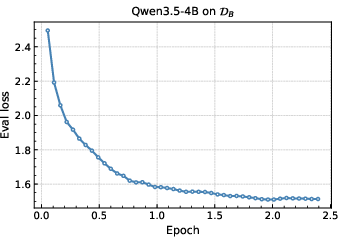
Figure 1: Validation loss curves over training for all four fine-tuning runs.
Training Data Pipeline
Training data are sourced from real agent trajectories under human supervision, partitioned into two datasets:
- DA: Step-level behavior cloning, retaining only operator-validated final steps with full context, tool schemas, and system prompts.
- DB: Domain knowledge mining, extracting physical value ranges, operational rules, error recovery sequences, validated tool outputs, Python snippets, and direct operator lessons. Atoms are expanded via DeepSeek-V4 (DeepSeek-AI et al., 26 Apr 2026) through surface-form paraphrasing, enhancing factual retention independent of syntax (Allen-Zhu et al., 2023, Maini et al., 2024).
This dual dataset design enables coverage of both operational knowledge and domain-specific heuristics.
Skill Construction and Executable Calibration Workflow
Rather than informal prompts, calibration is formalized as a Claude-Code Skill—a filesystem-packaged decision tree with orchestrator, parameterized command interface, configuration adapter, quality gates, and audit record layers. This pattern is derived from Anthropic's Agent Skills [anthropic_agent_skills_2025] [anthropic_skills_docs], encoding explicit measurement nodes (readout search, spectroscopy, Rabi calibration, readout optimization, T1, Ramsey) and robust failure handling (rollback edges, retry logic, exclusion of marginal fits).
For flux-tunable devices, spectrum-vs-flux characterizations are performed by dynamic programming ridge extraction, accepting the highest-frequency smooth branches as one-photon transitions. The algorithmic diagram and extracted ridges are shown below:
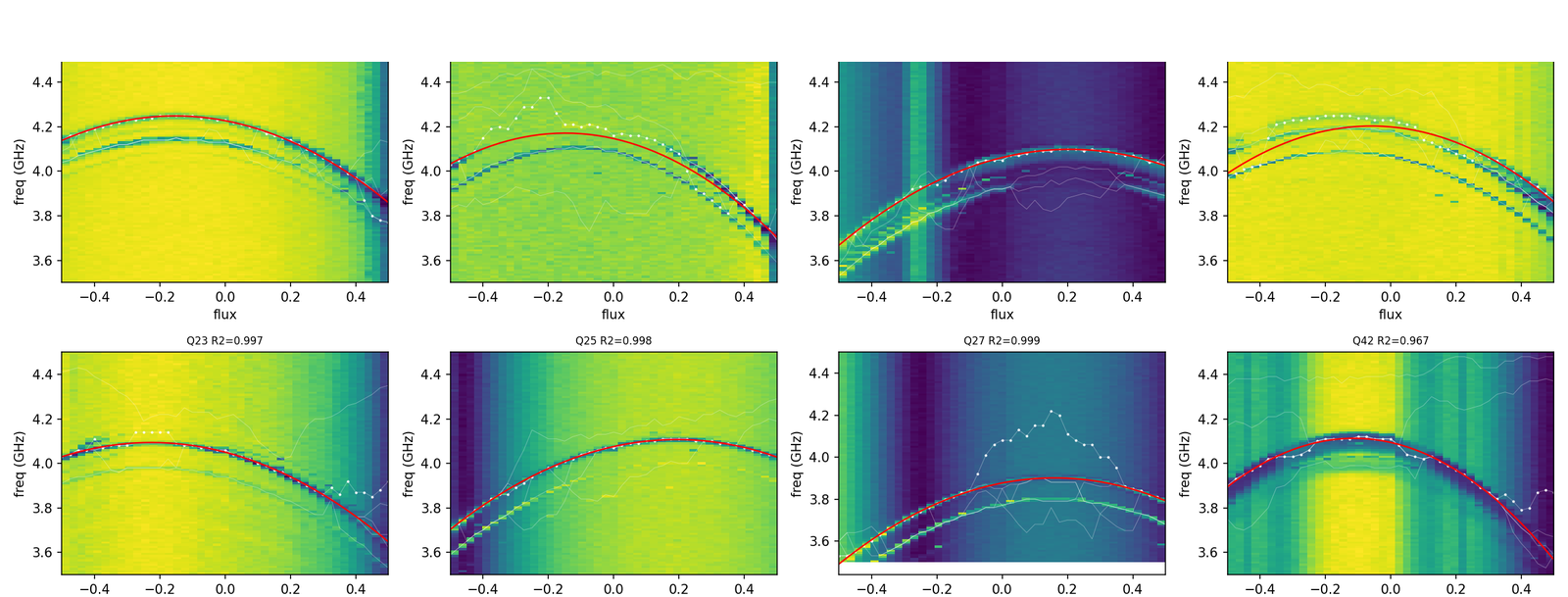
Figure 2: Multi-path dynamic-programming fit on representative spectrum-vs-flux panels. The fitter extracts several smooth ridge candidates and selects the highest-frequency accepted branch as the one-photon transition.
Workflow nodes are self-describing, decisions are numerically grounded, and audit artifacts are generated for post-hoc inspection and reproducibility. Grouping and batching respect underlying chip topology.
Fine-tuned Qwen-based models are benchmarked for skill adherence and cross-chip generalization. The 35B-DA checkpoint demonstrates high fidelity:
- 6 test sessions on a 16-qubit skill absent from training;
- 5 sessions fully adherent, 1 partial (self-corrected);
- No spontaneous regression to training skill documentation;
- Full protocol execution and parameter conformity.
In contrast, 35B-DB and dense 4B models show overfitting and capability degradation: memorization of training skill structure, parameter lock-in, file-structure persistence, and confabulated or incoherent tool use. Larger MoE models are strictly more favorable for robust skill switching; denser, smaller models lack capacity both for tool use and adaptation, with fine-tuning amplifying inherent limitations.
These empirical results highlight crucial trade-offs between domain knowledge transfer, instruction-following preservation, and architectural capacity. Mild overfitting may be permissible for single-chip deployments prioritizing stability, but for cross-device workflows, adaptability is essential and contingent on model scale and fine-tuning strategy.
Skill Interface Generality and Extension Beyond Qubit Characterization
The Skill abstraction is generalized to transmission-line characterization, enabling non-expert invocation of parameterized, auditable workflows for feature identification, Kerr-shift evidence, and readout-power selection. Representative artifacts from a TL16 run are presented below, with 14 transmission lines and 98 qubit sites processed agentically—Skill interface thus packages lab procedures for reuse and reproducibility outside benchmark scripts.
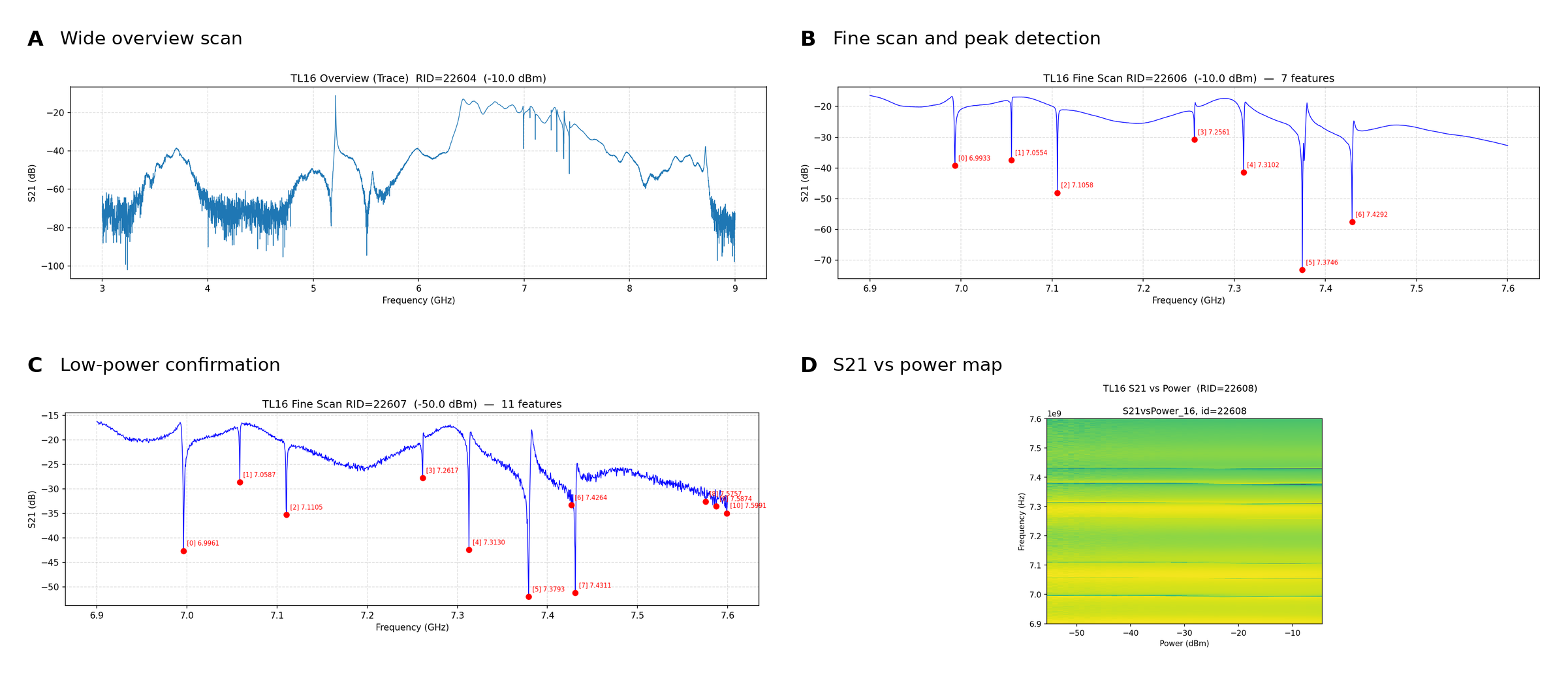
Figure 3: Representative outputs from the tl-characterize Skill on TL16. (A) wide overview scan, (B) high-power fine scan with seven detected resonator features, (C) low-power confirmation scan used for frequency matching and Kerr-shift evidence, and (D) S21-vs-power map for readout-power selection.
Comparative Analysis: NVIDIA Ising Calibration and Agent Architecture
NVIDIA's Ising-Cal-1 [QCalEval] and QCA Blueprint [QCA_blueprint] are analyzed. Ising-Cal-1 is a vision-LLM optimized for stateless plot QA via QCalEval benchmark (74.7 zero-shot score). It performs perception, not workflow orchestration; thus direct comparison on QCalEval is inappropriate. QCA Blueprint exposes calibration tasks as LangChain tools but lacks bundled domain knowledge or real hardware interfaces in its public release. Both architectures are orthogonal to the Skill-based approach, which encodes actionable, parameterized procedures and audit artifacts, executing on real hardware and enabling cross-device workflows.
Implications and Future Directions
This work demonstrates that agentic laboratory orchestration can scale to complex quantum hardware, provided that model capacity, fine-tuning protocols, and Skill abstractions are carefully engineered. Explicitly encoding experimental procedures as Skills, attaching robust quality gates, and ensuring auditable outputs enables reproducibility, adaptation, and human-in-the-loop control.
Practically, this approach advances the possibility of unattended or remotely supervised quantum device calibration, reduces dependency on narrowly specialized human intervention, and produces datasets suitable for longitudinal device characterization, experimental automation, and benchmarking. Theoretically, it illustrates that hierarchical agentic workflows are tractable with current LLM architectures and modular Skill interfaces, provided domain knowledge is transferred via scalable behavior cloning and paraphrased factual mining.
Future developments are likely to focus on:
- Scaling Skill abstraction to multi-stack quantum/hybrid devices.
- Integrating vision-LLMs for plot interpretation nested within workflow orchestration.
- Enhancing robustness of fine-tuning for adaptability amid shifting laboratory protocols.
- Auditable long-term logging and meta-optimization of calibration pipelines for experimental reproducibility and hardware drift correction.
Conclusion
The deployment of Skill-orchestrating LLM agents for autonomous calibration of a 112-qubit superconducting processor establishes agentic workflows as a rigorous, scalable methodology for experimental quantum computing. By packaging human expertise into modular Skills, calibrating models via real laboratory trajectories, and enforcing operational quality gates, the system achieves both practical laboratory robustness and generalizable cross-device adaptability. This paradigm is extensible to broader scientific domains requiring executable, auditable, and flexible agentic control.