- The paper demonstrates a novel dual-graph framework that integrates continuous-time cell lineage and discrete-time synaptic connectivity to predict neural development events.
- It employs a TGN architecture with GRU-based memory and transformer attention, achieving a mean test AUC of 0.839, significantly outperforming static GNNs.
- The study establishes a quantitative taxonomy of synaptic stability and offers interactive visualization tools to support hypothesis generation in developmental connectomics.
DevoTG: Temporal Graph Neural Networks for Modeling C. elegans Developmental Connectomics
Introduction
DevoTG presents a rigorous framework applying Temporal Graph Neural Networks (TGNs) to C. elegans developmental connectomics, integrating both cell lineage (Continuous-Time Dynamic Graph; CTDG) and synaptic connectivity (Discrete-Time Dynamic Graph; DTDG). The key feature is an explicit representation of dynamic biological events—cell divisions and synaptogenesis—using event-sequenced temporal graphs, allowing predictive and descriptive analyses of the nervous system's self-organization from birth to adulthood.
Temporal Graph Framework for Neural Development
The proposed methodology encompasses two graph structures:
- Cell Lineage as CTDG: Here, timestamped directed edges represent division events, embedding both spatial and temporal cues necessary for learning the generative rules of the embryonic and larval cellular topology.
- Developing Connectome as DTDG: Eight discrete timepoints, reconstructed from serial electron microscopy, allow edge-level tracking of synaptogenesis and connection pruning, facilitating quantitative categorization of wiring stability.
This dual-graph framework supports combining the deterministic lineage tree with highly variable, developmentally modulated synaptic architecture, yielding a comprehensive computational platform.
TGN Architecture and Training
The TGN implementation integrates the following architectural modules:
- Memory Module: GRU-based, maintaining per-node vectors that aggregate the entire event history. This introduces temporal context—a critical inductive bias in biological sequence prediction.
- Graph Attention Embedding: TransformerConv layers operate on memory vectors and encode both event recency and node interaction for local context.
- Link Predictor: A low-capacity MLP operates on concatenated node embeddings to score candidate division or synaptic events.
Training employs temporally disjoint splits (train/validation/test), strict negative sampling, and standard regularization. All evaluations use multiple random seeds to confirm statistical robustness.
Results
Temporal Evolution of Connectome Topology
Temporal visualization of the top 15 most connected neurons (Figure 1) demonstrates staggered-layer reconfiguration as development progresses, highlighting the continuous emergence of new connections and stratification by connection stability.
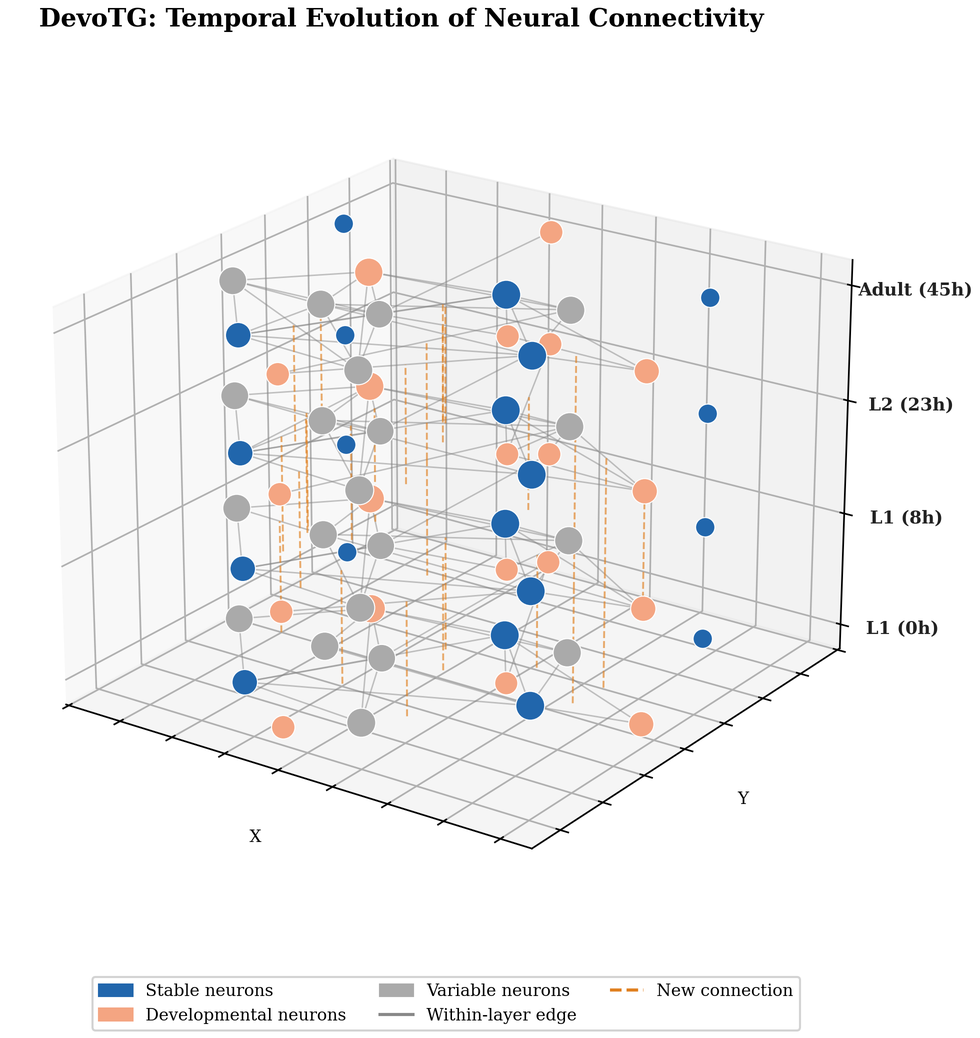
Figure 1: For the 15 most-connected neurons, development is depicted as stacked layers showing evolving synaptic structure and class-labeled node stability.
Connection Stability Taxonomy
A three-class taxonomy of connection stability is proposed, based on temporal persistence: stable (core architecture), developmental (transient, stage-specific), and variable (highly transient or potentially artifactually detected). Notably, 56.8% of all connection pairs are temporally variable, a higher proportion than cross-individual analyses, attributed to inclusion of gap junctions and the thresholding of weak, single-instance connections (Figure 2).
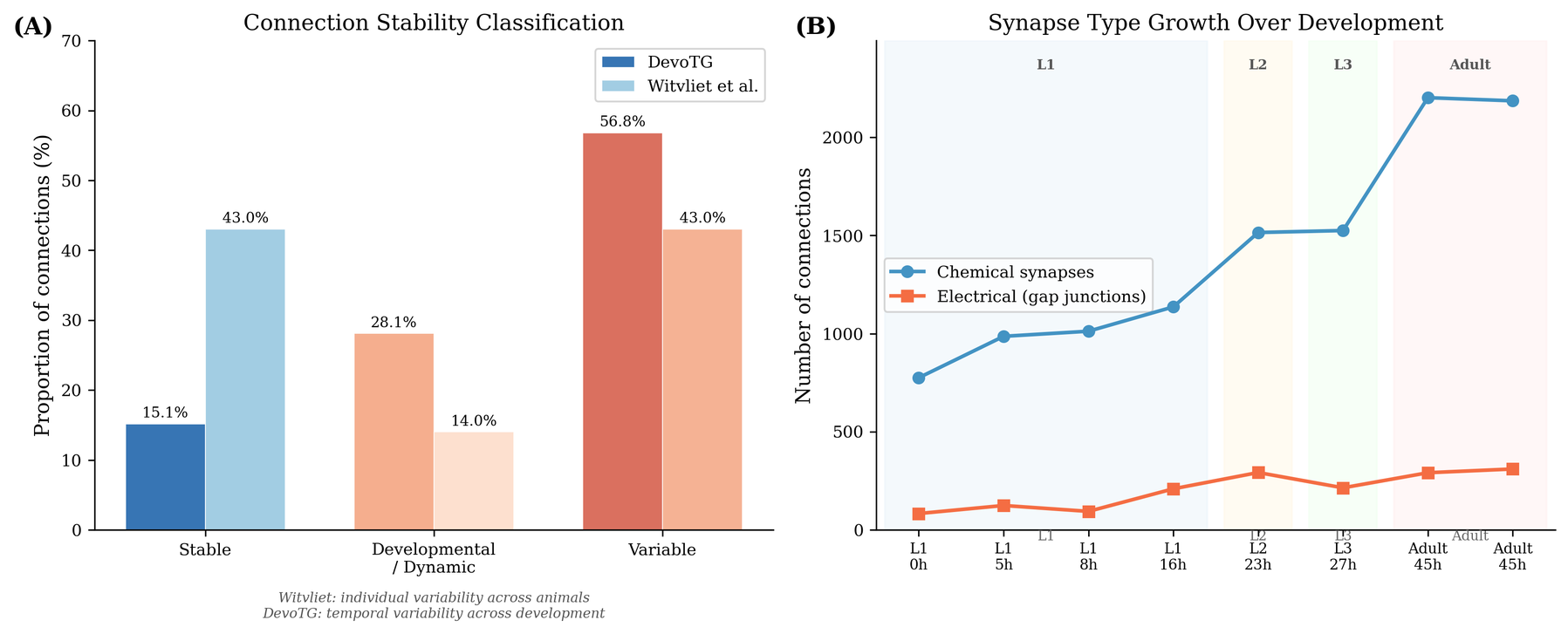
Figure 2: Temporal stability class distributions and synapse-type-specific edge growth, distinguishing chemical and electrical connection dynamics.
Hub Command Interneurons—Developmental Core
Ego-network analysis of the canonical locomotor command interneurons (AVA, AVB, AVE) reveals that their core interconnectivity (hub status) is present at hatching and reinforced by later input accrual (Figure 3). This mirrors the behavioral maturation of locomotor control and supports theoretical models that prioritize the invariance of central processing motifs, even as peripheral circuits remain plastic.
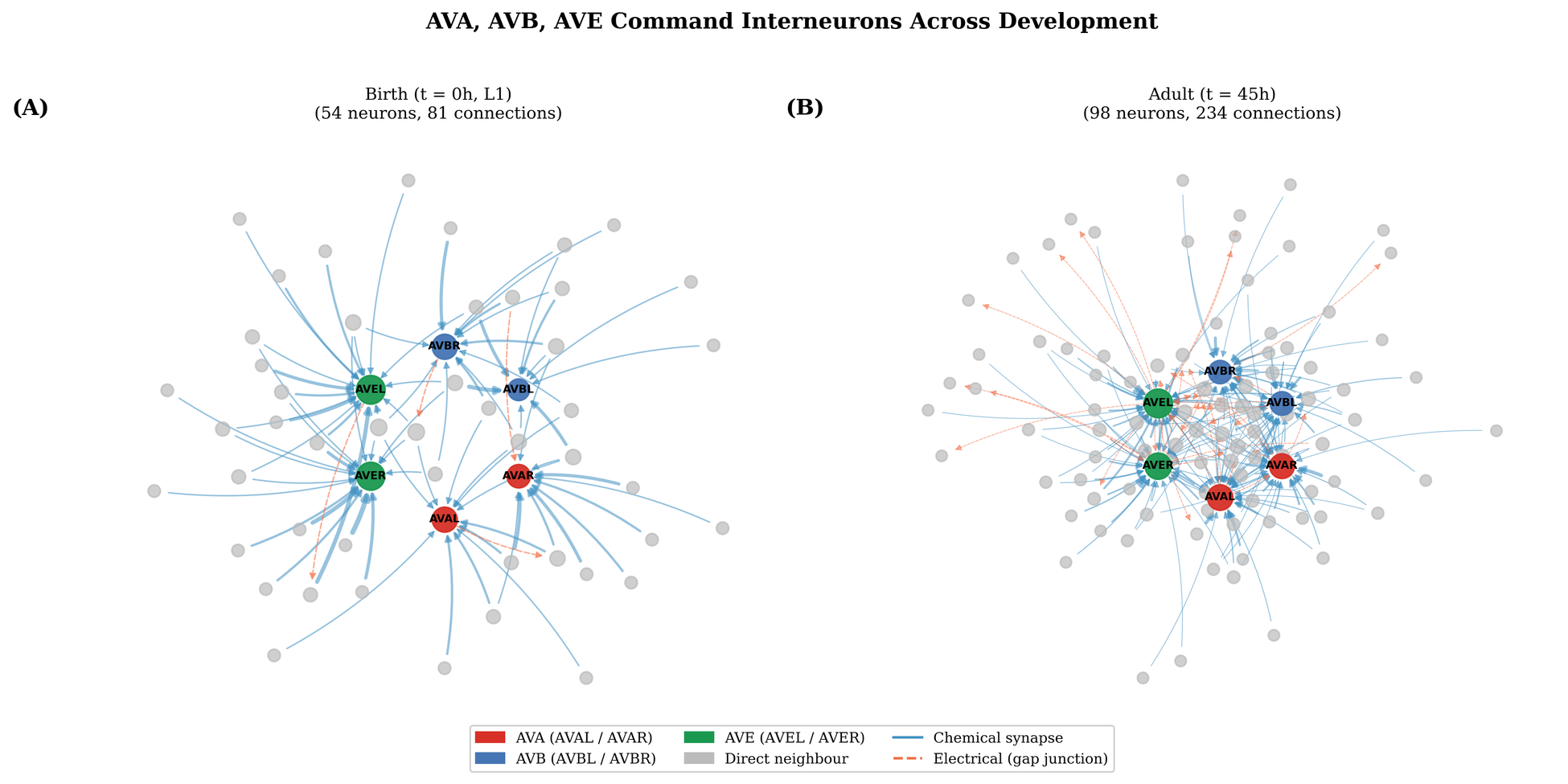
Figure 3: The AVA/AVB/AVE “command interneuron” pairs maintain dense reciprocal connectivity, with neighborhood expansion across development stages.
Spatiotemporal Lineage Mapping
The integration of lineage trees and spatial birth location scatterplots (Figure 4) enables joint interrogation of progenitor identities, spatial morphogenesis, and eventual circuit allocation. There is clear evidence for stereotyped birth position gradients and lineage-dependent topological roles.
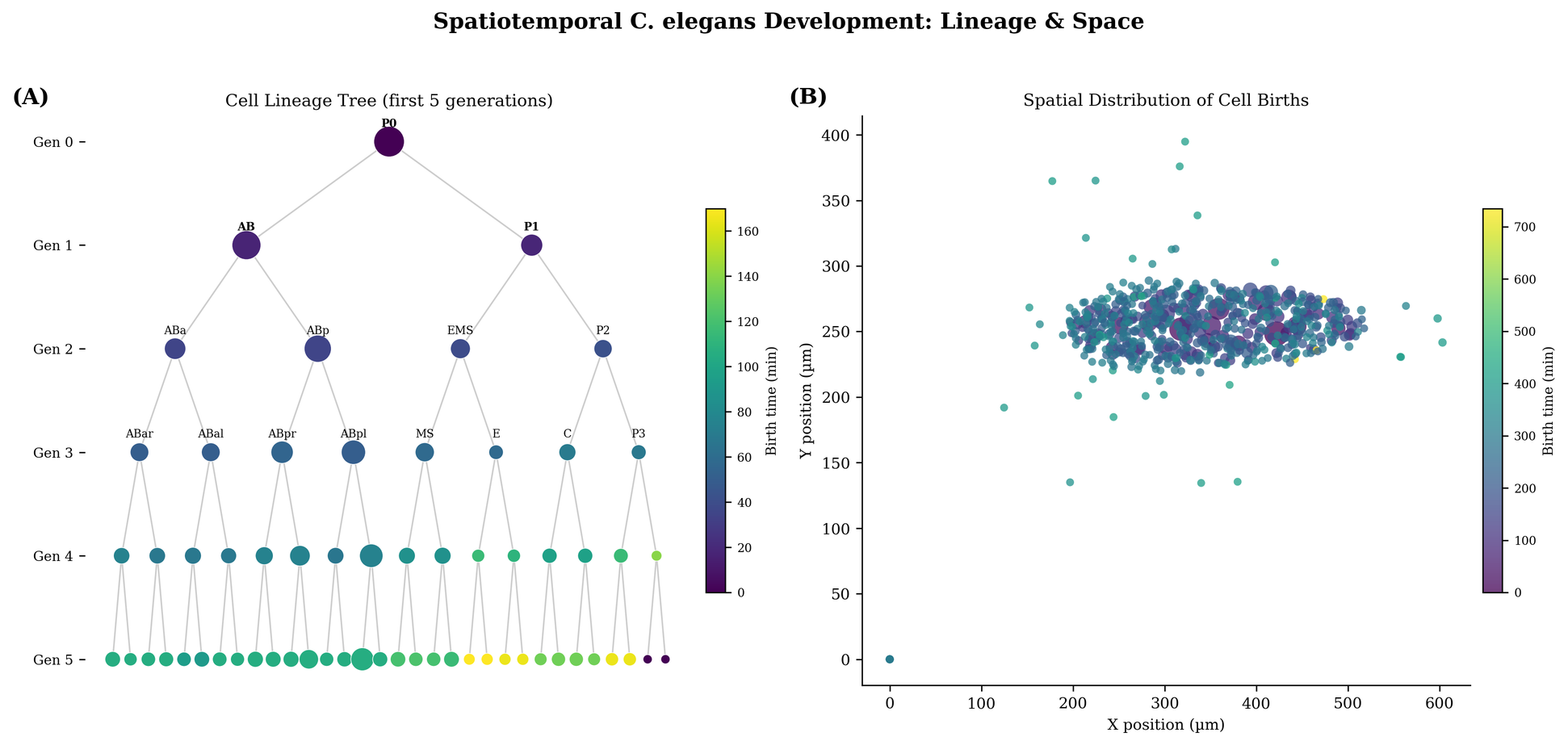
Figure 4: Spatiotemporal representation of cell division events, mapping both lineage tree dynamics and physical cell positioning.
The TGN achieves a mean test AUC of 0.839±0.007 (5 seeds), exceeding the static GNN by 26 points (AUC 0.577±0.080) and showing high training stability (Figure 5). Neither preferential attachment heuristics nor static GNNs are competitive, confirming that temporal sequence information is essential for modeling developmental fate. High validation AUC (0.937±0.001) indicates no overfitting or temporal-leakage effects.
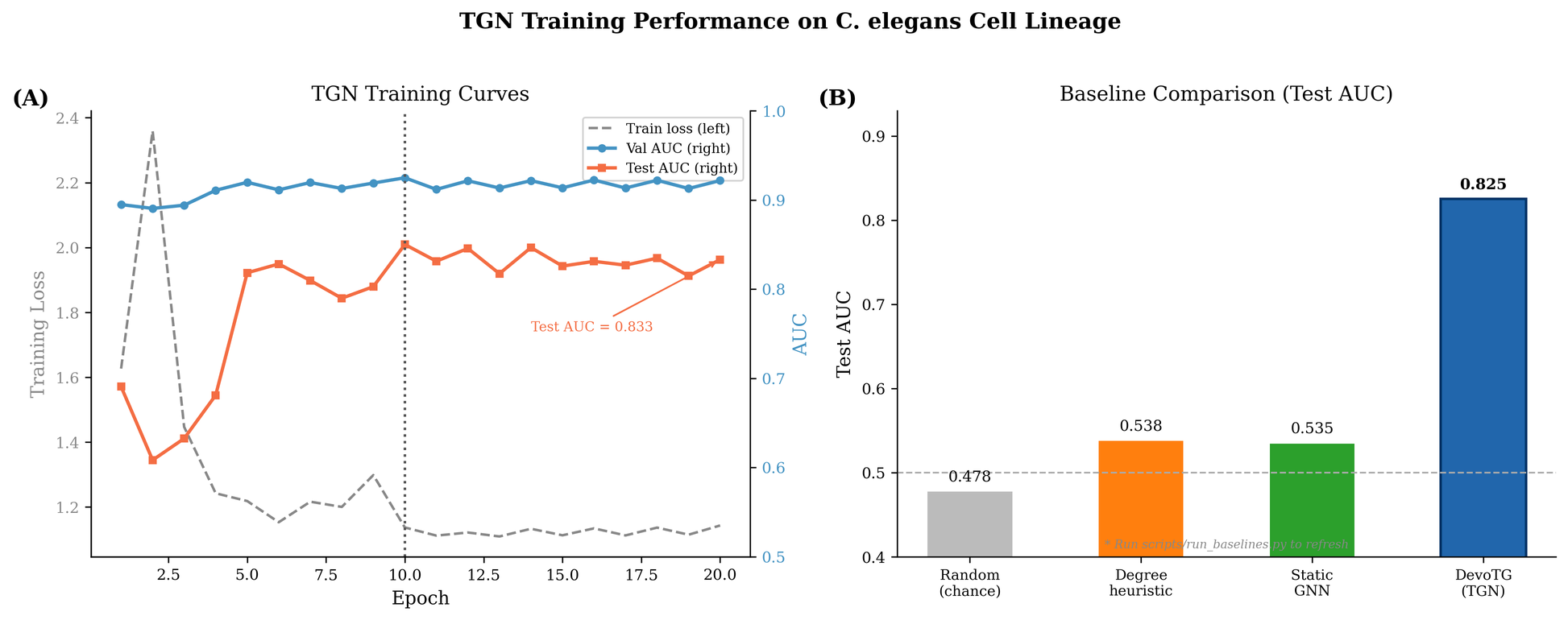
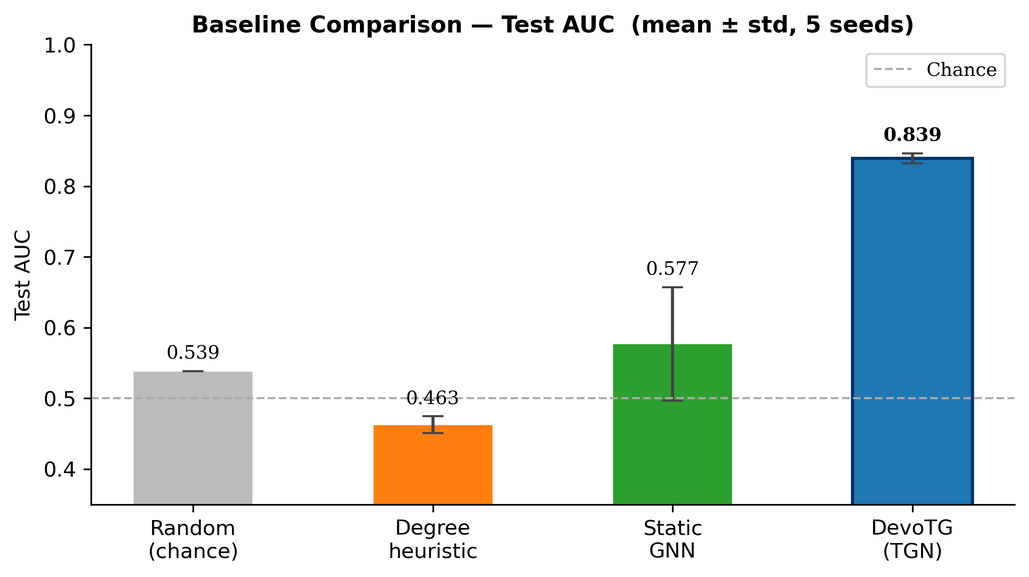
Figure 5: TGN training/validation traces and multi-seed comparison. The substantial delta to static GNNs demonstrates the exclusive value of temporal memory.
Implications and Theoretical Impact
The architecture and findings of DevoTG demonstrate the centrality of temporal information for predictive fidelity and descriptive power in connectome dynamics. Specifically:
- Temporal Memory as Inductive Bias: The decisive performance advantage of TGN over static GNNs isolates temporal event aggregation as a key mechanism for developmental inference, consistent with biological models of lineage-dependent competence and fate.
- Quantitative Temporal Taxonomies: Distinguishing stable, developmental, and variable connections enables cross-modal integration with molecular, activity-based, and behavioral datasets. This facilitates future causative studies, e.g., on the role of transient connections in learning or plasticity.
- Visualization and Accessibility: Open-source, interactive visualization tools directly support hypothesis generation, especially for neurodevelopmental biologists addressing questions of spatial organization, critical periodization, or core circuit invariance.
Practical Prospects and Future Directions
DevoTG is readily generalizable to other longitudinal connectomics datasets, including those incorporating multi-animal or multi-modal time series. Immediate future directions include:
- Extending TGN-based link prediction directly to synaptogenesis events in DTDG representations.
- Dissecting the developmental regulation of chemical vs. electrical synapse formation by separate modeling paths.
- Systematic sensitivity analysis for stability class thresholding.
- Comparative analyses across diverse nervous systems, further probing the universality of observed wiring and stability principles.
- Incorporating simultaneous activity data, enabling structure-function analyses in tandem with wiring diagrams.
Conclusion
DevoTG establishes temporal graph modeling as an indispensable framework for developmental connectome analysis, demonstrating that explicit temporal memory provides superior predictive and explanatory capacity compared to static graph methods. Its computational taxonomy of connection stability, ego-network analysis of command interneurons, and integrated visual analytics furnish critical tools for mechanistically resolving the assembly and maturation of neural circuits. Open-source code and modular workflows facilitate adaptation and extension, positioning DevoTG as foundational infrastructure for future studies in temporal connectomics.