- The paper presents Echo Networks that replace direct encoding with a matrix-centric genome, enabling systematic and scalable neuroevolution.
- It introduces algebraic mutation and recombination operators that yield superior performance on ECG signal classification compared to traditional RNNs.
- The approach facilitates the creation of minimal, interpretable neural models ideal for resource-constrained edge applications.
Echo Networks: A Matrix-Centric Approach to Neuroevolution
Introduction
The paper "Introducing Echo Networks for Computational Neuroevolution" (2604.08204) proposes a fundamentally different recurrent network architecture, termed Echo Networks, which leverages a purely connection-matrix-based topology. This design enables more systematic, scalable, and mathematically principled application of mutation and recombination in neuroevolution—a requirement for generating minimal, highly task-adapted networks suitable for resource-constrained extreme edge applications. Distinct from direct encoding practices prevalent in NEAT and related methods, the Echo Network representation is intended to foster greater regularity and enable the exploitation of matrix algebraic transformations for evolutionary operators.
Motivation and Network Representation
Conventional approaches to neuroevolution (e.g., NEAT) generate small feed-forward networks and RNNs by direct encoding of synaptic weights, with network growth driven by evolutionary gains. Yet, as evidenced in prior work, unique and sometimes brittle topologies emerge, complicating explanation, transfer, and theoretical analysis of resultant networks. The necessity for a more systematic and theory-friendly representation is acute when designing minimal networks for edge deployment, where computational and memory overhead become primary constraints.
Echo Networks are fully specified by a square connection matrix C∈Rn×n, with each entry cij representing the synaptic weight from neuron i (source) to neuron j (target). Input and output assignments are decoupled from structural constraints, enabling arbitrary designation of any subset of neurons for these roles. All connections are technically recurrent, including self-loops, and there are no layers, eliminating conventional depth hierarchies altogether. The computation proceeds as
at=f(C⊤at−1),
with optional input-injection and output-readout functions.
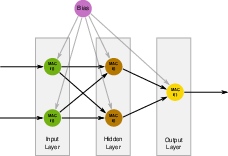
Figure 1: Schematic of a simple multilayer perceptron (MLP) using conventional layered structure.
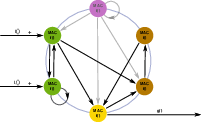
Figure 2: Schematic of a simple Echo Network, exemplifying the absence of layers, symmetric connection structure, and arbitrary input/output assignments.
Algorithmic Framework and Neuroevolutionary Operators
The connection matrix’s role as full genome encoding allows neuroevolution operators—mutation and recombination—to be realized as matrix algebraic transformations. Mutation corresponds to addition or perturbation of rows/columns, and recombination may act through operations such as averaging, crossover, or potentially more structured matrix decompositions and factorizations. Compared to standard direct encoding, where historical markers (e.g., NEAT's innovation numbers) are critical, the matrix representation streamlines correspondence between parental networks, facilitates matching, and potentially enables informed, theory-driven variation.
Empirical Evaluation
The evaluation focuses on classification of 1D ECG signals from the PTB-XL dataset. The problem is cast as a binary signal-level classification (normal vs. atypical), using neuroevolutionary search for both RNNs and Echo Networks. In the experimental protocol, populations evolve over 200 generations, using 5% of the training set per generation, with elitism, speciation, and shared fitness. Multiple runs are performed to assess variability.
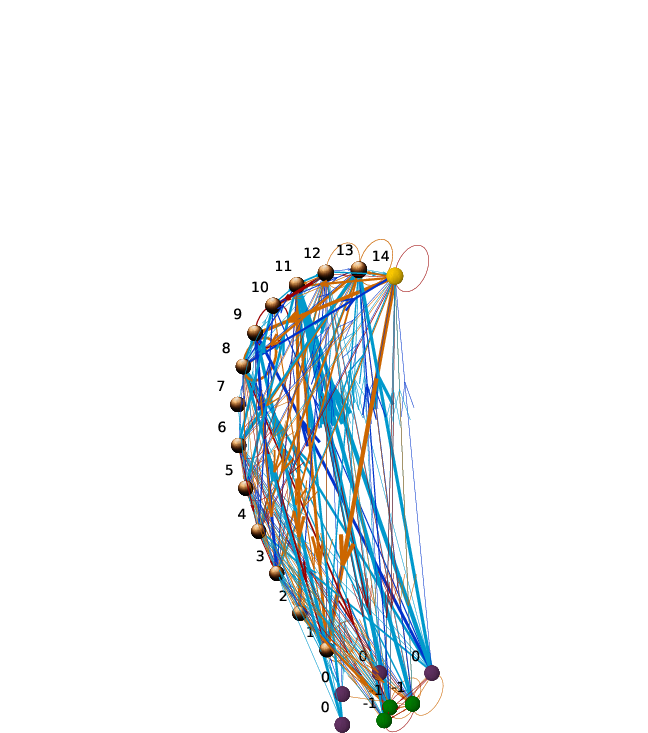
Figure 3: Example recurrent neural network (RNN) architecture evolved for ECG classification; reached 0.684 accuracy on the test set with 21 neurons and 250 weights.
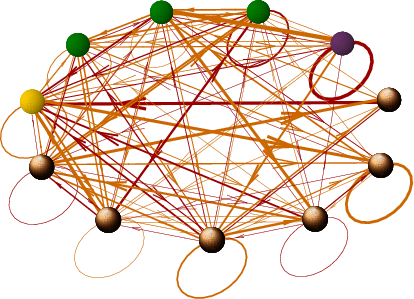
Figure 4: Example Echo Network evolved for ECG classification with 11 neurons and 121 weights (97 non-zero); achieved 0.696 accuracy on the test set.
Numerical results show Echo Networks surpassing classical RNNs in this setting: the best Echo Network achieves 0.717 test accuracy, with mean accuracy from 10 runs at 0.687 (std: 0.005) versus 0.671 (std: 0.007) for RNNs. Population-level evolution (island model with 8 populations) further boosts the best test accuracy to 0.717.
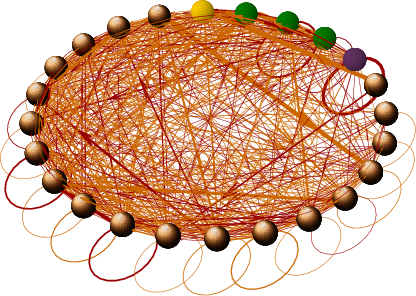
Figure 5: Best evolved Echo Network, reaching 0.717 accuracy with 24 neurons and 576 weights (447 non-zero) on the ECG task.
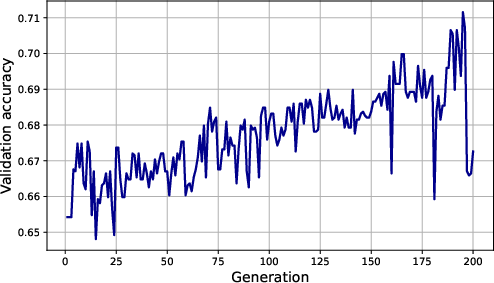
Figure 6: Validation accuracy progression over 200 generations, illustrating stochastics and evolutionary progress for the best network.
Comparison to Existing Paradigms
While the Echo Network's fully recurrent, non-layered architecture is reminiscent of reservoir computing (notably echo state networks and liquid state machines), there are decisive distinctions: (1) connectivity and weights are subject to directed optimization rather than random initialization, and (2) input/output assignment is explicit and arbitrary rather than fixed. The representation also has parallels to Hopfield networks in its homogeneous structure, yet Echo Networks differ fundamentally in their temporal processing and learning dynamics.
Theoretical and Practical Implications
The introduction of Echo Networks shifts the focus of neuroevolution from achievement of sparsity or minimality via incremental topology augmentation to systematic, matrix-based evolutionary search. Two key theoretical implications arise:
- Genome Algebraization: The ability to apply matrix factorizations and algebraic operators to the genome enables future development of mathematically principled evolutionary algorithms, potentially addressing the notorious issue where recombination of high-performing but topologically distinct networks yields catastrophic offspring.
- Compositional Design and Scalability: Echo Networks can, in principle, be recursively nested or networked in arbitrary hierarchical or irregular topologies, leveraging their flexible input/output role assignment. This paves the way for scalable minimal neural models for embedded, edge, or otherwise resource-restricted environments.
Practically, Echo Networks enable direct application of neuroevolution for real-world signal processing on the extreme edge, showing evidence of competitive performance with smaller parameter budgets relative to RNNs. The sole matrix genome admits efficient implementation, dynamic resizing, and direct interpretation for network analysis.
Future Directions
The Echo Network’s framework unlocks several research vectors:
- Extension to Broader Tasks: Application to domains beyond 1D time series (e.g., multidimensional signals, discrete event processing).
- Hybrid and Hierarchical Compositions: Recursive and non-hierarchical compositional Echo Networks with adaptive dynamic routing.
- Gradient-based Training: Exploration of backpropagation, forward-mode differentiation, or alternative credit-assignment algorithms in the Echo architecture.
- Principled Evolutionary Operators: Design of specialized factorizations and transformations as mutation/recombination mechanisms, leveraging the algebraic properties of the connection matrix.
Conclusion
Echo Networks provide a concise, powerful recurrent architecture optimized for computational neuroevolution and edge deployment. Their exclusive use of a connection matrix as a genome, together with decoupled input/output assignments and evolutionary operator compatibility, yields minimal, interpretable, and performant models for signal classification. While preliminary results for the ECG task are promising, ongoing research must clarify their advantage over alternative minimal networks and extend their applicability to more complex domains. The theoretical framework introduced by Echo Networks sets the stage for advancing both evolutionary computation and neural architecture design (2604.08204).

