- The paper introduces an information-theoretic paradigm that formalizes AI agent identity via non-geodesic behavioral metrics derived from response distributions.
- It employs magnitude and magnitude homology to differentiate between early uniform drift and potential late-stage anisotropic collapse in agent behavior.
- The study validates a two-tier 'Heartbeat' monitoring system that detects subtle identity drift through entropy metrics and deterministic first-token sampling.
Geometric Measurement of AI Agent Identity: A Technical Analysis of "Measuring What Persists: Conditioning Mechanisms and a Geometric Framework for AI Agent Identity"
The paper "Measuring What Persists: Conditioning Mechanisms and a Geometric Framework for AI Agent Identity" (2606.21843) introduces a rigorous, information-theoretically grounded approach to quantifying and diagnosing identity drift in persistent AI agents operating over long contexts. The core methodological contribution is the formalization of agent identity as non-geodesic structure in a behavioral metric space constructed from response distributions at carefully designed probe contexts. Metrics are defined by $\sqrt{\JSD}$ distances between sampled output distributions, chosen for their information-geometric canonicity and operational interpretability.
The framework builds on and extends the [0,1]-enriched categorical model of language outlined by Bradley, Terilla, and Vlassopoulos (BTV) (Bradley et al., 2021). Here, the agent's identity specification (e.g., a structured system prompt or "Card") is interpreted as a copresheaf over the enriched category, resulting in a covariant functor from contexts to response distributions. Notably, the behavioral metric space is operationalized in probe-response space rather than text-continuation space, allowing for black-box empirical analysis amenable to API-based evaluation.
Magnitude and its categorification—magnitude homology—are deployed as central invariants: magnitude yields a continuous, scale-sensitive fingerprint of behavioral diversity, while magnitude homology detects topological (non-geodesic) structure and provides sensitivity to catastrophic collapses in diversity. The technical backbone includes a first-order perturbation theory for magnitude in equilateral simplex configurations, providing a predictive link between perimeter contraction and overall magnitude.
Empirical Results and Theoretical Claims
Identity Structure and Drift Dynamics
The persistent agent ("Ada") is conditioned by a detailed Card specifying identity, values, voice, and reasoning style, with metric geometry probed by a validated suite of contextually diverse diagnostic prompts.
At baseline, Card-conditioned probe responses exhibit maximal pairwise $\sqrt{\JSD}$ distances, yielding an equilateral geometry whose scalar magnitude is theoretically tied to the total perimeter of the simplex.
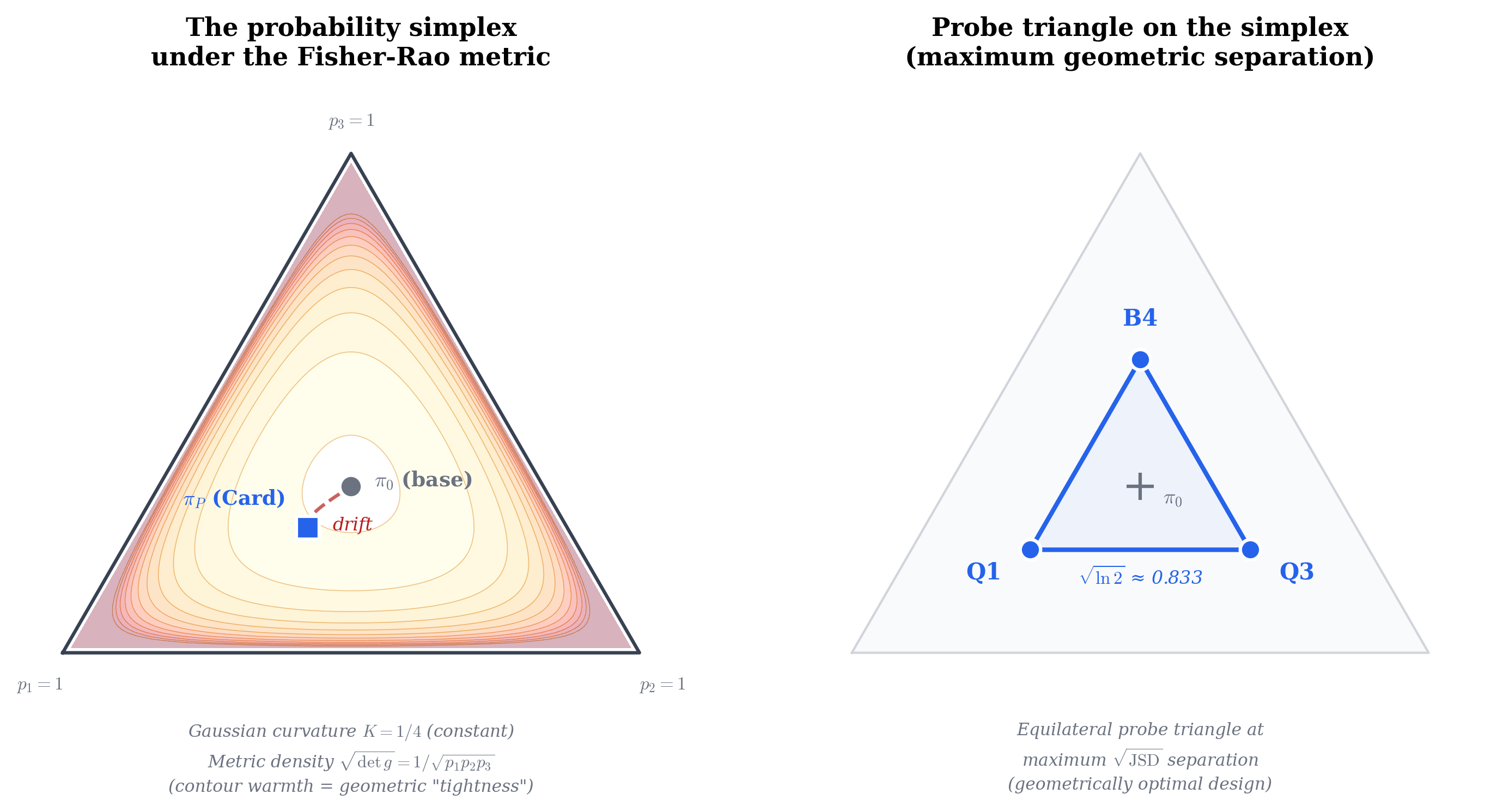
Figure 1: The probability simplex under the Fisher-Rao metric with the equilateral probe triangle. Each vertex represents a probe context.
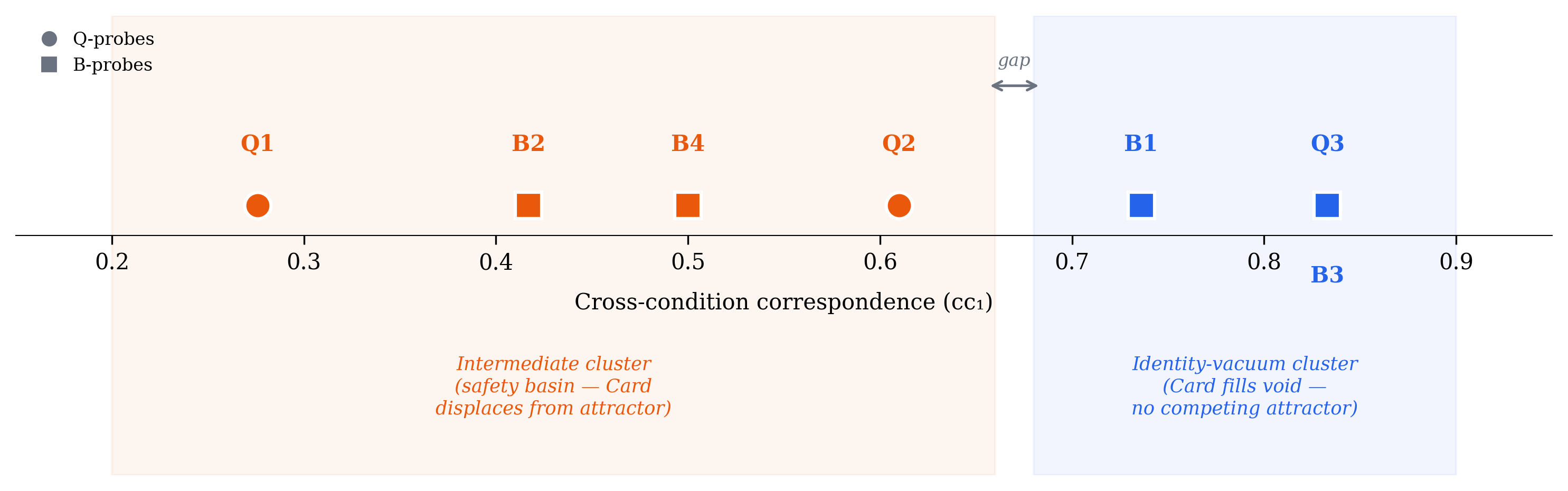
The principal empirical finding is the existence of two distinct conditioning mechanisms:
Analysis establishes that the equilateral geometry characterizes probe design properties rather than learned agent structure per se—a point substantiated via null-model control experiments.
Drift Detection and Leading Indicators
The key operational challenge addressed is the early detection of identity drift: the progressive erosion of characteristic agent behavior under the weight of long, uninformative context (sometimes labeled as "context dilution" or "attention budget depletion").
Card-conditioned distinctive signatures—including deterministic first-token identity markers and high prefix entropy in key probes—are lost substantially before human qualitative assessment detects degradation, demonstrating that fine-grained statistical measures provide leading indicators of drift.
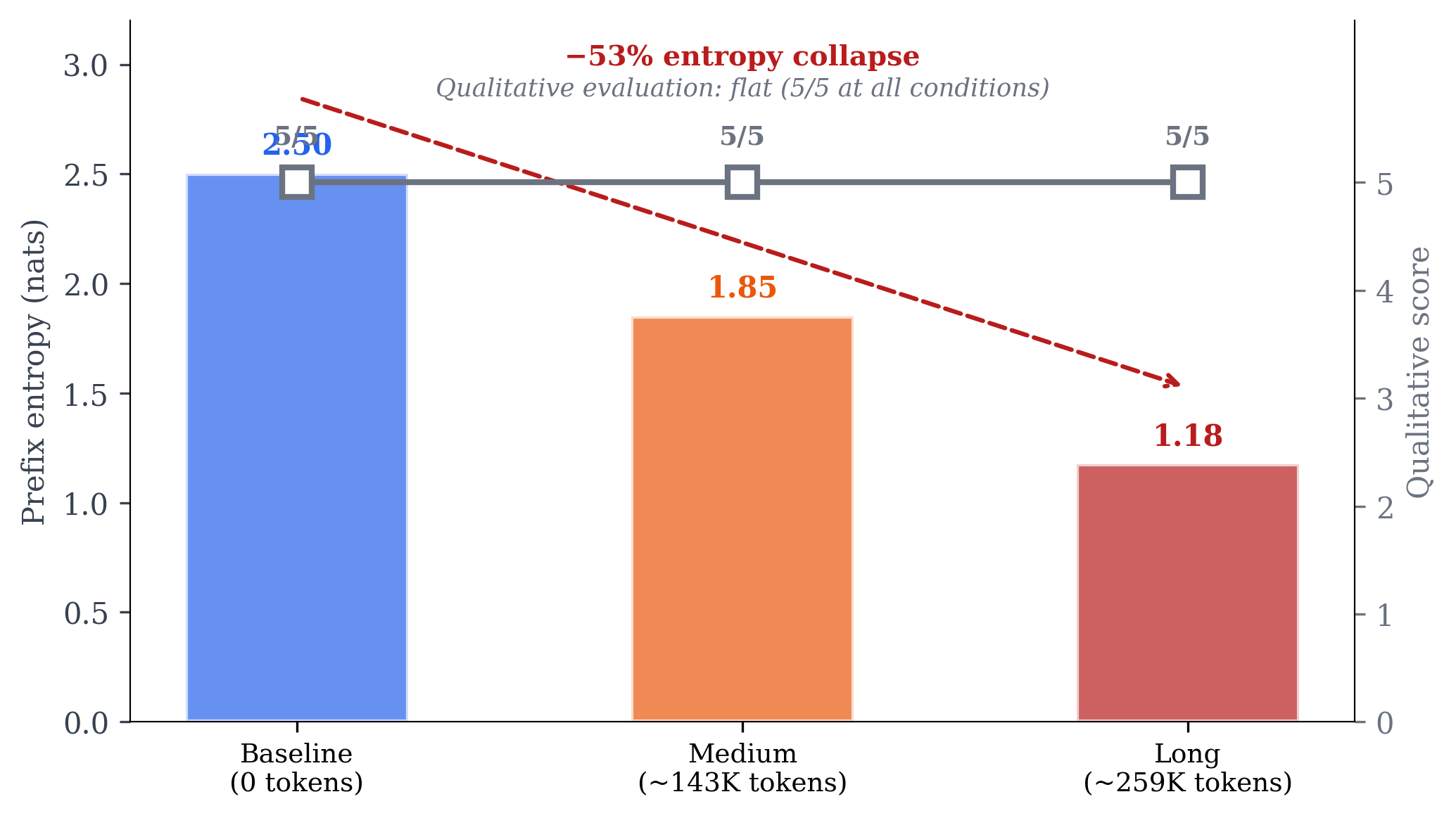
Figure 5: Entropy collapse as a leading indicator—Q3 prefix entropy drops 54% at long context while qualitative evaluations remain perfect.
However, a critical revision emerges: the observed contractions and entropy collapses are attributed to repetitive, not diverse, context padding. Experiments with varied bureaucratic context reveal no measurable degradation up to 150K tokens. This result tempers claims about generic context-length-driven drift and emphasizes the importance of artifact-free experimental controls.
Geometric and Topological Effects of Drift
The paper provides the first explicit first-order perturbation theory for magnitude in probe-response geometry. For equilateral probes, magnitude is provably first-order sensitive only to the total perimeter and insensitive to internal shape deformations—a manifestation of Sn-symmetry. Empirically, the observed magnitude contractions under repetitive-padding artifacts are quantitatively predicted by the perimeter formula to within 0.2%, confirming the accuracy of the theoretical model.
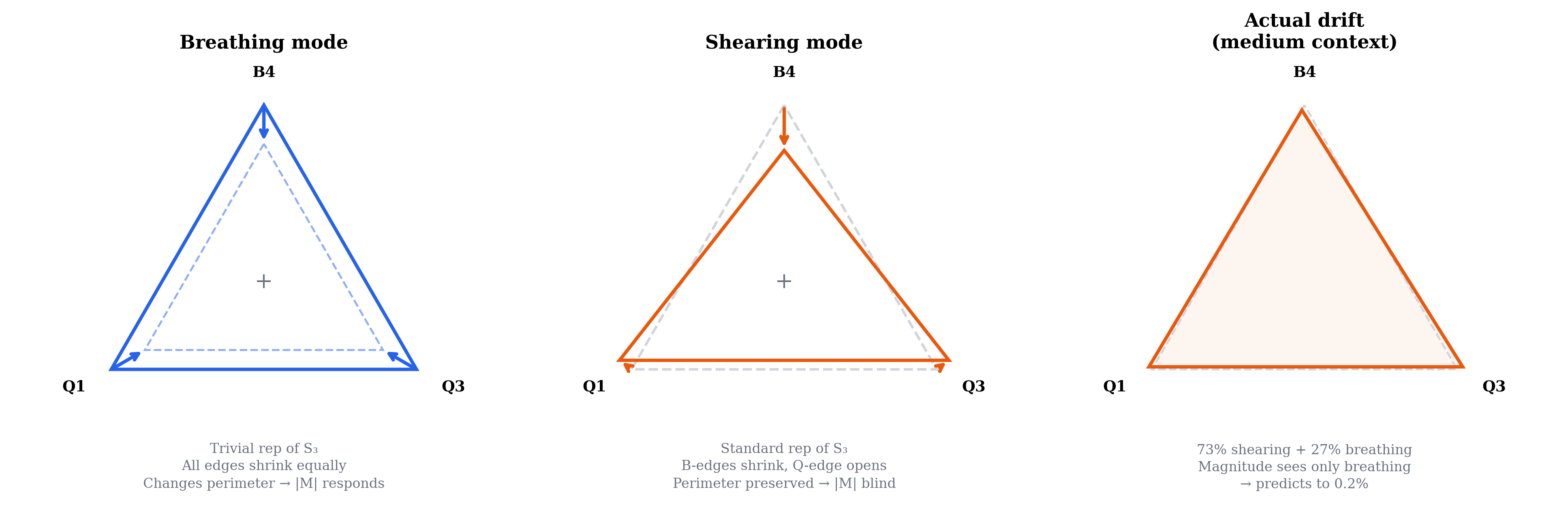
Figure 4: Mode decomposition of the drift signal—breathing (uniform contraction/expansion) drives magnitude response; shearing is first-order invisible.
Moreover, the drift process is dissected into two stages:
- Early drift: Uniform contraction (breathing) with preserved topological structure; magnitude decreases but magnitude homology is unaffected.
- Late drift: Anisotropic contraction with emergent betweenness/bifurcations; detected by changes in magnitude homology.
No evidence for the onset of late-stage (anisotropic/topologically simplifying) drift is found, though the framework strongly anticipates its future empirical observation.
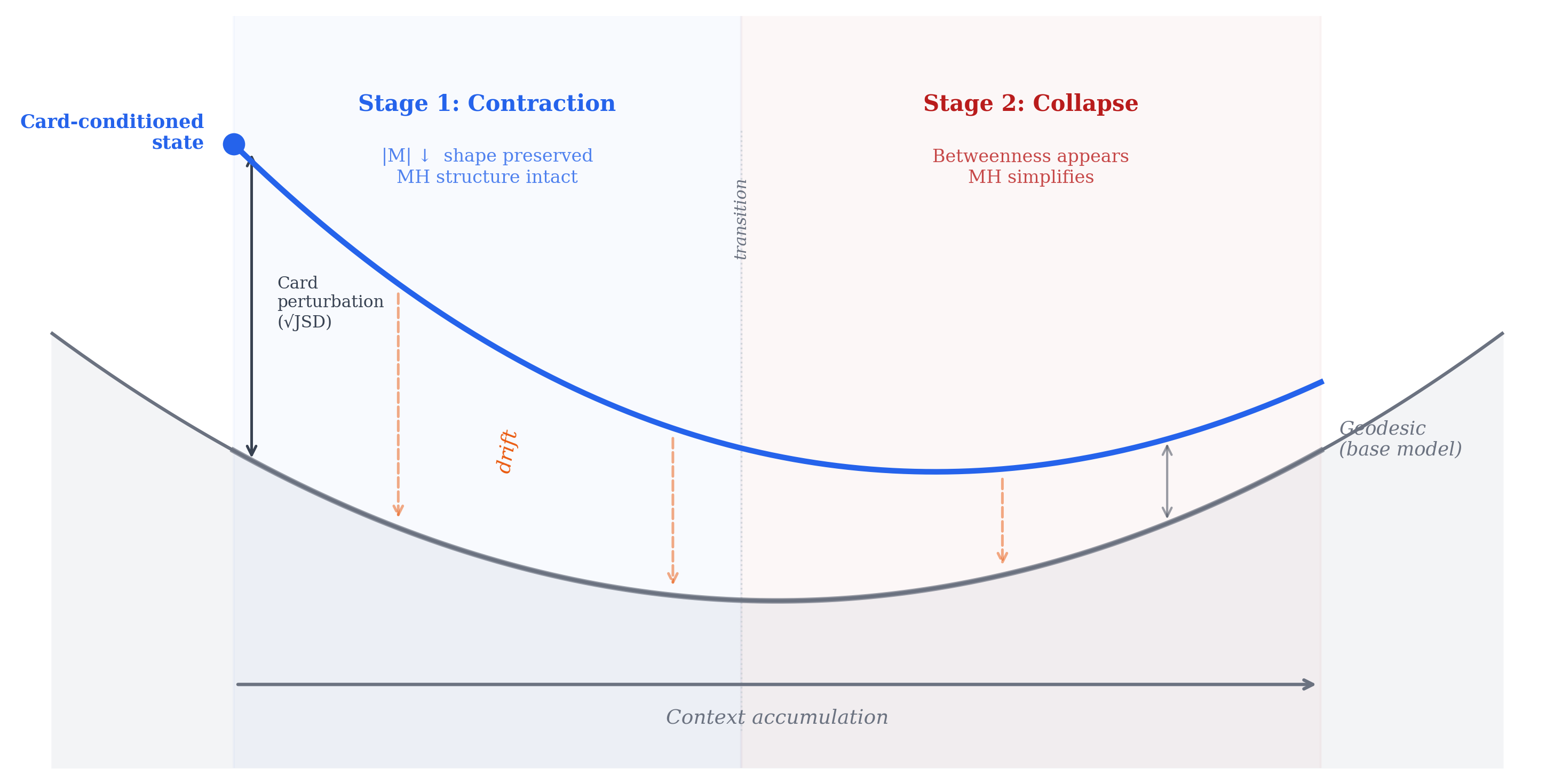
Figure 2: Conceptual framework—curved behavioral space, geodesic (path of least resistance), and two-stage collapse.
Practical Instrumentation: The Heartbeat Monitor
Empirically derived from these results is a two-tier "Heartbeat" monitoring system for operational deployments:
- Tier 1: Sampling deterministic first tokens on challenge probes as a low-cost binary drift gate.
- Tier 2: Continuous entropy-based monitoring on voice probes for richer, quantitative signals.
Provided thresholds for actionable alerts are exploratory and require confirmation under artifact-free context conditions and diverse models.
Significance, Limitations, and Future Directions
The framework represents the first formalization of AI agent identity as non-geodesic structure in output space, operationalizable as a black-box, information-geometric diagnostic. Unlike previous scalar (e.g., KL divergence) or linear (e.g., persona vector) approaches, the magnitude and magnitude homology toolkit can, in principle, differentiate between uniform contraction and structural collapse (i.e., they have diagnostic resolution with respect to drift sub-types).
Immediate theoretical implications include:
- A principled black-box method for early drift detection, complementary to white-box representational analyses (Chen et al., 29 Jul 2025).
- Clear architectural motivation for context management and system prompt anchoring, substantiated by geometric analysis of attention dilution (Li et al., 2024, Dongre et al., 9 Oct 2025).
- A foundation for future work probing more complex identity drift trajectories, involving multi-agent ensembles and richer probe batteries.
Limitations persist. The most notable are:
- All qualitative and longitudinal claims are rooted in single-agent, single-model, author-evaluated data; systematic, external replication is required.
- The observed drift phenomenon under repetitive padding is an artifact; context-length per se does not generically induce magnitude contraction for diverse context.
- Empirical detection of higher-order (anisotropic/topological) collapse awaits the design of probes and context challenges capable of inducing such degradation.
Future advances are anticipated in the extension of the geometric monitoring architecture to:
- Automated probe design with maximized sensitivity to axial collapse.
- Multi-agent fingerprinting and diversity assessment via cross-metric magnitude homology.
- Mechanistic integration with latent-space interpretability and spectral analysis as developed in complementary work [tanner2026companion].
Conclusion
This work establishes an information geometry and category theory-based paradigm for measuring and monitoring the persistence of AI agent identity in long-context deployments. While empirical drift signals are currently confounded by context artifact, the mathematical framework is robust, predictive, and well-positioned for application in larger-scale, multi-agent, and multi-model settings. The magnitude and magnitude homology perspective provides a path toward fine-grained, black-box diagnostic tools with superior resolution compared to prior methods, enabling both theoretical and operational advances in the field of agent alignment and robustness.