- The paper demonstrates that quenched nonreciprocal disorder prevents zero-temperature freezing by sustaining athermal, persistent dynamics.
- It employs a combination of mean-field analysis, numerical simulations, and finite-time scaling to reveal a continuous transition at a critical nonreciprocal density (p ≈ 0.20).
- The study identifies deterministic energy cycles and activated coarsening, highlighting how nonreciprocal interactions overcome domain-wall pinning even at T=0.
Nonreciprocal Disorder and Zero-Temperature Dynamics in 2D Ferromagnets
Introduction and Motivations
The paper "Nonreciprocal Disorder Prevents Zero-Temperature Freezing in a Ferromagnet" (2606.21582) undertakes a precise study of quenched nonreciprocity effects in spatially extended magnetic systems, specifically a two-dimensional Ising model with randomly distributed nonreciprocal (NR) bonds. While reciprocal disorder has been extensively examined in the random-bond and random-field Ising contexts, the impact of spatially quenched nonreciprocity – an archetype for antagonistic, asymmetric interactions found in neural assemblies, ecological networks, and flocking systems – remains largely unaddressed.
This work systematically characterizes equilibrium and non-equilibrium phases emerging from the admixture of NR couplings, focusing especially on the zero-temperature limit where conventional disordered ferromagnets (e.g., RBIM, RFIM) exhibit freezing or glassy dynamics. The primary technical innovation consists of demonstrating a continuous disorder-driven transition and the emergence of persistent athermal dynamics, revealing the crucial role of nonreciprocal frustration and deterministic energy cycles.
Model Architecture and Theoretical Characterization
The base model comprises Ising spins σi∈{−1,+1} on a square lattice, interacting via nearest-neighbor bonds with randomly assigned nonreciprocality at density p. Each directed bond Jij follows:
- Reciprocal: (Jij,Jji)=(+1,+1) with probability $1-p$
- Nonreciprocal: (Jij,Jji)=(+1,−1) or (−1,+1) with probability p/2 each
Spin updates follow Glauber dynamics:
Pσi→−σi=21−σitanh(hi/T),hi=j∑Jijσj
This construction preserves Z2 symmetry and retains discrete bond distribution, but fundamentally breaks the existence of a global free energy due to directional couplings.
A discretized mean-field treatment is developed, mapping the local field statistics onto an equivalent RBIM structure, yielding analytical expressions for the phase boundary p0. The theoretical framework is supplemented by coarse-grained field theory: NR disorder introduces a quenched random advection term to the usual Model A dynamics, but is shown to be RG-irrelevant near the clean-Ising critical point compared to dilution effects.
Phase Diagram and Critical Transition
Simulations and mean-field analysis demonstrate two principal phases:
- Ferromagnetic Order: For p1, spatial and temporal correlations exhibit long-range order.
- Disordered (Paramagnetic): For p2 or p3, correlations decay exponentially, with diverging relaxation times and correlation length at the transition.
The order-disorder transition at p4 is continuous, with a critical density p5, substantially below the percolation threshold p6 established via a gauge-symmetry argument. Unlike RBIM, there is no reentrant disorder at low temperatures; the zero-temperature line meets the p7 axis sharply.
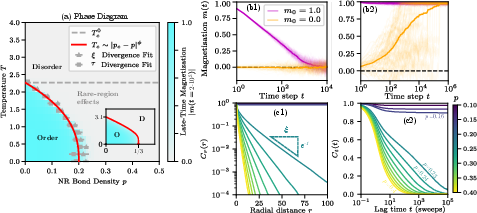
Figure 1: Phase diagram and magnetization relaxation for various p8, showing the critical transition and distinct correlation behaviors in ordered/disordered regimes.
Numerical extraction of critical exponents indicates that p9 and Jij0 increase at low Jij1, with strong finite-size corrections affecting the precise values.
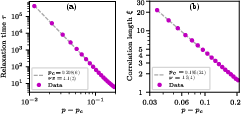
Figure 2: Divergence of relaxation time Jij2 and spatial correlation length Jij3 as Jij4, consistent with a continuous transition at Jij5.
Rare-Region Effects and Persistent Dynamics
The disordered phase of the NR Ising model displays salient rare-region effects, manifesting as stretched-exponential tails in the autocorrelation functions even at Jij6:
Jij7
These tails originate from patches with anomalously low NR bond density, which retain local order and reverse on large timescales. Unlike equilibrium systems, rare-region reversals persist with finite rates down to zero temperature, as NR driving prevents the system from freezing.
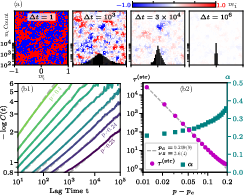
Figure 3: Visualization of rare ordered regions, time-averaged spin distributions, and stretched-exponential autocorrelation tails indicating persistent rare-region dynamics at Jij8.
Mechanism: Nonreciprocal Driving and Energy Descent
The key mechanism preventing zero-temperature freezing is the violation of proportionality between local selfish energy change and global energy, possible only in nonreciprocal systems. Finite clusters of NR bonds (e.g., Jij9 plaquettes) enable localized deterministic cycles in spin configurations, acting as a source of athermal persistent activity.
Simulation data confirms that all spins remain dynamically active at (Jij,Jji)=(+1,+1)0, with a significant proportion exhibiting negative local selfish energy changes even in steady state, while global energy is stationary.
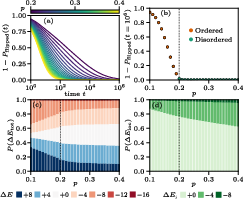
Figure 4: Fraction of spins remaining active and distributions of energy changes, highlighting non-equilibrium energy descent via local NR driving configurations.
Zero-Temperature Coarsening and Pinning
NR disorder fundamentally alters coarsening kinetics in the ordered phase. Domain-wall pinning, which halts growth in RBIM at (Jij,Jji)=(+1,+1)1, is circumvented; the system exhibits two-stage domain growth:
- Early: (Jij,Jji)=(+1,+1)2 (curvature-driven)
- Late: (Jij,Jji)=(+1,+1)3 (activated growth), with NR pinning defects locally stabilizing corners but nonreciprocal driving permitting continued domain evolution.
Absorbing configurations require extremely rare coordinated NR arrangements, so activated coarsening persists indefinitely for computational timescales.
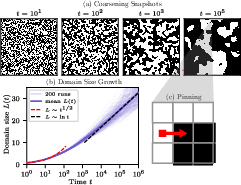
Figure 5: Domain snapshots after quenching, time evolution of domain size, and illustrative pinning defect, showing activated coarsening and NR-driven depinning.
Critical Scaling and Finite-Time Collapse
Finite-time scaling collapse of the magnetization during relaxation from ordered initial conditions confirms the continuous nature of the zero-temperature transition:
(Jij,Jji)=(+1,+1)4
The extracted order-parameter exponent (Jij,Jji)=(+1,+1)5 is notably smaller than the clean (Jij,Jji)=(+1,+1)6 Ising value, in line with known results for low-temperature disordered transitions.
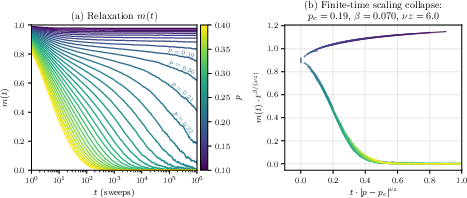
Figure 6: Scaling collapse of magnetization onto a master curve, supporting the continuous zero-temperature transition.
Implications and Prospects
From a theoretical standpoint, the results demonstrate that spatially quenched nonreciprocity generically destroys freezing and glassy behavior in 2D ferromagnets, replacing static order with persistent, athermal dynamics. This is consistent with the breakdown of fixed points in nonreciprocal fully-connected models (e.g., asymmetric neural networks, ecosystems), now shown to extend to finite-dimensional lattices.
Practically, the findings imply that sparse nonreciprocity can act as a robust mechanism to prevent macroscopic freezing in extended systems with local antagonisms, relevant for understanding persistent activity in biological and artificial collective systems. The identification of deterministic energy descent cycles is critical for the design of nonequilibrium materials and control protocols in active matter.
Future directions include:
- Extending analysis to higher dimensions, where equilibrium models possess finite-temperature spin glass transitions, to determine if and how NR disorder destabilizes glassy order.
- Precise measurement of critical exponents and comparison with universality classes.
- Exploration of nonreciprocal disorder effects in multi-species or vector spin models.
Conclusion
This paper establishes that quenched nonreciprocal disorder in a 2D Ising ferromagnet induces a continuous zero-temperature disorder-driven transition and perpetuates dynamical activity in the disordered phase. NR bonds supply deterministic athermal driving, preventing freezing and enabling phenomena such as persistent rare-region reversals and activated coarsening down to (Jij,Jji)=(+1,+1)7. These mechanisms constitute generic features of nonreciprocal disorder and lay the groundwork for further studies on nonequilibrium phase transitions and active dynamics in spatially extended systems.