- The paper demonstrates that nonreciprocal vision-cone interactions preserve the 2D Ising critical exponents even under strong NR perturbations.
- MC simulations with finite-size scaling reveal upward shifts in the critical temperature and significant anisotropic corrections in dimensionless observables.
- Dynamic RG analysis confirms that NR perturbations yield analytic corrections and a quadratic shift in critical temperature without altering the universality class.
Critical Behavior of the 2D Ising Model with Nonreciprocal Vision-Cone Interactions
Introduction
This work addresses the fate of the two-dimensional Ising universality class under nonreciprocal (NR) interactions, driven by an explicit violation of reciprocity and detailed balance through vision-cone interactions. The investigation connects equilibrium universality and non-equilibrium directional information flow, utilizing extensive Monte Carlo (MC) simulations and a dynamic renormalization-group (RG) analysis. The aims are twofold: to elucidate the robustness of critical exponents under NR perturbations and to characterize induced anisotropic corrections and deviations in dimensionless observables.
Model and Methodology
The considered system is an NR extension of the standard square-lattice Ising model. The vision-cone interaction scheme breaks reciprocity at the microscopic level: the coupling Jij for nearest-neighbors includes a polarization-dependent NR term λ, where Jij=J+λ/β if the interaction aligns with the local polarization p^i, and J otherwise. The stationary measure thus cannot be written as a global Hamiltonian, directly violating detailed balance.
MC simulations employ single-spin Glauber dynamics on system sizes L∈{8,16,…,256} and λ∈{0.1,0.3,1}. Observables analyzed include the Binder cumulant U4, the second-moment correlation-length ratio ξ/L, magnetization m, susceptibility λ0, energy-like observable λ1, and a specific-heat-like fluctuation λ2.
The scaling regime is investigated using the quotients method for finite-size scaling, enabling controlled extraction of critical temperatures and exponents, as well as analysis of amplitude ratios sensitive to non-equilibrium anisotropies.
Universality and Critical Exponents
The finite-size scaling analysis demonstrates that the critical exponents λ3, λ4, and λ5 are invariant under NR perturbations up to the largest simulated λ6, consistently matching the exact two-dimensional Ising values within numerical accuracy (Table~\ref{tab:MC:results}). The exponent for the leading correction-to-scaling is λ7, in agreement with equilibrium calculations.
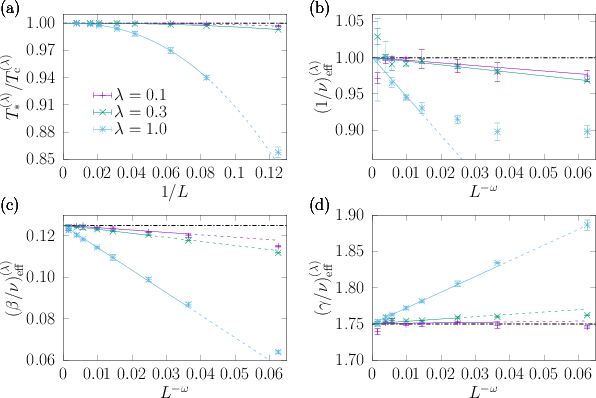
Figure 1: Finite-size scaling of crossing temperatures λ8 and effective exponents from quotients analysis for different λ9.
The critical temperature shifts upward as Jij=J+λ/β0 increases, but the scaling exponents remain unaffected. This behavior is consistent with RG predictions, where the NR perturbation is found to be irrelevant at the Wilson–Fisher fixed point, preserving the Ising class's asymptotics.
Dimensionless Observables and Anisotropy
A distinctly nonequilibrium signature arises in the scaling of universal amplitude ratios, notably the Binder cumulant Jij=J+λ/β1 and the ratio Jij=J+λ/β2. Both observables systematically deviate from their equilibrium Ising values as Jij=J+λ/β3 increases, with significant suppression evident for Jij=J+λ/β4. These deviations signal strong anisotropic scaling corrections introduced by directional NR interactions, even as the underlying critical exponents remain Ising-like. The amplitude of finite-size corrections and their functional dependence on Jij=J+λ/β5 aligns with expectations for relevant directional perturbations at finite system sizes.
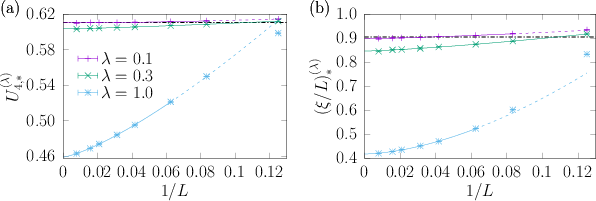
Figure 2: Thermodynamic-limit extrapolation of Binder cumulant Jij=J+λ/β6 and correlation-length ratio Jij=J+λ/β7 for varying Jij=J+λ/β8, highlighting systematic deviation from equilibrium.
The energy-like observable Jij=J+λ/β9 at criticality also shifts monotonically with increasing p^i0. The fluctuation quantity p^i1 exhibits a negative non-singular term for large p^i2, reflecting modifications in the fluctuation background unrelated to equilibrium thermodynamic stability.
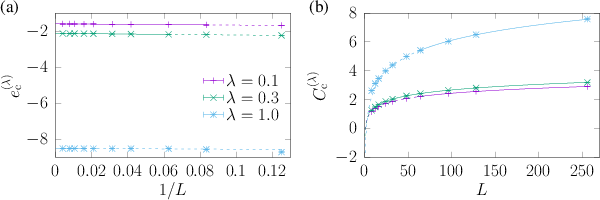
Figure 3: Finite-size scaling of critical energy-like observable p^i3 and specific-heat-like quantity p^i4 as a function of system size and p^i5.
Dynamic Renormalization-Group Analysis
A coarse-grained field-theoretic description confirms the lattice findings. The nonreciprocal term in the Langevin equation acts as a self-advection along a polarization vector, introducing explicit breaking of rotational invariance and generating anisotropic nonlinearities analogous to those in Burgers/KPZ-type systems. RG analysis at one loop shows that the NR coupling p^i6 is irrelevant at the Wilson–Fisher fixed point for p^i7: it produces only analytic corrections to the fixed-point parameters and a p^i8 shift in the critical temperature.
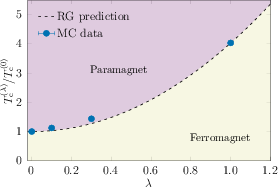
Figure 4: Quadratic scaling of the critical temperature shift p^i9 versus J0, in agreement with RG predictions.
Importantly, only the location of the transition is modified by nonreciprocity, while the scaling dimensions and universality class remain unchanged. The consistency between RG and MC results permits a quantitative test, providing the first direct verification at the microscopic level of such an RG scenario in nonreciprocal Ising-like models.
Implications and Future Directions
This study establishes that equilibrium critical scaling in the two-dimensional Ising universality class is robust against the introduction of nonreciprocal, vision-cone interactions. While such symmetry breaking yields strong anisotropic corrections in finite-size amplitude ratios, the universal asymptotics are preserved. This result underlines the irrelevance of this class of NR perturbations at the critical point and corroborates field-theoretic arguments in J1.
Theoretically, these findings delimit the scenarios where non-equilibrium perturbations can change universality in scalar field theories and quantify the boundaries of RG stability for the Ising class. Practically, they inform the modeling of active and biological systems with directional, nonreciprocal couplings, implying that for a broad class of symmetry-preserving directional interactions, equilibrium universality survives.
Future research should explore whether this robustness extends to systems with additional conservation laws, different symmetry classes, or in the presence of long-range interactions, as well as the crossover to cases where NR interactions become RG-relevant and possibly induce new universality classes or multicriticality. The interplay of finite-size scaling, geometrical anisotropy, and non-equilibrium correlations remains a rich domain for exploration.
Conclusion
Through large-scale simulations and dynamic RG analysis, the two-dimensional Ising universality class is shown to be stable under a broad range of nonreciprocal vision-cone interactions. The critical exponents remain Ising-like, but dimensionless ratios display striking, J2-dependent deviations arising from strongly anisotropic non-equilibrium corrections. These findings clarify the effect of nonreciprocal perturbations on critical behavior and provide a benchmark for further studies of universality in nonequilibrium many-body systems.