- The paper demonstrates that non-reciprocal couplings induce a tunable confinement length scale in a classical Ising gauge model.
- It employs Monte Carlo simulations to reveal self-avoiding trail dynamics of gauge quasiparticles on percolation clusters.
- The research connects microscopic non-reciprocity to macroscopic topological noise suppression and emergent dynamical regimes.
Non-Reciprocal Ising Gauge Theory: Dynamics and Confinement from Frustrated Non-Reciprocity
Introduction
The study of non-reciprocal interactions in many-body systems has recently emerged as a central topic across statistical physics, active matter, and condensed matter, offering a route to novel types of collective phenomena inaccessible in equilibrium. The "Non-reciprocal Ising gauge theory" (2604.03367) extends this paradigm by introducing non-reciprocal couplings into the classical Z2 Ising gauge theory, providing a highly controlled platform to investigate the interplay between non-reciprocity and geometric frustration. The work identifies new structural and dynamical regimes, particularly highlighting how non-reciprocity induces a tuneable confinement length scale and fundamentally alters the stochastic dynamics of gauge quasiparticles.
Model Definition and Symmetries
The constructed model consists of two interwoven species, A and B, of Ising variables each living on the bonds of a square lattice. Each species is governed by standard intra-species, four-body, reciprocal Z2 gauge (plaquette) interactions, while interspecies coupling simultaneously includes both reciprocal and non-reciprocal onsite terms. Importantly, the non-reciprocal interaction is designed such that each species acts to minimize its own "selfish energy," leading to dynamics that break detailed balance and conventional energy minimization principles.
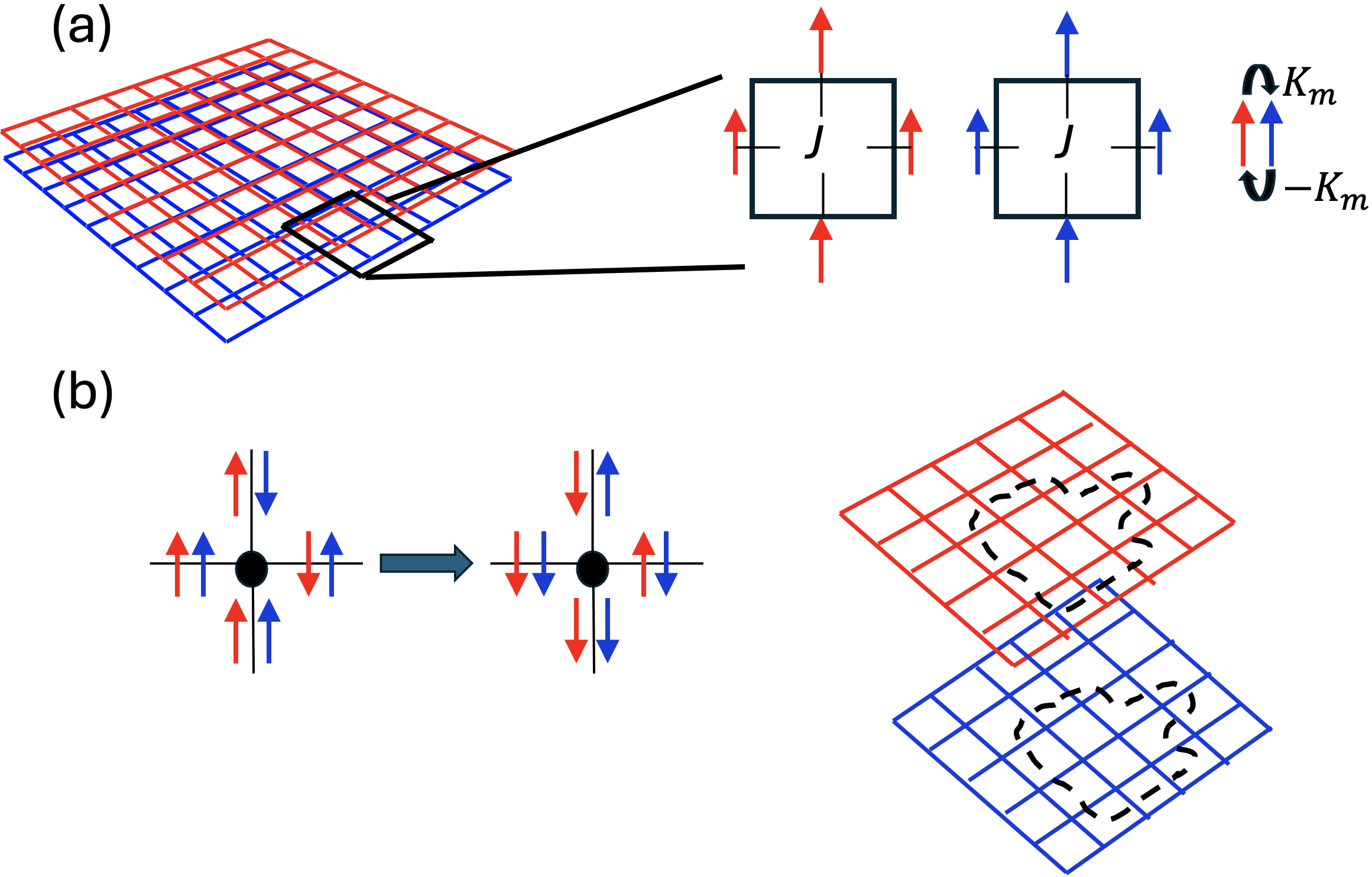
Figure 1: Schematic of the non-reciprocal Ising gauge theory with intra- and interspecies couplings and gauge-invariant closed-loop symmetry.
The theory preserves a local Z2 gauge invariance under the simultaneous flipping of all bonds at a given lattice site in both species, ensuring the absence of conventional order parameters and the necessity to probe gauge-invariant observables—most notably, Wegner-Wilson (WW) loops.
Quasiparticle Excitations and Confinement
In conventional (reciprocal) 2D Ising gauge theory, excitations manifest as deconfined, point-like plasmonic quasiparticles associated with −1 plaquettes. In this extended model, the interplay between reciprocal (Kp) and non-reciprocal (Km) interspecies couplings yields several nontrivial effects. While reciprocal interactions Kp induce correlated regions of aligned A and A0 spins and energetically confine single-species excitations, non-reciprocity A1 tunes the spatial scale over which such confinement is operative.
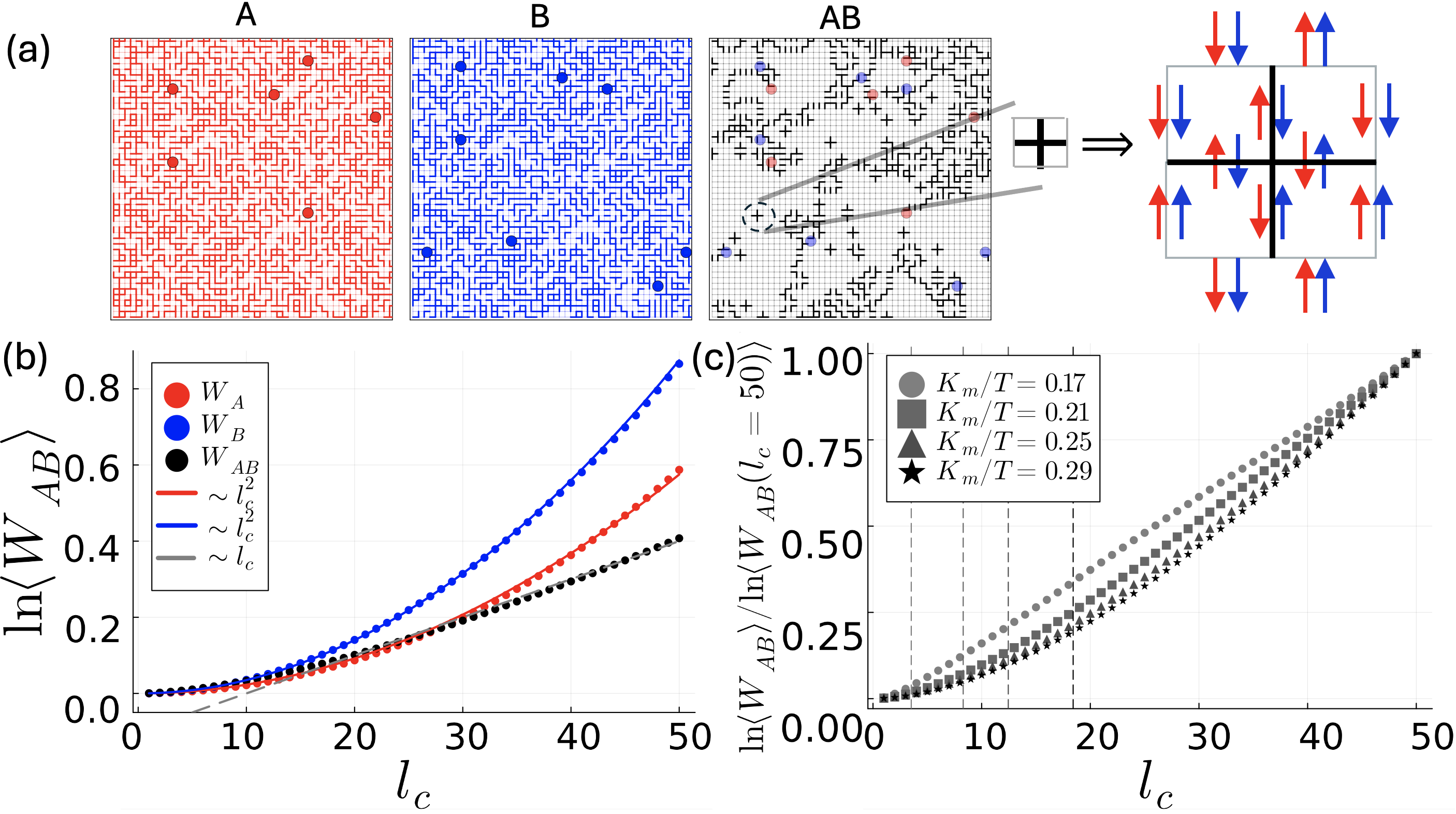
Figure 2: Snapshot illustrating A2 and A3 spin configurations, cluster structure, and correlation of combined WW observables with coupling parameters; linear-to-quadratic crossover in scaling with loop length is evident.
Strong numerical evidence is provided that the combined WW loop observable, A4, exhibits a linear scaling regime indicative of confinement, but with a crossover loop length directly controlled by the non-reciprocal coupling strength. The quadratic scaling expected for deconfined phases reemerges only on scales below this confinement length, which increases as A5 increases. Notably, increasing non-reciprocity at fixed A6 extends the deconfined regime, but—in contrast to equilibrium intuition—confinement persists at all finite A7.
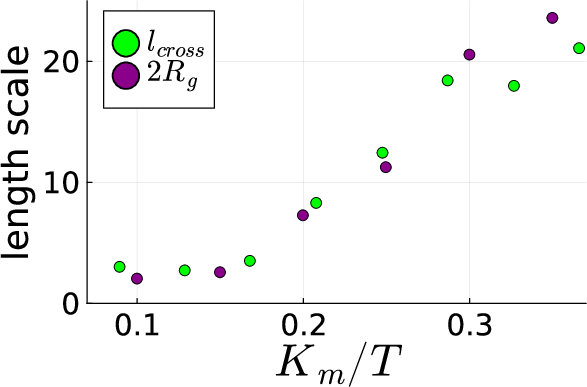
Figure 4: Confinement length scale extracted from WW loop crossover, matching the diameter of antiferromagnetic clusters as a function of A8.
Quasiparticle Dynamics in the Non-Reciprocal Regime
The dynamical behavior of isolated quasiparticles is fundamentally modified in the regime of strong non-reciprocity. When the system is in the low-density limit (A9), excitations in the B0 and B1 species are highly anticorrelated in time, leading to nontrivial intermittent dynamics.
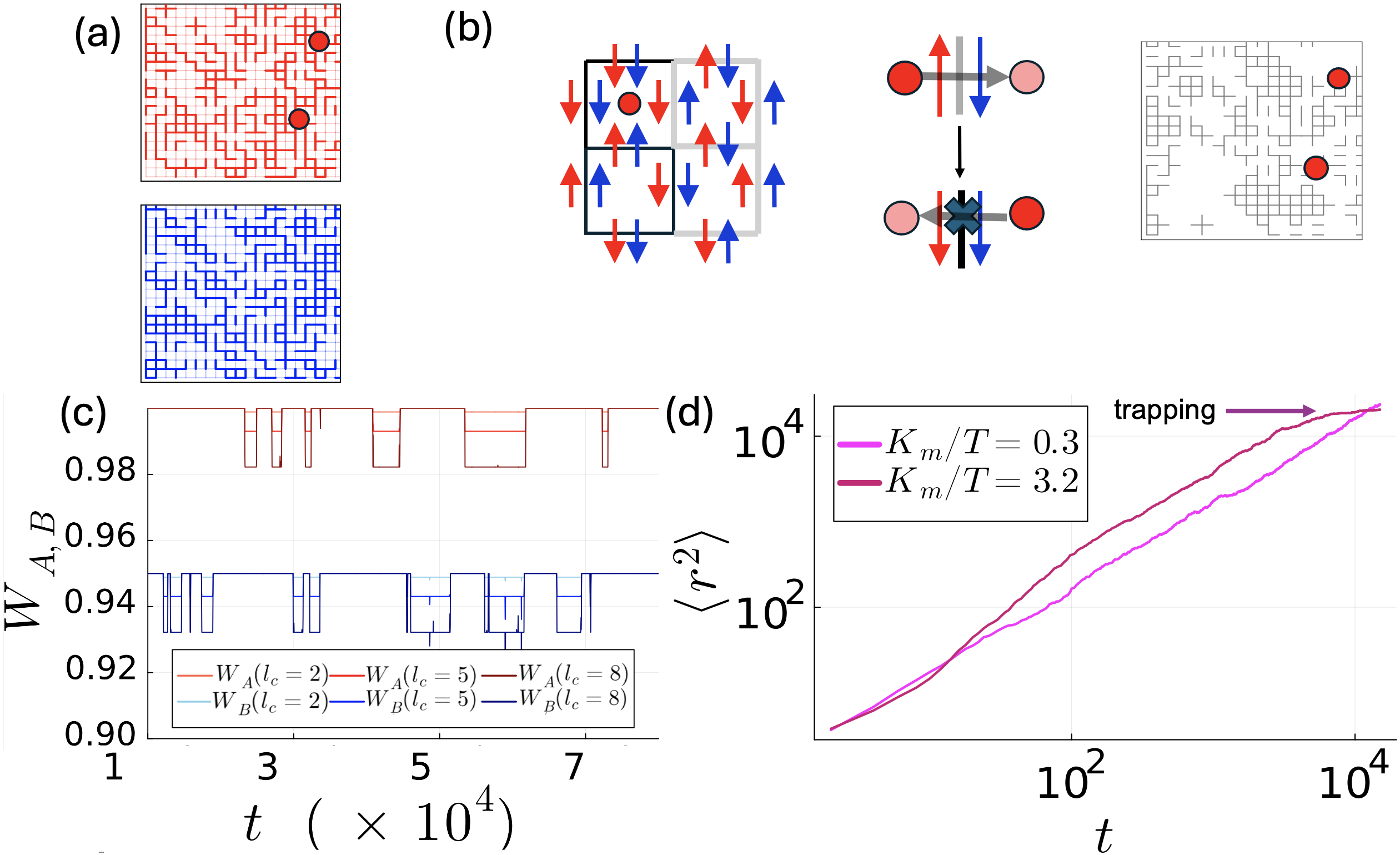
Figure 5: Time series and snapshots of quasiparticle occupations and their motion; strong B2 biases hopping to energetically favorable moves, resulting in self-avoiding trail (SAT) dynamics on a diluted percolation lattice.
Monte Carlo simulations constrained to permit quasiparticle motion but prohibit creation/annihilation reveal that the effective random walk of an B3 (or B4) quasiparticle follows a self-avoiding trail on a diluted network defined by the instantaneous configuration of the other species. In the B5 limit, this network is statistically equivalent to a critical percolation cluster, producing transient superdiffusive motion followed by long-lived trapping. At finite but large B6, this trapping is metastable, but in finite-size systems it is prominent on simulation timescales.
Magnetization Fluctuations and Topological Noise
Crucially, the mapping between quasiparticle motion and global magnetization evolution enables direct predictions for magnetic noise observables. In the absence of strong non-reciprocity, the second moment of the magnetization, B7, exhibits a topologically protected logarithmic correction to diffusive scaling, arising from the repeated bond visitation properties of random walks.
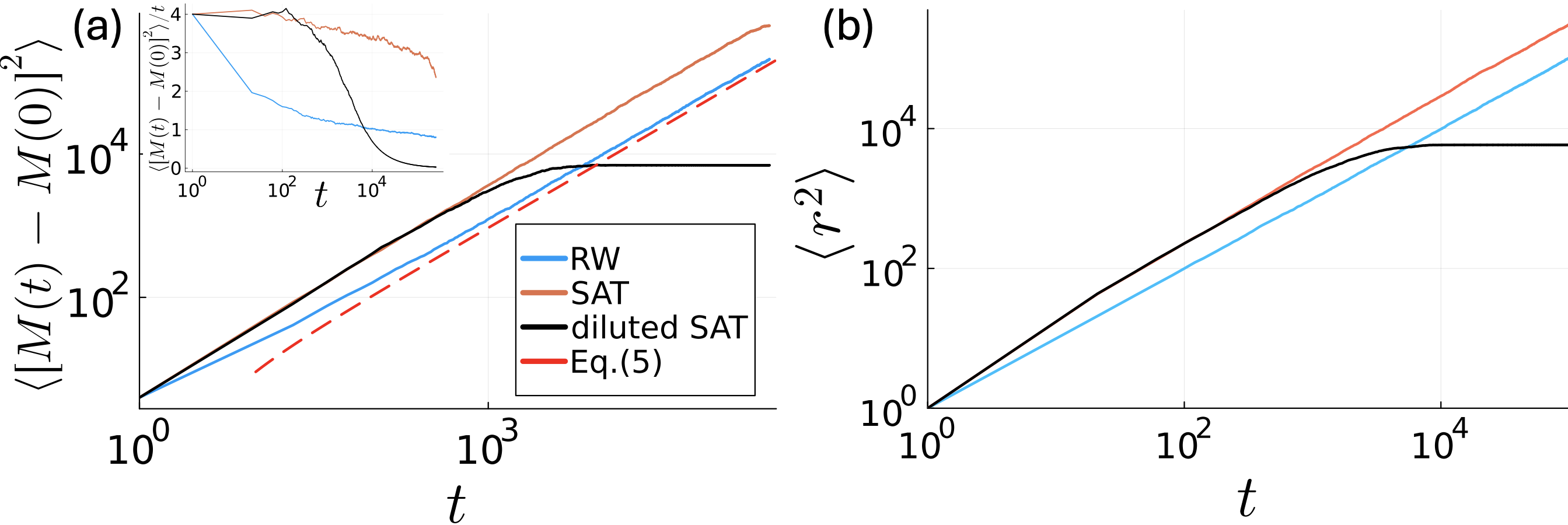
Figure 3: Comparison of magnetization variance under ordinary random walk, SAT, and SAT on percolation cluster in the toy model, with log-corrected and linear regimes indicated.
At strong non-reciprocal coupling, where the SAT dynamics dominates, this logarithmic correction is suppressed, and magnetization fluctuations become strictly diffusive up to the trapping timescale.
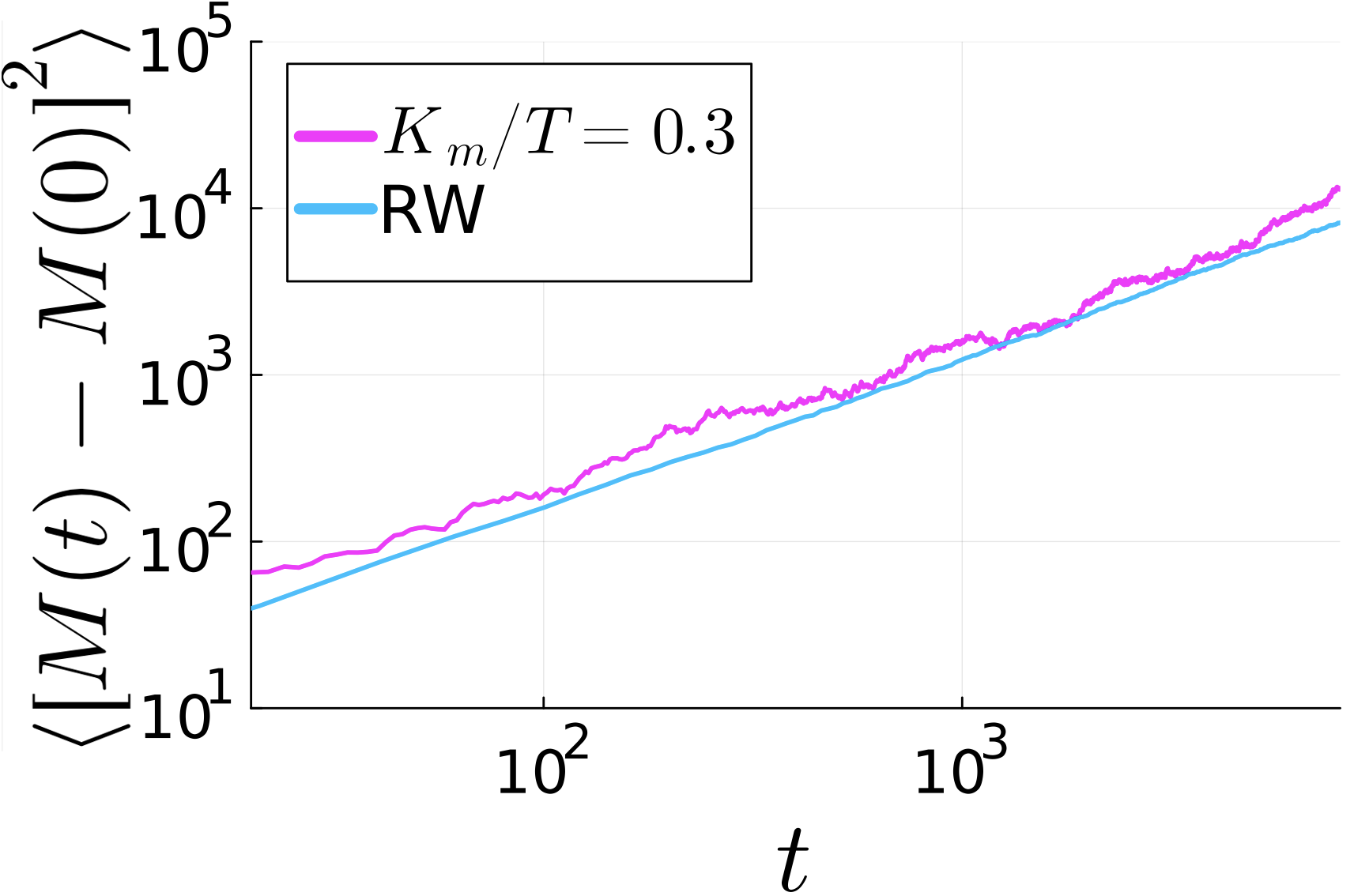
Figure 6: Agreement between weak-coupling theory/numerics for magnetization dynamics, confirming the random-walk regime before crossover to the SAT-dominated regime as B8 increases.
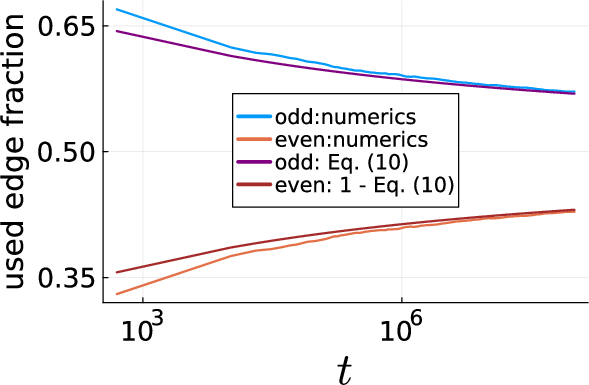
Figure 7: Analytical and numerical comparison of the fraction of bonds visited an odd number of times by the random walk process, explicating the origin of the logarithmic contribution.
The observed magnetic noise spectra thus directly encode the crossover from topologically constrained to unconstrained stochastic motion, tunable by the non-reciprocal coupling.
Theoretical and Practical Implications
This analysis reveals that the combination of gauge constraints and non-reciprocal dynamics enables access to regimes unattainable in equilibrium or reciprocal frustrated systems. The coexistence of confinement and non-reciprocal stochasticity leads to emergent phenomena such as tuneable confinement scales, correlated quasiparticle pair dynamics, and the suppression of topological noise contributions in magnetization.
The implications are multi-faceted: practically, they suggest design principles for active and metamaterial platforms where non-reciprocal gauge couplings can yield tunable transport, memory, and slow relaxation properties. Theoretically, these results provide a blueprint for extending non-reciprocal modeling to higher-dimensional gauge theories, quantum variants, and more complex symmetry classes. The work suggests that non-reciprocal B9 gauge theories could offer new routes to manipulating monopole dynamics and glassiness in spin ice materials.
Conclusion
The paper presents a comprehensive study of non-reciprocal Ising gauge theory, establishing that non-reciprocal coupling in a frustrated gauge setting yields unique dynamical and topological properties absent in either ingredient alone. The emergence of a tunable confinement length, correlated quasiparticle dynamics exhibiting self-avoiding trails on percolation networks, and the explicit manipulation of topological noise signatures in the magnetization, all illustrate the richness resulting from the intersection of non-reciprocity and geometric frustration. These findings significantly widen the scope of non-equilibrium statistical mechanics and point to future avenues in both theory and engineered soft matter/quantum systems.