- The paper demonstrates that non-Hermitian enhancements in TBG enable engineered plasmonic responses through controlled gain–loss profiles and moiré-induced band modifications.
- It employs a non-Hermitian continuum model and biorthogonal Kubo formalism to quantify optical conductivity and elucidate plasmon dispersion and damping.
- Numerical results show extended propagation lengths and strong subwavelength confinement, paving the way for tunable active photonic devices.
Moiré-Enhanced Plasmonics in Non-Hermitian Twisted Bilayer Graphene
Introduction and Motivation
The paper "Moiré-Enhanced Plasmonics in Non-Hermitian Twisted Bilayer Graphene" (2606.21186) establishes a theoretical framework for plasmonic excitations in twisted bilayer graphene (TBG) incorporating non-Hermitian physics. TBG, owing to its strong moiré band reconstruction near the magic angle, is a central platform for correlated quantum phenomena and offers unprecedented tunability of its electronic structure. The integration of non-Hermiticity via effective gain and loss profiles further extends the versatility of TBG, setting the stage for engineered plasmonic responses not accessible in conventional crystalline systems.
Recent advances in non-Hermitian photonics, particularly PT-symmetric configurations and exceptional-point physics, have revealed nontrivial spectral modifications, phase transitions, and functionalities in diverse platforms. The paper situates TBG as a fertile ground for these effects, with a focus on the interplay between moiré-induced band structure, biorthogonal optical matrix elements, and non-Hermitian plasmon-pole reshaping.
Non-Hermitian Continuum Model and Optical Conductivity
The theoretical approach builds on a non-Hermitian extension of the Bistritzer–MacDonald continuum model, introducing layer-dependent imaginary self-energy terms to realize gain and loss. The sublattice-staggered form iλtσz and iλbσz ensures that non-Hermiticity is encoded in a physically plausible manner, and the PT-symmetric case (λt=−λb) balances gain and loss.
For observables, the paper employs a biorthogonal Kubo formalism, where optical conductivity is computed using right and left eigenstates of the non-Hermitian Hamiltonian. The modified matrix elements and complex eigenvalues directly impact intraband and interband transitions, shifting both spectral positions and linewidths of collective modes.
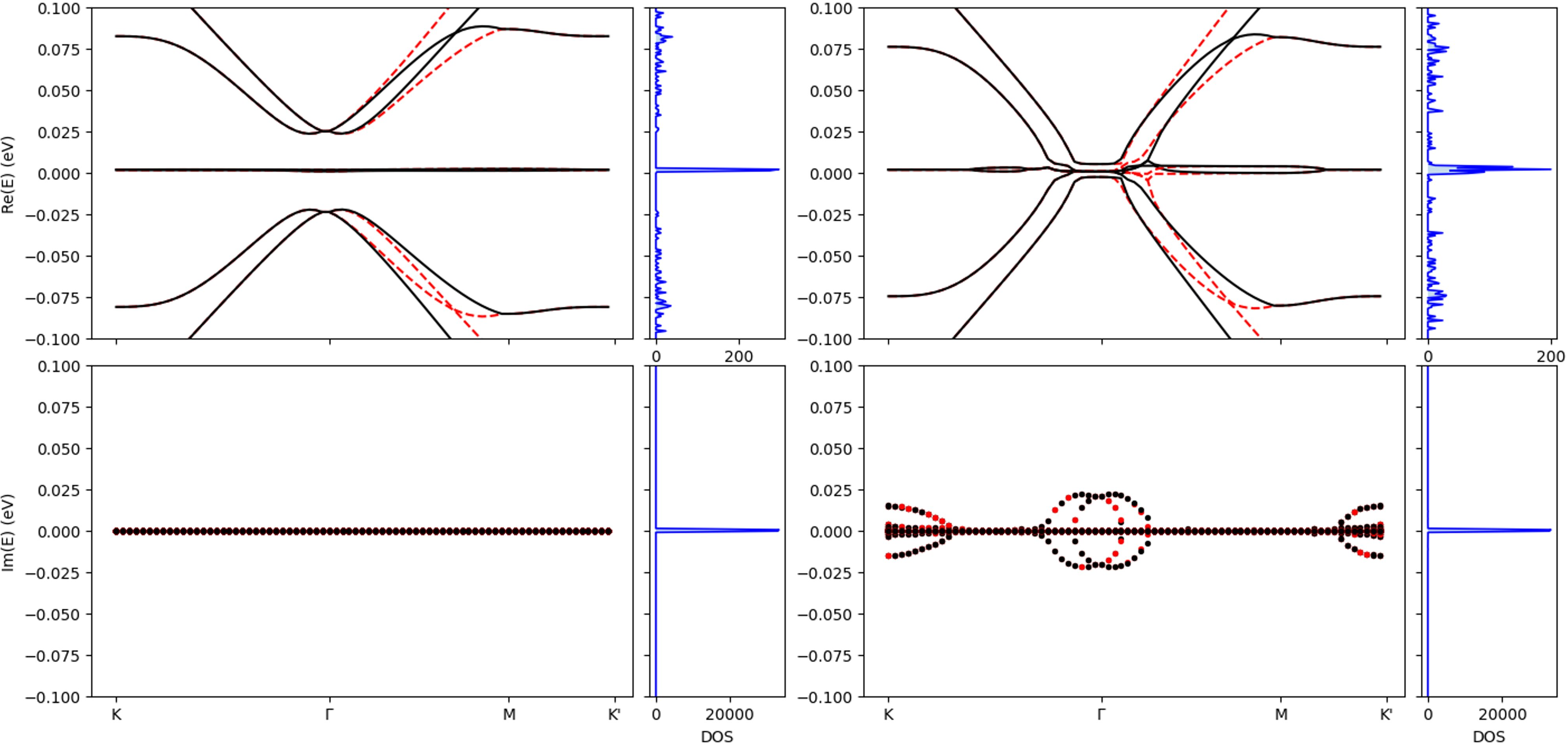
Figure 1: Electronic structure and density of states for TBG in passive and PT-symmetric non-Hermitian regimes; spectral broadening and redistribution are evident in the complex eigenvalue distribution.
Plasmon Dispersion, Damping, and Field Localization
The plasmonic response is numerically derived from the poles of the electromagnetic boundary-condition equations, distinguishing optical (in-phase) and acoustic (out-of-phase) branches. The formulation involves solving for complex wave vectors q(ω)=q′+iq′′, mapping dispersion, spatial attenuation, and mode confinement.
The acoustic branch exhibits pronounced subwavelength confinement and near-linear dispersion, particularly sensitive to interlayer Coulomb coupling and low-energy moiré states. The non-Hermitian environment, through gain–loss compensation, suppresses the imaginary component of q, dramatically enhancing propagation lengths within the linear regime.
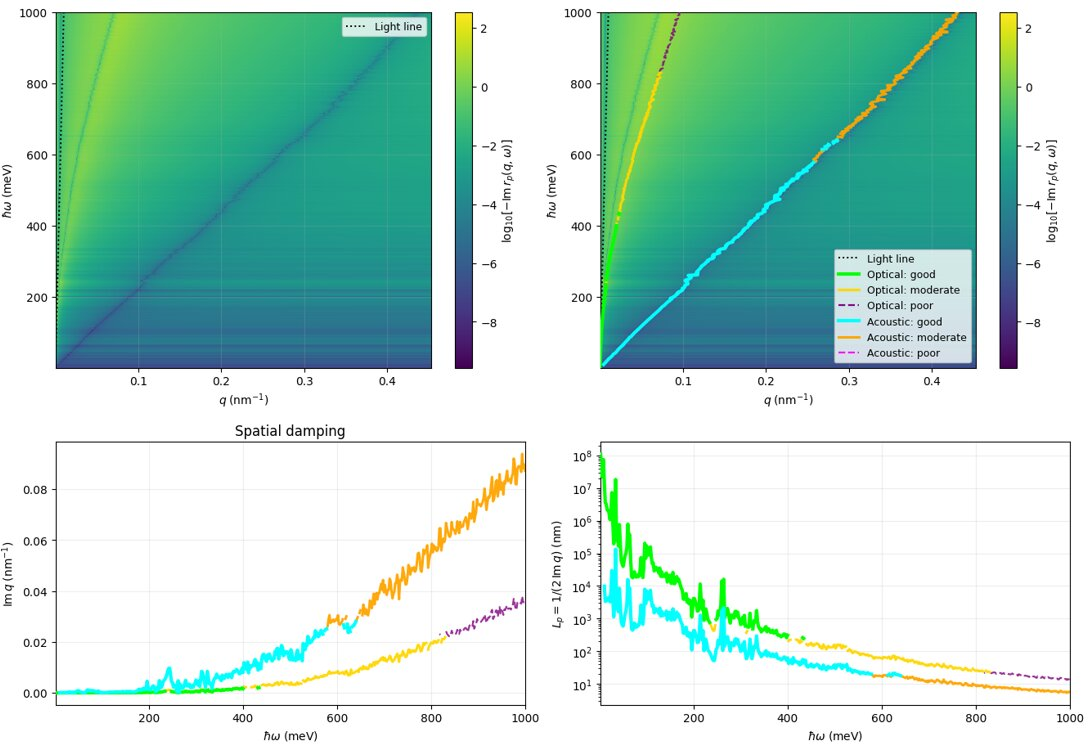
Figure 2: Plasmon dispersion and loss map for NH-TBG; acoustic and optical branches are visible with strong damping reduction at large gain, giving rise to extended propagation lengths.
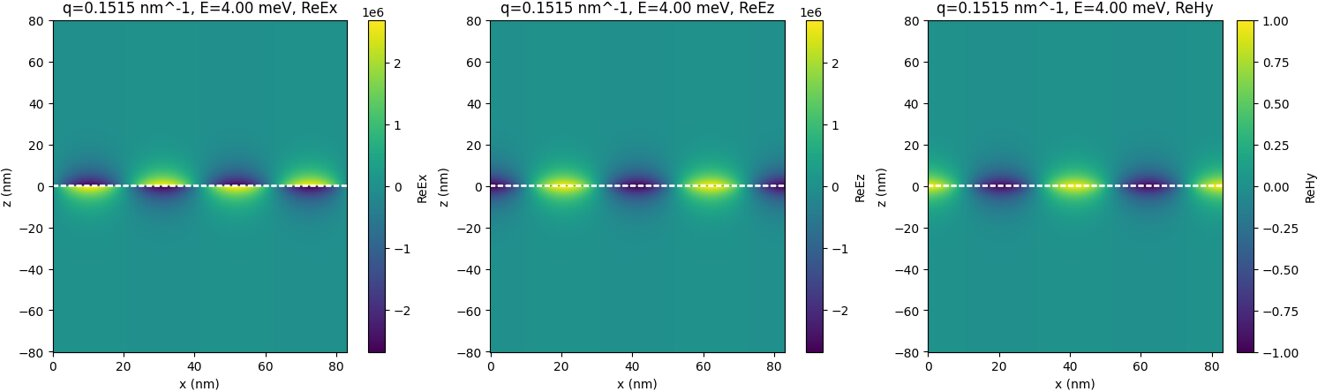
Figure 3: Transverse-magnetic field profiles in PT-symmetric NH-TBG; spatial localization near the bilayer is governed by high plasmon wave vector and reduced damping.
Analysis of Numerical Results and Stability Constraints
Numerical simulations demonstrate substantial increases in formal propagation length Lp=1/(2∣q′′∣) as gain–loss parameters are tuned, especially in the iλtσz0-symmetric configuration. Acoustic modes in particular combine reduced attenuation and high confinement factors, making them central candidates for non-Hermitian plasmonics in moiré materials.
However, these enhancements represent idealized upper bounds; in experimental scenarios, disorder, substrate losses, carrier relaxation, and nonlinear gain saturation impose practical stability limits. The system transitions from stable propagation to amplification when net gain prevails, and the iλtσz1-symmetric regime delineates the boundary between real-spectrum stability and complex eigenvalue growth. The mode enhancements, therefore, rely critically on maintaining gain–loss balance and normal-state operation above the superconducting critical temperature.
Implications, Applications, and Future Directions
The theoretical framework developed identifies TBG as a robust platform for active plasmonic control via non-Hermitian engineering. Unlike simple gain addition, the enhancement leverages the synergy between moiré-band reconstruction, biorthogonal current transitions, and plasmon-pole spectral reshaping. Experimental realization demands precise gain–loss manipulation and careful disorder and substrate management but promises tunable, confined plasmonic and photonic functionalities in two-dimensional quantum materials.
Practically, these results point to applications in nanoscale photonics, active plasmonic waveguides, and sensing, as well as driving new avenues for topological and exceptional-point physics in moiré platforms. Theoretically, future work should interrogate nonlinear effects, disorder averaging, device-level gain saturation, and full spectral stability, potentially incorporating more realistic reservoir dynamics and finite-size corrections.
Conclusion
This paper presents a rigorous non-Hermitian approach to moiré plasmonics in TBG, revealing both optical and acoustic plasmon branches with enhanced propagation and localization under controlled gain–loss conditions. The enhancements derive not from superconducting or correlated phenomena but from moiré-specific band structure and non-Hermitian spectral manipulation. TBG emerges as a promising architecture for active, tunable, and spectrally engineered plasmonics with implications for quantum material photonics, iλtσz2 symmetry, and exceptional-point science.