Go-with-the-Track: Video Compositing and Motion Control with Point Tracking
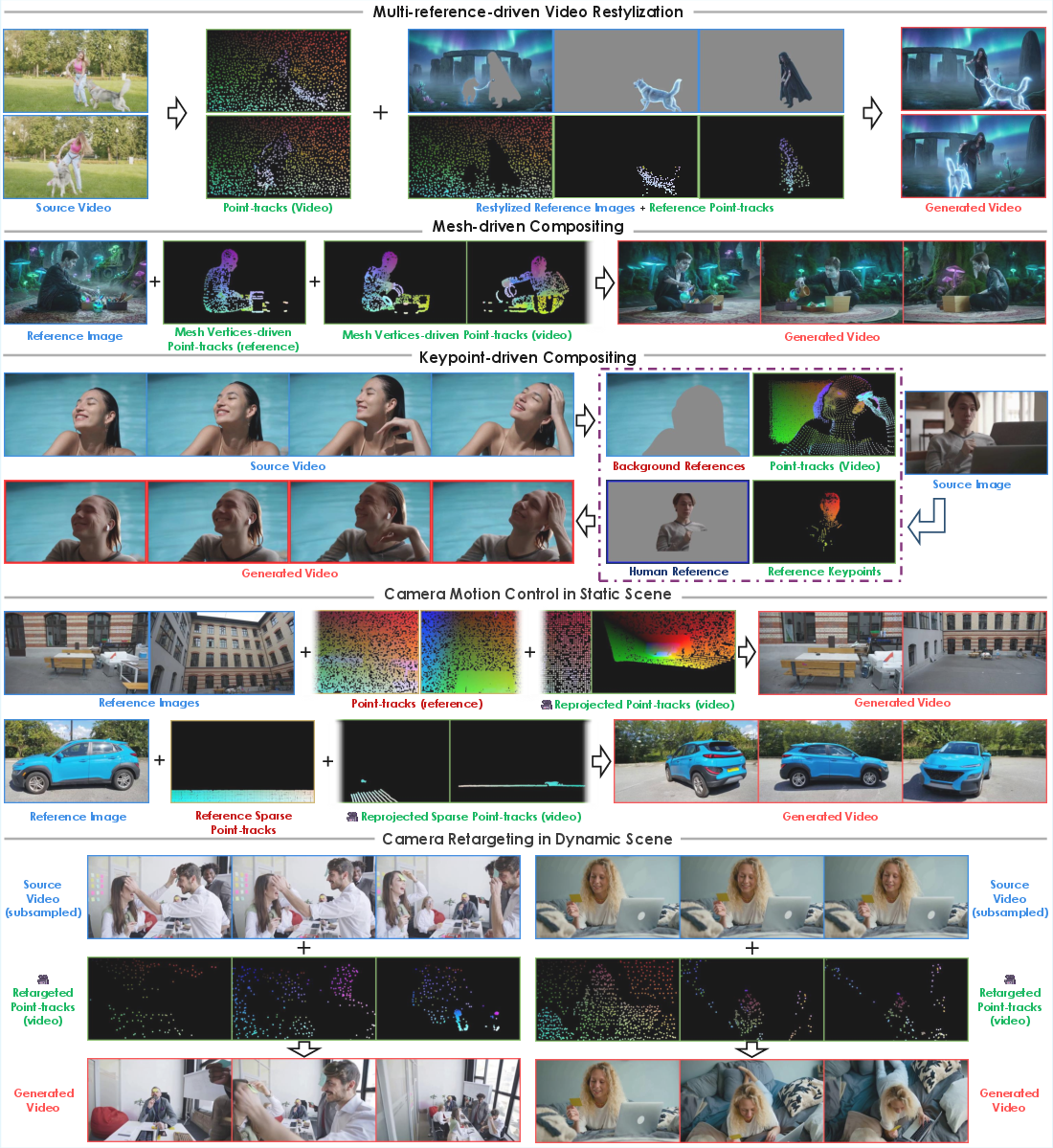
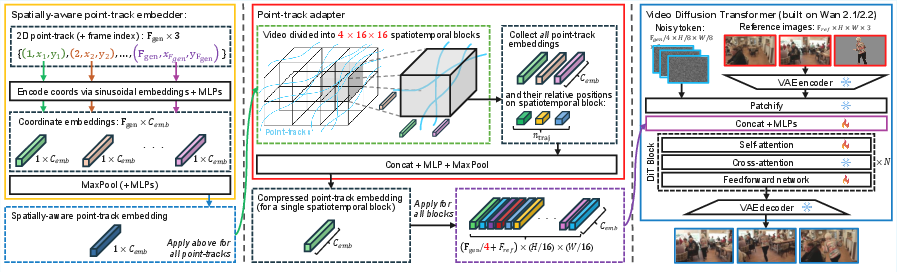
Abstract: Filmmaking demands precise motion control and reference image compositing -- capabilities that existing methods treat separately. Point-track-conditioned image-to-video models restrict content insertion to the first frame, while reference-to-video models lack fine-grained spatial-temporal control over how reference content integrates across frames. We present Go-with-the-Track, which unifies both capabilities by jointly conditioning on multiple reference images and reference-anchored point-tracks -- extending conventional point-tracks to explicitly establish correspondences between generated frames and reference images, thus enabling precise compositing and motion control throughout the video. To achieve this, we introduce spatially-aware point-track embeddings that encode the full sequence of point-track coordinates using a coordinate-wise MLP followed by temporal pooling. This representation captures the spatial characteristics of each point-track (serving as a unique identifier), while the embedding similarity correlates directly with spatial proximity, enhancing the model's ability to distinguish and associate point-tracks. We inject these point-track embeddings into a video diffusion transformer via a lightweight adapter, resolving the pixel-to-patch resolution mismatch while avoiding the substantial motion detail loss inherent in naive point-track subsampling. We use a hybrid training strategy to train jointly on dynamic, static, and synthetic scene video datasets to boost motion controllability. Experiments demonstrate that Go-with-the-Track achieves superior motion and reference control in a single model and enables new capabilities: multi-reference conditioned video generation with point-track driven compositing, as well as camera control for both static and dynamic scenes. Project Page: https://eyeline-labs.github.io/Go-with-the-Track/
Paper Prompts
Sign up for free to create and run prompts on this paper using GPT-5.
Top Community Prompts
Explain it Like I'm 14
Go-with-the-Track: Video Compositing and Motion Control with Point Tracking — Explained Simply
Overview: What is this paper about?
This paper introduces a new way to make AI-generated videos that both look like specific reference images and move exactly how the creator wants. It combines two things filmmakers care about:
- what appears in the video (like a character, prop, or style), and
- how it moves over time (like a camera zoom or a character walking).
The method is called “Go-with-the-Track.” It uses tiny “points” that you can place on images and video frames to guide where objects should be and how they should move across the whole video—not just the first frame.
Key Questions the Paper Tries to Answer
- How can we put things from one or more reference images into a video and keep them consistent throughout?
- How can we precisely control motion—like camera moves or object paths—over many frames?
- How can we do both at the same time with one model, instead of separate tools?
How It Works (in everyday language)
Think of making a video like directing a puppet show:
- Reference images are your “costume and look” for the puppet (what it should look like).
- “Point-tracks” are like drawing a path on the stage floor for the puppet to follow. Each point is a tiny marker that says, “This exact spot should travel here, then here, then here,” frame by frame.
The paper extends this idea:
- Normally, these point tracks only exist inside the video. Here, the tracks are “anchored” to both the reference images and the generated video. That means each track says both what to move (from the reference image) and how it should move (in the final video).
Because modern video AI runs on compressed “patches” (think: treating the video like a grid of blocks rather than individual pixels), the paper solves two big challenges:
- Identifying thousands of points without confusion
- Analogy: Imagine labeling thousands of dots so the system knows which dot is which, even when they move.
- Instead of giving each dot a random ID (which makes it hard to tell them apart in space), the model creates a “spatially-aware embedding” for each point.
- Analogy: It’s like summarizing the whole path of a dot into a smart label that reflects where it travels. Dots that move in similar places get similar “labels,” making it easier for the model to match and manage them.
- Converting pixel-level tracks to the model’s block-level world
- Analogy: If the AI thinks in big Lego blocks but your points sit on individual studs, you need a translator.
- The paper builds a lightweight “adapter” that gathers all the small point signals inside each block and turns them into one meaningful message for the AI. It also keeps small location details (like “near the top-left of this block”) so motion stays precise.
Training strategy:
- The model learns from a mix of datasets:
- Synthetic (computer-made) videos with perfect point tracking.
- Static-scene videos with known camera/depth, which make point-tracks very accurate.
- Real, diverse videos for natural-looking results.
- This balance helps the model be both precise (thanks to perfect labels) and realistic (thanks to real footage).
- They also add smart data tricks, like randomly hiding some tracks to teach the model to handle occlusions and missing data, and mixing how many points are given so it works with both dense and sparse guidance.
Under the hood (simple terms for technical bits):
- “Video diffusion transformer”: a common modern AI that makes videos by starting with noise and gradually refining it.
- “VAE” (Variational Autoencoder): compresses images into tokens, so the model can process videos efficiently.
- “Embeddings”: numeric summaries the model can understand—here, used to represent each point-track’s identity and path.
- “Pooling” (like max-pooling): combining many signals into one, while keeping the most important parts.
Main Findings: What did they discover?
The paper shows that Go-with-the-Track:
- Beats other top methods at following motion instructions (lower motion error) and maintaining visual quality (better scores like FID/FVD, and better similarity to ground truth).
- Works even when thousands of points are used and when those points start or end at different frames—not just the first frame.
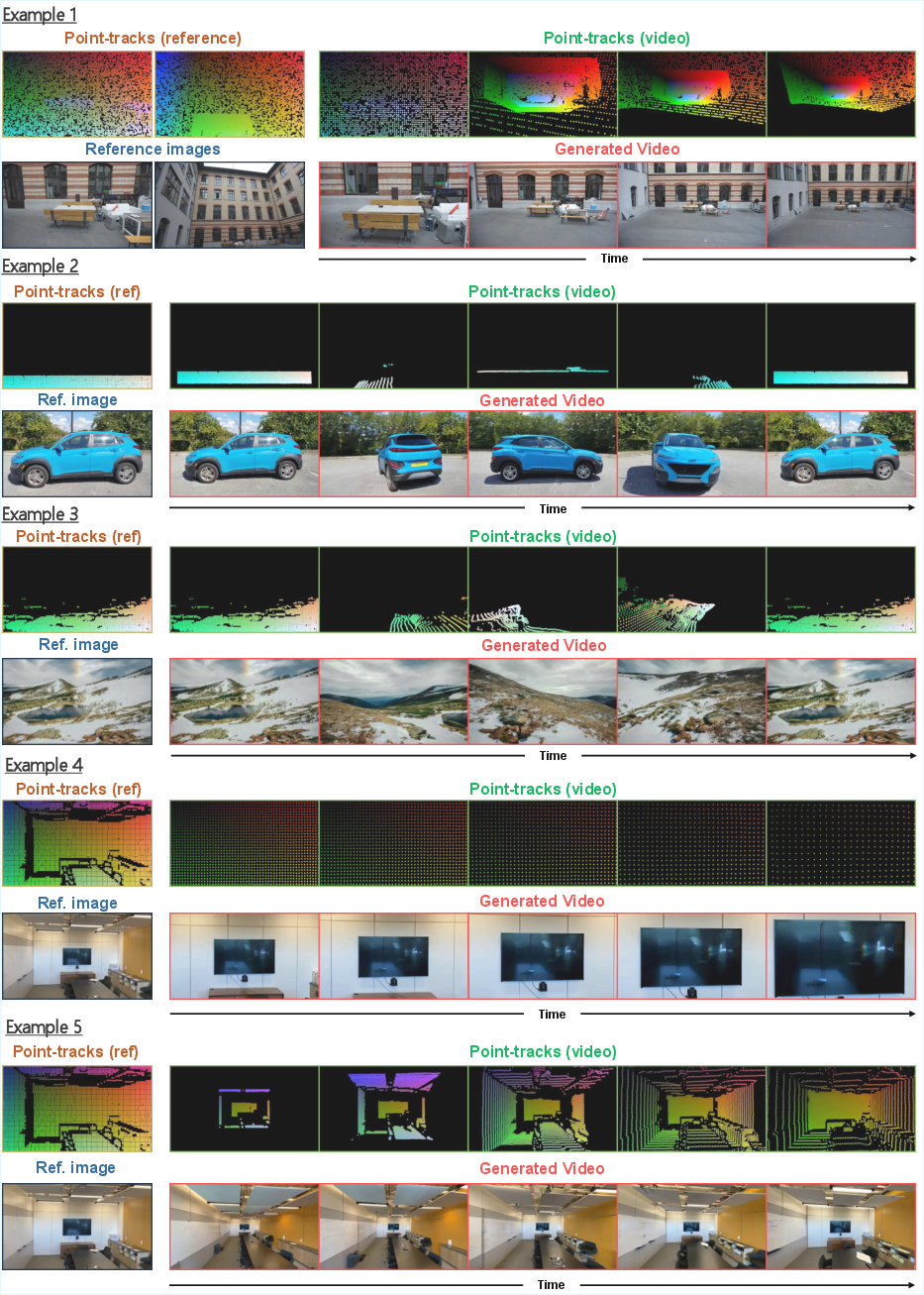
- Handles multiple reference images better: the more useful key frames you provide (like first, middle, last), the better the video matches both the look and the motion.
- Is preferred by human viewers: in a user study, people picked this method more often for motion following, preserving the subject’s appearance, and overall quality.
Why it matters:
- Filmmakers and creators can precisely place and move elements (characters, props, cameras) while keeping consistent looks, all in one model.
- It’s especially helpful when things enter or leave the scene across time—something older methods struggled with.
What This Could Mean for the Future
- Easier video compositing: You can insert characters or objects from images into moving scenes and control their paths precisely.
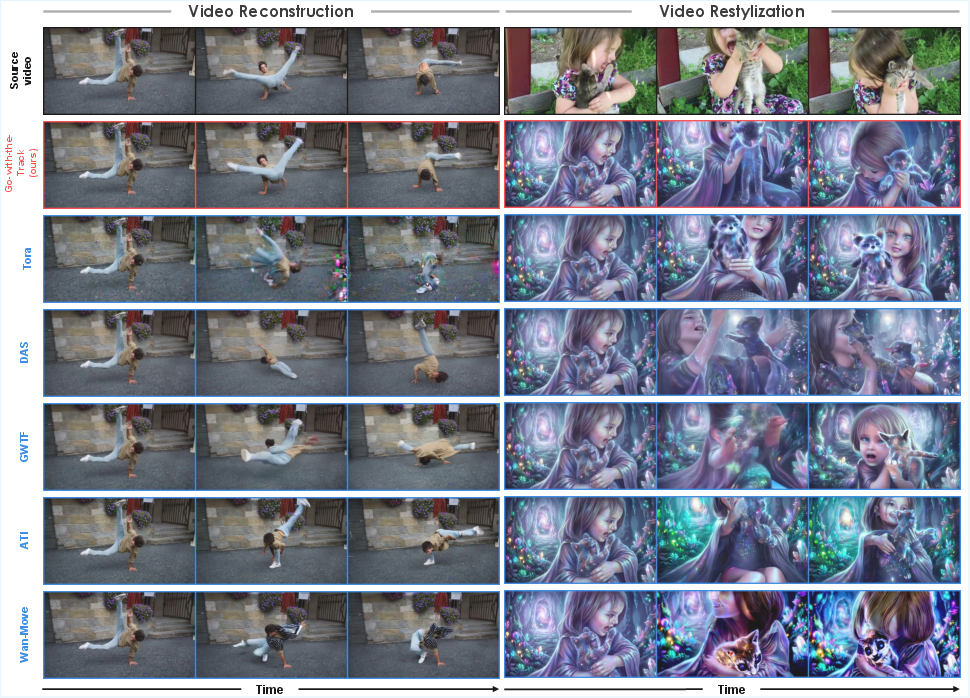
- Motion-preserving restylization: Keep the same movement but change the look using different reference images (e.g., turn a real scene into a watercolor style while keeping the same camera motion).
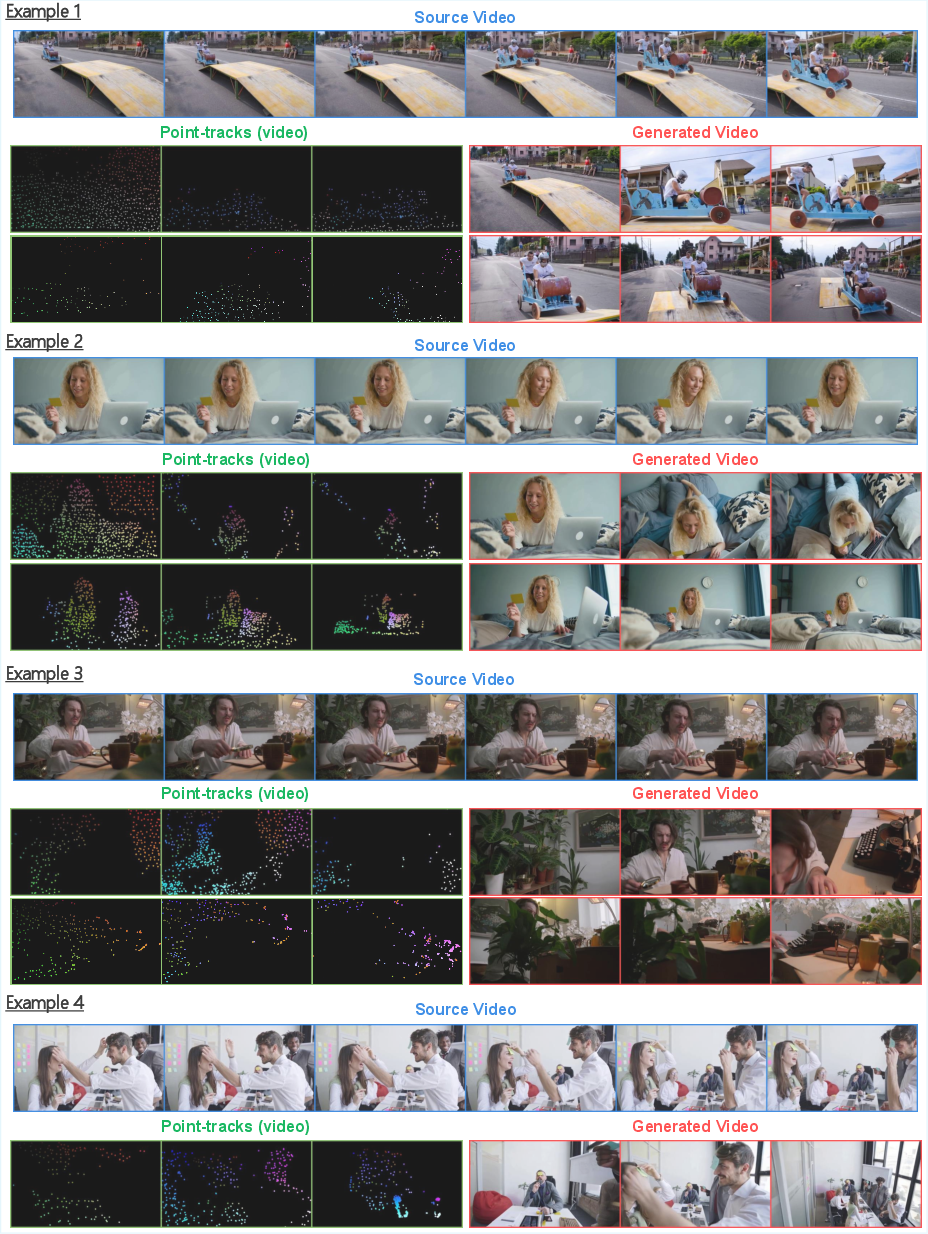
- Camera control in both static and dynamic scenes: You can tell the model how to move the camera and where to focus over time.
- More reliable tools for filmmakers: Combining appearance and motion control could make AI-assisted filmmaking far more predictable and creative-friendly.
Quick Recap
- Problem: Video tools either controlled motion or style well, but not both together with fine control.
- Idea: “Reference-anchored point-tracks” link what to show (from reference images) and how it moves (point paths) across all frames.
- How: Use smart point “embeddings” that reflect a point’s spatial path, plus an adapter to translate pixel points into the model’s block world without losing detail, trained on a hybrid of accurate and realistic data.
- Results: Better motion control and visual quality than existing methods, especially with multiple references and dense tracks.
- Impact: More powerful, precise, and creative video generation and editing for film, TV, and online content.
Knowledge Gaps
Unresolved gaps, limitations, and open questions
Below is a single, consolidated list of specific knowledge gaps and limitations that remain open for Go-with-the-Track, framed to guide future research.
- Lack of ground-truth point-tracks for real-world dynamic scenes: training relies on synthetic/static datasets for accurate tracks and real videos with tracker-derived labels; comprehensive real, dynamic GT benchmarks are missing, limiting precise supervision of motion control in real footage.
- Robustness to tracker noise not quantified: the model’s sensitivity to common tracking failures (drift, ID switches, missed detections, jitter) at inference time is not systematically evaluated under controlled noise regimes.
- Scalability to longer videos and higher resolutions is untested: training and evaluation are restricted to 49-frame, 480×832 videos; it is unknown how performance and stability change for minute-long shots, 4K outputs, or higher FPS.
- Computational efficiency and memory footprint are unreported: inference cost with up to 15k point-tracks and multiple references is not profiled, so real-time or production feasibility is unclear.
- Upper bounds of track density per latent block are unclear: the adapter collapses all tracks within a 4×16×16 spatiotemporal block into a single vector; the failure modes and quality degradation when many heterogeneous tracks collide in a block are not characterized.
- Ambiguity in 3D geometry and camera-object disentanglement: conditioning is purely 2D; there is no explicit 3D consistency constraint or camera parameter estimation/control, leaving parallax, foreshortening, and out-of-plane rotations under-constrained.
- Occlusion and layering are implicit and uncontrolled: there is no explicit occlusion ordering or depth-aware compositing mechanism; how the model handles occlusion boundaries, disocclusions, and inter-object interactions remains unexamined.
- Reference-only tracks are unsupported: the pipeline discards point-tracks that only exist in the reference images; inserting content that appears solely in references (without specifying target-frame tracks) is currently impossible.
- Embedding uses only generated-frame coordinates: spatially-aware embeddings ignore reference-image coordinates; the effect on correspondence when references are strongly misaligned (large scale/viewpoint changes) is not quantified.
- Failure under large viewpoint or scale changes is untested: generalization when reference images differ significantly from target frames (e.g., extreme zooms, oblique angles) is not systematically evaluated.
- Conflict resolution for overlapping multi-reference constraints is unspecified: how the model handles overlapping or conflicting tracks from different references (priority, blending, identity assignment) is not defined or analyzed.
- Photometric/relighting inconsistency is not controlled: the model does not explicitly harmonize lighting, shadows, or color between references and generated scenes; no relighting controls or metrics are provided.
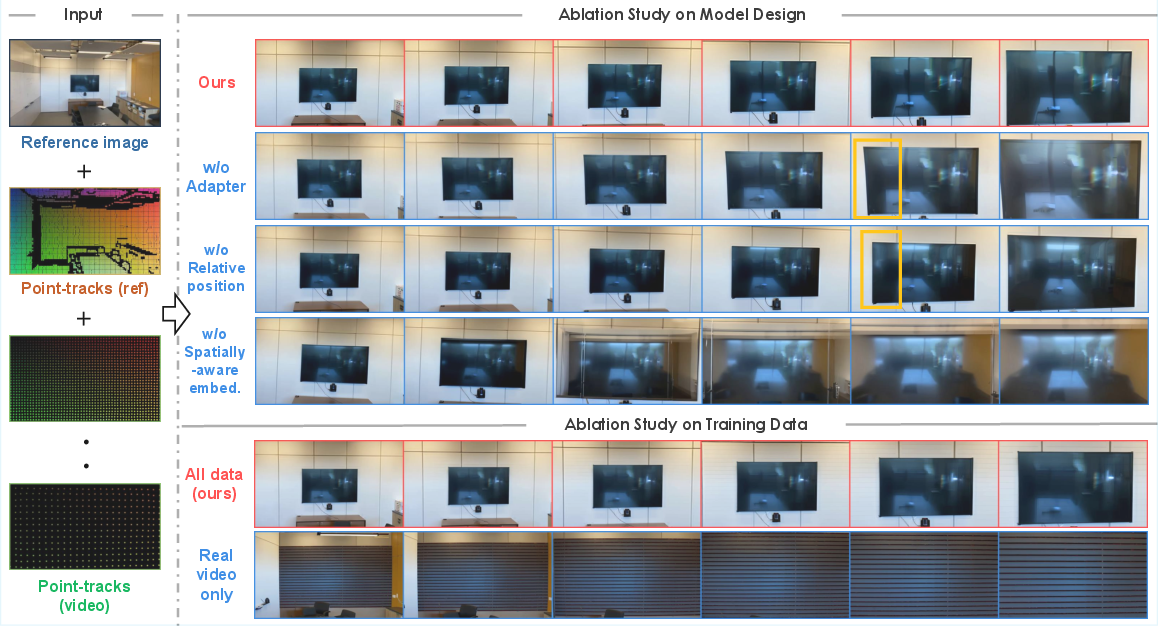
- Adapter design capacity vs. alternatives remains underexplored: max pooling with relative positions outperforms tested baselines, but the limits of this single-vector-per-block bottleneck, multi-token adapters, or hierarchical aggregation are not explored.
- Interplay and conflicts between text prompts, references, and tracks are unstudied: the model supports joint conditioning, but strategies for resolving conflicting signals (e.g., text vs. reference appearance vs. track motion) are not evaluated.
- Quantitative evaluation of reference adherence/identity preservation is limited: metrics primarily target reconstruction and motion (EPE via a tracker); objective measures of appearance/style/identity fidelity to references (e.g., CLIP, DINOv2, face-ID metrics) are absent.
- Motion fidelity metric depends on a tracker on generated videos: EPE is computed by re-tracking outputs with CoTracker3, introducing tracker bias; alternative GT-based motion metrics (beyond TAPVid3D subset) or tracker-agnostic measures are needed.
- Generalization across content domains is unknown: robustness to animation, cartoons, CGI, medical videos, or heavy stylization is not studied; training/evaluation data focus on natural videos.
- Practical authoring workflow is unclear: creating and curating thousands of tracks is burdensome; there is no discussion of user tools for track authoring, automatic track selection/coverage, or interactive editing and feedback.
- Camera control lacks explicit quantitative validation: although camera-control applications are showcased, there is no metric-based evaluation against known camera trajectories (e.g., from static-scene datasets with GT poses).
- Temporal consistency over very long horizons is unverified: identity and structure drift, temporal flicker, and scene continuity beyond 49 frames are not analyzed.
- Compositional scaling with many references is untested: experiments go up to 4 images; how quality and memory scale with 8–16+ references, and how to schedule/select references, is an open question.
- Sensitivity to occlusion gaps and missing segments in tracks is not assessed: while training augments with dropouts, the model’s ability to bridge long occlusions or re-identify after reappearance is not quantified.
- Backbone dependence and generality are narrow: results are shown for Wan 2.1/2.2; portability to other video diffusion backbones (e.g., different VAEs, tokenizers, or architectures) and necessary fine-tuning strategies are not explored.
- Failure-mode characterization is limited: the paper lacks a systematic inventory of typical failure cases (e.g., track collisions within blocks, mis-compositing at boundaries, lighting mismatch, fast motions), and diagnostics to guide future improvements.
Practical Applications
Immediate Applications
Below are concrete use cases that can be deployed with today’s tools and compute, leveraging the paper’s unified motion-control and multi-reference compositing, spatially-aware point-track embeddings, and lightweight adapter design.
- Motion-preserved restylization of existing footage (Film/TV, Advertising, Social/Creator)
- What you can do: Re-render a shot in a new style while preserving original camera/subject motion; swap costumes/props/backgrounds from multiple reference images while keeping motion intact.
- Example tools/workflows: “Style-from-References” node in Nuke/After Effects; batch restylization scripts for ad variants; editorial A/B style tests.
- Assumptions/dependencies: High-quality 2D point-tracks (off-the-shelf trackers); rights to use reference imagery and likenesses; current shot length/resolution limits (e.g., ~49 frames at 480×832 as trained) or need for tiling/chunking.
- Track-anchored logo/prop placement and set extensions (VFX, Advertising, Sports Broadcast)
- What you can do: Insert brand marks or digital props that enter/exit at precise times and locations; extend sets or signage that must follow surfaces under occlusion and parallax.
- Example tools/workflows: “Track-anchored Compositor” plug-in; batch brand replacement for regionalized ad delivery; compliance review renders.
- Assumptions/dependencies: Reliable dense or mid-dense tracks in the target regions; occlusion-aware tracking or manual masks; legal/brand approvals.
- Keypoint- or mesh-driven character replacement (Animation, Games, Virtual Production)
- What you can do: Replace an actor with a stylized character using body/joint keypoints or mesh vertices as tracks; keep gestures and timing but alter identity/costume.
- Example tools/workflows: Blender/Unreal Engine add-on that converts skeleton/mesh to point-tracks; previz-to-final asset swap pipelines.
- Assumptions/dependencies: Accurate keypoint or mesh extraction; consistent multi-reference appearance; ethical/consent constraints for identity edits.
- Camera motion control and reframing (Post-production, Sports/News, Education)
- What you can do: Design camera pans/zooms/dollies via point-tracks and multi-image references; stabilize or intentionally “handhold” a shot while preserving scene identity.
- Example tools/workflows: “CameraCtrl” timeline tool to sketch camera trajectories; reframing assistant for vertical/horizontal repurposing.
- Assumptions/dependencies: Enough static/dynamic tracks to disambiguate scene structure; scene-appropriate references; artifacts may appear on very long shots without chunking.
- Clean-plate generation and object removal along tracks (VFX, Restoration)
- What you can do: Remove booms, rigs, or bystanders and inpaint content that follows the original motion cues; generate temporally consistent clean plates.
- Example tools/workflows: Paint/inpaint nodes augmented with point-track conditioning; review overlays for QC.
- Assumptions/dependencies: Track coverage behind removed objects (or plausible hallucination tolerated); consistent lighting in references.
- Multi-reference continuity enforcement (Scripted Content, Continuity/QA)
- What you can do: Enforce wardrobe/prop consistency across shot variations by anchoring to canonical references; flag drift.
- Example tools/workflows: “Continuity Guard” that compares generated frames to reference-anchored regions.
- Assumptions/dependencies: Curated canonical references; human-in-the-loop acceptance thresholds.
- Sports telestration and analysis overlays (Broadcast, Coaching)
- What you can do: Generate explanatory overlays that stick to players/ball/field markings; synthesize illustrative insert shots that follow actual play motion.
- Example tools/workflows: Coaching dashboards that export CoTracker/DELTA tracks; broadcast replay packages.
- Assumptions/dependencies: Player/keypoint tracking quality; league/IP permissions for augmented feeds.
- AR filters and try-ons anchored to surfaces (Consumer Apps, E-commerce)
- What you can do: Place stickers, makeup, or apparel textures that remain stable under motion/occlusion; transform outfits using multi-reference looks.
- Example tools/workflows: Mobile pipeline that converts lightweight tracker outputs to track prompts; SKU-to-lookbook references.
- Assumptions/dependencies: Mobile-friendly inference or server offload; face/body tracking reliability; user consent.
- Dataset generation for vision research with controllable motion (Academia, Robotics)
- What you can do: Produce photorealistic, motion-controlled clips for evaluating tracking, optical flow, and SLAM; synthesize challenging occlusion/trajectory regimes.
- Example tools/workflows: Scripts to sweep camera/object tracks and styles; automatic metric logging (EPE, FID/FVD).
- Assumptions/dependencies: Accurate track specification; disclosure of synthetic origins in publications.
- Benchmarking controllable video generation (Academia)
- What you can do: Establish standardized tasks (dense/mid/sparse tracks, keyframe vs non-keyframe references) and metrics for motion fidelity and reconstruction.
- Example tools/workflows: Evaluation harnesses using CoTracker3; public leaderboards for track-following accuracy.
- Assumptions/dependencies: Common track formats; curated blind test sets with licenses.
- Instructional overlays that follow equipment motion (Education, Industrial Training)
- What you can do: Add step labels, safety highlights, or part names that remain affixed to moving machinery or tools.
- Example tools/workflows: Authoring tools to sketch track prompts; template libraries for standard procedures.
- Assumptions/dependencies: Sufficient track density in reflective/fast-moving regions; language/localization assets.
- Controlled background replacement for localization (Marketing, Streaming)
- What you can do: Swap posters, text, or scenery based on region while preserving scene dynamics.
- Example tools/workflows: “Localize-by-Track” batch process across catalogs; automated QC overlays.
- Assumptions/dependencies: Reference packs per locale; scriptable pipeline; typography legibility checks.
- Synthetic data for perception pretraining with camera path control (Robotics, AV, Drones)
- What you can do: Generate diverse, photorealistic trajectories with controlled camera motion for pretraining or stress-testing trackers and VO/SLAM.
- Example tools/workflows: Scenario generators that randomize tracks, occlusions, and styles.
- Assumptions/dependencies: Domain gap remains; careful validation against real-world distributions.
- Teaching and exploratory demos in HCI/Graphics courses (Academia)
- What you can do: Hands-on labs in controlled video generation, track design, and reference-driven compositing.
- Example tools/workflows: Classroom notebooks; small backbone variants for local training/inference.
- Assumptions/dependencies: GPUs for labs; open licenses of pretrained backbones and datasets.
Long-Term Applications
The following rely on further research, scaling, latency reduction, or ecosystem development (standards, policy). They extend the paper’s innovations—reference-anchored point-tracks, spatially-aware embeddings, and hybrid training—toward broader impact.
- Real-time on-set generative compositing and camera control (Virtual Production, Live Broadcast)
- Vision: Interactive, track-driven insertions on LED volumes; live dolly/zoom synthesis matching actor motion.
- Potential products: “Live Go-with-the-Track” with low-latency diffusion or distillation; hardware-accelerated adapters.
- Dependencies: Sub-100 ms pipelines; robust online tracking; safety/approval gating; high-resolution models.
- End-to-end editorial integrations (NLE/VFX suites)
- Vision: Native plug-ins for Premiere/Resolve/Nuke enabling track authoring, multi-reference management, and reversible edits.
- Potential products: Unified “Track Graph” timeline; shot-to-shot continuity enforcement.
- Dependencies: Standardized track I/O; project-level caching; collaboration/versioning features.
- Long-form, story-level motion and appearance control (Film/TV)
- Vision: Maintain character/prop identity and camera language consistently across minutes/hours with hierarchical tracks and global references.
- Potential products: Sequence-level controllers; memory modules for cross-shot continuity.
- Dependencies: Scalable memory; drift mitigation; compute cost management.
- 3D-aware, multi-view consistent generation (XR, VFX, Robotics)
- Vision: Fuse point-tracks with scene representations (NeRFs/GS/meshes) for cross-view consistency and depth-aware insertions.
- Potential products: “Track-to-3D” bridge; hybrid pipelines combining reconstruction and generative video.
- Dependencies: Joint 2D–3D training data; calibration; reliable depth/pose under dynamic scenes.
- Physics- and interaction-aware track control (Games, Simulation)
- Vision: Enforce contact, collision, and dynamics constraints so that inserted objects interact plausibly with actors and environments.
- Potential products: Constraint solvers over track space; differentiable physics-guided adapters.
- Dependencies: Learned or analytic physical priors; annotated interaction datasets.
- Closed-loop simulation for robotics/AV training (Robotics, AV)
- Vision: Generate photorealistic, controllable scenarios with curriculum over camera/object tracks to train/control policies.
- Potential products: Scenario farms with domain randomization over tracks, weather, and style.
- Dependencies: Bridging sim-to-real gap; safety validation; scenario coverage metrics.
- At-scale ad personalization with compliance guardrails (Marketing, Platforms)
- Vision: Massive, track-controlled brand/locale variants, with automatic checks for placement safety and disclosure.
- Potential products: “Policy-Aware Personalizer” that validates content regions, watermarks, and consent.
- Dependencies: Rights management; audit logs; scalable review workflows.
- Media provenance, audit, and forensics around track-conditioned edits (Policy, Standards, Trust & Safety)
- Vision: Record cryptographic logs of reference assets and track prompts; watermark synthesized regions; standardize “track provenance” metadata.
- Potential products: C2PA-like extensions for point-track conditioning; forensics tools detecting inconsistent track–content correspondences.
- Dependencies: Industry standards; regulator and platform adoption; privacy-safe logging.
- Accessibility-first video augmentation (Public Sector, Education)
- Vision: Auto-generate sign-language insets, high-contrast labels, or camera reframes guided by tracks to improve accessibility.
- Potential products: “Accessible Cut” pipeline for public content.
- Dependencies: High-quality keypoint tracking (hands/face); domain-specific references; community input.
- Consumer-grade mobile editors with guided track authoring (Daily Life, Creator Economy)
- Vision: Draw simple trajectories or tap-anchor regions to add consistent effects, props, or outfit changes over long clips.
- Potential products: Touch-first “Track Painter” UI; on-device distilled models.
- Dependencies: Efficient models; battery/thermal constraints; privacy protections.
- Automated localization of diegetic text and signage (Streaming, Internationalization)
- Vision: Replace on-screen text (posters, store signs) based on locale while preserving camera/object motion.
- Potential products: “Diegetic Text Localizer” with font/layout engines tied to track geometry.
- Dependencies: OCR/typography modules; cultural review; high-res text rendering.
- Continuous evaluation suites for controllable video (Academia, Platforms)
- Vision: Shared benchmarks spanning dense/mid/sparse tracks, keyframe vs. non-keyframe references, and occlusion regimes.
- Potential products: Public datasets with track annotations and policy-aligned evaluation protocols.
- Dependencies: Licensing for footage; standard track formats; community buy-in.
Cross-cutting assumptions and dependencies
- Technical: Quality and density of 2D point-tracks (especially under occlusion/fast motion); availability of multi-reference images; current model limits on resolution/clip length; significant GPU memory/compute for 14B backbones; need for chunking/shot stitching for long-form content.
- Data/Legal/Ethics: Rights and consent for reference images and identity edits; brand safety; disclosure/watermarking; adherence to platform and regional regulations.
- Ecosystem: Standardized interchange for track prompts and reference provenance; integration with existing DCC tools; reproducible metrics (e.g., EPE, FID/FVD) and public benchmarks.
These applications flow directly from the paper’s key advances: reference-anchored point-tracks that unify motion control and compositing, spatially-aware embeddings that scale to thousands of tracks, and an adapter that preserves fine motion cues when mapping from pixel space to compressed latent tokens.
Glossary
- AdamW: An optimizer that decouples weight decay from gradient updates, improving training stability in deep models. "We train at resolution with $49$ frames using AdamW~\cite{AdamW} (lr , weight decay ) with 1000-step linear warmup for up to 24K iterations."
- Attention pooling: A feature aggregation method that uses learned attention weights to combine inputs, often trading off sharpness for smoothness. "We compare: (1) random sampling of a single point-track per spatiotemporal block~\cite{chu2025wan, wang2025}, (2) max pooling only without relative position injection, and (3) attention pooling instead of max pooling."
- Channel-wise concatenation: Combining feature tensors by appending channels to add conditioning information before further processing. "Following prior work~\cite{he2025cameractrl2, ren2025gen3c}, we concatenate the adapter output channel-wise with video tokens after patchification and apply an MLP to recover the original channel dimension."
- Classifier-free guidance: A sampling technique that mixes conditional and unconditional model predictions to strengthen adherence to conditioning signals. "Text prompts and reference images are independently dropped with probability $0.15$ to enable joint classifier-free guidance at inference."
- CoTracker3: A point-tracking model used to estimate trajectories in videos for evaluation of motion accuracy. "Motion fidelity: Measured as the L2 distance between visible input tracks and estimated tracks from generated videos using CoTracker3~\cite{cotracker3}."
- Coordinate-wise MLP: A multilayer perceptron applied to per-frame coordinate tuples to encode spatial trajectories into embeddings. "we introduce spatially-aware point-track embeddings that encode the full sequence of point-track coordinates using a coordinate-wise MLP followed by temporal pooling."
- Cross-attention: A transformer mechanism that aligns and integrates information from conditioning inputs into the main token stream. "We train newly initialized weights from scratch and finetune self-attention and feed-forward layers in each DiT block, keeping cross-attention frozen."
- DELTA tracker: A tracking system used to annotate real videos with point-tracks for training and generalization. "Finally, we use publicly available general-video datasets (e.g., OpenVidHD~\cite{nan2024openvid}, MiraData~\cite{ju2024miradatalargescalevideodataset}, OpenHumanVid~\cite{li2024openhumanvid}) annotated using the DELTA~\cite{ngo2024delta} tracker, which improves generalization to real-world footage."
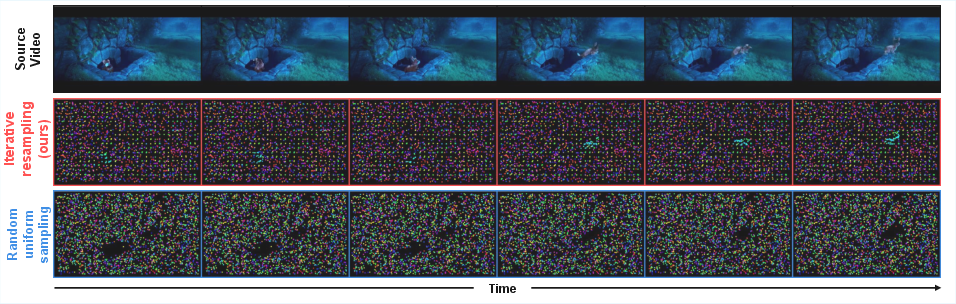
- Densification (iterative): A process that progressively adds tracks to sparsely covered regions to ensure comprehensive motion constraints. "We instead develop an iterative densification algorithm that detects and fills sparsely tracked regions, ensuring point-track coverage across the full scene."
- Diffusion Transformer (DiT): A transformer architecture tailored for diffusion models, processing tokens temporally and spatially. "We train newly initialized weights from scratch and finetune self-attention and feed-forward layers in each DiT block, keeping cross-attention frozen."
- DL3DV: A real-world static-scene dataset providing depth and camera pose for accurate point-track computation. "We use the real-world static-scene dataset DL3DV~\cite{ling2024dl3dv} and synthetic static-scene dataset TartanAir~\cite{tartanair2020iros}, which provide ground-truth depth and camera pose, allowing us to compute accurate point-tracks."
- Endpoint error (EPE): The L2 distance between input and estimated tracks, measuring motion-following accuracy. "We call this metric endpoint error (EPE)."
- Fréchet Inception Distance (FID): A metric comparing distributions of generated and real images to assess visual fidelity. "Visual fidelity: Evaluated using FID and FVD, which compare the generated and reference videos and favor models close to the real-data distribution."
- Fréchet Video Distance (FVD): An extension of FID for videos, assessing temporal and visual realism. "Visual fidelity: Evaluated using FID and FVD, which compare the generated and reference videos and favor models close to the real-data distribution."
- Grid pooling: Aggregating point features within spatial grids to produce region-level descriptors. "Inspired by grid pooling in Point Transformer V2/V3~\cite{wu2022point, wu2024ptv3}, we aggregate via max pooling."
- Hybrid training strategy: Combining synthetic, static-scene, and real video datasets to improve motion control and robustness. "We use a hybrid training strategy to train jointly on dynamic, static, and synthetic scene video datasets to boost motion controllability."
- Keyframe: A reference frame that exactly matches a generated frame, anchoring appearance and structure. "A keyframe means that the reference image appears exactly in the generated frames, whereas non-keyframe images do not match any target video frame."
- LPIPS (Learned Perceptual Image Patch Similarity): A perceptual metric comparing image similarity using deep features. "Reconstruction accuracy: Assessed via LPIPS, PSNR, and SSIM, which measure per-frame similarity between generated and ground-truth videos."
- Max pooling: A pooling operation that selects the maximum feature value, preserving salient identity cues. "For each block, we collect all point-track embeddings within it. Inspired by grid pooling in Point Transformer V2/V3~\cite{wu2022point, wu2024ptv3}, we aggregate via max pooling."
- Optical flow: Pixel-wise motion field estimation between frames, often unreliable under occlusion or large displacements. "While GWTF uses dense optical-flow, optical-flow cannot reliably track long-range movements, especially under occlusion."
- Patchification: Converting images or videos into non-overlapping patches to produce tokens for transformer processing. "Following prior work~\cite{he2025cameractrl2, ren2025gen3c}, we concatenate the adapter output channel-wise with video tokens after patchification and apply an MLP to recover the original channel dimension."
- Patchified latent space: A compressed representation where spatial-temporal data is tokenized into patches for efficient diffusion. "The latent diffusion model operates in a highly compressed patchified latent space (downsampled spatially and temporally), whereas our point-tracks are defined in the high-resolution pixel space."
- Point cloud: A set of 3D points representing scene geometry used to anchor camera or object motion. "Camera control for both static and dynamic scenes using multiple reference images captured from different viewpoints and time steps, along with their associated static or dynamic point clouds."
- PointOdyssey: A synthetic dataset with dynamic 3D meshes enabling ground-truth per-vertex track derivation. "We further use the dynamic synthetic dataset PointOdyssey~\cite{zheng2023point}, containing scenes with dynamic 3D meshes from which we derive per-vertex point-tracks to help disentangle camera motion from object motion."
- Point-track: A sequence of 2D coordinates tracking a point across frames, used to condition motion in generation. "Point-track-conditioned video generation aims to control the motion of generated videos by conditioning on explicit point-track signals given as track prompts."
- Point-track adapter: A module that aggregates pixel-space point-track embeddings into compressed latent tokens for conditioning. "Point-Track Adapter: To downsample pixel-space point-track embeddings into a compressed patchified latent space, our lightweight adapter aggregates embeddings that fall within each spatiotemporal block."
- Point-track embeddings: Vector representations of tracks that encode identity and spatial characteristics for association. "we introduce spatially-aware point-track embeddings that encode the full sequence of point-track coordinates using a coordinate-wise MLP followed by temporal pooling."
- PSNR (Peak Signal-to-Noise Ratio): A reconstruction metric quantifying fidelity by comparing pixel intensities. "Reconstruction accuracy: Assessed via LPIPS, PSNR, and SSIM, which measure per-frame similarity between generated and ground-truth videos."
- Relative position: Position offsets within a block used to retain fine-grained spatial information during pooling. "we concatenate each embedding with its relative position within the block and apply MLPs before pooling."
- RoPE (Rotary Position Embeddings): A positional encoding technique that rotates token embeddings to encode relative positions. "reference images are assigned RoPE~\cite{RoPE} positional indices starting from $100$, following~\cite{cao2025uni3c};"
- Sinusoidal encoding: A position encoding method mapping indices to sine–cosine features for model input. "for each point-track, we augment its coordinates with frame indices , pass them through a sinusoidal encoding and a shared coordinate MLP."
- Sinusoidal embeddings: Fixed periodic positional embeddings previously used to distinguish identities or positions. "Prior works employ random RGB values~\cite{burgert2025motionv2veditingmotionvideo} or sinusoidal embeddings~\cite{wang2025, burgert2025, shin2025motionstream}, which struggle with spatiotemporally discontiguous point correspondencesâ"
- SSIM (Structural Similarity Index): A perceptual metric assessing structural similarity between images. "Reconstruction accuracy: Assessed via LPIPS, PSNR, and SSIM, which measure per-frame similarity between generated and ground-truth videos."
- TAPVid3D-ADT: A dataset providing ground-truth point-tracks for rigorous evaluation of motion fidelity. "Furthermore, we use a random subset of 50 videos from TAPVid3D-ADT~\cite{tapvid3d}, which provides ground-truth point-tracks."
- Temporal coherence: Consistency of content across time in a generated video. "Recent progress in video diffusion models~\cite{wan2025wan,kong2025hunyuanvideosystematicframeworklarge,genmo2024mochi,ray3_luma_ai,nvidia2025worldsimulationvideofoundation,hacohen2026ltx2efficientjointaudiovisual, hacohen2024ltxvideorealtimevideolatent} has dramatically improved the realism and temporal coherence of generated videos."
- Temporal max-pooling: Aggregating per-frame features by taking the maximum across time to produce a single embedding. "For each point-track, we encode its coordinate sequence using a shared coordinate-wise MLP, followed by temporal max-pooling."
- Temporal pooling: Reducing a sequence over time to a single representation, preserving salient temporal characteristics. "encode the full sequence of point-track coordinates using a coordinate-wise MLP followed by temporal pooling."
- TartanAir: A synthetic static-scene dataset with ground-truth camera and depth for computing accurate tracks. "We use the real-world static-scene dataset DL3DV~\cite{ling2024dl3dv} and synthetic static-scene dataset TartanAir~\cite{tartanair2020iros}, which provide ground-truth depth and camera pose, allowing us to compute accurate point-tracks."
- Timestep embedding: A learned vector associated with the diffusion step of a token, modulated for reference conditioning. "their timestep embedding is replaced with a learnable embedding initialized from timestep $0$, following~\cite{he2025unirelight}."
- Variational Autoencoder (VAE): A generative encoder–decoder used to map images to latent tokens for diffusion conditioning. "Following prior works~\cite{cao2025uni3c,bai2025recammaster,wang2024animatelcm,kant2025pippo}, reference images are encoded via the VAE and concatenated with noisy video tokens along the token dimension."
- Video diffusion models: Generative models that iteratively denoise latent representations to synthesize video. "Recent progress in video diffusion models~\cite{wan2025wan,kong2025hunyuanvideosystematicframeworklarge,genmo2024mochi,ray3_luma_ai,nvidia2025worldsimulationvideofoundation,hacohen2026ltx2efficientjointaudiovisual, hacohen2024ltxvideorealtimevideolatent} has dramatically improved the realism and temporal coherence of generated videos."
- Video tokens: Patch-level latent representations of video frames processed by diffusion transformers. "reference images are encoded via the VAE and concatenated with noisy video tokens along the token dimension."
- Spatiotemporal block: A 3D block in time and space that maps to a single latent token, used for aggregating conditioning tracks. "we divide the video into spatiotemporal blocks, each corresponding to a single latent token."
- Point Transformer V2/V3: Transformer architectures for point clouds that popularized grid-based pooling strategies. "Inspired by grid pooling in Point Transformer V2/V3~\cite{wu2022point, wu2024ptv3}, we aggregate via max pooling."
- PointNet: A neural architecture for point sets that uses max pooling to capture global features. "Max pooling outperforms attention pooling, consistent with design decisions in PointNet~\cite{PointNet} and recent point transformers~\cite{wu2022point, wu2024ptv3}."
Collections
Sign up for free to add this paper to one or more collections.

