- The paper demonstrates that the contagion matrix quantifies evaluator bias transfer with pairwise coefficients ranging from 0.143 to 0.304, evidencing measurable propagation.
- The methodology models bias propagation as an epidemic-like process using spectral radius thresholds to classify suppression, persistence, or cascade regimes.
- Experimental results indicate that increasing evaluator committee diversity reduces effective bias contagion by up to 72.4%, offering actionable insights for robust LLM design.
Contagion Networks Framework
The paper presents Contagion Networks, a formalism for quantifying and analyzing the propagation of evaluator bias through multi-agent LLM systems. The central construct is the Cross-Agent Contagion Matrix ΓN, where each entry γi→j measures the magnitude of bias transferred from agent i to agent j via peer evaluation and subsequent Test-Time Reinforcement Learning (TTRL). This approach models the multi-agent LLM ecosystem as a dynamical system analogous to epidemic processes in network science, capable of exhibiting suppression, persistence, or cascade regimes governed by the spectral radius ρ(ΓN).
In this formalism, bias propagation is not merely an individual agent effect but an emergent network phenomenon. The cumulative propagation factor βL captures attenuation or amplification along L-length paths. The propagation regime theorem demonstrates that the network topology, model homogeneity, and diversity of evaluator profiles critically determine whether bias attenuates, persists, or cascades toward system-wide strategy collapse.
Experimental Design and Results
The empirical evaluation focuses on a controlled three-agent experiment using DeepSeek-chat, with each agent differentiated by structured (step-by-step), balanced, or evidence-based evaluator bias prompts. Strategy space encompasses five response paradigms across code generation, reasoning, summarization, logic, and creative writing. Experiments are organized into four phases: baseline preference characterization, pairwise contagion measurement, chain-based propagation, and mitigation by evaluator committee diversity.
Key findings:
- Evaluator biases are measurable and propagate between agents, even within a single model family, with pairwise contagion coefficients γ∈[0.143,0.304], as shown in the cross-agent contagion network (Figure 1).
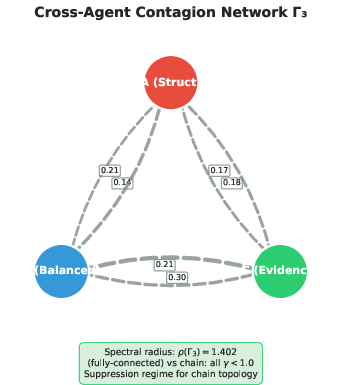
Figure 1: Cross-agent contagion network Γ3 (mean over n=2 seeds); all edges indicate the suppression regime for chain topology.
- Under chain topology, cumulative propagation attenuates rapidly (γi→j0), with each hop substantially below the cascade threshold γi→j1, confirming the suppression regime.
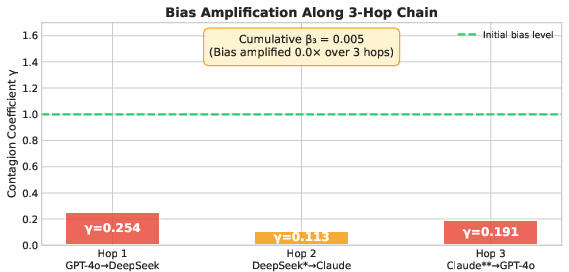
Figure 2: Per-hop contagion coefficients along the 3-agent chain, demonstrating near-complete attenuation after three hops, consistent with suppression.
- The suppression regime is robust: homogeneous-model systems exhibit 3–5γi→j2 weaker contagion than cross-model settings (as previously reported in MM-EPC), implicating model architecture and training as implicit regularization mechanisms.
- Evaluator committee diversity is an actionable mitigation: increasing committee size from γi→j3 to γi→j4 reduces effective contagion by 72.4%, with strategy entropy γi→j5 approaching the theoretical maximum.
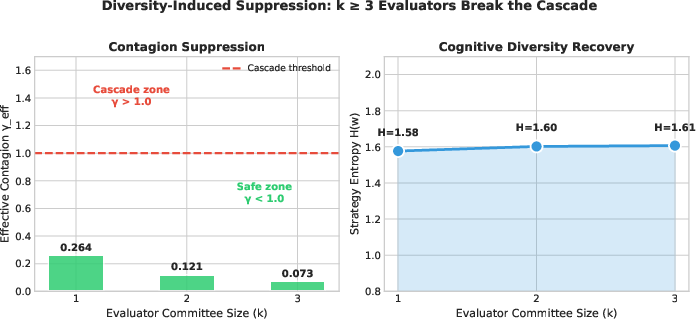
Figure 3: Diversity-induced reduction of effective contagion; effective γi→j6 decreases monotonically with committee size and strategy entropy approaches theoretical maximum.
Theoretical Implications
By extending contagion modeling to the multi-agent domain, the paper provides a quantitative bridge between isolated evaluator preference collapse and emergent network effects. The spectral radius-based regime classification is mathematically rigorous, mapping directly onto epidemiological threshold theory. The diversity-induced suppression theorem offers provable guarantees that evaluator committee heterogeneity can break potential cascade states, provided sufficient preference orthogonality and committee size.
This work also highlights topology-dependency: while chain topologies suppress propagation, fully-connected networks (with γi→j7) remain vulnerable to system-wide collapse if cross-model (or highly divergent) evaluator pools are deployed. The generalization potential to a tensor-indexed contagion matrix γi→j8 across evaluators, targets, and modalities suggests broad applicability in multi-dimensional LLM system architectures.
Practical Implications and Recommendations
Practically, the framework is immediately useful for diagnostic monitoring and mitigation in multi-agent LLM deployments:
- Prefer evaluator pools with homogeneous base models and diverse bias prompts to maintain suppression.
- Measure γi→j9 prior to deployment; topology and spectral radius directly inform the risk of bias amplification.
- Use multi-evaluator committees (i0) to maximize entropy and minimize effective contagion even within suppression regimes.
- Track real-time strategy entropy i1 as an explicit indicator of cognitive diversity and system health.
These recommendations generalize to prevalent systems such as AutoGen, MetaGPT, and ChatDev, where peer evaluation is integral to collaborative workflows yet remains a potential vector for emergent bias.
Limitations and Future Directions
The experimental scope is constrained to a single model family (DeepSeek-chat) and limited evaluator prompt granularity. The cross-model comparison relies on external MM-EPC data, highlighting the need for full-protocol replication across heterogeneous agent architectures (GPT-4o, Claude, DeepSeek) under identical conditions. Additional topology experimentation (star, ring, full mesh) and statistical robustness improvements are warranted. Extending contagion modeling beyond TTRL—for example, via parameter-efficient adaptation or in-context learning—may reveal alternative propagation mechanisms and magnitudes.
Future research should operationalize i2 monitoring in production-scale multi-agent LLM environments, directly integrating the released experimental framework and elaborating the network dynamical theory for real-world agent ensembles.
Conclusion
Contagion Networks provides a rigorous, quantitative framework for understanding and controlling evaluator bias propagation in multi-agent LLM systems. The results show that peer evaluation fundamentally forms a bias contagion network, with the magnitude and regime of propagation determined by model homogeneity, evaluator diversity, and system topology. Actionable strategies—homogeneous evaluator pools, committee diversity, and entropy monitoring—emerge from the formalism. The framework augments prior work on cross-modal contagion by generalizing to arbitrary agent graphs and task domains, laying the foundation for robust, bias-aware multi-agent LLM system design and deployment.