- The paper establishes that the effective dimension, quantified by the participation ratio of kernel eigenvalues, unifies the roles of entanglement and noise in governing model generalization.
- The paper presents evidence that quantum noise acts as a ridge-like spectral regularizer, moderating overfitting by contracting the kernel spectrum and improving test accuracy.
- The paper shows that test accuracy consistently collapses onto a single curve as a function of effective dimension across varied circuit topologies and noise regimes, supporting a unified spectral generalization law.
Spectral Regularization and Generalization in Quantum Kernel Vision Models
Introduction
This paper establishes a precise spectral principle for understanding generalization in quantum vision models, specifically those employing quantum feature maps evaluated via kernel methods. Two persistent empirical observations in quantum vision architectures—(i) improved generalization with greater or more uniform circuit entanglement, and (ii) surprising increases in test accuracy upon injection of quantum noise—are unified under the governing role of the quantum feature kernel’s effective dimension. The effective dimension, quantified by the participation ratio of kernel eigenvalues, is shown to behave as a spectral regularizer in overfitting regimes, mediating the bias–variance tradeoff and connecting entanglement, noise, and generalization.
Quantum Feature Kernel and Effective Dimension
Quantum vision models encode classical data into quantum states via parameterized circuits, resulting in a feature map ρ(x). The Hilbert–Schmidt kernel k(x,x′)=Tr[ρ(x)ρ(x′)] yields a Gram matrix with eigenvalues {λi}. The effective dimension, defined as
deff=tr(K2)(trK)2,
summarizes the concentration of the kernel's spectrum and corresponds to the ridge effective dimension in classical kernel learning theory. This quantity is central to the capacity and generalization properties of kernel classifiers.
Entanglement and Noise as Spectral Controls
Entanglement topology and quantum noise are interpreted as complementary spectral "knobs":
- Entanglement structure: Acts as a prerequisite by providing high kernel–target alignment, enabling nontrivial correlation across features.
- Quantum noise: Contracts the kernel spectrum, acting as a ridge-like regularizer, and provably reduces the effective dimension, especially under global depolarizing channels.
This principle is visualized in an overview schematic connecting quantum feature encoding, kernel computation, spectrum analysis, and classifier performance, with entanglement and noise as upstream controls.
(Figure 1)
Figure 1: Overview schematic—entanglement and noise independently regulate the effective dimension, which governs test accuracy via spectral regularization.
Quantum noise channels (depolarizing and amplitude damping) are analytically shown to filter the spectrum toward rank-one structure, reducing deff and enforcing monotonic contraction under suitable conditions.
Empirical Evidence: Collapse onto a Single Spectral Curve
The central empirical finding is that across distinct entangled circuit ansatze (chain, ring, all-to-all), test accuracy as a function of deff collapses onto a single curve, regardless of whether deff is manipulated via circuit topology or noise injection. This convergence is conditional on sufficient entanglement (kernel–target alignment), and is not observed for unentangled (product) maps, which exhibit low alignment and spectral factorization.
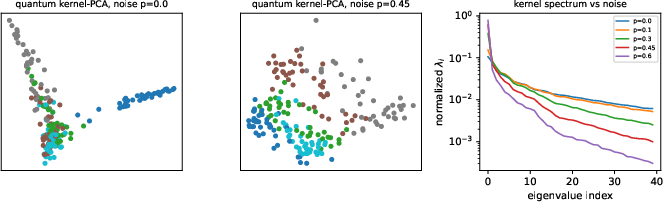
Figure 2: Noise reshapes the quantum feature geometry—quantum kernel-PCA embeddings visualize contraction of the feature spectrum with increasing noise.
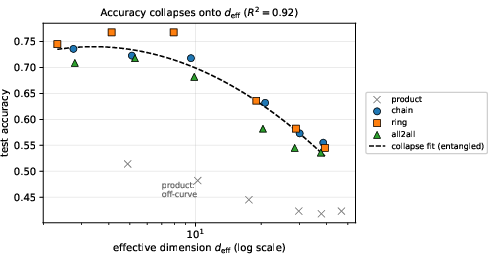
Figure 3: Across a 4×6 grid (entangling topology × noise level), accuracy collapses onto a single function of deff.
Noise-Induced Regularization: Inverted-U and Sign Flip
Amplitude damping and depolarizing noise systematically contract k(x,x′)=Tr[ρ(x)ρ(x′)]0, reduce training accuracy (i.e., memorization), and increase test accuracy—characteristic of ridge-like regularization in classical overfitting regimes. The regularization benefit exhibits an inverted-U dependence: excess noise eventually destroys signal-carrying eigen-directions, reducing generalization. The magnitude of the improvement grows with the severity of overfitting (fraction of corrupted labels), and the optimal noise rate is largely invariant to label corruption fraction.
This mechanistic effect is replicated on real IBM Heron hardware: device noise contracts the spectrum and increases test accuracy on overfitting tasks.
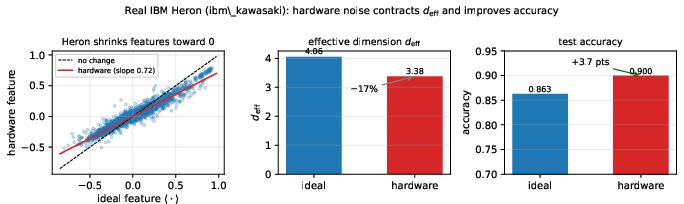
Figure 4: On IBM Heron hardware, intrinsic device noise contracts k(x,x′)=Tr[ρ(x)ρ(x′)]1 and improves test accuracy—demonstrating noise-as-regularization in practice.
The predicted sign flip is observed: in overfitting regimes, spectral contraction via noise increases generalization, while in underfitting regimes, the identical operation diminishes test accuracy.
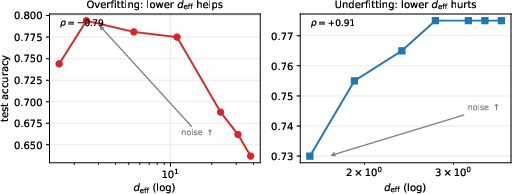
Figure 5: The k(x,x′)=Tr[ρ(x)ρ(x′)]2–accuracy relation reverses between overfitting and underfitting regimes—noise-induced contraction benefits test accuracy only when the model overfits.
Robustness: Datasets, Architectures, and Training
The principle persists across multiple benchmarks (Digits, Fashion-MNIST, BloodMNIST), circuit depths, and widths, as well as in trained quantum vision transformers and quantum convolutional models. When kernel alignment is high, the effective dimension is the dominant predictor of generalization, with minimal dependence on the specifics of circuit topology or noise channel.
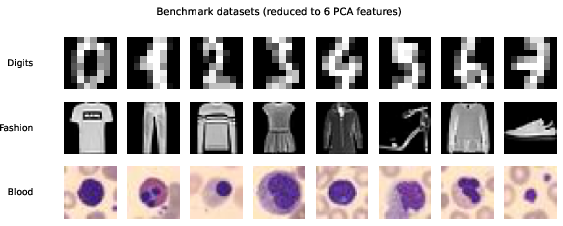
Figure 6: Representative images from Digits, Fashion-MNIST, and BloodMNIST—quantum feature maps constructed from PCA-reduced vision data.
Practical and Theoretical Implications
The spectral account transforms entanglement and quantum noise from ad-hoc hyperparameter heuristics into measurable, controllable design handles. Selection of the optimal noise level can be performed label-free based on training data alone, reducing computational search. On classical data with quantum kernels, noise acts on the spectrum directly and cannot be substituted by SVM regularization alone. The effective dimension is not a universal sufficient statistic; kernel–target alignment and spectral shape remain essential, especially in the empirical cross-ansatz collapse.
This framework opens avenues for principled quantum kernel model design, leveraging entanglement and noise as spectral controls and tying quantum architecture decisions to classical learning theory. Realizing spectral regularization natively on quantum hardware is especially relevant given unavoidable device noise.
Conclusion
This work organizes previously unexplained empirical behaviors in quantum vision kernel models into a single spectral generalization law governed by the effective dimension. Entanglement acts as an alignment precondition, and noise acts as a spectral regularizer. Accuracy, within suitably entangled regimes, collapses onto a function of effective dimension, with the sign of the effect set by the data/model regime. The findings provide a predictive, theoretically grounded principle for quantum vision system design and offer transferable diagnostics to classical kernel learning.