- The paper demonstrates that DFT-trained MACE NNPs accurately replicate the octahedral hydration, realistic diffusion coefficients, and dissociative water-exchange mechanism in aqueous Mg2+ solutions.
- The paper employs active learning and transition path sampling to iteratively refine NNPs, effectively sampling rare-event configurations that challenge classical force fields.
- The paper reveals that while NNPs capture structural and dynamic details with high fidelity, they significantly underestimate absolute solvation free energy due to missing long-range electrostatics.
DFT-Trained Neural Network Potentials for Aqueous Mg2+: Structural, Thermodynamic, and Kinetic Benchmarks
Introduction and Motivation
The accurate simulation of Mg2+ in aqueous environments remains a persistent challenge within biomolecular modeling. Conventional classical force fields are unable to simultaneously reproduce key structural, thermodynamic, and kinetic properties of Mg2+ solutions, a deficiency linked to omission of quantum many-body phenomena such as polarization and charge transfer. The adoption of machine-learned interatomic potentials, specifically neural network potentials (NNPs) trained on density functional theory (DFT) references, offers a systematic approach to bridging the gap between electronic structure accuracy and practical time/length scales. This paper addresses the capability of DFT-trained MACE NNPs to reproduce structural, kinetic, and thermodynamic solution properties of aqueous MgCl2, using functionals revPBE-D3/zd and revPBE0-D3/zd, with benchmarking against experiment and conventional force fields (2606.20105).
NNP Development, Iterative Training, and Validation
The authors employ the MACE architecture, an equivariant message-passing neural network, to develop NNPs for MgCl2/water based on AIMD trajectories generated with both GGA and hybrid DFT references. The data-driven iterative refinement ensures that rare-event configurations, particularly those related to water exchange in the first hydration shell, are effectively sampled and represented. Active learning strategies were critical to improving NNP transferability and accuracy in high-free-energy and transition-state regions, as validated by force/energy comparisons against DFT targets and by agreement with AIMD-derived potentials of mean force.
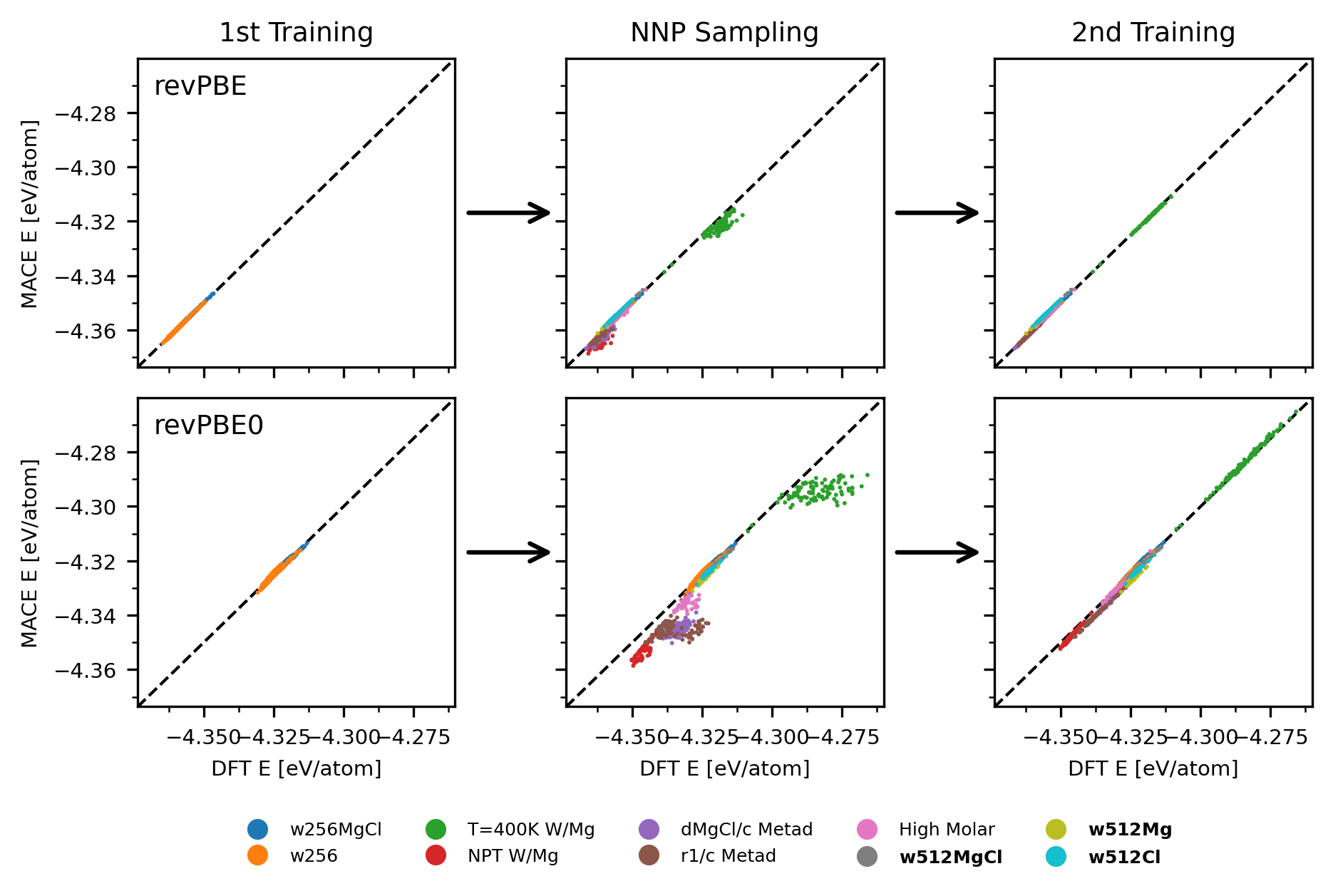
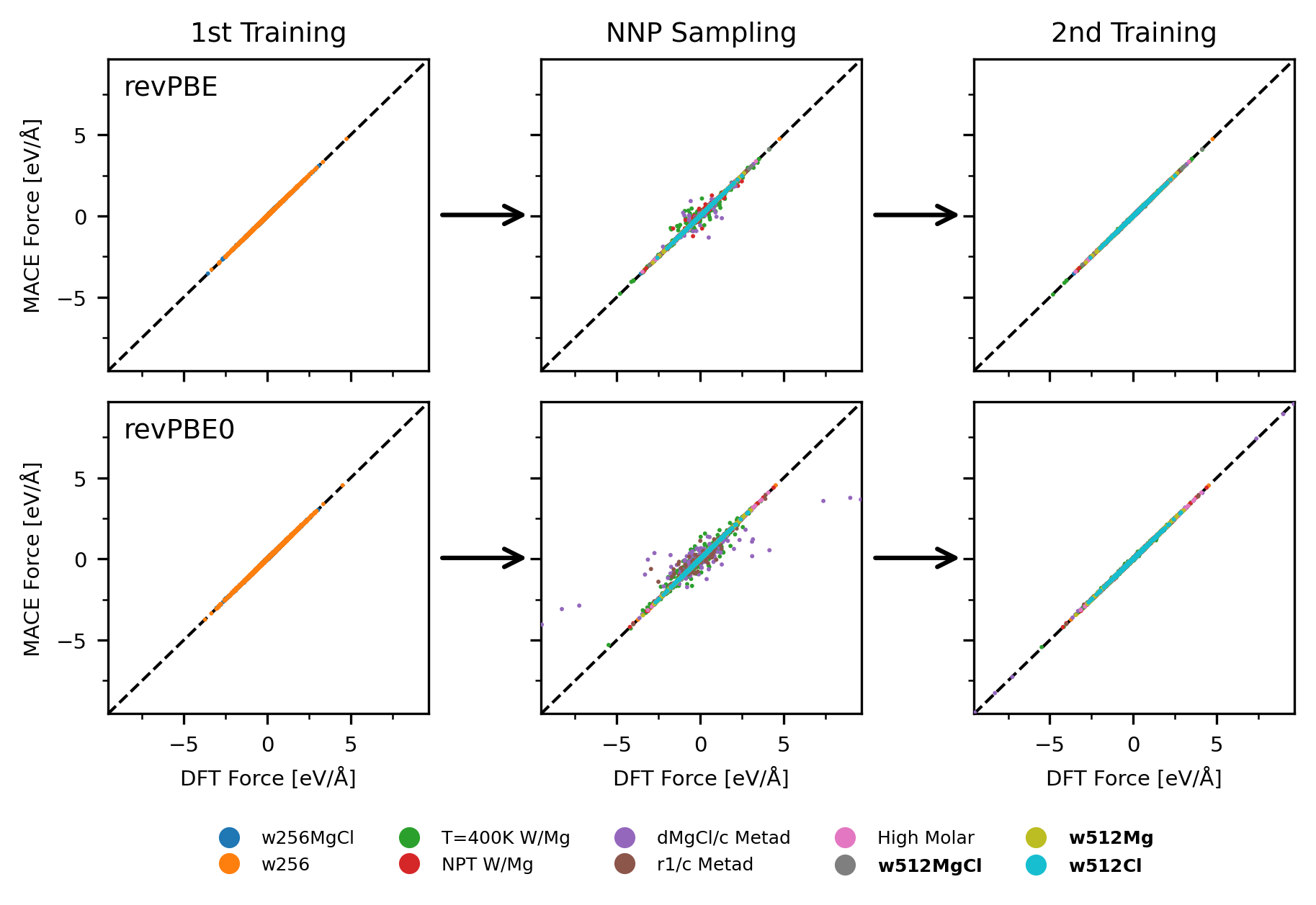
Figure 1: DFT-predicted energies per atom and force components are robustly predicted by MACE NNPs across both revPBE and revPBE0 across test, equilibrium, and enhanced sampling domains.
Hydration Shell Structure and Self-Diffusion
Structural analysis reveals that both revPBE-D3/zd and revPBE0-D3/zd NNPs accurately reproduce the octahedral six-coordinated hydration shell of Mg2+, with predicted Mg–O distances (0.211/0.206 nm) falling within the experimental interval (0.209 ± 0.004 nm). Coordination numbers from simulation consistently yield n1=6. Diffusion coefficients for Mg2+ are also tightly matched to experiment (0.75×10⁻⁵ cm2/s for revPBE-D3/zd vs. 2+0 cm2+1/s experimental), confirming that NNPs trained on suitable functionals capture realistic transport dynamics. However, revPBE0-D3/zd produces a lower value and reduced mobility, indicating persistent sensitivity to exchange-correlation functional choice.

Figure 2: Structural, dynamic, thermodynamic, and kinetic properties compared across NNPs, classical force fields, and experiment for aqueous Mg2+2.
Water Exchange Kinetics and Mechanism
Classical force fields historically fail to reproduce both rate and mechanism of water exchange for Mg2+3, typically overconstraining the hydration shell and missing the correct dissociative pathway. The present work employs transition path sampling (TPS) and transition interface sampling (TIS) leveraging the NNPs, capturing microsecond-timescale rare events and probing the exchange pathway and rate constant directly from unbiased dynamical trajectories. Both NNPs yield a dissociative exchange mechanism, as evidenced by two-dimensional free energy landscapes along Mg–O distance and coordination number and trajectory analysis.
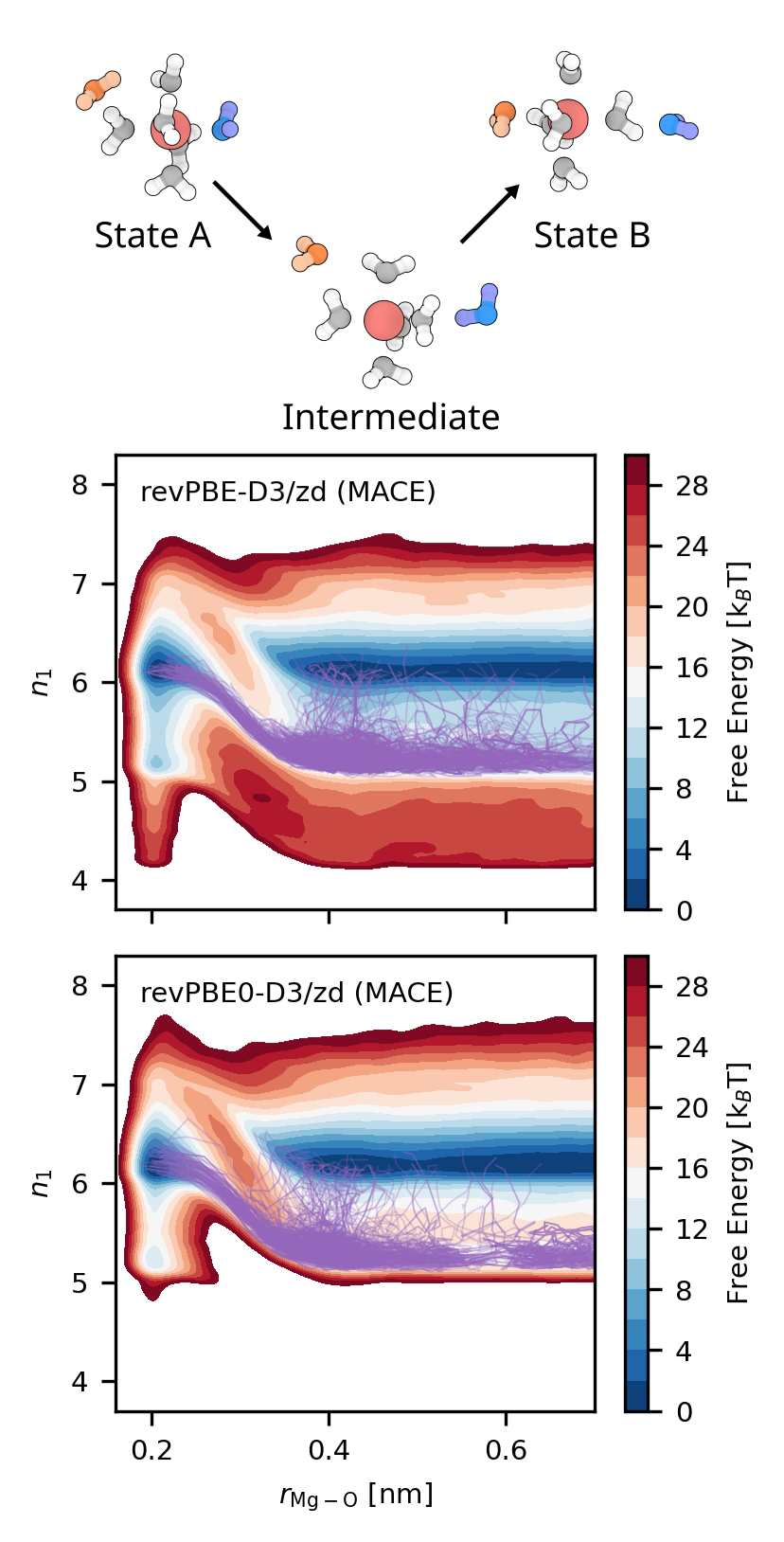
Figure 3: Schematic and free energy landscapes demonstrating dissociative water-exchange mechanism for Mg2+4 observed via TPS.
Exchange rates obtained from TIS are 2+5 s2+6 (revPBE-D3/zd) and 2+7 s2+8 (revPBE0-D3/zd), bracketing the experimental rates (2+9–2+0 s2+1) within an order of magnitude. This is a substantial advancement over classical dissociative force fields, which underestimate rates by four orders of magnitude.
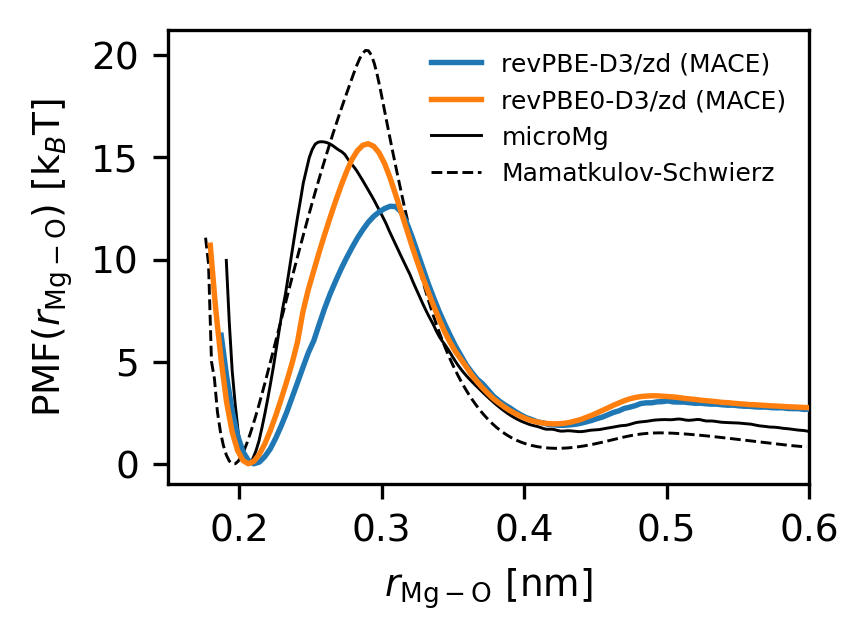
Figure 4: Potential of mean force as a function of Mg–O distance, contrasting NNPs and classical force fields reveals elevated barriers for revPBE0-D3/zd.
Ion Pairing and Activity Derivatives
Ion pairing propensities, quantified via Mg2+2–Cl2+3 radial distribution functions and activity derivatives, show that NNPs do not yield stable inner-shell ion pairs and instead produce solvent-shared associations, matching experiment. Thermodynamic activity derivatives at 1.08m salt concentrations align with experimental benchmarks and classical force fields.
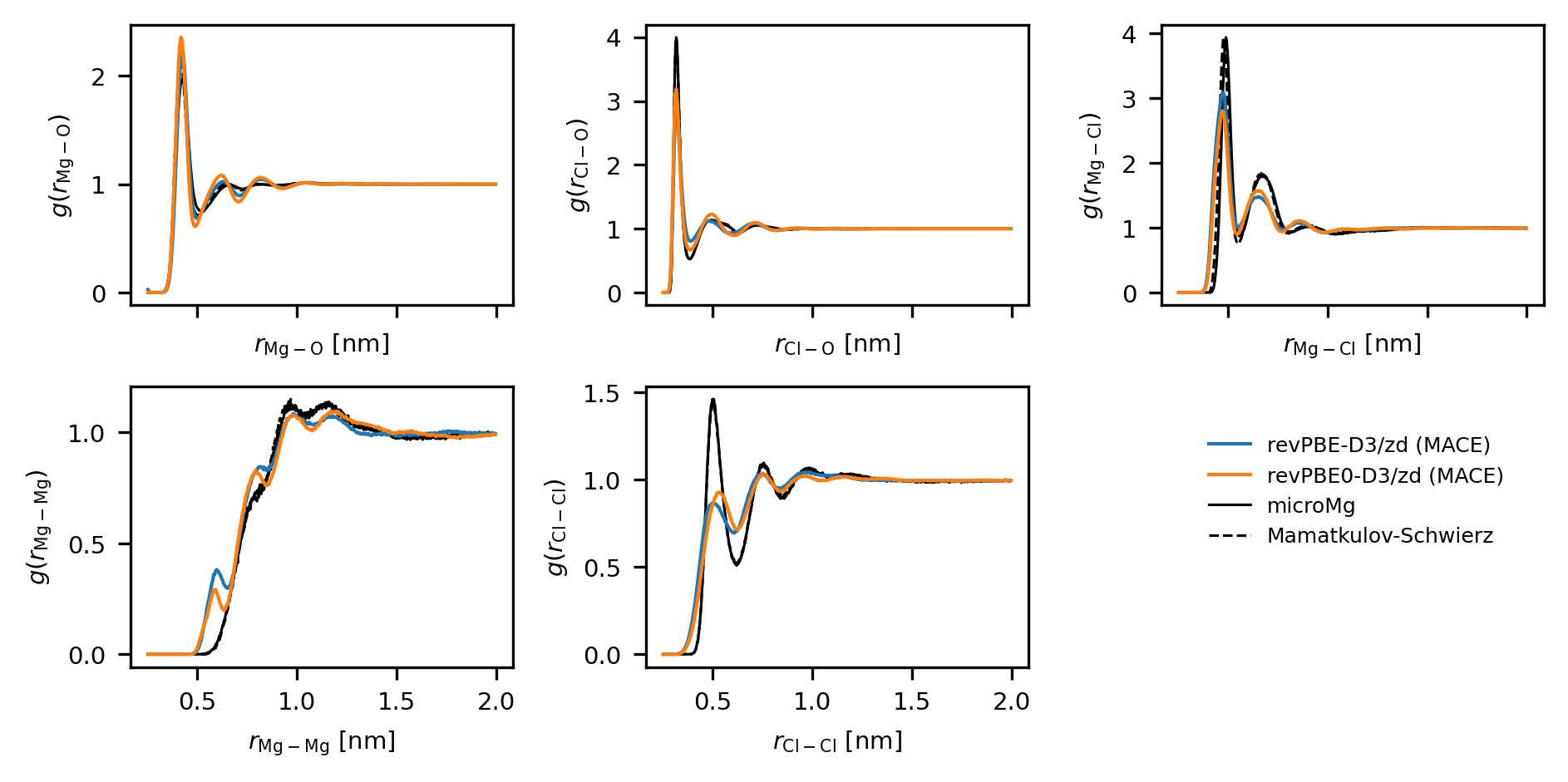
Figure 5: RDFs for Mg–Cl and Mg–water validate that NNPs reproduce correct solvent-shared pairing and water coordination across concentrations.
Solvation Free Energy Limitations
Despite success in structural and kinetic domains, both NNPs fail to reproduce the absolute ion solvation free energy, underestimating experiment by more than 1500 kJ/mol (2+4 to 2+5 kJ/mol for NNP vs. 2+6 kJ/mol experimental). The authors attribute this shortcoming to the absence of explicit long-range electrostatic treatment in the local NNP architecture, further aggravated by issues related to charge transfer and dielectric response in periodic simulation boxes.
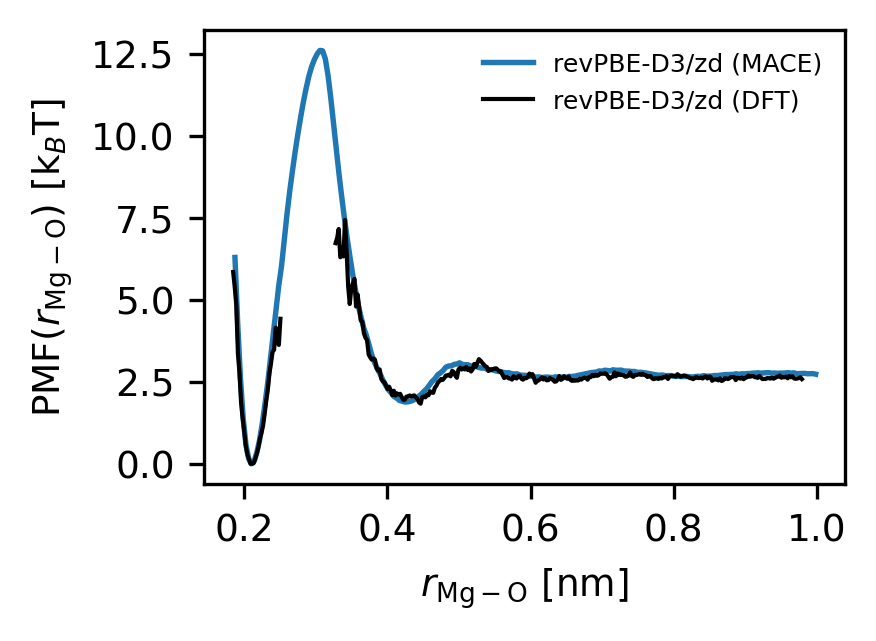
Figure 6: NNP and AIMD potentials of mean force exhibit strong consistency in well-sampled regions, reinforcing structural accuracy.
Implications, Theoretical Perspectives, and Future Directions
This comprehensive benchmarking demonstrates that DFT-trained NNPs can replicate a wide spectrum of structural and dynamical properties for Mg2+7 in water, including hydration shell metrics, diffusion, ion pairing, and correct dissociative water-exchange kinetics. However, it exposes a strong contradiction in their inability to accurately predict solvation thermodynamics. The results highlight the necessity of incorporating explicit long-range interactions, global charge states, and charge-equilibration into NNP descriptors. Theoretical progress in developing NNPs capable of variable charge, long-range electrostatics, and explicit charge transfer is required to resolve these issues. This will be important for application of NNPs to dilute ionic solutions, biomolecular simulations, and systems where dielectric response is critical.
Conclusion
DFT-trained MACE neural network potentials for Mg2+8 aqueous solutions systematically reproduce structural, kinetic, and dynamic properties while failing to capture solvation thermodynamics quantitatively. The dissociative water-exchange mechanism and realistic rates are predicted, in agreement with experiment, marking a significant advance over classical force field approaches. Results underscore the importance of rigorous benchmarking against experiment and expose persistent limitations of local NNP architectures, motivating future development to include robust long-range electrostatics and charge-resolved descriptors for accurate thermodynamics. The paper sets new standards for NNP validation in electrolyte modeling and guides advancements toward next-generation machine-learned force fields for biomolecular and condensed-phase systems.