- The paper demonstrates that dynamic electron screening modulates the water–carbon π bond, evidenced by the suppression of antisymmetric IR stretching modes.
- It contrasts empirical force fields with ML-based potentials, showing that ML models more accurately capture electron polarization and free energy landscape details.
- The study highlights isotopic effects that validate the role of electron dynamics, paving the way for improved modeling of hydration at aromatic interfaces.
Introduction and Context
The nature of intermolecular interactions between water and aromatic π systems has far-reaching implications across chemistry and materials science, from biomolecular stability to heterogeneous interface phenomena. However, the quantification and mechanistic insight into the so-called water-π bond, especially its dynamical and spectroscopic manifestations, remain elusive due to the inherent weakness and complexity of these noncovalent forces. The study "Electron dynamics mediate the water-carbon π bond" (2604.03464) directly addresses these challenges through a synergistic application of gas-phase ion cluster spectroscopy, isotope editing, and state-of-the-art ML potential energy and dipole moment modeling.
Experimental System and Isotope Labeling
The work centers on mass-selected clusters comprising a single pyrene anion (Pyr−) and one water molecule, with further isotopic substitution (H2O, D2O, HOD) to dissect vibrational and electron-nuclear contributions. The use of argon-tagged predissociation action IR spectroscopy at cryogenic temperatures delivers high spectral resolution and circumvents condensed-phase broadening, enabling unambiguous interrogation of the water-π bond under well-characterized conditions.
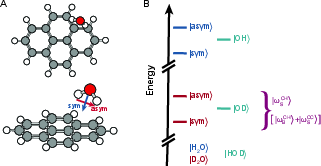
Figure 1: Structure and energy level diagram for the vibrations of anionic pyrene monohydrate clusters and their isotopologues, illustrating vibrational mode symmetries and energetic separation.
This isotopic control exploits the invariance of the electronic potential under the Born-Oppenheimer approximation, providing a unique means to disentangle electron dynamics from pure nuclear mass effects. Deuteration systematically red-shifts vibrational frequencies and narrows linewidths via slower nuclear motion, without directly affecting electronic structure.
Empirical versus Machine-Learned Potentials: Structural and Dynamic Consequences
Two contrasting computational paradigms are rigorously evaluated: (i) empirical force fields built from fixed charge assignment and established water models (TIP4P/2005 + DREIDING), and (ii) ML interatomic potentials (specifically, MACE—Message Passing Neural Networks for Atomistic Chemical Environments), trained on DFT data for flexible and charge-independent interaction representation.
The empirical point-charge approach yields a rigid, skeletal electrostatic landscape on the π system, with limited configurational options for the hydration site. In stark contrast, the MLIP constructs a highly delocalized electron density profile, fundamentally altering the topography of the free energy landscape.
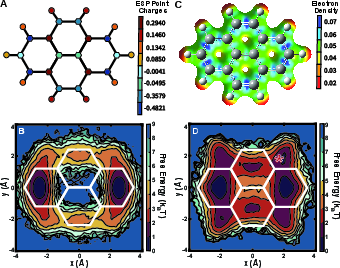
Figure 2: Free energy surfaces of water migration on the pyrene anion, contrasting empirical point charge and ML electron density models, and revealing markedly enhanced mobility and additional basins with the MLIP.
Numerically, the MLIP predicts lower free energy barriers between hydration basins and detects a "butterfly" motif of four discrete minima absent from the empirical model, implying drastically increased surface mobility for water. These features are consequences of the breakdown of the multipole approximation at short range and the need to correctly describe π electron polarization and electronic softness.
Vibrational Spectroscopy: Electron Dynamics and Image Dipole Effects
A central quantitative result of the paper involves the analysis of IR spectra for the various isotopologues, compared against both model predictions. The experimental data exhibit a pronounced suppression of the antisymmetric OH (and OD) stretching modes—an effect anomalous when considered in the context of isolated water, where the antisymmetric stretch is typically dominant.
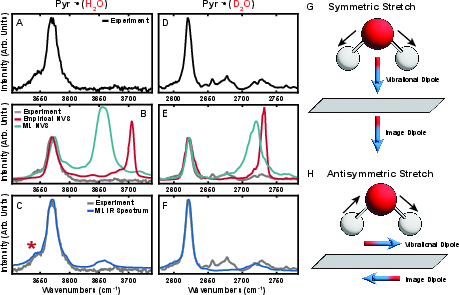
Figure 3: IR spectra of Pyr−⋅H2O and Pyr−⋅D2O clusters: empirical and ML vibrational models fail to suppress the antisymmetric stretch, whereas full ML dipole models incorporating electronic dynamics closely match experiment.
Neither the empirical nor the vibrational-only ML models can capture this intensity quenching; both erroneously predict strong antisymmetric stretches with comparable or greater intensity than the symmetric mode. Only the ML dipole model, which includes dynamic electron response along the MD trajectory, faithfully reproduces the experimental suppression. This strongly supports a mechanism dominated by electronic screening, specifically an image dipole effect formed by induced polarization of the π electron cloud.
The alignment of the water symmetric stretch transition dipole normal to the aromatic plane couples constructively with the image dipole, amplifying the IR activity, whereas the antisymmetric stretch, oriented primarily in-plane, is destructively quenched. This represents a direct, molecular-scale analog of classical electromagnetic image dipole effects near conductive surfaces.
Isotope Effects and Mode Splitting in HOD Complexes
Isotopologue-resolved measurements with HOD further support the electrodynamic screening hypothesis. Isotopic substitution splits the vibrational manifold into distinct OH and OD local modes, each displaying a doublet structure reflecting transiently "bound" and "free" oscillator environments.
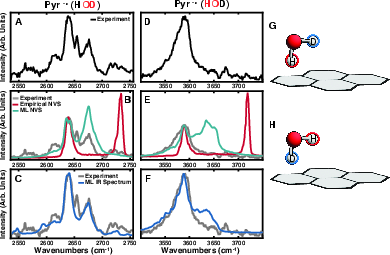
Figure 4: IR spectra of Pyr−⋅HOD, showing experimental and theoretical (empirical, ML, ML-dipole) results for OD and OH stretches, with doublets and intensity patterns only reproduced by full ML electronic models. Geometrical illustrations clarify orientation-selective dipole coupling.
The "blue" (higher frequency) component of each doublet is associated with vibrations less engaged in the π-bond and thus more parallel to the aromatic surface. Consistent with the electrodynamic model, these are selectively suppressed in intensity, a feature quantitatively captured only by ML-based dipole calculations. The correspondence is stronger for OD than OH modes, attributed to improved theoretical convergence for lower-frequency vibrations.
Theoretical and Practical Implications
The study demonstrates that electronic dynamics—specifically non-instantaneous polarization of conjugated π electrons—are essential for an accurate description of water-π bonding and its vibrational signatures. Fixed-charge models, while often satisfactory for structural energies and bulk phase modeling, fundamentally misrepresent the IR activity of key vibrational modes and cannot account for coupling between electron and vibrational dynamics. This has strong implications for the interpretation of spectroscopic data, force field design, and ab initio molecular dynamics in noncovalent complexes.
The results analogize familiar macroscopic electrodynamic phenomena (e.g., the Chance-Prock-Silbey theory for radiative decay near interfaces) to the molecular scale, emphasizing that electronic fluctuation and image dipole concepts are not confined to metallic or macroscopic surfaces.
Practically, these findings are highly relevant for modeling hydration at graphitic and aromatic interfaces, with possible repercussions for understanding hydrophobicity, wetting dynamics, and bio-macromolecular recognition. Subtle electrodynamic effects, largely invisible in conventional force fields, may become dominant at watery-carbonic boundaries or under nanoconfinement.
Future Prospects
The integration of ML potentials with dynamic dipole inference represents a paradigm shift for molecular simulation, particularly in weakly bound and dynamically rich systems. With increased accessibility to methods like MACE, future developments may target:
- Extension to larger aromatic systems and heterogeneous solvation environments.
- Inclusion of explicit charge transfer and nonadiabatic effects for electronically excited states.
- Improved interpretability and transferability of MLIP models across a broader chemical space.
- Systematic exploration of electrodynamic phenomena in other noncovalent complexes and at bio-material interfaces.
These directions hold promise for cross-fertilization between experimental spectroscopy, computational chemistry, and machine learning, leading towards quantitatively predictive molecular models.
Conclusion
By combining precise gas-phase ion spectroscopy, isotope labeling, and advanced ML potentials, this work elucidates the crucial role of electron dynamics in the water-π bond. The image dipole screening effect, absent in conventional fixed-charge models but emergent from dynamic ML representations, is essential for reproducing the experimental IR signatures of water-π complexes. Theoretical and practical consequences span from force field design to interfacial hydration phenomena, highlighting a fundamental shift in our understanding of noncovalent interactions where electronic and vibrational degrees of freedom are inextricably coupled.
(2604.03464)