- The paper establishes that finite-density cores in low-mass halos produce measurable wave-optics distortions in LISA-band gravitational waves.
- The analysis employs both NFW and cored-NFW profiles, using full pipeline simulations to quantify diffraction and frequency-domain effects.
- The study reveals that observable mismatches occur for near-aligned, massive halos, emphasizing the need for refined models in gravitational lensing.
Finite-Core Effects in Wave-Optics Lensing of LISA-Band Gravitational Waves by Low-Mass Dark Matter Halos
Overview and Motivation
This paper establishes a technically rigorous baseline for the generic imprint of finite-density cores in low-mass dark matter halos on the diffractive lensing of gravitational waves from massive binary black holes (MBHB) in the LISA frequency band. The central concern is the differentiation between cuspy (Navarro-Frenk-White, NFW) and cored density profiles, a point of longstanding debate in dark-matter astrophysics. By focusing on fixed total virial mass comparisons, the authors isolate effects on the inner halo structure, decoupling wave-optics lensing signatures from trivial global mass rescaling. They propagate both NFW and cored-NFW profiles through the full pipeline—from halo density to detector-level waveform mismatch—quantifying the spectral distortion and its detectability. Additionally, an SIDM-inspired isothermal-core (IC-NFW) cross-check demonstrates the generic nature of the finite-core effect.
The authors model low-mass (106–109 M⊙) halos or subhalos as gravitational lenses for LISA-band GWs. All computations are performed in dimensionless variables, including impact parameter y and frequency w=8πGMLzf/c3. For diffractive lensing signatures (w∼1), the primary sensitivity is to structures in the inner halo.
The cored-NFW profile is parameterized as:
ρcNFW(r;q)=(r/rs+q)(1+r/rs)2ρ0(q),q=rc/rs
with mass normalization fixed to match the NFW virial mass, ensuring variations in F(w) are due to central mass redistribution rather than total mass. An IC-NFW profile, motivated by SIDM simulations, provides an independent cross-check on the phenomenological baseline.
Transfer Function Modifications: Response-Level Analysis
A systematic comparison of convergence, lensing potential, time-domain diffraction integral, and frequency-domain amplification factor exposes the morphological imprint of a finite core.
The convergence profiles show pronounced suppression and flattening for cored halos relative to NFW:
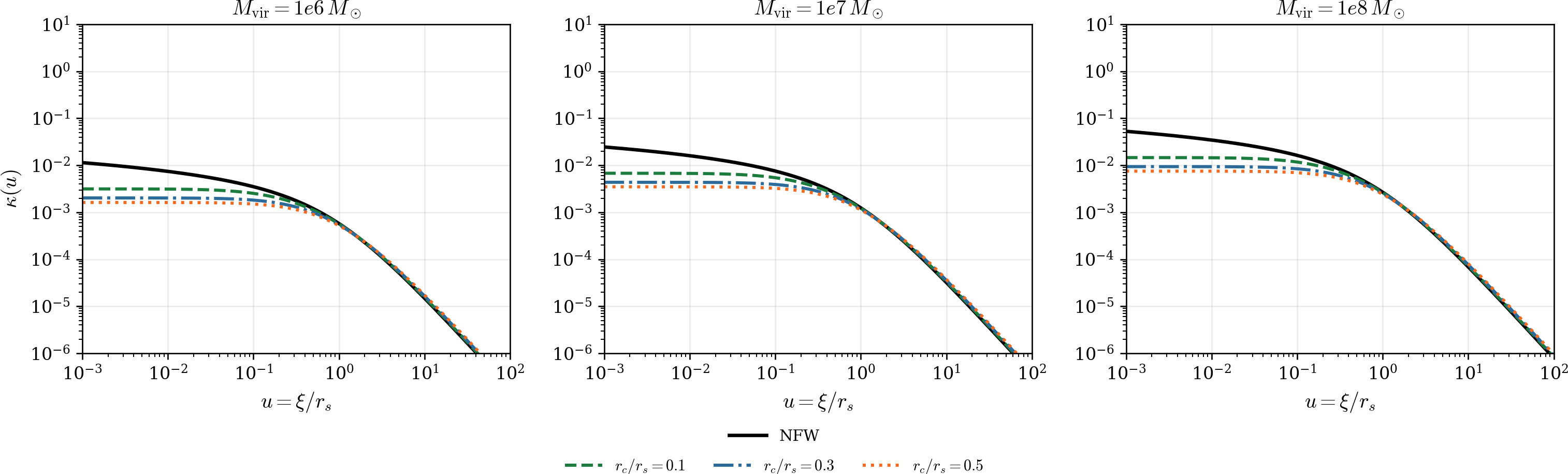
Figure 1: Convergence κ(u) for NFW and cored-NFW halos, visualizing core-induced suppression for varying rc/rs.
Alterations in the lensing potential are similarly localized to the inner halo region:
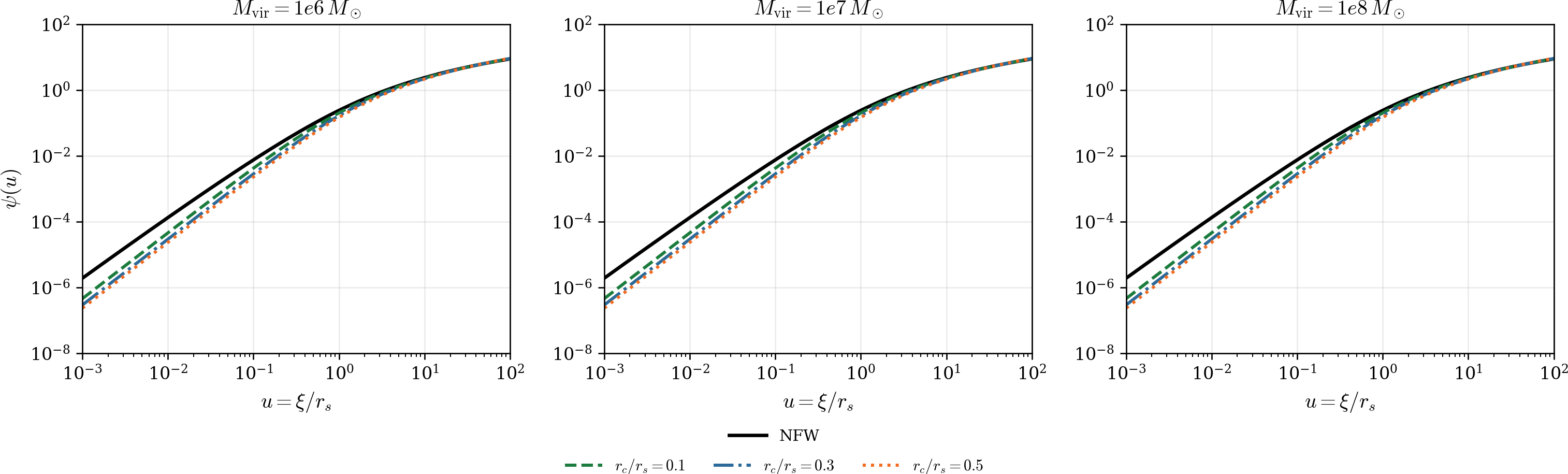
Figure 2: Lensing potential ψ(u) for identical mass halos; a finite core produces a shallower central potential.
The time-domain diffraction integral 109 M⊙0 demonstrates that finite cores broaden and lower the response, most distinctly at small impact parameters:
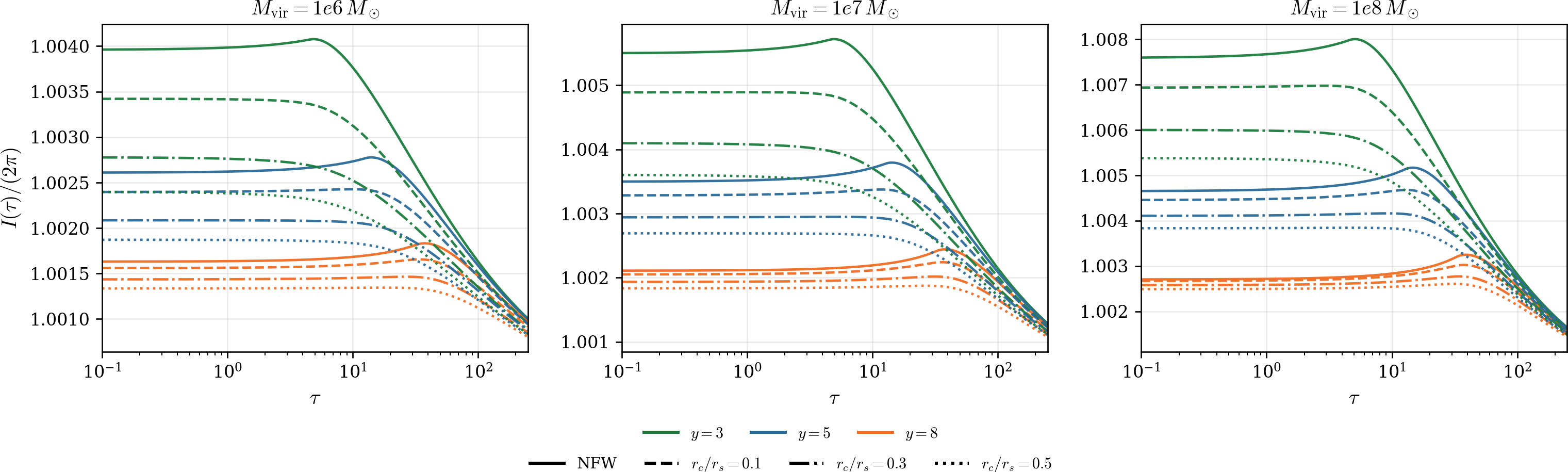
Figure 3: Time-domain diffraction integral 109 M⊙1 for NFW and cored-NFW halos; core-induced smoothing is strongest for small 109 M⊙2.
The frequency-domain amplification factor captures the transfer-function distortion central to GW lensing analysis. Finite cores suppress and reshape the diffraction peak and subsequent oscillatory structure:
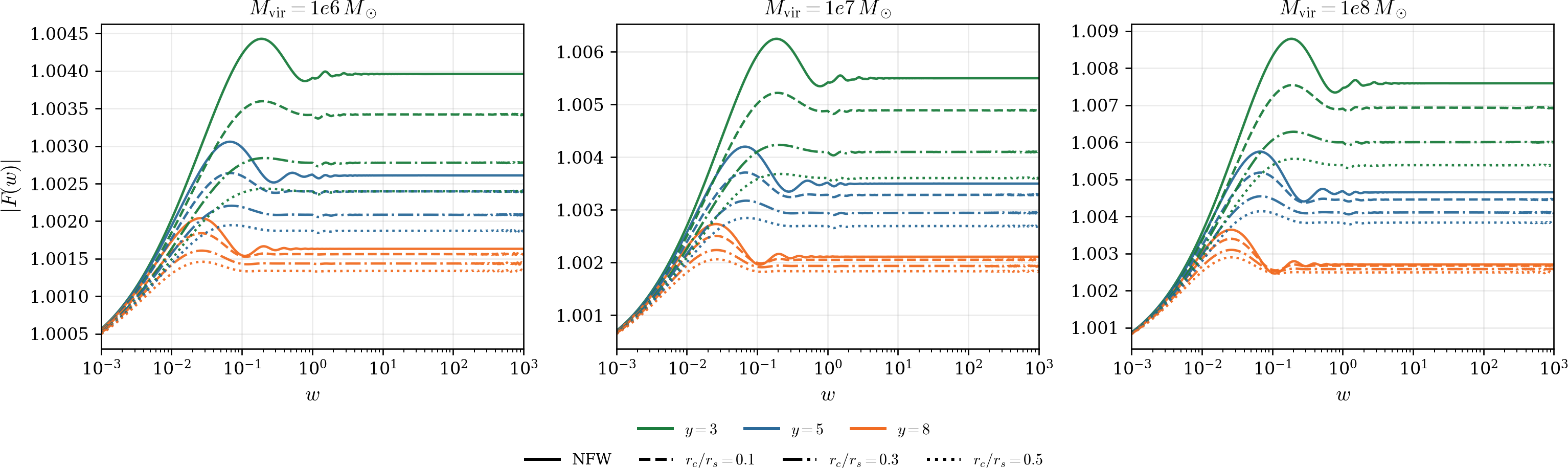
Figure 4: Frequency-domain amplification factor 109 M⊙3 for NFW and cored-NFW halos; the effect is most prominent for small 109 M⊙4 and large 109 M⊙5.
The IC-NFW profile results, provided as an SIDM-motivated cross-check, confirm the qualitative robustness of these effects:
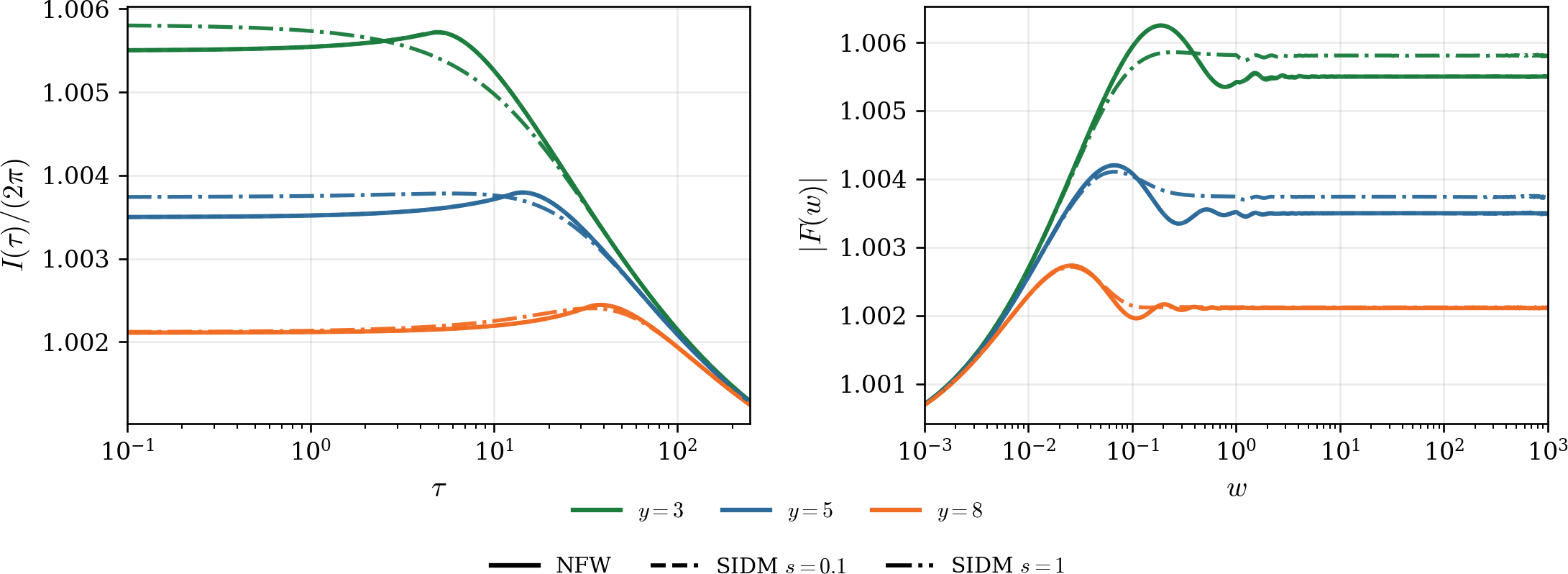
Figure 5: SIDM-inspired IC-NFW comparison; both 109 M⊙6 and 109 M⊙7 deviate from NFW when an isothermal core extends to 109 M⊙8.
Template Degeneracies and Residual Analysis
A quantitative template-fitting exercise is performed: a cored-NFW "truth" signal is fit using NFW templates with varying concentration (109 M⊙9) and impact parameter (y0). The minimum residual is localized, indicating incomplete degeneracy. The best-fit NFW template generally adopts a lower concentration to mimic the cored profile, but structured residuals remain, especially in the diffractive regime.
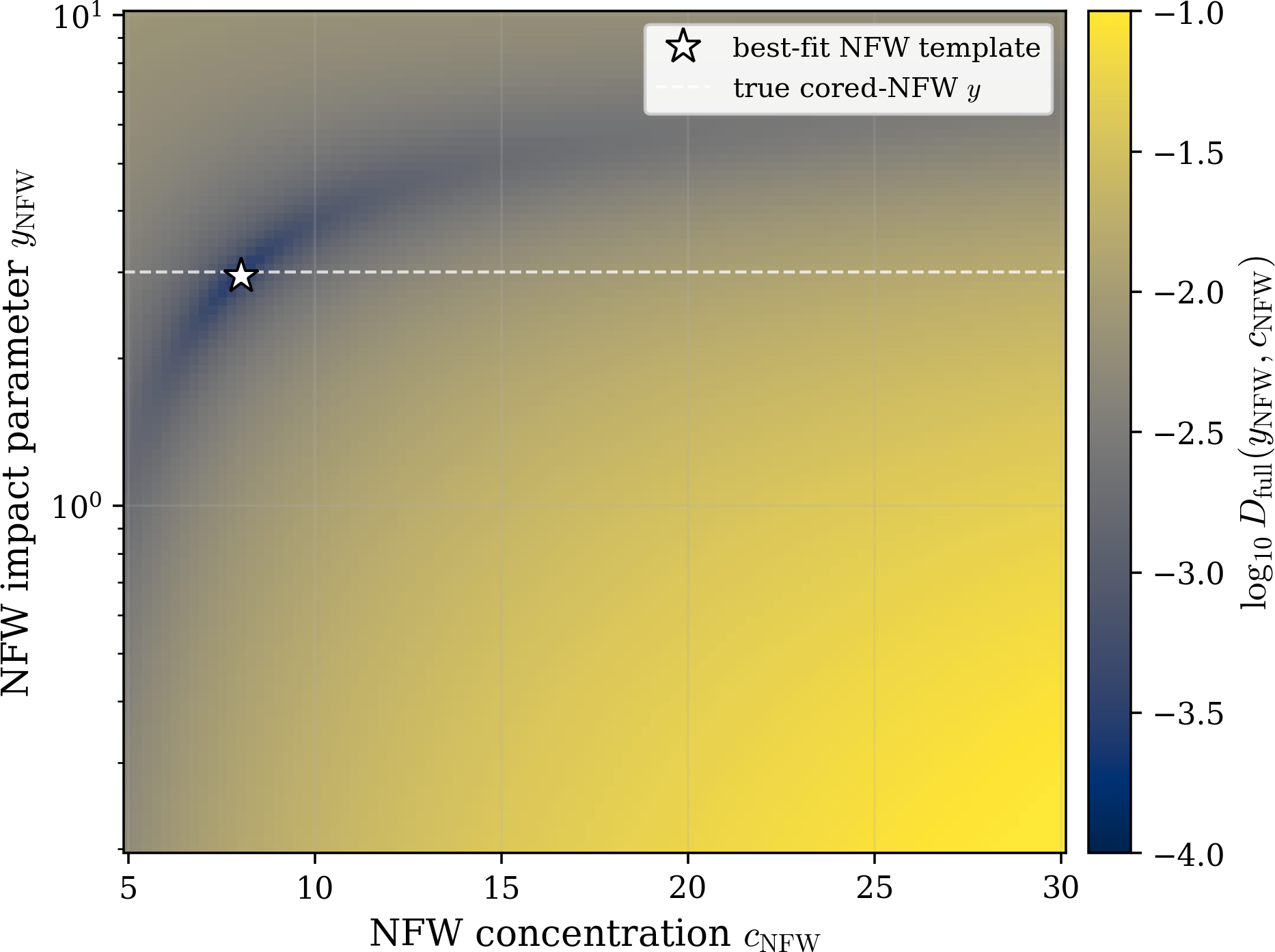
Figure 6: Template-fitting residual in the y1-y2 plane; degeneracy is partial and localized.
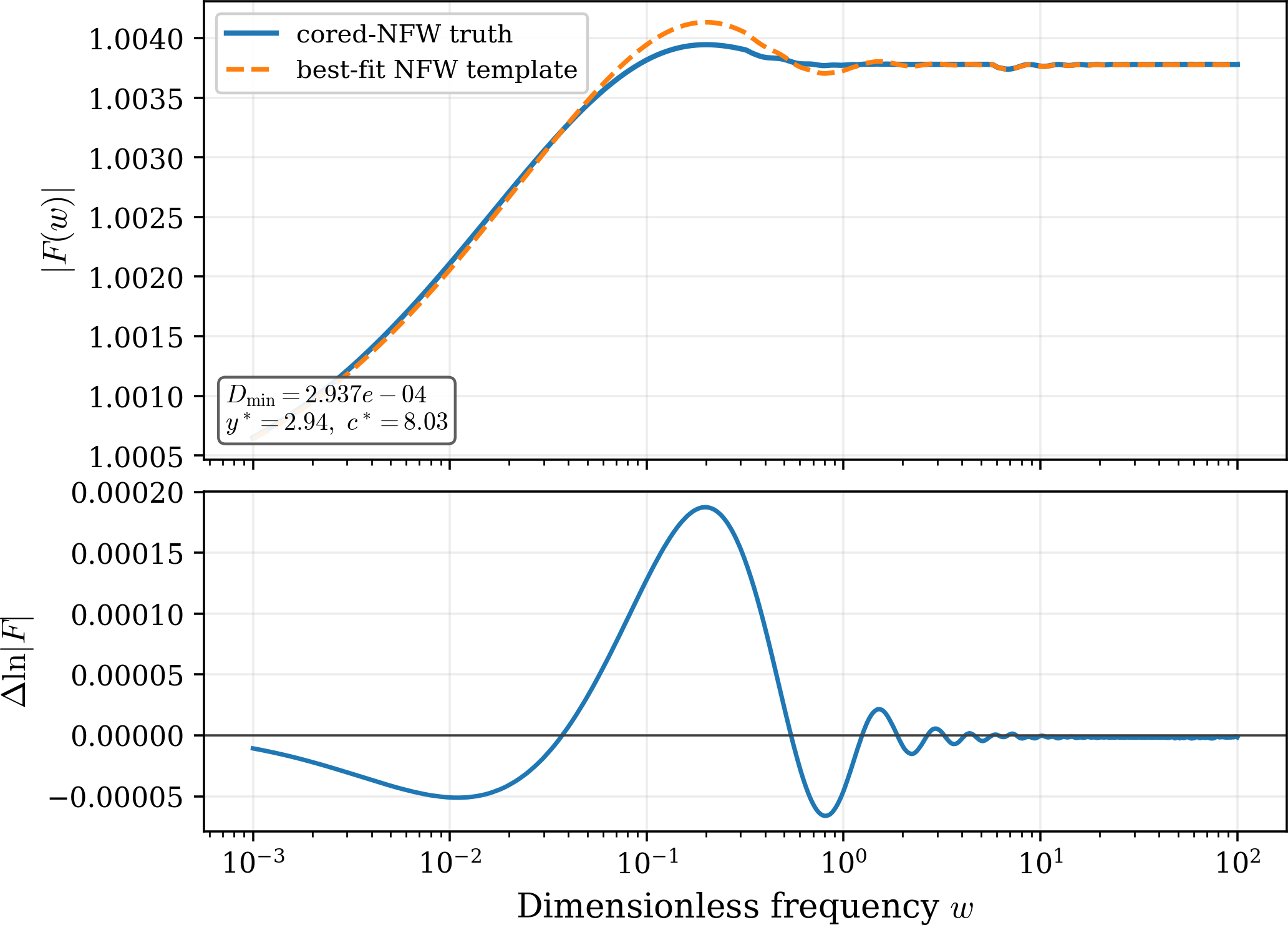
Figure 7: Best-fit NFW template versus cored-NFW truth; structured residuals persist around the diffraction transition even after alignment.
A scan over y3 shows that distinguishability peaks around y4–y5, with decreasing residuals for larger core sizes as the transfer function becomes smoother and more easily mimicked by low-concentration NFW templates.
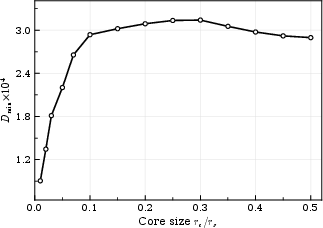
Figure 8: Minimum NFW-template residual y6 as a function of y7; distinguishability is maximized for intermediate core size.
A formal NFW recovery test confirms that the cored-NFW profiles approach NFW in the y8 limit.
Detector-Level Relevance: LISA MBHB Case Study
The mismatch between cored-NFW-lensed and unlensed waveforms is computed for a fiducial LISA MBHB (y9) using a sky-averaged noise curve. An observable distortion (w=8πGMLzf/c30) occurs only for w=8πGMLzf/c31 and small impact parameters, implying detectability is a function of favorable lens--source alignment and halo mass.
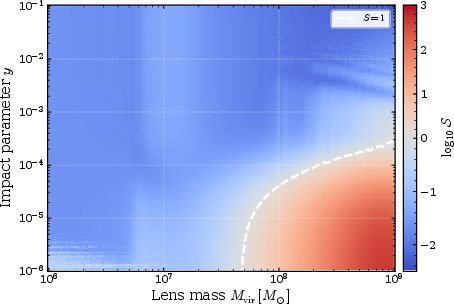
Figure 9: Detector-weighted relevance of cored-NFW lensing distortion; observable mismatch is restricted to high-mass, close-alignment parameter space.
The analysis constrains the cross-section for detectable finite-core-induced lensing distortions in isolated-halo and strongly lensed macro-image scenarios, emphasizing the necessity for precise modeling of macro-lensing, subhalo populations, and parity effects in future studies.
Conclusions
The paper rigorously demonstrates that finite-density cores in low-mass dark matter halos produce coherent, frequency-dependent distortions in LISA-band GW lensing transfer functions, distinctly modifying both amplitude and phase in the wave-optics regime. These distortions are only partially degenerate with variations in NFW concentration and impact parameter. Structured spectral residuals persist, especially for intermediate core sizes.
The detector-level analysis shows that observable distortions are expected primarily for near-aligned, massive subhalos, either in isolated line-of-sight configurations or as perturbers of strongly lensed macro-images. This finite-core baseline must be established before attributing potential GW lensing features to any specific microphysical model (such as FDM or SIDM).
Prospects for future developments include population-level analyses, machine-learning classification of lens-induced waveform distortions, and comprehensive modeling of lensing environments incorporating both cored and cuspy profiles in realistic cosmological contexts. This work provides a critical reference point for the interpretation of wave-optics lensing signals in GW surveys such as LISA.

