- The paper introduces a novel multi-strategy interrogation framework that significantly reduces Expected Calibration Error (ECE) in medical VQA.
- Experiments on three public datasets demonstrate that combining punitive and challenge prompts improves confidence alignment in various MLLM architectures.
- The study reveals a tradeoff in domain adaptation where fine-tuning for medical specificity increases accuracy but worsens calibration without proper intervention.
Confidence Calibration for Multimodal LLMs in Medical VQA
Motivation and Context
Multimodal LLMs (MLLMs) have become integral to medical decision-support systems, leveraging the synergy between textual and visual modalities for sophisticated tasks such as Medical Visual Question Answering (VQA). Clinical reliability necessitates not only high predictive accuracy but also properly calibrated confidence, as misalignment—especially overconfidence—can lead to deleterious outcomes in high-stakes environments. Prior work in calibration has focused mainly on unimodal LLMs; investigation into calibration under multimodal and medical contexts remains sparse and underspecified.
This empirical study systematically analyzes calibration properties of several state-of-the-art MLLMs on three public medical VQA datasets, introducing a novel multi-strategy calibration framework and reporting strong reductions in Expected Calibration Error (ECE). The manuscript further interrogates calibration variation as a function of domain specialization and pretraining paradigms.
Methodology
The core method proposes a Multi-Strategy Fusion-Based Interrogation (MS-FBI) workflow, combined with an auxiliary expert LLM assessment. The two-phase interrogation leverages prompt engineering to collect deeper cognitive evidence from MLLMs and applies penalty constraints to discourage overconfidence in erroneous answers.
- Initial Inquiry: The MLLM outputs both its answer and self-assessed confidence. Penalization prompts ("You will be punished if the answer is wrong but you answer it with high confidence") are designed to simulate medical decision cost structures.
- Deep Inquiry: Logical challenge and explanation-based prompts are used to elicit rebuttal and stepwise reasoning from the MLLM, probing for cognitive inconsistencies and latent error sources.
- Strategy Combination: Six modular prompt combinations—activating punishment, challenge, and explanation mechanisms—enable systematic ablation and adaptation.
Collected evidence is then templated and provided to an expert LLM for final confidence recalibration and qualitative reasoning analysis.
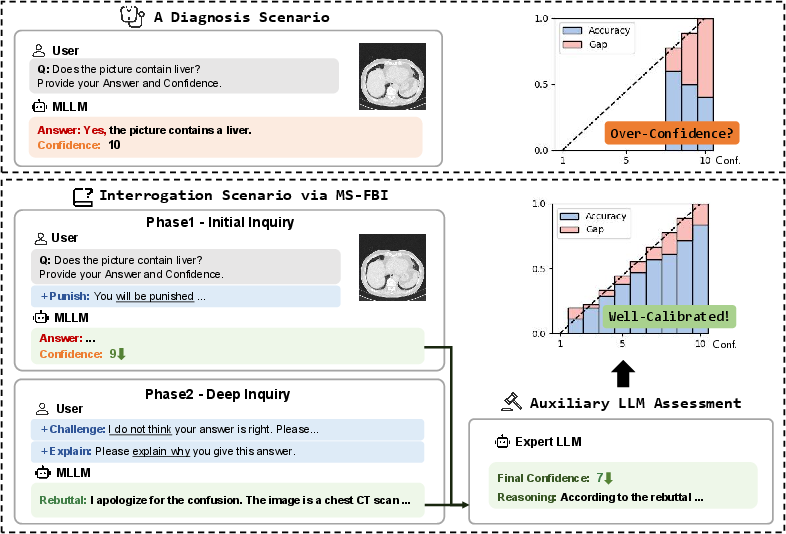
Figure 1: The MLLM initially overconfidently identifies a liver in a chest CT scan; through two-phase interrogation and LLM expert evaluation, confidence is recalibrated to more reliable levels.
Experimental Setup
Evaluation is performed on three gold-standard medical VQA datasets: Med-VQA, VQA-RAD, and SLAKE, with a focus exclusively on closed-ended questions to ensure robust confidence quantification. Four MLLM architectures are benchmarked: LLaVA-1.5-Med-Mistral-7b, LLaVA-NeXT-Mistral-7b, Molmo-7b, and MedVLM-R1, reflecting both domain-specific and general-purpose paradigms.
Calibration metrics are:
- Expected Calibration Error (ECE): Measures the absolute difference between confidence and empirical accuracy across binning partitions.
- Area Under ROC Curve (AUROC): Quantifies the ability of confidence scores to discriminate correct from incorrect predictions.
Baseline calibration strategies include Vanilla (direct verbalization), Punish (penalization prompts), and Top-K (verbalized likelihoods over k guesses).
Results and Analysis
The proposed MS-FBI + Expert LLM method demonstrates strong absolute reductions in ECE across all datasets and models, consistently outperforming baseline calibration protocols. For instance, LLaVA-1.5-med-7B exhibited an average ECE decrease from 44.28% (Vanilla) to 26.22% (MS-FBI), a relative reduction of 40.8%. AUROC also improved, indicating better discrimination between correct and incorrect predictions.
Significantly, domain-specialized MLLMs showed persistent overconfidence compared to general-purpose models. Fine-tuning on medical datasets appears to exacerbate calibration errors—a finding aligned with recent literature on SFT-induced miscalibration [ren2024sft]. This underlines a complex tradeoff in domain-adaptation, where improved task accuracy may not translate to appropriate uncertainty quantification.
Strategy ablations revealed that the combination of punishment and challenge (Pu.+Ch.) yielded optimal calibration, but the effectiveness varied by model architecture and dataset. Notably, more sophisticated strategy combinations did not always outperform simpler strategies, suggesting that overinterrogation may introduce cognitive noise.
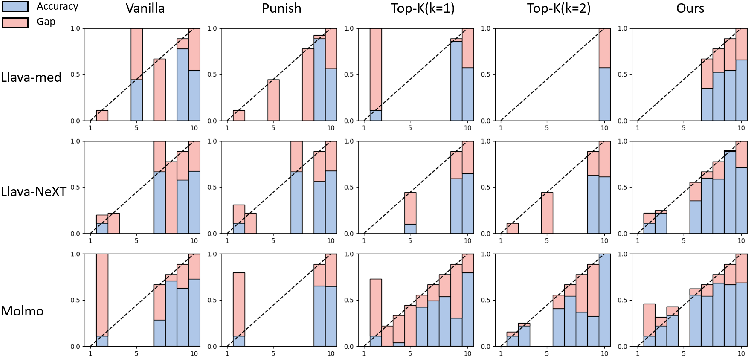
Figure 2: Visualization of confidence vs. accuracy calibration for different methods and models; MS-FBI achieves the closest alignment between confidence and accuracy curves.
Practical and Theoretical Implications
The empirical findings validate that multi-strategy interrogation—particularly when paired with expert LLM assessment—substantially enhances reliability by improving the alignment between model confidence and actual prediction accuracy. This is crucial for deployment in clinical scenarios where trust and interpretability are non-negotiable.
From a theoretical perspective, the manuscript exposes calibration heterogeneity across MLLM architectures and domain adaptation schemes, suggesting that universal calibration protocols may be insufficient. Further, the capacity for prompting strategies to extract reasoning chains and quantify introspection points towards richer future optimization opportunities—potentially integrating reinforcement learning or meta-learning for adaptive calibration.
Future Directions
Several open research avenues arise:
- Further optimization of modular prompt engineering for cross-domain calibration.
- Unification of expert assessment standards to minimize inter-expert variability.
- Efficient calibration strategies minimizing computational overhead, suitable for deployment in real-time clinical contexts.
- Extension to open-ended medical VQA and non-textual modalities to improve generalization.
Conclusion
This work establishes an empirical and methodological foundation for confidence calibration in MLLMs within medical VQA, combining multi-strategy interrogation with expert LLM evaluation to achieve substantial improvements in reliability. The results underscore the necessity of domain-aware calibration and modular interrogation frameworks, offering actionable insights for the development of trustworthy AI-assisted clinical decision-support systems.

