- The paper introduces QMaxCal, a path-space KL regularization framework based on Girsanov's theorem, optimizing quantum trajectories to suppress decoherence.
- It demonstrates significant performance gains, such as a 15× reduction in population variance and up to a 50% improvement in fidelity under challenging noise conditions.
- The approach scales efficiently using stochastic Schrödinger equations, enabling robust control and optimization in multi-qubit systems on standard hardware.
Path-Space Regularization in Open Quantum Control: The QMaxCal Framework
Introduction and Context
QMaxCal introduces a formal path-space regularization paradigm for optimizing open quantum systems under environmental decoherence, establishing a KL-divergence-based framework rooted in Girsanov's theorem. This approach targets the trajectory distributions of quantum systems, penalizing exposure to noise channels rather than the control amplitude or its smoothness. The methodology is motivated by the operational realities of quantum hardware, where environmental decoherence fundamentally limits fidelity and where standard penalties (fluence, smoothness) fail to actively mitigate environmental coupling. QMaxCal leverages stochastic Schrödinger equation (SSE) trajectories, enabling scalable simulation and optimization that directly targets the statistical structure of monitored quantum evolutions.
Theoretical Foundations
Open quantum control problems are conventionally framed within the Lindblad formalism, describing ensemble-averaged density matrix evolution. However, the unraveling into quantum trajectories (via the SSE) enables optimization over individual realization dynamics, which are sensitive to environmental coupling on a per-trajectory basis. Girsanov's theorem provides an explicit expression for the Radon–Nikodym derivative—and thus the KL divergence—between trajectory distributions sharing decoherence channels but differing in control-induced drifts.
The path-space KL estimator is given by:
KL[P(1)∥P(2)]=21EP(1)[∫0Tk∑(Δαk(t))2dt]
where Δαk(t) is the difference in channel drift between evolutions. This estimator is closed form, differentiable, and immediately usable for gradient-based policy optimization.
QMaxCal instantiates this general estimator with two reference measures:
- Wiener KL Regularizer: Takes the reference as pure Brownian motion (zero drift), penalizing squared channel drift along the trajectory.
- Drift-Variance Regularizer: Uses the closest constant-drift process as reference, penalizing temporal and ensemble variance in channel drift.
Both regularizers are structurally distinct from fluence and smoothness penalties. They incentivize quantum trajectories to traverse regions of Hilbert space where decoherence effects are minimized, specifically targeting decoherence-free subspaces (DFS) if accessible.
Quantitative comparisons across five representative benchmarks illustrate QMaxCal's efficacy relative to baselines. These include single-qubit amplitude damping, STIRAP three-level transfer, a diamond model with computational leakage, and multi-qubit chains with both synthetic and real hardware calibration. Gains are evaluated along axes of final-state fidelity, forbidden-state occupation, and robustness to noise-model mismatch.
In the amplitude damping benchmark, the Wiener KL regularizer contracts the population variance by 15× over baseline, and reduces infidelity by up to 50%, achieving +17pp fidelity improvement at moderate decoherence strength. Notably, the fidelity gap grows further under increased mismatch in the noise model (up to +27pp under 2.5× stronger noise).

Figure 1: SSE-trajectory population variance at γT=2, demonstrating a marked reduction in variance under Wiener KL regularization.
Drift-variance regularization shows pronounced effectiveness in scenarios with site-specific noise asymmetry, notably in calibrated IBM Kingston qubit chains. Here, QMaxCal reduces infidelity by approximately 16%, consistently outperforming both unregularized gradient optimizers and constrained-RL policies.
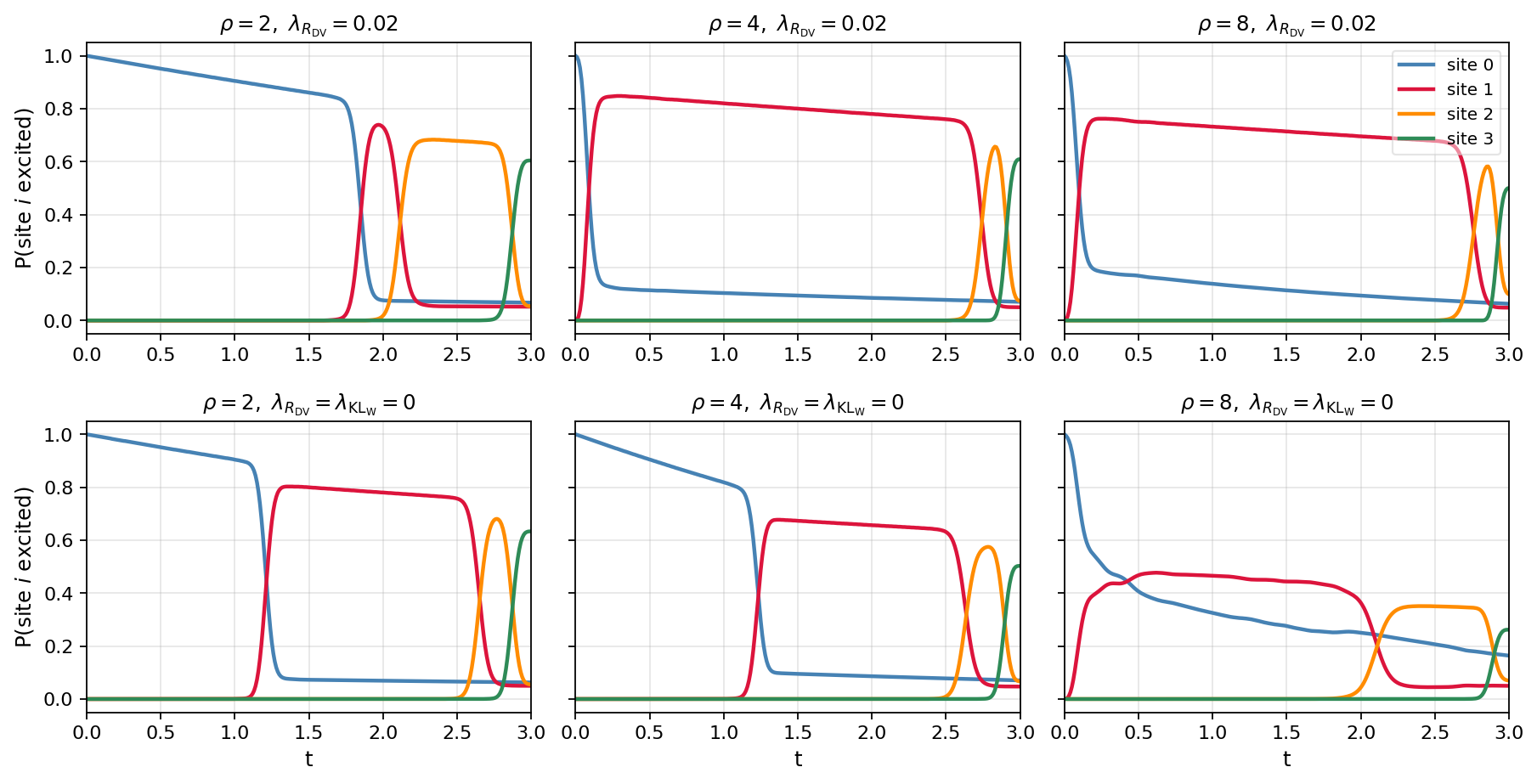
Figure 2: Site populations across the asymmetry sweep, highlighting drift-variance routing toward low-noise sites as asymmetry ρ increases.
In the diamond system, the mechanism is evident: Wiener KL regularization discovers indirect routing strategies through protected auxiliary states, avoiding lossy computational states—a behavior baseline optimizers fail to produce.
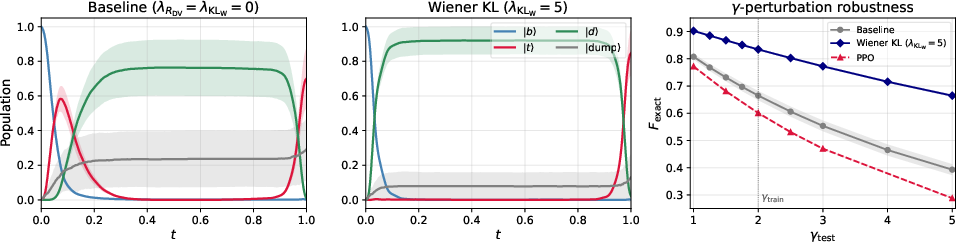
Figure 3: Diamond system evolution under noise, illustrating QMaxCal's superior routing and robustness to γ-perturbation.
On hardware-calibrated chains, drift-variance regularization actively suppresses excitation on noisy sites, increasing transfer fidelity robustly.
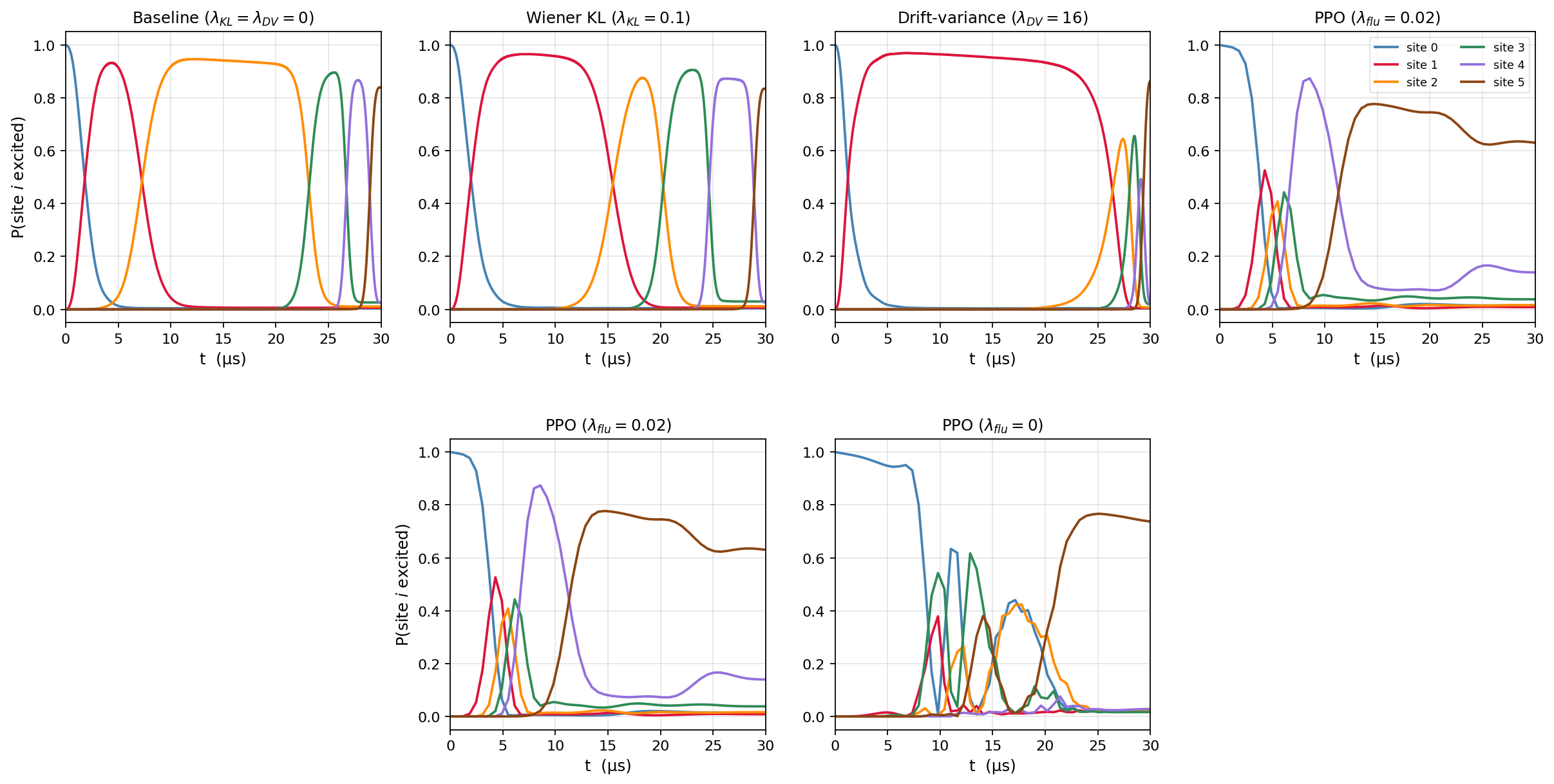
Figure 4: IBM Kingston q14→q9 evolutions, drift-variance regularizer maintaining excitation on target site and suppressing occupation on the noisy site.
Additional experiments illustrate that QMaxCal regularization is not a surrogate for smoothness penalties: direct ablation shows that derivative constraints degrade fidelity, and only path-space regularization identifies and exploits protected subspaces.
Structural Analysis and Mechanistic Insights
Path-space KL regularization aligns with the Maximum Caliber principle, selecting minimally biased trajectory distributions subject to dynamical and environmental constraints. The Wiener KL induces a strong inductive bias toward the joint Lindblad kernel (Δαk(t)0), while the drift-variance regularizer identifies all DFSs, including those not annihilated by Lindblad operators. When such subspaces exist and are accessible, QMaxCal routes the system through them, minimizing exposure to decoherence; if they do not exist or are unreachable, regularization gains vanish, consistent with theoretical predictions.
Empirically, regularization is especially effective in systems with pronounced noise structure:
- Reachable DFS or Lindblad kernel (amplitude damping, diamond)
- Lossy intermediate states in transfer protocols (STIRAP)
- Large site-to-site decoherence asymmetry (chains)
It is ineffective or redundant in uniform-noise or weak-noise scenarios.
Practical Implications and Scalability
QMaxCal's trajectory-based optimization inherits a substantial computational advantage, as trajectory space scales Δαk(t)1 versus Δαk(t)2 for density matrix methods. SSE-based autodiff enables scalable gradient computation and parallelization, reaching 12-qubit systems on standard hardware, beyond the reach of density-matrix solvers.
Regularizers are differentiable and compatible with both gradient-based and RL paradigms. Policies trained under QMaxCal are robust to noise-model mismatch, a key property for experimental deployment where environmental parameters may drift.
Limitations and Extensions
Three principal limitations are acknowledged:
- The Girsanov estimator is derived for diffusive SSE unravellings; extension to jump (piecewise deterministic) unravellings requires marked-point-process machinery.
- Lindblad formalism excludes non-Markovian environments.
- Regularization only acts as a structural prior: gains require accessible DFSs; otherwise, it is neutral.
Future directions include variational evaluation of the diffusive Girsanov estimator directly on quantum hardware (neural density-ratio estimation) and extending the framework for jump unravellings and non-Markovian settings.
Conclusion
QMaxCal establishes a closed-form, gradient-compatible regularization framework for open quantum control, targeting trajectory space and penalizing observable consequences of environmental decoherence. It demonstrates strong empirical gains in fidelity and robustness across diverse settings, especially where noise structure can be exploited. Both practical and theoretical implications are profound: QMaxCal provides structural priors for optimal control in noisy quantum devices and enables scalable optimization at the trajectory level, offering a pathway toward deeper circuits and more robust quantum technology deployments.

