- The paper presents a novel Tikhonov‐regularised projected gradient flow that stabilizes equality‐constrained quantum control by addressing ill-conditioning in the Gram matrix.
- It rigorously establishes theoretical guarantees including quadratic L2 convergence, exact conditioning identities, and discrete stability via CFL-type bounds.
- Empirical benchmarks on a three-level system confirm the method's effectiveness in reducing fluence drift and step rejections while achieving near-perfect state fidelity.
Tikhonov-Regularised Projected Gradient Flow for Equality-Constrained Bilinear Quantum Control
The paper addresses the problem of constrained quantum optimal control where a smooth bilinear objective must be maximized under several integral equality constraints in the control field. The state of a finite-dimensional quantum system, evolving according to a time-dependent Schrödinger equation perturbed by a control field, must be transferred to a target state with maximal fidelity. However, physical and engineering considerations introduce crucial constraints, including zero pulse area, fixed fluence, and fixed area against a reference oscillation. These physically motivated constraints make the unconstrained maximization of the control objective fundamentally ill-posed for practical implementation.
A key issue with classical projection-type gradient flows is the emergence of ill-conditioning due to near-linear dependencies among constraint gradients in the L2 inner product space. This ill-conditioning manifests as Gram matrices with persistently large condition numbers, leading to instability and loss of constraint preservation upon discretisation. Previous implementations have relied on heuristic step-size adaptation and lack quantitative guarantees on stability and constraint enforcement.
To overcome the instability in numerical implementations, the paper introduces a Tikhonov-regularised projected gradient flow, replacing the moving Gram matrix Γ with Γ+ϵ2I, with ϵ a regularisation parameter. This regularisation systematically stabilises the inversion required in the projected flow and offers transparent analytical control over the step size in explicit integrators, yielding five rigorous results:
- Exact Conditioning Identity: The spectrum of the regularised Gram matrix is shifted by ϵ2, so the condition number becomes (σ02+ϵ2)/(σM2+ϵ2), where σk are the singular values of the constraint assembly operator (Theorem 1).
- Monotonic Ascent: Objective monotonicity of the flow, dJ/ds≥0, is preserved for all ϵ≥0 (Theorem 2).
- Constraint Drift Quantification: The deviation from constraint satisfaction due to regularisation is exactly quadratic in ϵ, with explicit computable prefactors (Theorem 3).
- Γ0 Convergence: The regularised flow converges to the unregularised flow at rate Γ1 under appropriate invertibility assumptions (Theorem 4).
- Discrete Stability (CFL) Condition: In the forward-Euler discretisation, a Courant–Friedrichs–Lewy (CFL) type step-size bound ensures discrete monotonicity through explicit dependence on the regularised Gram matrix norm, supplanting heuristic step-halving (Theorem 5).
The structure of the regularised algorithm is summarised in an explicit update in Algorithm 1 of the paper.
Numerical Verification and Empirical Phenomenology
A central contribution is the empirical investigation of the regularised flow on a three-level quantum control benchmark relevant to the all-optical generation of Bell states in coupled atoms, subject to zero-area, fixed-fluence, and fixed-resonant-area constraints. All key theoretical predictions are robustly validated:
- The unregularised flow (Γ2) suffers from extreme Gram matrix condition numbers Γ3–Γ4, leading to significant fluence constraint drift (Γ5–Γ6), while affine constraints are preserved only up to solver precision.
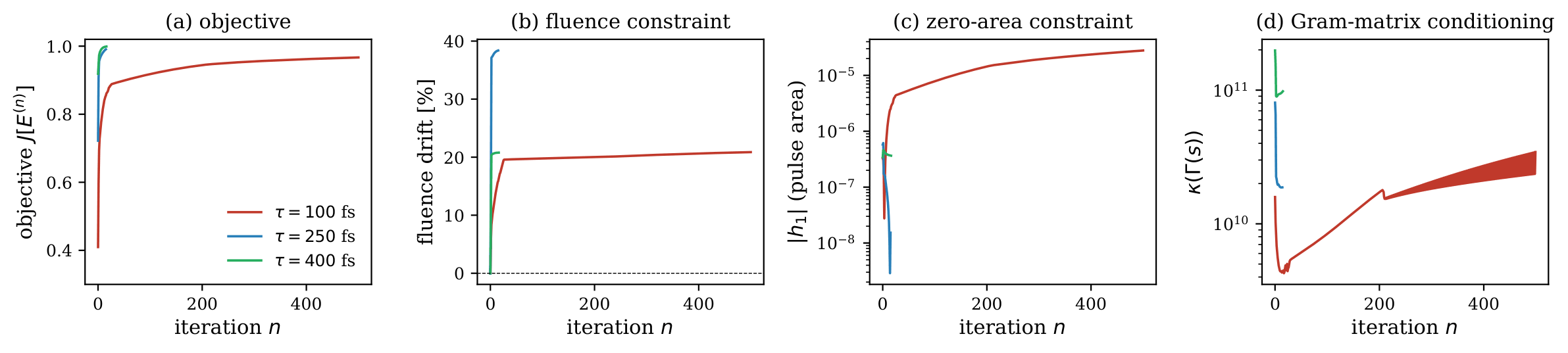
Figure 1: Baseline unregularised flow (Γ7). (a) Objective Γ8, (b) relative fluence drift, (c) absolute pulse area, (d) Gram-matrix condition number Γ9. Gram-matrix ill-conditioning is persistent and severe for all pulse durations.
- For the regularised flow, the empirical Γ+ϵ2I0-distance to the unregularised solution exhibits precise Γ+ϵ2I1 scaling over eight orders of magnitude in Γ+ϵ2I2, saturating only as predicted for larger regularisations.
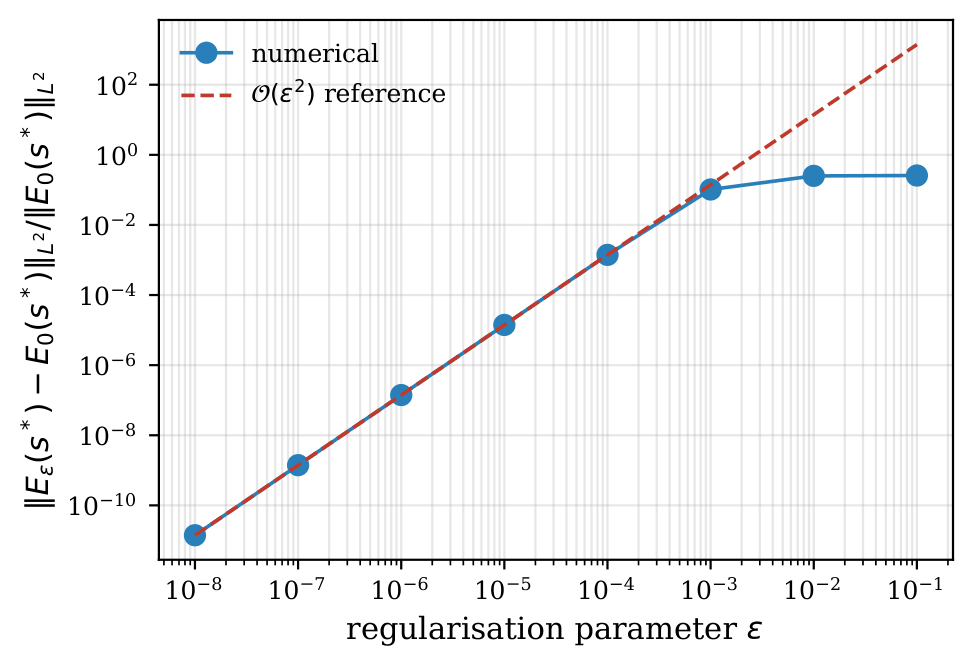
Figure 2: Empirical verification of quadratic convergence: relative Γ+ϵ2I3-distance between regularised and unregularised solutions scales as Γ+ϵ2I4 across eight decades.
- The condition number of Γ+ϵ2I5 follows theoretical scaling, sharply decreasing as Γ+ϵ2I6 increases and entering a regime where discretisation becomes robust, with significant reductions in both step rejections and constraint drift.
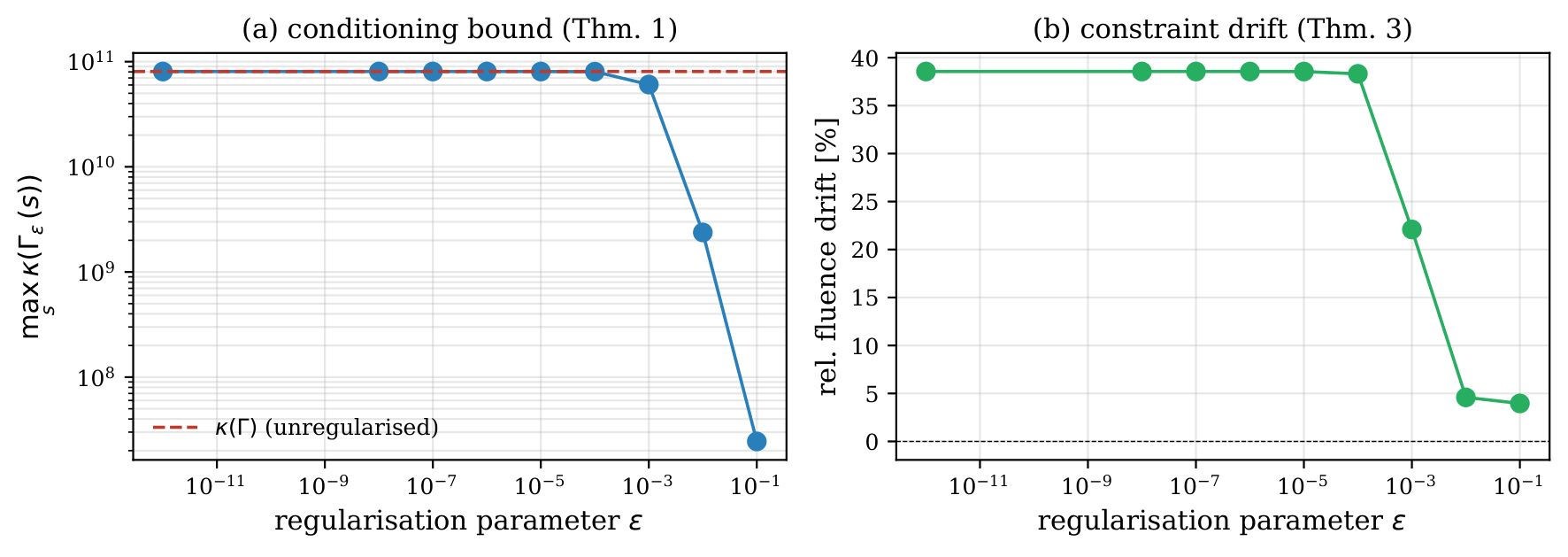
Figure 3: (a) Maximum condition number Γ+ϵ2I7 along the trajectory. (b) Relative fluence drift at final iteration, reflecting the regularisation-induced trade-off.
- In aggressive step-size regimes, moderate regularisation (Γ+ϵ2I8 in Γ+ϵ2I9–ϵ0, non-dimensionalised) eliminates step rejections and lowers fluence drift by an order of magnitude without penalising final objective fidelity.
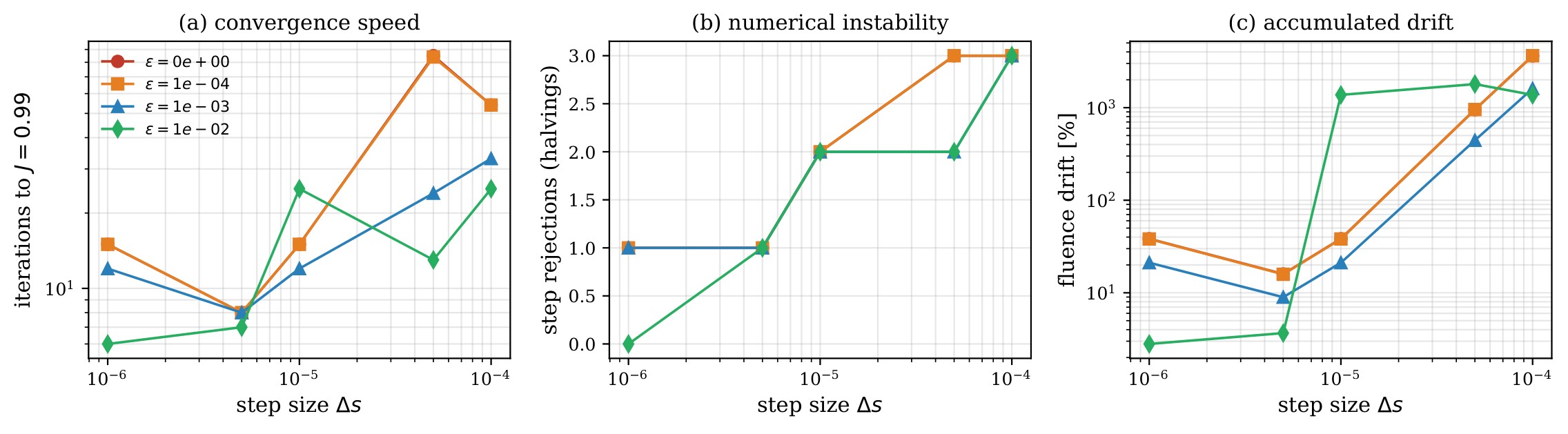
Figure 4: Practical impact of regularisation at ϵ1. (a) Required iterations, (b) number of step-halving rejections, (c) relative fluence drift. Moderate ϵ2 significantly improves all metrics.
- The ϵ3 distances between final optimal controls at different ϵ4 match theoretical predictions, and all regularised procedures achieve ϵ5.
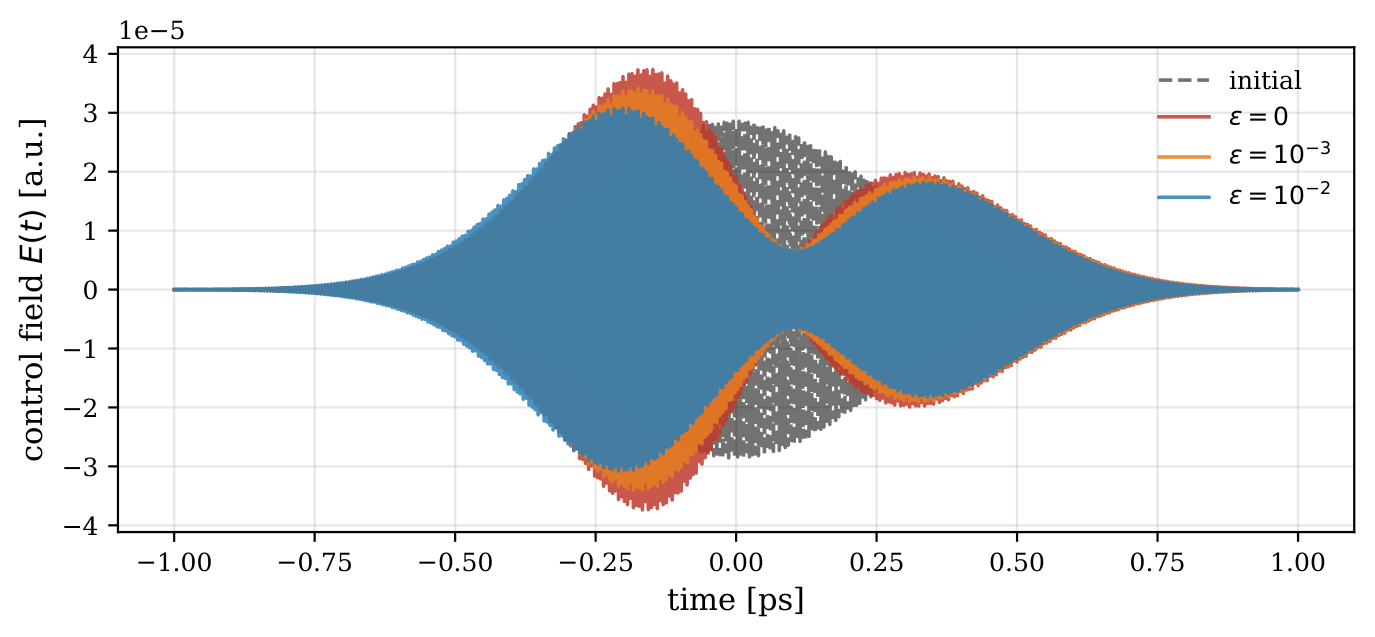
Figure 5: Initial control (dashed) and final controls for ϵ6, ϵ7, ϵ8. Final state fidelity and inter-control distances are consistent with analytic bounds.
Implications and Outlook
The introduction and analysis of Tikhonov regularisation in projected gradient flows for constrained quantum control offers robust theoretical and practical remedies for numerical ill-conditioning endemic to equality-constrained bilinear problems. It provides:
- A principled calibration of the regularisation parameter, balancing the trade-off between constraint preservation and numerical stability.
- Quantitative, predictive guarantees on constraint drift and convergence rates, enabling algorithmic transparency and reproducibility.
- A mathematically-founded alternative to step-size tuning heuristics, directly applicable to a range of scenarios beyond the quantum control setting.
The mathematical structure and regularisation strategy is independent of the details of the bilinear system and readily generalises to more complex scenarios, including non-bilinear dynamics, higher-dimensional constraints, and even PDE-constrained quantum or classical control. Future directions include adaptive regularisation (e.g., Tikhonov–Morozov principles), advanced integrators, and multi-control extensions, as well as direct applications to the design of quantum gates for neutral-atom and superconducting quantum technologies, where the constraint-ill-conditioning challenge is structurally pervasive.
Conclusion
The work provides an integrated analytical and empirical treatment of Tikhonov-regularised projected gradient flows for equality-constrained bilinear quantum control, quantifying how moderate regularisation yields both robust discrete-time convergence and precise control over constraint satisfaction, validated on physically relevant benchmarks. The framework represents a significant step towards reliable and reproducible implementation of constraint-sensitive quantum optimal control algorithms (2604.26625).

