- The paper establishes a parity selection rule that differentiates even-parity information functionals from odd-parity entropy production in driven nonequilibrium steady states.
- It employs a driven Ornstein-Uhlenbeck process and symmetry analysis to show that mutual information remains invariant under drive reversal, unlike entropy production.
- The findings hold under both Gaussian and heavy-tailed noise regimes, offering clear experimental implications for mesoscopic device design.
Parity Selection Rule in Driven Nonequilibrium Steady States
Introduction
The paper "Parity Selection Rule for Information and Dissipation in Driven Steady States" (2606.19702) presents a rigorous analysis of symmetry constraints governing information and entropy production in linear nonequilibrium steady states (NESS) driven by rotation. The central result is the identification of a parity selection rule that orthogonally separates symmetric information functionals (such as snapshot mutual information) and entropy production in these systems, based on the reversal parity of the driving parameter. This selection rule precludes any tight equality merging information with dissipation for rotationally driven NESS, explaining the structural origin of the observed mismatch in order and symmetry between information-theoretic and thermodynamic quantities.
Canonical Model and Structural Symmetry
The primary object of study is the n-dimensional driven Ornstein-Uhlenbeck (OU) process:
dxt=−(A−Ω)xtdt+dNt,
with A=A⊤≻0 the symmetric relaxation matrix (reversible component), Ω=−Ω⊤ the antisymmetric rotational drive (irreversible component), and noise dNt admitting both Gaussian and heavy-tailed, isotropic α-stable forms. The drive reversal ω→−ω induces a discrete symmetry operation, pivotal in organizing functionals into parity-even and parity-odd sectors. In the planar (n=2) case, the drive is represented canonically as Ω=ωJ with J the symplectic generator.
The structural alignment condition dxt=−(A−Ω)xtdt+dNt,0 (relaxation and diffusion matrices commute) enables simultaneous diagonalization, facilitating explicit symmetry analyses. The paper also delineates the distinction between detailed balance and this alignment, noting the latter permits non-zero entropy production for dxt=−(A−Ω)xtdt+dNt,1.
Parity Selection Rule: Even and Odd Branches
The rule distinguishes three features:
- Even branch: Rotation-invariant symmetric information functionals (e.g., snapshot mutual information dxt=−(A−Ω)xtdt+dNt,2) exhibit exact parity-evenness under drive reversal, and at full isotropy (dxt=−(A−Ω)xtdt+dNt,3, dxt=−(A−Ω)xtdt+dNt,4), become strictly independent of dxt=−(A−Ω)xtdt+dNt,5, attaining a closed-form anchor value:
dxt=−(A−Ω)xtdt+dNt,6
This result is numerically verified to high precision across broad dxt=−(A−Ω)xtdt+dNt,7 ranges.
- Odd branch: The entropy production rate dxt=−(A−Ω)xtdt+dNt,8 is rooted in odd parity, flipping sign under drive reversal and, at isotropy, admits explicit quadratic dependence:
dxt=−(A−Ω)xtdt+dNt,9
Under alignment A=A⊤≻00 in A=A⊤≻01, the prefactor is given by traces and determinants of A=A⊤≻02:
A=A⊤≻03
- Orthogonality and No-go Corollary: The orthogonality enforced by parity forbids any tight identity equating a symmetric information (even-parity) functional to an entropy production (odd-parity) functional for all A=A⊤≻04. At best, one-sided thermodynamic uncertainty relations are permitted, but any ratio A=A⊤≻05 diverges as A=A⊤≻06, explicitly diagnosing the structural mismatch.
The numerical evaluation of these branches is visualized in the following figure.
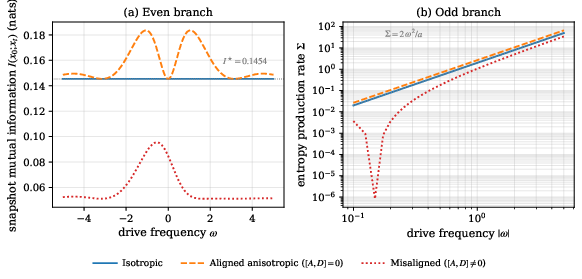
Figure 1: Mutual information and entropy production as functions of A=A⊤≻07 for various configurations, illustrating the even/odd parity and structural separation between information and dissipation.
The aligned anisotropic case preserves even-parity without isotropic blindness, while any misalignment (A=A⊤≻08) yields visible parity-breaking proportional to A=A⊤≻09.
Diagnostics and Quantitative No-go
A direct diagnostic of the selection rule is the divergence of Ω=−Ω⊤0 as Ω=−Ω⊤1 in aligned cases and the near-machine precision parity violation Ω=−Ω⊤2 in these regimes, contrasted with gross violation in misaligned cases.
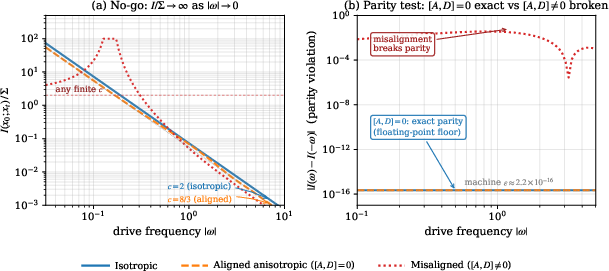
Figure 2: Ratio Ω=−Ω⊤3 and parity violation Ω=−Ω⊤4 versus Ω=−Ω⊤5, demonstrating the no-go for tight equalities and confirming selection rule predictions.
Regime of Heavy-Tailed Noise
An important extension of the rule is its validity under isotropic Ω=−Ω⊤6-stable noise with tail index Ω=−Ω⊤7, where variance is infinite and variance-based bounds are vacuous. The selection rule, anchored in symmetry of the drift, remains exact across this regime. The finiteness and Ω=−Ω⊤8-independence of Ω=−Ω⊤9 are established via sub-Gaussian constructions on logarithmic moments. In contrast to variance-based thermodynamic uncertainty relations, which fail for dNt0, the selection rule’s structural constraint persists unaffected.
Experimental Implications
The electrical autonomous Brownian gyrator presents a direct platform for these symmetry tests. Circuit-level control of dNt1 (via nonreciprocal elements or active feedback), together with programmable dNt2-stable noise injection, enables measurement of mutual information and dissipation across both Gaussian and heavy-tailed regimes. The strongest test is isotropic blindness of mutual information, while the divergence of dNt3 for small dNt4 and robustness of parity across noise regimes are device-generic and sharply falsifiable.
Theoretical and Practical Significance
The parity selection rule reveals the structural obstruction to merging information-theoretic and thermodynamic functionals into tight equalities in driven NESS. The dNt5 (even) versus dNt6 (odd) hierarchy underlines irreducible constraints of symmetry, surviving even in regimes where classical fluctuation theorems and variance-based bounds are rendered inoperative. This advances a symmetry-based diagnostic for information-entropy relations, with implications for device design and the analysis of feedback/dissipation in stochastic thermodynamics.
Conclusion
The paper establishes a symmetry-driven selection rule separating symmetric information and dissipation in rotationally driven NESS, rigorously formalized and numerically validated across aligned, isotropic, and misaligned regimes, and extended into the heavy-tailed domain. The rule prohibits any equality-type merger of information with entropy production in the presence of rotational drive, yet admits one-sided uncertainty bounds. Theoretical implications include clarifying the foundations of information thermodynamics and identifying symmetry as the root of structural constraints. Practically, the rule is experimentally testable in mesoscopic devices and relevant for engineering stochastic systems under nonequilibrium conditions.