Can In-Context Learning Support Intrinsic Curiosity?
Abstract: Effective machine learning depends not only on how we model data, but also on what data we choose to collect. While large sequence models have revolutionized data modeling, the problem of automated data selection, or "intrinsic curiosity", remains a significant challenge. Classic approaches incentivize exploration by rewarding an agent based on its "learning progress", which measures how much a newly acquired observation improves a world model's predictive ability. However, evaluating these rewards traditionally requires expensive inner loops of gradient descent updates within each trajectory, rendering them computationally impractical at scale. In this work, we investigate whether the emergent in-context learning (ICL) capabilities of sequence models can eliminate this bottleneck by serving as immediate, update-free world models. Specifically, we evaluate whether an exploration policy can be trained to maximize learning progress, using solely the prediction errors and counterfactual context manipulations of an in-context learner. We first prove that in general Markov decision processes, this is in fact impossible in an unbiased way: the resulting intrinsic rewards either suffer from nuisance terms that bias their estimation of true learning progress, or they cannot be implemented using an in-context learner's prediction errors. Conversely, we prove a positive result for a broad subclass of non-temporal settings, encompassing active learning and Bayesian Experimental Design: here, ICL-derived rewards successfully bound and asymptotically converge to the true learning progress. We corroborate our theory with controlled experiments across continuous and symbolic environments, demonstrating that our ICL-driven framework successfully trains curious data-collection policies that explore optimally.
Paper Prompts
Sign up for free to create and run prompts on this paper using GPT-5.
Top Community Prompts
Explain it Like I'm 14
Overview
This paper asks a simple question with big consequences: can today’s “in‑context learning” models (like Transformers that learn from examples in their input) help machines explore smartly on their own? In other words, can a model decide which data to collect next so that it learns the most about the world, without doing slow, repeated training steps in the middle of its exploration?
Key Objectives
The authors focus on curiosity as a tool for learning. They aim to find out:
- Can we train an exploration policy that chooses what to look at next by measuring how much its predictions improve?
- Can we do this using only fast, in‑context prediction errors (no inner training loops)?
- Do these “prediction-based” curiosity rewards match the gold-standard measure of learning new information (called Bayesian information gain), and when?
Methods in Plain Language
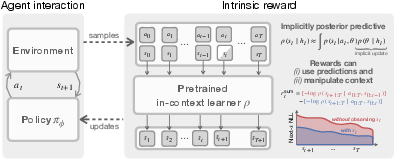
Think of a robot with a “world model” that tries to predict what will happen next. The robot gets points (intrinsic rewards) not for completing tasks, but for collecting data that makes its model smarter.
The paper compares several ways to give the robot curiosity points:
- Surprisal: reward “how surprising” an observation is. Problem: surprise can come from randomness (like a noisy TV) that doesn’t teach anything useful.
- Learning progress: reward when the model’s predictions improve. Classic versions need the model to update its weights mid‑trajectory and then re‑evaluate, which is slow.
- New idea (r_sum): reward how much better the model predicts future events if it “keeps” the current observation versus if it “masks” (pretends it didn’t see) it. This uses a sequence model’s in‑context predictions and simple context edits instead of weight updates.
- Description length (r_dl): reward how many “bits” it would save to describe the current observation after “updating” with it. In some settings, this can also be approximated using in‑context tricks.
To make all this work fast, the authors use an in‑context learner (a pretrained sequence model) that, given the history of actions and observations, predicts what comes next in a single forward pass. They then build curiosity rewards from those predictions and train a policy that maximizes these rewards.
They study two types of environments:
- General sequential worlds (like video games): what happens next depends on what just happened and on hidden rules.
- BED (Bayesian Experimental Design) worlds: like doing lab experiments or active learning. Each trial’s result depends on your chosen action and the hidden rules, but not on the previous state. This structure makes analysis and implementation much easier.
Main Findings
1) General worlds: a negative result
In rich, sequential environments, the authors prove that any curiosity reward you build using only a sequence model’s prediction errors (and simple context edits) cannot, in general, give an unbiased estimate of the true “how much did I learn?” signal (Bayesian information gain). In short, there will always be extra “nuisance” terms, like:
- Aleatoric noise: pure randomness that looks surprising but teaches nothing (the “noisy TV” problem).
- Abductive coupling: short‑range effects between consecutive states that aren’t just about learning the hidden rules.
This means that in general environments, there’s no practical, finite-horizon, prediction-only trick that perfectly measures true learning progress.
2) BED (experimental) worlds: a positive result
In BED settings (think: picking the next question to ask a teacher, or the next point to measure in a science experiment), the situation improves a lot:
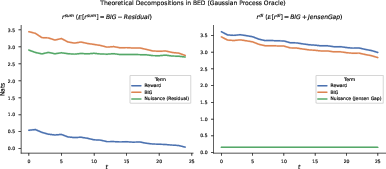
- The new r_sum reward (improvement in future predictions when you include versus mask the current observation) becomes a lower bound on the true information gained, and as you consider longer sequences, it approaches the true information gain.
- The r_dl reward (improvement in description length) becomes an upper bound on the true information gain, and also gets tight under natural conditions.
- Most importantly, both can be computed using in‑context predictions and simple context manipulations, without slow inner-loop training.
So, in these lab/active-learning style settings, in‑context learners can support curiosity that meaningfully tracks true learning.
3) Experiments: three testbeds
The authors test their ideas in three controlled environments where the agent must actively collect informative data:
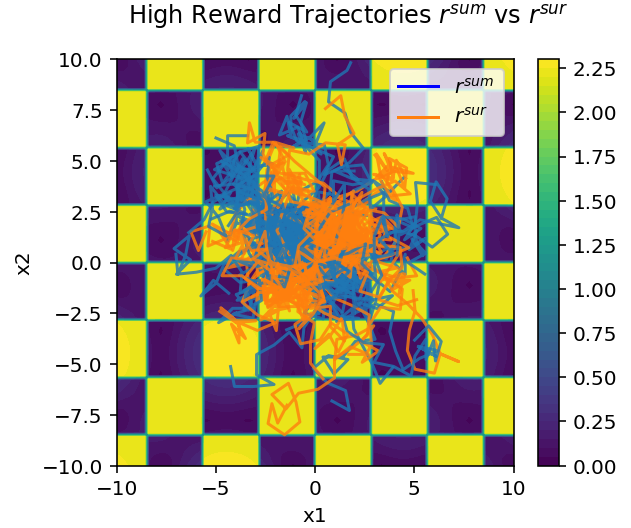
- Gaussian Process (GP) function learning: the agent chooses where to sample a continuous function that has both smooth structure and regions with extra measurement noise.
- Mastermind: a code-breaking game; both a clean version and a noisy version where one color is “evil” and randomizes feedback in certain positions.
- Alchemy: a symbolic rule-discovery game; also tested with a noisy “evil stone” that randomizes outcomes for one input type.
For each, they pretrain an in‑context learner to predict outcomes and then train a policy with different curiosity rewards. They also include an “oracle” Bayesian predictor when possible to check correctness.
What they found:
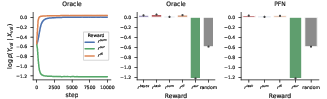
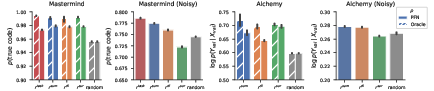
- Surprisal performs well only in noise-free environments. As soon as noise appears, it chases randomness and performs worse than random exploration (“noisy TV” problem).
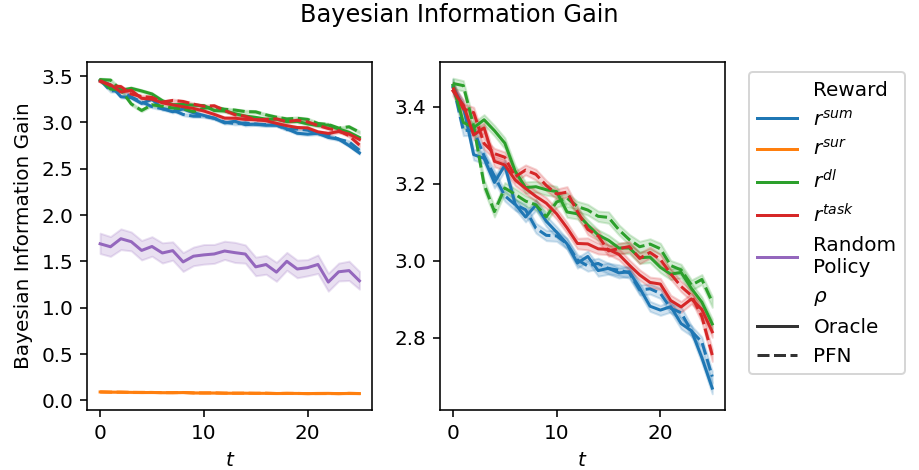
- r_sum and r_dl remain strong in both clean and noisy versions. They focus on actions that truly reduce uncertainty about the hidden rules.
- In GP with a checkerboard noise pattern, surprisal steers the agent toward noisy regions (bad), while r_sum avoids them and learns the function faster.
- In Mastermind and Alchemy, surprisal collapses under noise, while r_sum and r_dl stay robust and informative.
Why This Matters
- Fast, practical curiosity: In certain common settings (active learning, scientific experiments, data collection pipelines), you can get solid, theoretically grounded curiosity signals using only a pretrained in‑context learner’s predictions. That means faster, cheaper exploration without inner training loops.
- Robustness to noise: Rewards that measure genuine learning (r_sum, r_dl) avoid being fooled by randomness, unlike surprisal.
- Guidance for design: If your problem looks like “choose the next informative experiment,” these methods provide a principled and scalable way to explore.
Takeaway and Future Directions
- Big picture: In general, fully sequential worlds remain hard—prediction-only curiosity rewards can’t perfectly match true information gain without biases. But in experimental/active-learning settings, the new r_sum and the r_dl rewards bound and approach the true signal and work well in practice.
- What’s next: Extending these ideas to broader, more realistic environments may require peeking into or controlling the model’s internal representations (not just its outputs), handling very long contexts, and dealing with distribution shift when the exploration policy changes what the model sees. Combining the “lower” and “upper” bounds (r_sum and r_dl) might also yield tighter, more stable curiosity signals.
Knowledge Gaps
Knowledge gaps, limitations, and open questions
Below is a single, concrete list of what remains missing, uncertain, or unexplored, structured to guide future research:
- Closing the gap in general BAMDPs: No practical, finite-horizon, prediction-only reward computable from an in-context learner’s outputs identifies Bayesian information gain (BIG) in general MDPs; can a new estimator beyond the paper’s class F, or with enhanced model interfaces, achieve unbiased BIG without requiring infinite horizons or gaps?
- Correcting the “abductive” bias in general BAMDPs: Is there a principled way (e.g., control variates, causal adjustment, conditional independence–inducing interventions) to remove the one-step abductive term that persists in r_sum outside BED?
- Beyond BED: Characterize the minimal structural conditions weaker than full BED under which r_sum or r_dl become asymptotically unbiased for BIG, and derive practical tests to detect when those conditions approximately hold in an unknown environment.
- Finite-sample guarantees: Provide non-asymptotic bounds for the bias and variance of r_sum and r_dl (and NDIGO-style variants) in BED and non-BED settings; quantify rates at which the residual (r_sum) and Jensen gap (r_dl) shrink with T and t.
- Model misspecification analysis: Derive robustness guarantees when the in-context learner ρ is not exactly Bayesian (calibration error, likelihood misspecification, or prior mismatch); bound the induced bias in the intrinsic reward and its effect on policy optimality.
- Counterfactual masking validity: The theory assumes a “mask” removes only s_t’s contribution and preserves Bayesian coherence; how should ρ be trained (data augmentation, masked objectives, permutation invariance) to ensure masks yield faithful counterfactuals in practice?
- Mixing and long-range dependence: Results rely on mixing assumptions; how do the conclusions change in slowly mixing or non-mixing dynamics (e.g., long-term dependencies, partial observability), and can alternative rewards or training schemes mitigate failures?
- Learning interfaces for interventions: r_dl in general BAMDPs requires posterior updates outside ρ’s predictive interface; can we train ρ to expose approximate posterior features (e.g., task vectors, sufficient-statistic heads) that support interventional queries needed for BIG-like rewards?
- Double-limit necessity: Theoretical identification of BIG requires both T → ∞ and K → ∞; can we design tractable approximations (e.g., blocked or sampled gaps, partial marginalization, learned surrogates) that recover most of the benefit at finite compute?
- Online RL at single-lifetime scale: The method is episodic, with rewards computed post-hoc; what stochastic or incremental estimators allow low-latency intrinsic rewards online without evaluating the entire future remainder?
- Context-length limits: In-context learning saturates with long contexts; what mechanisms (e.g., memory modules, periodic consolidation via weight updates) preserve learning progress signals over extended lifetimes?
- Credit assignment and stability: How do different RL optimizers and baselines interact with high-variance, non-stationary intrinsic rewards from ρ, especially if ρ is fine-tuned online? Provide guidelines or algorithms for stable joint policy–model training.
- Covariate shift under active policies: ρ is pretrained on random-action trajectories, but deployment induces highly informative, non-random trajectories; what training curricula, domain randomization, or DAgger-style data aggregation best mitigate this shift?
- Calibration of ρ: Large sequence models are often poorly calibrated; which calibration techniques (temperature scaling, conformal methods, Bayesian ensembling) most improve the faithfulness of intrinsic rewards derived from predictive likelihoods?
- Action informativeness: Assumption (v) treats actions as policy-generated and non-informative about θ; in real settings, actions can leak operator intent or constraints. Can we extend the theory and rewards to settings where actions themselves carry information about θ?
- Continuous and high-dimensional action spaces: r_dl’s counterfactual “repeat the same action” is simple in discrete BED; how should it be implemented and stabilized in continuous, high-dimensional action spaces where exact repeats are ill-posed?
- Scaling to rich sensory modalities: The experiments use structured symbolic/low-dimensional BED tasks; how well do the conclusions transfer to vision, language, or robotics with high-dimensional observations and complex latent structure?
- Comparing to alternative curiosity baselines: The paper omits direct empirical comparisons to strong non-Bayesian baselines (e.g., RND, ICM, ensemble disagreement). How do r_sum and r_dl fare in compute–performance trade-offs against these methods?
- BIG oracle evaluation: Where exact BIG is tractable (e.g., GP oracles), systematic measurement of the bias of r_sum and r_dl versus BIG over training would validate theoretical decompositions and inform practical corrections.
- Sensitivity to prior mismatch: PFNs rely on synthetic priors; quantify how mis-specified priors impact exploration quality and whether learned priors (or hierarchical/meta-priors) improve robustness.
- Safety-aware exploration: The framework optimizes informativeness, not risk; how to incorporate safety constraints or risk-sensitive objectives into ICL-derived curiosity without degrading information gain excessively?
- Hybrid bounds: Since r_sum lower-bounds and r_dl upper-bounds BIG in BED (asymptotically), can we design learnable hybrids or adaptive weighting schemes that tighten the gap at finite horizons and improve policy learning?
- Representation learning of θ: Can we directly learn low-dimensional, disentangled representations of θ from ρ’s hidden states that enable efficient BIG estimation or planning in latent space?
- Task transfer and extrinsic objectives: To what extent do curiosity-trained policies and PFN representations transfer to downstream extrinsic tasks (planning/control), and what trade-offs arise between pure informativeness and task performance?
- Sample complexity and compute budgets: Provide end-to-end compute analyses for training ρ and the policy under different rewards, establishing practical regimes where ICL-driven curiosity is advantageous over gradient-based world-model updates.
Practical Applications
Below is an overview of practical, real-world applications stemming from the paper’s findings and methods. The key technical takeaway is that pretrained in-context learners (ICL/PFNs) can act as amortized Bayesian predictors to compute intrinsic curiosity rewards without gradient updates. In general MDPs, unbiased BIG-like rewards are not implementable via the predictive interface alone; however, in Bayesian Experimental Design (BED) settings (i.e., conditionally independent observations given latent parameters and chosen actions), ICL-based rewards such as and are deployable now and provably converge toward Bayesian information gain (BIG), avoiding “noisy TV” failure modes.
Immediate Applications
These can be implemented today in BED-like settings using pretrained PFNs/ICL models and the paper’s rewards (, ), with minimal or no gradient-based inner loops.
- Active learning for tabular/structured data (software/ML)
- What: Use / to select the next sample to label, replacing heuristics (uncertainty, entropy) with ICL-based BIG proxies that are robust to aleatoric noise.
- Tools/workflows: Plugin for annotation platforms (Label Studio, Snorkel, Scale AI) that pretrains a PFN on synthetic or historical data and ranks unlabeled items by /; integration into AutoML pipelines (e.g., with TabPFN).
- Assumptions/dependencies: BED-like independence given latent parameters; PFN prior must approximate the deployment distribution; good calibration of predictive likelihoods; masking/context manipulation supported.
- Experimental design assistants in R&D (materials, chemistry, biology)
- What: Adaptive selection of assay conditions, synthesis parameters, or measurement settings to maximize information gained per experiment.
- Tools/workflows: ELN-integrated “experiment recommender” that proposes next settings using a PFN world model trained on lab logs or simulators; batch-mode / for multi-well plates.
- Assumptions/dependencies: Trials are conditionally independent given latent mechanism (BED); availability of prior or simulator; measurement noise modeled in pretraining.
- Geospatial/environmental sampling and sensor scheduling (energy, climate, agriculture)
- What: Choose sampling locations/timepoints (e.g., soil, air, water) to learn latent fields efficiently (analogous to the paper’s GP environment).
- Tools/workflows: GIS plugin that uses a PFN/GP predictive model to plan drone/vehicle sampling routes by maximizing ; SCADA sensor schedulers for grids/pipelines.
- Assumptions/dependencies: Latent spatial process model (often GP) approximates reality; independence across samples conditional on field and chosen action; known or learnable noise map.
- Manufacturing quality control sampling (industry/operations)
- What: Adaptive inspection policies that select items or process conditions to reduce uncertainty in defect mechanisms with few tests.
- Tools/workflows: MES/QC dashboard module computing / on inspection outcomes; guides destructive testing allocation.
- Assumptions/dependencies: Per-item outcomes independent given latent defect rates/process parameters; reliable historical priors.
- Software testing and fuzzing with resets (software)
- What: Curiosity-guided test-case generation for deterministic, resettable programs/services; prioritize inputs that most improve the predictive model of program behavior.
- Tools/workflows: Fuzzer extension that maintains an ICL predictor over (input → outcome/signature) and uses to schedule next inputs.
- Assumptions/dependencies: Test runs are effectively independent given the program version/configuration (BED via reset); PFN trained on prior input–output logs.
- Symbolic rule discovery and configuration testing (software/devops)
- What: Actively probe rules/constraints in systems (feature flags, configuration policies) akin to Mastermind/Alchemy settings.
- Tools/workflows: “Rule miner” that suggests next probe to tighten the feasible rule set; CI/CD integration for config verification.
- Assumptions/dependencies: Deterministic mapping from configuration+input to output within a test window; restartability; BED holds approximately.
- Survey design and adaptive questionnaires (market research, social science)
- What: Select the next question adaptively to learn a respondent’s latent traits/preferences with minimal burden, robust to response noise.
- Tools/workflows: Survey platforms (Qualtrics, Typeform) add “informative next question” logic via a PFN over historical response patterns and /.
- Assumptions/dependencies: Conditional independence of item responses given latent traits (IRT-like); manageable priors; response noise modeled.
- Recommender onboarding and cold-start elicitation (software/consumer)
- What: Choose a small set of probe items/questions to rapidly learn a new user’s preference vector.
- Tools/workflows: Onboarding flow that uses PFN predictions of click/like to pick next probe by /; supports fast personalization.
- Assumptions/dependencies: Approximate conditional independence of responses given latent preferences; stable catalog embeddings; well-specified priors.
- Diagnostic test ordering decision support (healthcare)
- What: Suggest the next lab/imaging test to maximize information about suspected latent conditions, explicitly handling noisy measurements.
- Tools/workflows: EHR-integrated recommender leveraging a PFN trained on retrospective cohorts to compute / across candidate tests.
- Assumptions/dependencies: Regulatory approval; careful calibration/validation; privacy/security; quasi-BED structure (conditionally independent tests given latent diseases) must be acceptable in targeted contexts.
- Audit and compliance sampling (finance, enterprise)
- What: Adaptive selection of transactions/contracts for audit to quickly identify or rule out latent fraud patterns.
- Tools/workflows: Compliance dashboards ranking candidates by / using a PFN trained on historical findings.
- Assumptions/dependencies: Case outcomes independent given latent fraud process; class imbalance and label quality; governance constraints.
- Educational tutoring systems (education)
- What: Choose the next exercise to most reduce uncertainty about student mastery (robust to guessing/slips).
- Tools/workflows: Edtech plugins using PFN-based predictors of correctness/time-on-task; to select the next item.
- Assumptions/dependencies: IRT-like conditional independence given mastery; content tagging quality; ethical considerations.
- Data curation and labeling budget allocation (ML ops)
- What: Allocate limited labeling budget to datapoints that most improve model predictive performance, avoiding “noisy” instances.
- Tools/workflows: Labeling queue prioritization using /; integration with dataset versioning tools (DVC, Weights & Biases).
- Assumptions/dependencies: Fit to BED-style label acquisition; representative pretraining priors; calibration of predictive uncertainties.
- Field experiment and A/B test scheduling (product/marketing)
- What: Choose next variants or cohorts to test to learn latent response curves efficiently while handling stochasticity.
- Tools/workflows: Experimentation platforms (Optimizely, LaunchDarkly) add ICL-based BIG proxies for arm/context selection.
- Assumptions/dependencies: Stationarity during test windows; consistent randomization; independence across units conditional on latent response model.
Long-Term Applications
These require further research to relax BED assumptions, handle temporal dependencies, scale context lengths, or enable latent-space posterior manipulation.
- Autonomous exploration in robotics and embodied AI (robotics)
- What: Curiosity-driven policies in temporally dependent, partially observable environments (SLAM, manipulation, navigation).
- Tools/workflows: “Curiosity engine” that leverages task-vector manipulations of ICL hidden states to approximate BIG/learning progress.
- Assumptions/dependencies: Advances in estimating/controlling latent posteriors from ICL states; stability in online learning; safe exploration.
- Online reinforcement learning with streaming intrinsic rewards (software/robotics)
- What: Compute curiosity rewards on-the-fly without episodic resets; amortize via truncated windows or stochastic estimators.
- Tools/workflows: Streaming / approximators; memory-aware architectures; periodic consolidation/weight updates.
- Assumptions/dependencies: Solutions to context-length limits, saturation of ICL learning, and non-stationarity; efficient approximate masking/gaps.
- BIG-consistent estimators beyond BED (theory/ML)
- What: Practical approximations to the paper’s gap-based limits (large , large gap ) or hybrid – bounds for general MDPs.
- Tools/workflows: Open-source library offering tunable BIG proxies with theoretical controls; diagnostics for abductive/residual bias.
- Assumptions/dependencies: Better masking/marginalization in sequence models; mixing assumptions; computational feasibility.
- Autonomous scientific discovery platforms (science/industry)
- What: Full closed-loop labs (robotic synthesis, characterization, modeling) driven by ICL-based information gain across multistep protocols.
- Tools/workflows: Orchestrators that coordinate instruments, PFN predictors, and experiment queues; multi-fidelity experiment design.
- Assumptions/dependencies: Handling temporal/causal dependencies; reliable simulators/priors; lab safety and compliance.
- Adaptive clinical trials and cohort allocation (healthcare)
- What: Informative patient assignment, dose-finding, and interim analyses guided by BIG-like objectives robust to measurement noise.
- Tools/workflows: Trial design software with ICL-based planners; harmonization with Bayesian regulatory frameworks.
- Assumptions/dependencies: Complex temporal confounding, ethics, and regulation; strong priors and causal structure; rigorous validation.
- Multi-agent sensing and active networks (energy, IoT, defense)
- What: Coordinated sensor/task allocation across fleets (drones, smart meters) to maximize collective information gain.
- Tools/workflows: Distributed curiosity planners; communication-efficient rollout of with decentralized priors.
- Assumptions/dependencies: Communication constraints; robustness to adversarial/noisy nodes; partial observability.
- Privacy-preserving active learning and experiment design (policy/ML)
- What: Maximize information gain under differential privacy or federated constraints.
- Tools/workflows: DP-aware PFNs; secure aggregation of curiosity signals; federated scheduling.
- Assumptions/dependencies: Privacy–utility trade-offs; tighter calibration under privacy noise; regulatory alignment.
- Autonomous driving and simulation data acquisition (mobility)
- What: Choose where/when/how to collect new data in the wild or sims to reduce model uncertainty efficiently (rare events).
- Tools/workflows: Data flywheels with curiosity-driven scenario selection; sim-to-real transfer guided by BIG proxies.
- Assumptions/dependencies: General MDP temporal structure; covariate shift; safety constraints; simulator fidelity.
- Program analysis and stateful systems testing (software)
- What: Extend curiosity-guided fuzzing to stateful, concurrent systems and long workflows.
- Tools/workflows: State-aware PFNs; episodic abstractions/option discovery for temporally extended tests.
- Assumptions/dependencies: Decomposition to BED-like subroutines; scalable context handling; deterministic replay/reset.
- Economic and policy pilots with adaptive design (public policy)
- What: Informative rollouts of social programs with adaptive sampling of regions or cohorts to learn latent response heterogeneity.
- Tools/workflows: Policy experimentation platforms with BIG-like targeting; fairness/ethical oversight modules.
- Assumptions/dependencies: Causal validity; spillovers/time trends (non-BED); governance and transparency.
- Hybrid human–AI workflows for discovery and diagnostics (cross-sector)
- What: Human experts approve AI-proposed “next-best measurements,” combining domain knowledge with / rankings.
- Tools/workflows: Decision-support UIs exposing predicted BIG, uncertainty decompositions, and counterfactuals.
- Assumptions/dependencies: Trust, interpretability, and auditability; calibrated uncertainties; organizational adoption.
- Foundation-model-based experiment planners (software/science)
- What: Use LLMs with ICL to reason about high-level experimental narratives; augment with PFNs to compute numeric curiosity rewards.
- Tools/workflows: Co-pilot that generates hypotheses and candidate actions, then ranks them with / from a domain PFN.
- Assumptions/dependencies: Hallucination control; calibration mismatch between LLMs and Bayesian predictive targets; tool-use reliability.
Notes on feasibility and dependencies common across applications:
- BED fit: Immediate deployment assumes the domain can be approximated as BED (trials independent given latent parameters and actions).
- Prior shift: PFNs must be pretrained on a prior close to the deployment data; covariate shift will degrade performance unless jointly adapted.
- Calibration: Predictive likelihoods should be well-calibrated; evaluation against an oracle or strong baseline is recommended.
- Context limits: Sequence models’ context windows and masking/marginalization support can constrain horizon and the fidelity of .
- Safety/ethics/regulation: Particularly in healthcare, policy, and finance, human oversight, rigorous validation, and compliance are essential.
Overall, the paper’s ICL-driven curiosity framework is immediately actionable in BED-style domains (active learning, experiment design, sampling) and offers a principled path toward robust, noise-aware information gathering. Extensions to temporally structured, real-world RL settings are promising but require advances in posterior access/manipulation, long-context modeling, and safe online optimization.
Glossary
- Abductive term: A bias term capturing residual dependence between consecutive observations not explained by shared latents; it can inflate prediction-based rewards beyond information about the environment. "The abductive term captures kernel-mediated coupling between and the next observation that is not explained by their common dependence on ."
- Active learning: A setting where actions are chosen to collect the most informative data about unknown parameters or functions. "encompassing active learning and Bayesian Experimental Design"
- Aleatoric: Refers to irreducible randomness or noise in observations, distinct from learnable uncertainty. "epistemic (i.e., learnable) and aleatoric (i.e., noise)."
- Amortized learning: Learning to perform inference or prediction in a single forward pass by reusing computations learned offline across tasks. "to perform amortized learning on a new dataset at inference time."
- Bayes-Adaptive Markov Decision Process (BAMDP): An MDP augmented with a latent parameter sampled from a prior, making the dynamics Bayesian with respect to that latent. "We consider a Bayes-Adaptive MDP (BAMDP) with states , actions , horizon , and a latent environment parameter fixed throughout an episode."
- Bayesian Experimental Design (BED): A framework where each action selects an experiment whose outcome depends on unknown parameters, with trials conditionally independent given those parameters. "We now consider Bayesian Experimental Design (BED) environments"
- Bayesian information gain (BIG): The expected reduction in uncertainty about latent parameters after an observation; equivalent to mutual information between the observation and the parameters. "Bayesian information gain (BIG)"
- Bayesian oracle: An exact Bayesian predictor used as a reference model that performs exact posterior inference under the true generative assumptions. "The Bayesian oracle performs exact GP posterior inference."
- Bayesian posterior-predictive: The predictive distribution obtained by integrating the likelihood over the posterior of the latent parameters. "such that it has learned to emit the Bayesian posterior-predictive:"
- Bayesian surprise: Another name for Bayesian information gain, measuring how much beliefs change after observing new data. "Bayesian information gain (BIG) or Bayesian surprise"
- Counterfactual context manipulations: Modifying the model’s input history to simulate hypothetical scenarios for reward computation. "using solely the prediction errors and counterfactual context manipulations of an in-context learner."
- Description length (DL) reduction: An intrinsic reward that measures how much observing a transition would reduce the code length (negative log-likelihood) of data under the model. "a learning progress reward based on description length (dl) reduction"
- In-context learning (ICL): The ability of sequence models to adapt behavior to new tasks from examples provided in the input context, without weight updates. "In-context learning (ICL) has emerged as a highly effective paradigm for addressing this problem"
- Intrinsic curiosity: An exploration principle that rewards collecting data that improves a world model, independent of extrinsic task rewards. "the problem of automated data selection, or ``intrinsic curiosity'', remains a significant challenge."
- Intrinsic rewards: Rewards defined solely from the agent’s trajectory that encourage information gathering rather than task completion. "utilizing ``intrinsic rewards'' to drive the collection of data, which are defined strictly as a function of the trajectory"
- Jensen gap: The non-negative difference arising from applying Jensen’s inequality, here causing an upward bias in a reward estimator. "i.e., BIG plus a non-negative Jensen gap."
- Kullback-Leibler divergence: A measure of difference between two probability distributions, used here to quantify information gain over parameters. "maximize the Kullback-Leibler divergence between the prior and posterior over environment parameters"
- Learning progress: An intrinsic reward that measures the improvement in predictive log-likelihood after updating the model with a new observation. "The learning progress intrinsic reward is "
- Markov Decision Processes (MDPs): Sequential decision-making models where the next state depends only on the current state and action. "We provide a negative result for general Markov Decision Processes (MDPs)"
- Mixing (given θ): An assumption that dependencies between distant future and current states vanish when conditioning on the latent parameters and actions. "mixing given : as ."
- Mutual information: A measure of the shared information between two random variables, used to define the optimal intrinsic reward. "we consider an ``optimal'' intrinsic reward as one that maximizes the per-step mutual information between an observed state and the latent environment parameters"
- NDIGO reward: A prediction-improvement intrinsic reward that compares future log-likelihoods with and without a past observation. "an extension of the NDIGO reward of \citet{azar2019world}"
- Noisy TV problem: A failure mode where surprisal-seeking policies prefer inherently random observations that do not improve the model. "a policy seeking surprisal will learn to sit in front of a ``noisy TV''"
- Posterior consistency: The property that the posterior concentrates on the true parameter as more data are observed. "posterior consistency: as "
- Prior-Fitted Networks (PFNs): Sequence models pretrained on synthetic data from a prior over tasks to perform amortized inference at test time. "Prior-Fitted Networks (PFNs) \citep{nagler2023statistical,muller2022transformers}"
- PPO: A policy-gradient reinforcement learning algorithm used to train the exploration policy. "We train policies with PPO or REINFORCE"
- REINFORCE: A classic Monte Carlo policy-gradient algorithm for reinforcement learning. "We train policies with PPO or REINFORCE"
- Surprisal: An intrinsic reward based on negative log-likelihood of observations under the current model, encouraging unpredictable data. "The surprisal reward is ."
- Telescopes: Refers to a sum whose intermediate terms cancel, simplifying cumulative reward expressions. "It telescopes over the remaining trajectory and is an extension of the NDIGO reward"
Collections
Sign up for free to add this paper to one or more collections.