PragReST: Self-Reinforcing Counterfactual Reasoning for Pragmatic Language Understanding
Abstract: Natural language understanding often depends on meanings that are implied rather than explicitly stated, requiring pragmatic reasoning. Despite strong performance on math and logical reasoning, LLMs still struggle with making pragmatic inferences, often choosing literal interpretations. To improve LLM pragmatic reasoning, we introduce PragReST, a self-supervised framework that constructs pragmatic QA data, generates counterfactual reasoning traces, and trains models to internalize them through supervised fine-tuning and reinforcement learning, without human-labeled training data or distillation from a stronger teacher. Across four pragmatic benchmarks (PragMega, Ludwig, MetoQA, and AltPrag), PragReST improves over backbone models, task-specific pragmatic tuning baselines, and non-counterfactual variants of the same pipeline. On accuracy-based benchmarks, PragReST improves over the instruct backbone by 5.37 and 5.50% (absolute) for Qwen3-8B and Qwen3-14B, respectively. Our error analysis and ablations underscore the importance of counterfactual reasoning: PragReST primarily reduces errors caused by failures to contrast observed utterances with plausible alternatives, and removing counterfactual reasoning substantially reduces performance. Moreover, our training preserves out-of-domain performance on general-knowledge and mathematical reasoning benchmarks.
Paper Prompts
Sign up for free to create and run prompts on this paper using GPT-5.
Top Community Prompts
Explain it Like I'm 14
PragReST: Teaching AI to “Read Between the Lines”
What is this paper about?
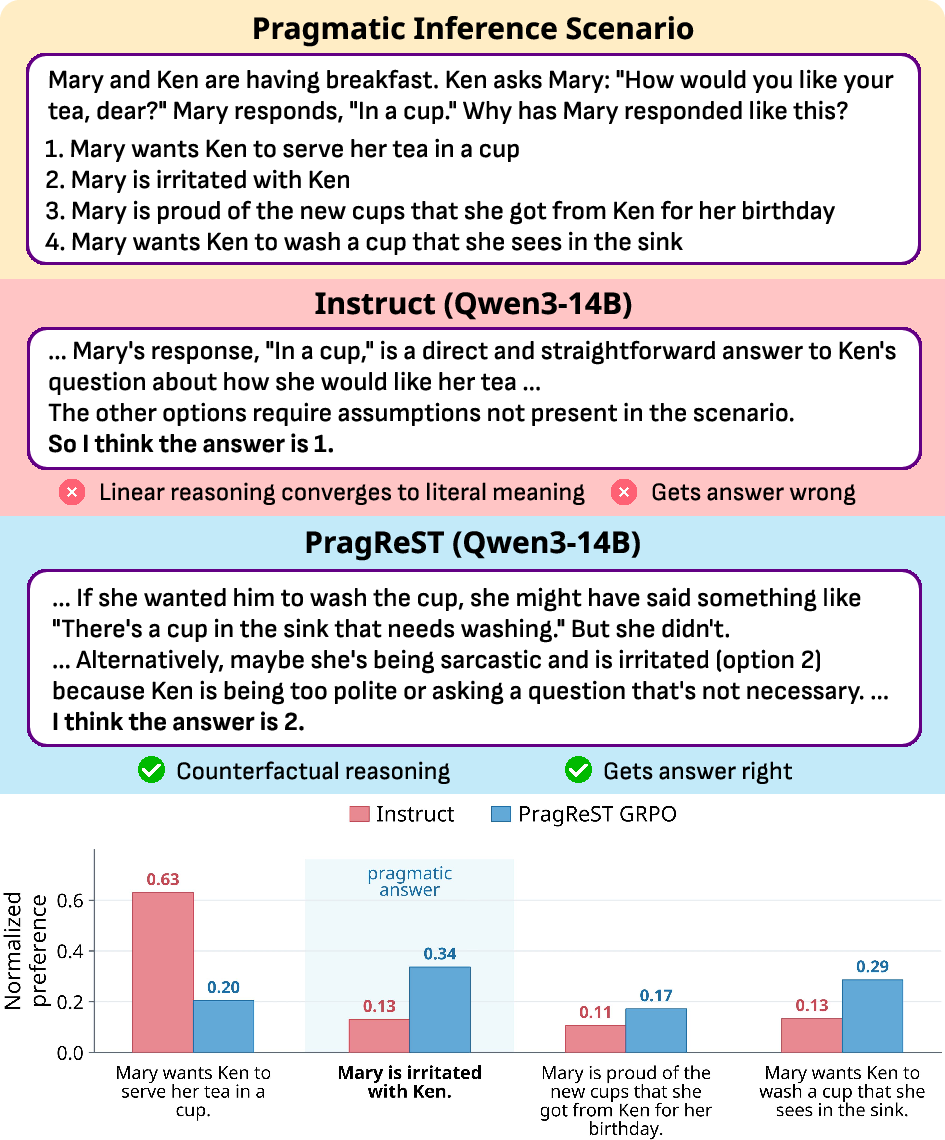
This paper is about helping AI systems understand what people really mean—not just the literal words they say. In real life, we often imply things. For example, if someone asks, “How do you want your tea?” and you reply, “In a cup,” you might actually be showing annoyance, not just answering the question. This kind of reading between the lines is called pragmatic reasoning.
The authors introduce PragReST, a training method that teaches AI to do this kind of reasoning by practicing a special kind of “what-if” thinking called counterfactual reasoning.
1) Big picture: the paper’s main purpose
The goal is to make LLMs (AIs that understand and generate text) better at pragmatic understanding—figuring out implied meanings, intentions, and social cues—by training them to compare what was said with what could have been said instead. And they do it without relying on human-labeled data or a stronger teacher model.
2) Key questions the paper asks
The paper focuses on three simple questions:
- Can an AI learn better “reading between the lines” skills without being taught by humans or a smarter AI?
- Is “what-if” (counterfactual) reasoning the key to improving this kind of understanding?
- Can the AI get better at pragmatics without getting worse at other skills like math or general knowledge?
3) How the method works (in everyday terms)
Think of a student who teaches themselves:
- They make their own practice questions,
- They check their own answers,
- They learn a specific way to think (“what-if” thinking),
- Then they drill themselves with a reward system for correct reasoning.
PragReST follows that idea in two stages.
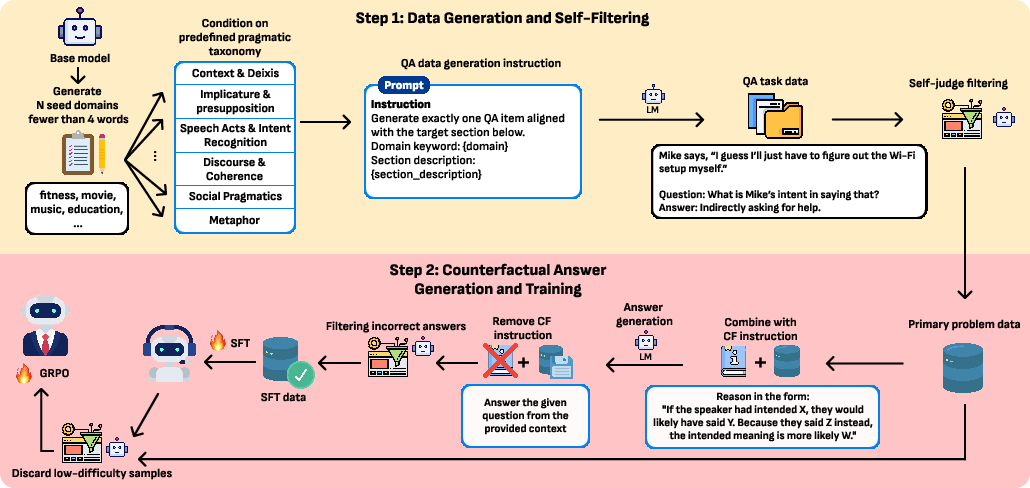
- Stage A: Make and filter practice data
- The AI invents lots of short everyday situations and questions that require reading between the lines (based on a list of pragmatic skills like implicatures, presuppositions, and social hints).
- It also creates “correct answers” for those situations.
- Then it acts as a simple judge to filter out bad or unclear examples (only keeping the better ones).
- Stage B: Learn “what-if” reasoning, then get reinforced
- Supervised Fine-Tuning (SFT): The AI solves the kept examples while being guided by a “counterfactual script” that nudges it to:
- Compare the actual words with possible alternative phrasings,
- Ask: “If the speaker meant X, would they have said this, or something else?”
- Use that contrast to find the intended meaning.
- Afterward, the model is trained on these good solutions, but without the script, so it learns to do this “what-if” reasoning by itself.
- Reinforcement Learning (RL with GRPO): The AI then practices more and “earns points” when its final answers match what a simple correctness judge expects. It focuses on harder prompts and keeps improving its decision-making.
Simple analogy:
- SFT is like learning with worked examples that show the right way to think.
- RL is like playing a game where you try multiple answers and get points for correct ones, improving your strategy over time.
Important detail: The model doesn’t need human labels or a stronger “teacher model.” It generates, checks, and learns from its own data—a self-improvement loop.
4) Main results and why they matter
Across four tests of pragmatic understanding—PragMega, Ludwig, MetoQA, and AltPrag—PragReST beats the original versions of the models it starts from and other specialized training methods.
Key takeaways:
- Clear accuracy gains: On the three accuracy-based tests (PragMega, Ludwig, MetoQA), scores improved by about 5–6 percentage points on average for both medium (8B) and larger (14B) models.
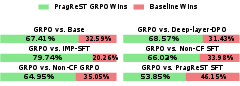
- Better at interpreting implied meaning: A “preference test” where a separate evaluator compared answers shows PragReST’s interpretations were preferred more often.
- The “what-if” part is crucial: A version of the method that skipped the counterfactual (what-if) thinking didn’t help much. That shows the improvement really comes from learning to compare what was said with what could have been said.
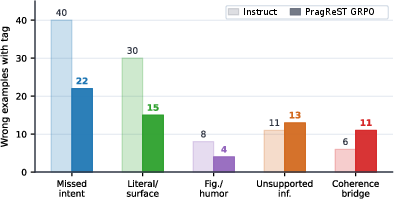
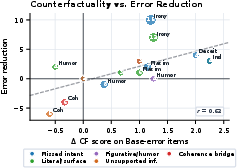
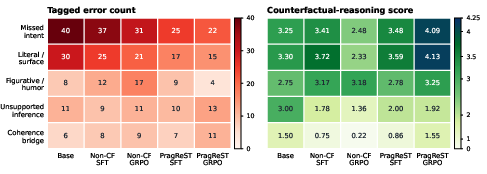
- Fewer “literal” mistakes: Error analysis shows the biggest reductions were in:
- taking things too literally, and
- missing the speaker’s intent.
- These are exactly the kinds of mistakes counterfactual reasoning helps fix.
- No big trade-offs: Performance on math and general-knowledge tasks stayed about the same, so the AI didn’t “forget” other skills while getting better at pragmatics.
- Works across different models: The method improved multiple AI models (not just one brand or size), and the gains were consistent across training runs.
Why this matters:
- Understanding implied meaning is key for helpful, polite, and safe assistants.
- It moves AI a step closer to human-like conversation skills.
5) What this could lead to (implications)
- Smarter assistants: Better at understanding hints, politeness, sarcasm, and context—making conversations feel more natural.
- Safer and clearer communication: More accurate interpretations of user intent reduce misunderstandings.
- A general recipe for self-improvement: Shows that AIs can teach themselves complex social reasoning using structured “what-if” thinking, not just math-like tasks with exact answers.
Limitations and future directions:
- Not all errors are fixed yet—especially ones where the AI guesses beyond what the context supports.
- The work was done in English; pragmatic rules differ across languages and cultures.
- Future work could add stronger evidence-checking and extend to multilingual settings.
In one sentence
PragReST teaches AI to “read between the lines” by practicing a special kind of “what-if” reasoning on self-made examples, leading to better understanding of implied meanings without needing human-labeled data or a smarter teacher.
Knowledge Gaps
Knowledge gaps, limitations, and open questions
The paper leaves the following concrete gaps and open questions that future work could address:
- External validity of self-generated training data: How closely do the model-generated pragmatic scenarios match real conversational data (e.g., spontaneous dialog, social media, task-oriented interactions), and does performance transfer to naturally occurring, human-authored contexts?
- Reliance on a self-judge drawn from the same backbone: To what extent do shared biases between the generator and the binary judge inflate data acceptance rates or reinforce spurious heuristics, and how would results change if the judge were independently trained or human-calibrated at scale?
- Judge calibration and robustness: The first-token margin m(q) = p(yes|q) − p(no|q) is a crude confidence surrogate—how sensitive are outcomes to this choice versus better-calibrated confidence measures (temperature scaling, ensemble agreement, or multi-turn adjudication)?
- Reward hacking and gaming the judge: Does GRPO training learn to exploit systematic weaknesses of the yes/no judge (e.g., output-format artifacts, phrasing), and how can one detect and mitigate such gaming (counter-judges, adversarial evaluation, or randomized secret constraints)?
- Ground truth reliability in synthetic data: Because the “reference” answer is model-generated, how often are references themselves pragmatically faulty or ambiguous, and what is the impact on SFT and RL when the reward function enforces an incorrect reference?
- Minimal human validation: Beyond a small agreement study, there is no large-scale human audit of synthetic data quality, judge reliability across phenomena, or training-induced changes. What is the measured error rate of the self-judge and references across a sizable, stratified human-labeled sample?
- Coverage and diversity of pragmatic phenomena: The domain seeds and taxonomy-driven prompts may underrepresent phenomena like sarcasm, prosody-dependent implicature, presupposition accommodation, politeness strategies, and multi-party interactions. How can coverage be systematically expanded and measured?
- Multilingual and cross-cultural pragmatics: Does the counterfactual supervision recipe transfer across languages and culturally diverse pragmatic norms, and what adaptations (e.g., culture-specific alternatives, region-specific judges) are needed?
- Multi-modal pragmatic cues: Many pragmatic inferences hinge on prosody, gesture, visuals, or environmental context. How would PragReST incorporate multi-modal inputs and generate/verify counterfactual alternatives that depend on non-textual signals?
- Generalization to interactive settings: The method targets single-turn QA-style interpretation. Does it improve multi-turn, interactive dialog where intentions evolve, including mixed-initiative settings and real-time clarifications?
- Pragmatic generation (speaker role): The work focuses on interpretation. Can the same counterfactual training improve pragmatic language production (e.g., choosing utterances that appropriately imply intended meanings), and how should rewards be defined for speaker-side pragmatics?
- Over-interpretation risk on literal tasks: Does counterfactual training increase the tendency to infer unwarranted implicatures when tasks require strictly literal reading (e.g., information extraction, legal text)? A targeted adversarial evaluation for “don’t over-infer” cases is missing.
- Scaling laws and data budget: How do gains scale with the number of domain seeds, generated items, judge thresholds, and SFT/RL steps? What is the marginal utility of more synthetic data versus stronger judges?
- Ablations on pipeline design choices: The paper does not vary key knobs (judge threshold percentile, difficulty filter settings, group size G, reward weights, presence/absence of pragmatic taxonomy descriptions, iterative regeneration loops). Which components contribute most, and which are unnecessary?
- Alternative reward/verification signals: Could external verifiers (e.g., entailment checkers, discourse coherence models, structured RSA-like simulators) provide more reliable rewards than a single binary judge? What’s the trade-off between verifier accuracy and training stability?
- Alternative baselines and prompting strategies: The non-counterfactual baseline is relatively weak. How do results compare to at-inference contrastive prompts that explicitly enumerate alternatives, to tool-augmented RSA/IBR reasoning, or to preference learning from human pragmatic judgments?
- Robustness of AltPrag evaluation: Heavy reliance on GPT-4.1 for pairwise judgments risks judge-specific biases (length/style preferences). How do preferences change under multiple independent judges, length normalization, and judge ablations?
- Statistical significance and reliability: While bootstrap SEs are reported, formal significance tests and effect sizes across runs and decoding settings are limited. Are improvements robust under temperature sampling, nucleus sampling, and across multiple random seeds per evaluation?
- Contamination checks: No analysis rules out pretraining exposure to the evaluation benchmarks. Can data provenance analysis or canary-based checks establish that gains are not due to latent contamination?
- Compute, cost, and efficiency: The paper does not quantify compute cost per gain (generation, filtering, SFT, GRPO). What are the cost-performance trade-offs, and can more efficient curricula or active selection reduce cost?
- Safety and bias audits: The synthetic data could encode social biases or unsafe content. How does PragReST affect stereotyping, toxic implicatures, or social harms, and what guardrails (filters, safety judges) are effective?
- Long-context and discourse structuring: Coherence-bridge errors persist. Can explicit discourse structure representations (RST, coreference graphs) or retrieval-augmented grounding reduce unsupported-inference and coherence failures?
- Measuring internalization of counterfactual reasoning: Current evidence is correlational. Can targeted probes (e.g., counterfactual contrast tests, causal mediation analyses, controlled distractor alternatives) establish that models genuinely use counterfactual comparisons rather than pattern-matching?
- Iterative self-improvement loops: The pipeline runs a single generate–filter–train cycle. Would iterating (re-generating harder items with the improved policy, upgrading the judge, and re-training) produce continued gains without collapse?
- Generalization across backbones and sizes: Results on three additional backbones are promising but limited. How do effects vary across much smaller and larger models, different pretraining corpora, and varying instruction-tuning regimes?
- Reward composition and format compliance: The composite reward mixes format compliance with correctness; its weighting is not ablated. Does format shaping inadvertently steer style in ways preferred by judges but not by humans?
- Decoding-time integration of alternatives: The approach learns counterfactual reasoning during training; it does not test decoding-time mechanisms (e.g., self-consistency over enumerated alternatives, contrastive decoding) that might further boost reliability.
- Task transfer beyond pragmatics: While math/knowledge are largely preserved, broader task repertoires (reasoning under uncertainty, planning, tool use) are not evaluated. Does counterfactual pragmatics interfere with or aid these capabilities?
- Human-centered evaluation at scale: Beyond small-sample checks, there is no large-scale, blinded human evaluation of interpretations for appropriateness, helpfulness, and calibration. Can such evaluations validate real-world utility and user trust?
Practical Applications
Immediate Applications
The following use cases can be deployed now by adapting the paper’s PragReST pipeline (self-generated pragmatic QA, counterfactual SFT, and GRPO-based RL) to specific domains. They leverage the method’s empirically demonstrated gains in implicature resolution, metonymy, and open-ended pragmatic recovery while preserving general knowledge and math performance.
- Customer support “implicature resolver” microservice (Software, Customer Experience)
- What: Detects implied dissatisfaction, veiled “no,” or indirect requests in chats/calls; recommends clarifying responses or escalations.
- Tools/products/workflows: CRM plugin (e.g., Zendesk/Salesforce) that runs a PragReST-tuned intent layer over conversations; dashboards highlighting implied intents.
- Assumptions/dependencies: Domain-specific synthetic data generation and self-judge calibration; human-in-the-loop for escalation; privacy-compliant logging.
- Email and workplace assistant for tone/intent interpretation (Productivity, Enterprise Software)
- What: Surfaces likely implied meanings (e.g., “Let’s circle back” as polite deferral), suggests clarifying questions or rewrites.
- Tools/products/workflows: Outlook/Gmail plugin; “counterfactual critique” step in drafting pipelines; Copilot/Workspace add-on.
- Assumptions/dependencies: Adaptation to organizational norms; opt-in for sensitive communications; guardrails to avoid over-assertive interpretations.
- Product feedback and review mining beyond literal text (Marketing, Product Analytics)
- What: Extracts implied pain points, sarcasm, and presuppositions from reviews and social posts; reduces literal/surface bias.
- Tools/products/workflows: Analytics pipeline with a PragReST-based “pragmatic signal” feature; alerts for implied churn risk.
- Assumptions/dependencies: Robust domain seeds (e.g., “returns policy,” “shipping delays”); careful thresholding to control false positives.
- Safety sentinel for indirect risk cues (Healthcare triage, Trust & Safety)
- What: Flags indirect references to self-harm, harassment, or abuse that may be phrased euphemistically.
- Tools/products/workflows: Middleware “pragmatic sentinel” between frontend and response generator; priority routing to trained staff.
- Assumptions/dependencies: High-recall tuning; jurisdiction-specific escalation protocols; stringent human oversight.
- Accessibility: “Social intent explainer” for neurodiverse users (Assistive Tech, Education, Daily Life)
- What: Paraphrases messages with inferred implied meanings and likely speaker intent, with counterfactual alternatives shown.
- Tools/products/workflows: Browser extension or messaging app plugin; toggleable overlays that highlight implicatures/presuppositions.
- Assumptions/dependencies: Strong disclaimers; privacy-by-design; customization for user preferences and sensitivity levels.
- L2 language learning tutor for pragmatics (Education)
- What: Teaches implicatures, presuppositions, and speech acts with counterfactual explanations and practice items generated via PragReST.
- Tools/products/workflows: Exercises that contrast literal vs intended readings; automated feedback using the “pragmatic reasoning” chain.
- Assumptions/dependencies: Current evidence is English-centric; multilingual extensions require further training.
- Agent-to-agent communication clarity in software systems (Software Agents)
- What: Adds a counterfactual reasoning step to reduce miscoordination from literal interpretations between agents.
- Tools/products/workflows: Middleware that injects a “contrast observed utterance vs alternatives” pass before acting.
- Assumptions/dependencies: Latency/compute budget for extra reasoning; careful reward shaping to avoid over-interpretation.
- UX copy and policy phrasing checker (Marketing, Legal/Compliance)
- What: Evaluates whether public-facing text could be misread; proposes alternative phrasings with fewer unintended implicatures.
- Tools/products/workflows: “Counterfactual copy checker” integrated into content review; batch analysis for release trains.
- Assumptions/dependencies: Domain norms vary by audience; human editorial approval remains required.
- Legal/compliance draft review for unintended implications (Legal, Finance)
- What: Highlights presuppositions or ambiguous commitments in contracts, disclosures, or disclaimers.
- Tools/products/workflows: Document review plugin that annotates potential pragmatic risks with counterfactual alternatives.
- Assumptions/dependencies: Expert oversight; jurisdiction-specific standards; conservative settings to reduce overreach.
- Trust & Safety moderation with pragmatic nuance (Platforms)
- What: Detects sarcasm, coded language, or veiled threats beyond literal phrasing.
- Tools/products/workflows: Triage layer that elevates posts for human review when implied meaning crosses risk thresholds.
- Assumptions/dependencies: Clear policy definitions; careful calibration to minimize cultural bias and false positives.
- Human–robot interaction: indirect command understanding (Robotics, Smart Home)
- What: Interprets “It’s cold in here” as a request to increase temperature; resolves politeness/indirectness.
- Tools/products/workflows: PragReST-tuned module for voice assistants; contrastive intent resolver prior to action execution.
- Assumptions/dependencies: Context sensors (e.g., thermostat state); user consent; fallback to confirmation prompts.
- Domain-specific pragmatic dataset generation for rapid tuning (AI/ML Engineering)
- What: Use the paper’s pipeline to synthesize pragmatic QA for new domains (e.g., banking support, travel booking) without human labels.
- Tools/products/workflows: Open-source PragReST repo + LoRA adapters; offline difficulty filtering; self-judge margins.
- Assumptions/dependencies: Base LLM quality; correctness judge reliability; compute for SFT/RL iterations.
- Academic research utilities (Academia)
- What: Error taxonomy replication, counterfactual reasoning analyzers, and benchmarks for studying pragmatics in LLMs.
- Tools/products/workflows: Reusable scripts for generating/labeling pragmatic failure modes; ablation-friendly training loop.
- Assumptions/dependencies: English-focused resources; IRB/ethics for human studies; reproducibility via released code/models.
Long-Term Applications
These use cases require further research, scaling, or development—often along multilingual, multimodal, cultural, or regulatory dimensions identified as limitations in the paper.
- Clinical conversation support with pragmatic layers (Healthcare)
- What: Infer implicit symptoms, discomfort, non-adherence, or hesitations in patient–clinician dialogues; suggest clarifying questions.
- Tools/products/workflows: EHR-integrated copilot that surfaces implied concerns with counterfactual justifications.
- Assumptions/dependencies: Clinical validation studies; regulatory approval; bias and cultural-sensitivity safeguards; strict human oversight.
- Cross-lingual and cross-cultural pragmatic competence (Localization, Global CX)
- What: Extend PragReST to multiple languages and cultural norms of indirectness, politeness, and humor.
- Tools/products/workflows: Multilingual pragmatic taxonomies; region-specific self-judges; cultural calibration datasets.
- Assumptions/dependencies: Native-speaker validation; expanded benchmarks; careful handling of cultural variance.
- Multimodal pragmatics (Voice, Vision, Embodied AI)
- What: Combine text with prosody, facial expressions, and situational context to interpret irony, sarcasm, or gestures.
- Tools/products/workflows: Multimodal counterfactual reasoning layer for social robots, call-center voice analytics, AR.
- Assumptions/dependencies: Aligned audio/visual datasets; multimodal model training; privacy for sensor data.
- Negotiation and sales coaching via pragmatic inference (Sales, BizDev)
- What: Real-time in-call coaching that interprets client hedges or soft “no,” proposing calibrated responses.
- Tools/products/workflows: Sales copilot with counterfactual intent scoring and playbook suggestions.
- Assumptions/dependencies: Consent and compliance; ethical boundaries; longitudinal outcome validation.
- Policy analysis and public consultation interpretation (Public Sector, Policy)
- What: Identify implied commitments, presuppositions, or latent concerns in public comments and legislative drafts.
- Tools/products/workflows: “Pragmatic impact analyzer” for policy drafters; scenario testing for alternative phrasings.
- Assumptions/dependencies: Accountability and audit trails; nonpartisan oversight; explainability requirements.
- Agentic systems with self-generated pragmatic curricula (Autonomous Agents)
- What: Agents improve collaborative communication using self-constructed pragmatic tasks and counterfactual rewards.
- Tools/products/workflows: Continual learning loop combining self-judge rewards and team coordination metrics.
- Assumptions/dependencies: Robustness to self-reinforcement artifacts; safety constraints; compute budget for continual RL.
- Standardized pragmatic AI safety audits (AI Safety, Standards)
- What: Sector-wide suites to test misinterpretations that could cause harm (e.g., medical, legal, safety-critical).
- Tools/products/workflows: PragReST-derived benchmarks with error taxonomies; certification protocols.
- Assumptions/dependencies: Community consensus on test coverage; shared metrics; third-party evaluation.
- Personalized pragmatic profiles (Personalization, CX)
- What: Tune models to individual users’ norms—level of directness, humor, and politeness—reducing miscommunication.
- Tools/products/workflows: On-device adapters fine-tuned with user-approved data; privacy-preserving learning.
- Assumptions/dependencies: Consent, data minimization, and portability; safeguards against stereotyping.
- Cross-channel customer journey orchestration with implied-risk scoring (Marketing, Retention)
- What: Aggregate implied signals across email, chat, and social to predict churn or dissatisfaction not stated explicitly.
- Tools/products/workflows: Pragmatic feature store; risk dashboards with counterfactual explanations.
- Assumptions/dependencies: Data integration and governance; fairness assessments; rigorous backtesting.
- Education: writing tutors for unintended implicatures/presuppositions (EdTech)
- What: Feedback on drafts to avoid unintentionally assertive or ambiguous phrasing; instruction in discourse pragmatics.
- Tools/products/workflows: Classroom-ready tutors with configurable rubrics; formative assessment modules.
- Assumptions/dependencies: Teacher oversight; alignment with curricula; bias mitigation.
- Governance of self-generated training pipelines (Policy, Compliance)
- What: Frameworks for auditing synthetic data, self-judges, and reinforcement signals to prevent drift and bias amplification.
- Tools/products/workflows: Documentation standards for self-generated datasets; audit logs for reward models.
- Assumptions/dependencies: Regulatory guidance; standardized reporting; tooling for reproducibility.
- Cognitive science and psycholinguistics research (Academia)
- What: Use LLMs as testbeds for theories linking counterfactual reasoning and human pragmatic inference.
- Tools/products/workflows: Controlled experiments with counterfactual scaffolds; comparisons to human judgments.
- Assumptions/dependencies: IRB approvals; careful interpretation of model–human parallels; open datasets and code.
Notes on feasibility
- Base-model dependence: Gains depend on a reasonably strong backbone (paper shows benefits across Qwen3-8B/14B, Gemma-4-E4B, GPT-OSS-20B); weaker models may need more data or adapters.
- Judge reliability: The constrained binary self-judge and margin thresholds are pivotal; miscalibration can admit noisy labels or overfit domain quirks.
- Domain and culture sensitivity: Current evidence is English-focused; transfer to other languages/cultures requires additional work.
- Compute and latency: SFT+GRPO add cost; production deployments may use LoRA adapters and lower “reasoning effort” to meet SLAs.
- Safety and oversight: In high-stakes settings (healthcare, legal), deploy only with human oversight and thorough validation to mitigate over-interpretation risks.
- Data governance: Synthetic-data pipelines must meet privacy, transparency, and audit requirements in regulated sectors.
Glossary
- AIME2025: A competitive mathematics exam-style benchmark used to assess problem-solving ability. "and AIME2025 \citep{opencompass_aime2025}."
- AltPrag: A benchmark for open-ended pragmatic recovery. "AltPrag \citep{yu_pragmatic_2026} evaluates open-ended pragmatic recovery,"
- answer-aware question generation: Generating questions conditioned on a known target answer to create grounded QA items. "closer to answer-aware question generation and grounded synthetic QA generation than to ordinary benchmark inference"
- bootstrap standard errors: Uncertainty estimates computed by bootstrap resampling of examples. "Values are point estimates with bootstrap standard errors over examples."
- counterfactual reasoning: Reasoning by contrasting what was said with plausible alternatives to infer intent. "Fundamentally, pragmatic inference can be framed as a counterfactual reasoning process:"
- DAPO: An offline difficulty-filtering approach used to remove trivial prompts before RL training. "following DAPO~\citep{yu_dapo_2026}."
- Deep-layer-DPO: A variant of preference optimization that restricts updates to deeper layers for social/pragmatic tasks. "The second is Deep-layer-DPO, following \citet{wu_rethinking_2024},"
- Deixis: Context-dependent reference (e.g., here, now, you) that requires situational context to interpret. "including implicature, presupposition, deixis, metonymic reference, and open-ended pragmatic recovery,"
- Discourse and Coherence: Pragmatic phenomena concerning how utterances connect and make sense across a conversation or text. "Discourse and Coherence,"
- distillation: Training a student model using outputs, labels, or rationales from a stronger teacher. "Distillation from stronger teachers is also an imperfect substitute:"
- first-token confidence margin: The difference between the model’s probabilities for first-token “yes” vs. “no,” used as a judge score. "we derive a first-token confidence margin"
- GRPO: A group-based reinforcement learning algorithm that optimizes responses using grouped rollouts and rewards. "via GRPO \citep{shao_deepseekmath_2024},"
- greedy decoding: Deterministic generation by selecting the most probable token at each step. "under greedy decoding."
- Implicature: Implied meaning drawn from conversational context and principles rather than literal words. "including implicature, presupposition, deixis, metonymic reference, and open-ended pragmatic recovery,"
- Iterated Best Response (IBR): A game-theoretic framework modeling recursive reasoning between communicators. "Iterated Best Response (IBR) \citep{franke2009signal}"
- LoRA: Low-Rank Adaptation; a parameter-efficient fine-tuning technique using low-rank adapters. "train LoRA adapters"
- MATH-500: A benchmark testing multi-step mathematical reasoning ability. "MATH-500 \citep{lightman_lets_2023, hendrycks_measuring_2021}"
- metonymic reference: Referring to an entity via a related concept (e.g., “the White House” for the U.S. administration). "evaluates metonymic reference resolution,"
- MetoQA: A benchmark focused on metonymic reference resolution. "MetoQA \citep[metonymic reference resolution;] []{sravanthi_pub_2024}"
- MMLU-Pro: An advanced multi-domain knowledge and reasoning benchmark. "MMLU-Pro \citep{wang_mmlu-pro_2024}"
- pairwise comparison: An evaluation that judges between two model outputs directly. "a blind GPT-4.1 pairwise comparison"
- pass@8: The probability of solving a problem within 8 independent samples. "we report pass@8;"
- presupposition: Background assumptions taken for granted by an utterance. "such as implicatures and presuppositions \citep{levinson_pragmatics_1983}."
- pragmatic inference: Inferring intended meanings using context, speaker goals, and social norms. "still struggle with pragmatic inference tasks"
- pragmatic taxonomy: A categorization of pragmatic phenomena used to sample training/evaluation tasks. "a pragmatic taxonomy category"
- privileged information: Auxiliary information available during training of a teacher (or scaffold) but not at inference. "self-distillation with privileged information"
- Rational Speech Acts (RSA): A probabilistic model of pragmatic speaker–listener reasoning over alternatives. "Rational Speech Acts (RSA) \citep{frank_goodman_2012, goodman_pragmatic_2016}"
- reference-based score: An evaluation metric comparing generated outputs to reference answers or interpretations. "which uses a reference-based score,"
- Reinforcement Learning with Verifiable Rewards (RLVR): RL where rewards are provided by deterministic, checkable verifiers. "Reinforcement Learning with Verifiable Rewards (RLVR) has driven progress in math and code"
- self-judge: Using the model itself as a constrained binary evaluator to filter or score data. "filtered by a self-judge."
- self-reinforcing: A self-improvement setup where the model generates its own training data and signals without external labels. "PragReST is self-reinforcing in the sense that it does not rely on human-labeled pragmatic training data,"
- supervised fine-tuning (SFT): Updating a model on labeled examples via maximum-likelihood training. "following two training paradigms: supervised fine-tuning (SFT) and reinforcement learning (RL)."
- TruthfulQA: A benchmark measuring factual truthfulness of model outputs. "TruthfulQA \citep{lin-etal-2022-truthfulqa}"
- verifier: A deterministic procedure or program used to check solution correctness. "checked by deterministic verifiers"
- zero-variance groups: Batches where all sampled rollouts earn identical rewards, yielding no learning signal. "these zero-variance groups provide no learning signal."
Collections
Sign up for free to add this paper to one or more collections.

